Output · PDF · Editable LaTeX
Storage capacity: complete current results
Attempts 1–3 · 9 November 2026
$$\boxed{1\le \alpha_-\le \alpha_+\le2.}$$
The exact endpoints and their equality remain open.
What is \(\alpha_-\)?
What is \(\alpha_+\)?
Which dual certificates force nonstorage?
Do \(\alpha_-\) and \(\alpha_+\) coincide?
What do the finite classifications establish?
Model and endpoint definitions
For integers \(n\ge2\), \(1\le m\le2^n\), sample an unordered set of distinct memories uniformly:
$$D_{n,m}=\{s^1,\ldots,s^m\}\sim\operatorname{Unif}\binom{\{-1,1\}^n}{m}.$$
$$J\in\mathbb R^{n\times n},\qquad J=J^\top,\qquad J_{ii}=0,\qquad h\in\mathbb R^n.$$
$$F_n(m)=\left\{\exists(J,h):\ s_i^\mu((Js^\mu)_i+h_i)>0\quad\forall i\in[n],\ \mu\in[m]\right\}.$$
$$\text{load}=\frac{m}{n}.$$
$$p_n(m)=\Pr(F_n(m)),\qquad q_n(u)=1-p_n(\lfloor un\rfloor).$$
$$\begin{aligned} \alpha_-&=\sup\{u>0:p_n(\lfloor un\rfloor)\longrightarrow1\},\\ \alpha_+&=\inf\{u>0:p_n(\lfloor un\rfloor)\longrightarrow0\}. \end{aligned}$$
$$n\to\infty\quad(u\text{ fixed}),\qquad\log=\ln.$$
Constraint matrix and the symmetry experiment
Write \([k]=\{1,\ldots,k\}\), \(\operatorname{sym}T=(T+T^\top)/2\), and \(\mathbf1_k=(1,\ldots,1)^\top\).
$$d=n+\binom n2,\qquad N=nm,\qquad\theta=(h,(J_{ij})_{i<j})\in\mathbb R^d.$$
$$A_R=A(D_{n,m})\in\mathbb Z^{N\times d},\qquad(A_R\theta)_{\mu i}=s_i^\mu((Js^\mu)_i+h_i).$$
There is one coordinate for each field and each unordered edge; both endpoint constraints share the same edge coordinate.
$$\mathcal C(D)=\{\lambda\in\mathbb R_{\ge0}^{N}:\mathbf1_N^\top\lambda=1,\ A_R^\top\lambda=0\}.$$
For a fixed sample, each neuron predicts its own sign from the other memory coordinates:
$$E_i=\left\{\begin{array}{l} \exists\big((J_{ij})_{j\ne i},h_i\big)\in\mathbb R^{n-1}\times\mathbb R:\\ s_i^\mu\left(\sum_{j\ne i}J_{ij}s_j^\mu+h_i\right)>0\quad\forall\mu\in[m] \end{array}\right\}.$$
$$E=E_n(m)=\bigcap_{i=1}^n E_i,\qquad F=F_n(m)\subseteq E.$$
E fits the rows of J without symmetry; F requires the same inequalities with \(J=J^\top\), and each row stays fixed across all memories.
$$F^c=E^c\ \dot\cup\ (E\cap F^c).$$
The first event is local failure; the second is symmetry-only failure.
$$c_n(u)=\Pr(F^c\mid E)=\frac{\Pr(E\cap F^c)}{\Pr(E)}\quad\text{if }\Pr(E)>0.$$
$$e_n(u)=\Pr(E),\qquad p_n(m)=\Pr(F)=e_n(u)[1-c_n(u)],\qquad m=\lfloor un\rfloor.$$
The probabilities are over uniformly sampled memory sets; neuron feasibility events need not be independent.
Lemma: conditional failure bounds the endpoint
For fixed \(u>0\), assume \(e_n(u)>0\) eventually. Then
$$c_n(u)\to1\quad\Longrightarrow\quad \alpha_+\le u.$$
Proof. The identity and \(0\le e_n(u)\le1\) give
$$0\le p_n(\lfloor un\rfloor)=e_n(u)[1-c_n(u)]\le1-c_n(u)\to0.$$
Q1 · Storage constructions
What is \(\alpha_-\)?
Proposition 1 (R2). Storage with sublinear excess
Attempt 2
For uniform distinct patterns and one real symmetric zero-diagonal network with free fields, $$M_n=n+\left\lfloor\frac{n}{55296\log n}\right\rfloor,\qquad p_n(M_n)\longrightarrow1.$$
Use inverse augmented covariance to write every margin as a residual.
Bound all residuals and singularity probabilities at the stated excess.
Proposition 2 (C1). Projection construction
Attempt 1
Let \(1\le m\le n\), \(S=[s^1\ \cdots\ s^m]\in\{-1,1\}^{n\times m}\). Set \(U=[S^\top\ \mathbf1_m]^\top\in\mathbb R^{(n+1)\times m}\). If deleting any of its first \(n\) rows leaves column rank \(m\), define
$$P=U(U^\top U)^{-1}U^\top=\begin{pmatrix}B&h\\h^\top&c\end{pmatrix},\qquad J=B-\operatorname{diag}(B).$$
Then \(J\) is symmetric with zero diagonal, and
$$s_i^\mu((Js^\mu)_i+h_i)=1-P_{ii}>0\qquad(1\le i\le n,\ 1\le\mu\le m).$$
Thus one network stores every supplied pattern. For uniform distinct random patterns, the rank condition holds with probability tending to one at \(m=n\); consequently
$$p_n(n)\longrightarrow1,\qquad \alpha_-\ge1.$$
Project onto the augmented pattern span and remove the diagonal.
Row-deletion rank gives positive margins; random rank bounds give the limit.
Proposition 3 (C2). Symmetrization margin loss
Attempt 1
Let \(T\in\mathbb R^{n\times n}\) have zero diagonal, \(h\in\mathbb R^n\), and \(s^1,\ldots,s^m\in\{-1,1\}^n\), with \(m\ge1\). Define
$$J=\tfrac12(T+T^\top),\qquad K=\tfrac12(T-T^\top),$$
$$r_{i\mu}=s_i^\mu((Ts^\mu)_i+h_i),\qquad\ell_{i\mu}=s_i^\mu(Ks^\mu)_i.$$
The symmetric zero-diagonal network \((J,h)\) has signed margins
$$s_i^\mu((Js^\mu)_i+h_i)=r_{i\mu}-\ell_{i\mu}.$$
It strictly stores the sample with this field exactly when \(\min_{i,\mu}(r_{i\mu}-\ell_{i\mu})>0\).
Split the directed matrix into symmetric and skew parts.
Subtract the skew contribution from each original signed margin.
Trained primal route: setup
This route fixes \(u=9/5\), \(m=\lfloor9n/5\rfloor\).
$$\begin{gathered} (J^{\mathrm{free}}_{i,-i},h_i)=\underset{J_{i,-i}\in\mathbb R^{n-1},\,t\in\mathbb R}{\operatorname{argmin}}\ (\|J_{i,-i}\|_2^2+t^2),\\ \text{subject to }s_i^\mu\left(\sum_{j\ne i}J_{ij}s_j^\mu+t\right)\ge1\quad(\mu\in[m]). \end{gathered}$$
The subscript \(-i\) removes the diagonal entry; \(J^{\mathrm{free}}\) denotes the fit without symmetry before constructing a symmetric J.
The strictly convex problem has a unique solution on E; put \(J^{\mathrm{free}}_{ii}=0\) and abort outside E.
For row weights \(d_i\ge0\), \(\sum_i d_i=n\), use
$$J=\operatorname{sym}(\operatorname{diag}(d)J^{\mathrm{free}}).$$
$$\delta_i(J)=\min_{\mu:s_i^\mu=1}(Js^\mu)_i-\max_{\nu:s_i^\nu=-1}(Js^\nu)_i.$$
A row containing only one label imposes no opposite-label test; otherwise a free field exists exactly when \(\delta_i(J)>0\).
For the graph reduction use augmented indices \(i,j\in\{0,\ldots,n\}\); graph signs \(z_\mu\in\{-1,1\}\) are scalar variables, distinct from the feature vectors \(z_i^\mu\).
The graph has m pattern vertices, with all its signed edge constraints retained; consistency means every cycle has compatible signs, and isolated vertices count as components.
$$\widehat E=\bigcap_{i=0}^n\left\{\exists A_i\in\mathbb R^n:\ A_i\cdot z_i^\mu\ge1\ \forall\mu\in[m]\right\}.$$
Here \(s_0^\mu=1\), the other signs retain their original values, and \(z_i^\mu=(s_i^\mu s_j^\mu)_{j\ne i}\); augmented feasibility also imposes the row \(i=0\) test.
Proposition 4. Trained primal graph
Attempt 3
On \(E\), define the inverse-\(Q\) candidate by
$$Q_i=\|J^{\mathrm{free}}_i\|_2^2+h_i^2,\qquad d_i=\frac{n/Q_i}{\sum_jQ_j^{-1}},\qquad J=\operatorname{sym}(\operatorname{diag}(d)J^{\mathrm{free}}).$$
Let \(C\) be its success event: \(E\) holds and every opposite-label score gap is positive.
For the augmented graph, on \(\widehat E\), let \(A_i\) be the minimum-norm unit-margin fit to \(z_i^\mu\), and set
$$Q_i^{\rm aug}=\|A_i\|_2^2,\qquad T_{ij}=A_{ij}/Q_i^{\rm aug},\qquad J^{\rm aug}=\operatorname{sym}T,$$
$$M_{i\mu}=s_i^\mu(J^{\rm aug}s^\mu)_i.$$
For each pair with \(M_{i\mu}+M_{i\nu}\le0\), impose \(z_\mu z_\nu=s_i^\mu s_i^\nu\).
$$r_n=m-\#\{\text{components, including isolated vertices}\},$$
$$\mathcal A_{n,R}=\{\widehat E,\ \text{graph consistent},\ r_n\le R\}.$$
For every fixed integer \(R\ge0\),
$$2^{-R}\Pr(\mathcal A_{n,R})-o(1)\le\Pr(C)\le\Pr(\mathcal A_{n,R})+2^{-(R+1)}+o(1).$$
Encode failed score pairs as signed equations on pattern vertices.
Use graph rank and uniform column occupancy to count successful roots.
Proposition 5. The optimized weighted family
Attempt 3
On \(E\), let
$$\mathcal P=\{(i,\mu,\nu):s_i^\mu=1,\ s_i^\nu=-1\}.$$
For \((i,\mu,\nu)\in\mathcal P\), define
$$(g_{i\mu\nu})_i=\tfrac12\sum_{j\ne i}J^{\mathrm{free}}_{ij}(s_j^\mu-s_j^\nu),$$
$$(g_{i\mu\nu})_j=\tfrac12J^{\mathrm{free}}_{ji}(s_j^\mu-s_j^\nu)\quad(j\ne i).$$
$$\gamma_* =\max_{d\ge0,\,\sum_i d_i=n}\min_{r\in\mathcal P}g_r\cdot d.$$
If \(\gamma_*>0\), a maximizing \(d\) gives a storing matrix
$$J=\operatorname{sym}(\operatorname{diag}(d)J^{\mathrm{free}})$$
with suitable fields; use \(\min\varnothing=+\infty\).
Express every opposite-label score gap as a linear function of the weights.
A positive minimum gap permits a separating field in every row.
Proposition 6. The exact rank reduction
Attempt 3
For the inverse-\(Q\) candidate and augmented graph above,
$$\Pr(C)=\mathbb E[\mathbf1_{\widehat E}\mathbf1_{\rm consistent}2^{-r_n}]+o(1).$$
A consistent signed graph of rank r accepts a sign fraction \(2^{-r}\).
Uniform forest occupancy transfers this count to the trained graph.
Conditional proposition 7. The remaining actual-law probability
Attempt 3
If the positive alternative in Gap 5 or the survival estimate in Gap 12 holds, then
$$\alpha_+\ge9/5>17/10.$$
Both probability premises remain open.
Positive survival of a symmetric candidate gives positive full-storage limsup.
The required survival probability is still unestimated.
Q2 · Nonstorage bounds
What is \(\alpha_+\)?
For a fixed neuron i, the input and label of pattern \(\mu\) are
$$\text{input: }s_{-i}^\mu=(s_j^\mu)_{j\ne i}\in\mathbb R^{n-1},\qquad\text{label: }s_i^\mu\in\{-1,1\}.$$
$$z_i^\mu=(s_{-i}^\mu,1)\in\mathbb R^n.$$
For fixed vectors z in general position and independent fair labels, Cover’s homogeneous count gives
$$C(m,n)=2\sum_{j=0}^{n-1}\binom{m-1}{j},\qquad q^{\rm row}_{m,n}=2^{-m}C(m,n).$$
General position means every set of at most n vectors is linearly independent; arbitrary fixed inputs give an upper bound by the same count.
Under iid full spin patterns the labels of this one row are independent fair signs conditional on its inputs; conditioning to distinct full patterns costs at most \(\binom m2 2^{-n}\).
$$F\subseteq E\subseteq E_i,\qquad p_n(m)\le q^{\rm row}_{m,n}+\binom m2 2^{-n}.$$
Cube inputs may be degenerate, and separate feasible rows may fail reciprocal compatibility; the one-row success count below two gives no symmetric-storage lower bound.
Cover, “Geometrical and statistical properties of systems of linear inequalities” (1965), Theorem 1, p. 326, supplies the count; equality requires its general-position hypothesis.
Proposition 8 (R1). Endpoint bracket
Attempt 1
For all integers \(n\ge2\), \(1\le m\le2^n\), the one-neuron count gives
$$p_n(m)\le 2^{1-m}\sum_{k=0}^{n-1}\binom{m-1}{k}+\binom m2\,2^{-n}.$$
Use \(\binom{m-1}{k}=0\) for \(k>m-1\); the resulting bounds are
$$1\le \alpha_-\le \alpha_+\le2,\qquad p_n(n)\longrightarrow1.$$
$$\forall u>2:\quad p_n(\lfloor un\rfloor)\longrightarrow0,$$
$$\limsup_{n\to\infty}p_n(2n)\le\tfrac12.$$
Apply Cover’s count to one row, then condition on distinct patterns.
Combine its binomial tail with the projection lower guarantee.
Positive-floor route: setup
This route fixes \(1<u<2\), \(m=\lfloor un\rfloor\), \(\alpha=n^{-4}\), with primitive columns indexed by fields i and unordered edges ij.
$$U=\begin{bmatrix}S\\\mathbf1_m^\top\end{bmatrix},\qquad S=[s^1\ \cdots\ s^m],\qquad \kappa_{n,m}=\Pr_{\rm iid}\{\sigma_{\min}(U)<c_u\sqrt n\}=o(1).$$
Here \(\sigma_{\min}\) is the least row singular value and \(c_u>0\) is the conditioning constant at that fixed load.
For iid uniform spin columns define cube primitives, and independently define Gaussian primitives:
$$C_{\mu,i}=s_i^\mu,\qquad C_{\mu,ij}=s_i^\mu s_j^\mu,\qquad G\in\mathbb R^{m\times d},\quad G_{\mu\ell}\overset{\rm iid}{\sim}N(0,1).$$
$$[A(Y)^\top\lambda]_{h_i}=\sum_{\mu=1}^mY_{\mu,i}\lambda_{i\mu},\qquad [A(Y)^\top\lambda]_{ij}=\sum_{\mu=1}^mY_{\mu,ij}(\lambda_{i\mu}+\lambda_{j\mu}).$$
$$\mathcal L_\alpha=\{\lambda\in\mathbb R^N:\lambda\ge \alpha\mathbf1_N,\ \mathbf1_N^\top\lambda=1\},\qquad \rho(Y)=\min_{\lambda\in\mathcal L_\alpha}\|A(Y)^\top\lambda\|_2.$$
$$\epsilon=(c_u/2)n^{-7/2},\qquad f(Y)=\psi(\rho(Y)/\epsilon).$$
One fixed smooth \(\psi:[0,\infty)\to[0,1]\) equals one on \([0,1/2]\) and zero on \([1,\infty)\); \(\mathcal L_\alpha\) is nonempty for all sufficiently large n.
$$\widetilde G_{\mu\ell}=\frac{\sqrt m\,G_{\mu\ell}}{\|G_{\cdot\ell}\|_2},\qquad \Delta_{n,m}=\binom m2\,2^{-n}=o(1).$$
The normalized columns are independent uniform directions of length \(\sqrt m\); cube edge columns remain products of the singleton columns.
Gaussian and cube expectations use these primitive laws, rather than independent full constraint-matrix entries.
For the Hermite statement, let \(V_\ell=\|G_{\cdot\ell}\|_2^2\), \(\Omega_\ell=G_{\cdot\ell}/\|G_{\cdot\ell}\|_2\); conditioning on V or \(\Omega\) means conditioning on the entire corresponding column array.
Conditional proposition 9. Positive-floor transfer
Attempt 3
If Gap 3 and Gap 4 hold at the same fixed load \(u\in(1,2)\), then
$$p_n(\lfloor un\rfloor)\to0,\qquad \alpha_+\le u.$$
Correct a sufficiently small positive-floor residual to an exact cube dual.
Transfer Gaussian occurrence through the same-load comparison estimate.
Proposition 10. Exact reciprocal correction
Attempt 3
Suppose \(\sigma_{\min}(U)\ge c_u\sqrt n\), and a seed \(\lambda\) satisfies
$$\lambda\ge\alpha\mathbf1_N,\qquad\mathbf1_N^\top\lambda=1,\qquad\|A(C)^\top\lambda\|_2\le\frac{\alpha c_u\sqrt n}{2}.$$
Then there exists an exact certificate
$$\lambda_*\ge0,\qquad\mathbf1_N^\top\lambda_*=1,\qquad A(C)^\top\lambda_*=0.$$
Solve the moment correction using the augmented matrix’s right inverse.
The singular-value bound keeps the corrected multipliers nonnegative.
Proposition 11. A finite probability bridge
Attempt 3
With the floor, cutoff and primitive laws defined above,
$$\begin{aligned} p_n(m)\le{}&1-\mathbb E_Gf(G)+|\mathbb E_Cf(C)-\mathbb E_Gf(G)|\\ &+\kappa_{n,m}+\Delta_{n,m}, \end{aligned}$$
where \(\kappa_{n,m},\Delta_{n,m}\to0\) at fixed \(u\in(1,2)\).
Bound storage by the complement of the exactified cube cutoff test.
Add the Gaussian comparison, conditioning and distinctness errors.
Proposition 12. Remove Gaussian column radii
Attempt 3
For independent normalized Gaussian columns \(\widetilde G\), $$|\mathbb E_Gf(G)-\mathbb Ef(\widetilde G)|=O_{u,\psi}(\sqrt{\log n/n}).$$ Positive invertible column scaling also preserves exact floor-zero occurrence samplewise.
Normalize all Gaussian primitive columns and control their extreme radii.
Compare the entire cutoff test before and after this column scaling.
Proposition 13. A restricted Gaussian construction is excluded
Attempt 3
For fixed \(1<u<2\), \(1<C_0<1+1/u\), define $$\rho_{C_0}(G)=\min_{\lambda\in\mathcal L_\alpha,\ N\|\lambda\|_2^2\le C_0}\|A(G)^\top\lambda\|_2.$$ For some fixed \(k_{u,C_0}>0\), $$\Pr_G\{\rho_{C_0}(G)<k_{u,C_0}/\sqrt n\}=O_{u,C_0}(n^{-1}).$$
Lower-bound the residual on the additional bounded-norm multiplier set.
The unrestricted minimum is smaller, so its occurrence remains open.
Proposition 14. Two interaction correlations vanish
Attempt 3
At \(u=33/20\), write each Gaussian primitive column as \(G_{\cdot\ell}=\sqrt{V_\ell}\,\Omega_\ell\), and put $$F_j=\sum_{\ell,\mu}H_j(G_{\mu\ell}),\qquad W_j=F_j-\mathbb E(F_j\mid V)-\mathbb E(F_j\mid\Omega),\quad j\in\{4,6\}.$$ Here \(H_4(x)=x^4-6x^2+3\), \(H_6(x)=x^6-15x^4+45x^2-15\), and \(L=\|\psi^{\prime}\|_\infty\). For the same cutoff test f, $$|\mathbb E(fW_4)|=O(L\log^3n/\sqrt n),\qquad |\mathbb E(fW_6)|=O(L\log^4n/\sqrt n).$$
Subtract radial and directional conditional means from the Hermite sums.
Combine radial control with the cutoff bound for degrees four and six.
Conditional proposition 15. Supply the two probability premises
Attempt 3
Conditional on Gap 3 and Gap 4 at \(u=33/20\), $$\alpha_+\le33/20<17/10.$$ At \(u=9/5\), the same premises give only the compatible bound \(\alpha_+\le9/5\).
Insert Gaussian occurrence and the angular comparison into the bridge.
Both premises must hold at the same fixed load.
Q3 · Dual certificates
Which dual certificates force nonstorage?
Proposition 16 (D1). Exact finite primal–dual alternative
Attempt 1
For integers \(n\ge2,m\ge1\), let \(s^1,\ldots,s^m\in\{-1,1\}^n\). These spin patterns are not jointly storable if and only if there are real multipliers
$$\lambda_i^\mu\ge0,\qquad\sum_{i=1}^n\sum_{\mu=1}^m\lambda_i^\mu=1,$$
such that
$$\sum_{\mu=1}^m\lambda_i^\mu s_i^\mu=0\quad(1\le i\le n),$$
$$\sum_{\mu=1}^m(\lambda_i^\mu+\lambda_j^\mu)s_i^\mu s_j^\mu=0\quad(1\le i<j\le n).$$
When such a witness exists, one exists with at most \(n(n+1)/2+1\) positive entries.
Apply the strict linear alternative to all shared-edge margin constraints.
Normalize the dual; convex-hull sparsification bounds its positive entries.
Proposition 17 (D2). Coupled moment equations
Attempts 1–2
Let \(S=[s^1\ \cdots\ s^m]\), \(\Lambda=(\lambda_i^\mu)\ge0\), \(B=\Lambda\odot S\), and \(t=\Lambda\mathbf1\). Nonstorage is equivalent to existence of such multipliers satisfying $$B\mathbf1=0,\qquad BS^\top=\operatorname{diag}(t)+K,\qquad K^\top=-K,\qquad\mathbf1^\top t=1.$$
Collect each field equation in the row sums of the signed multipliers.
Collect each shared-edge equation in the symmetric part of the moment matrix.
Proposition 18 (D3). Extensive pattern support
Attempt 1
Let \(n\ge8\), \(1\le m\le2n\), and let \(D\) be a uniform distinct \(m\)-subset of \(\{-1,1\}^n\). Set
$$r=\lfloor n/8\rfloor,\qquad H(t)=-t\log t-(1-t)\log(1-t),\qquad c_0=\tfrac78\log2-2H(1/16)>0.$$
Then
$$\Pr\{\exists E\subseteq D:\ |E|\le r,\ E\text{ nonstorable}\}\le\frac{2n e^{-c_0n}}{1-\binom r2 2^{-n}}.$$
For a normalized nonnegative dual witness in \(\mathcal C(D)\), define its active pattern set by
$$T(\lambda)=\{\mu:\ \sum_{i=1}^n\lambda_i^\mu>0\}.$$
Every such active set is itself nonstorable. Thus, for every fixed \(0<\alpha\le2\) at \(m=\lfloor\alpha n\rfloor\), with probability tending to one every nonstorage witness has \(|T(\lambda)|>\lfloor n/8\rfloor\).
A certificate’s active patterns themselves form a nonstorable subset.
Union-bound projection rank failures over every sufficiently small subset.
Proposition 19 (D4). Extensive neuron support
Attempt 2
For each fixed \(0<u<2\), some \(\beta(u)>0\) satisfies, at \(m=\lfloor un\rfloor\), $$\Pr\{\exists\text{ normalized exact nonnegative dual supported on at most }\lfloor\beta(u)n\rfloor\text{ neurons}\}\longrightarrow0.$$
Reduce a fixed active-neuron set to the required random convex-hull event.
Apply its discrete probability bound and sum over small neuron sets.
Proposition 20 (D5). Pairwise relaxation is insufficient
Attempt 1
For distinct spins \(s^1,\ldots,s^m\in\{-1,1\}^n\), put \(d^{\mu\nu}=s^\mu-s^\nu\). Joint storage implies that some symmetric zero-diagonal real matrix \(J\) satisfies
$$(d^{\mu\nu})^\top Jd^{\mu\nu}>0\qquad(1\le\mu<\nu\le m).$$
Failure of the pairwise system is equivalent to the existence of real coefficients
$$c_{\mu\nu}\ge0,\qquad\sum_{\mu<\nu}c_{\mu\nu}>0,\qquad\sum_{\mu<\nu}c_{\mu\nu}d^{\mu\nu}(d^{\mu\nu})^\top\text{ is diagonal}.$$
Such coefficients certify nonstorage. Satisfying the pairwise inequalities does not certify storage: a six-pattern example in dimension five satisfies all pairwise inequalities but admits no storing network. For every fixed \(\alpha>2\), a uniform distinct sample of \(m=\lfloor\alpha n\rfloor\) patterns is, with probability tending to one, nonstorable while satisfying the pairwise inequalities.
Add opposite-margin inequalities to eliminate fields and obtain pair tests.
Use exact counterexamples and the random construction to disprove sufficiency.
Prefix route: setup
Use a uniformly ordered distinct sample and write \(D_r\) for its first r patterns, \(A_r=A(D_r)\), and \(Q_r=F_n(r)^c\).
$$m=\lfloor33n/20\rfloor,\qquad k=m-1,\qquad\Delta_n=p_n(k)-p_n(m)=\Pr(Q_m,\neg Q_k).$$
$$\varphi_r=\max_{\lambda\ge0,\,\mathbf1^\top\lambda=1,\,A_r^\top\lambda=0}\min_{i,\mu}\lambda_{i\mu},$$
with \(\varphi_r=0\) if the dual set is empty.
$$\sigma_{\min}([S_k;\mathbf1_k^\top])\ge c\sqrt n\quad\text{with probability tending to one},\qquad c>0.$$
$$\alpha_n=\frac{n^{-4}(1+\sqrt n/c)}{1-n^{-3}}\sim c^{-1}n^{-7/2}.$$
Proposition 21. Prefix boundary and thinness
Attempt 3
At \(m=\lfloor33n/20\rfloor\), \(k=m-1\),
$$\begin{aligned} \Pr\{Q_m,0<\varphi_m<n^{-4}\}\le{}&\Delta_n+\Pr(Q_k,\varphi_k=0)\\ &+\Pr(Q_k,0<\varphi_k<\alpha_n)+o(1). \end{aligned}$$
Extend a positive-floor prefix dual across every possible next pattern.
Split thin children into births, boundary prefixes and thin prefixes.
Proposition 22. Uniform extension
Attempt 3
Let a deterministic prefix have augmented least singular value \(\sigma>0\) and an exact normalized dual \(\lambda\ge\alpha\mathbf1\), with \(\alpha>0\).
After adjoining any cube pattern, an exact normalized dual exists with coordinate floor at least
$$t(\alpha,\sigma)=\frac{\alpha}{1+n\alpha+n/\sigma}.$$
Add mass at the new pattern and correct the reciprocal moments.
Use the prefix singular value to bound the loss of the coordinate floor.
Proposition 23. Split the full thin child event
Attempt 3
On \(\sigma_{\min}([S_k;\mathbf1_k^\top])\ge c\sqrt n\),
$$\varphi_k\ge\alpha_n\quad\Longrightarrow\quad\varphi_m\ge n^{-4}.$$
Hence
$$\begin{aligned} \{Q_m,0<\varphi_m<n^{-4}\}\subseteq{}&\{Q_m,\neg Q_k\}\cup\{Q_k,\varphi_k=0\}\\ &\cup\{Q_k,0<\varphi_k<\alpha_n\}. \end{aligned}$$
The extension bound excludes a thin child above the prefix floor threshold.
Partition all remaining cases and add the conditioning error.
Conditional proposition 24. Three unproved prefix limits
Attempt 3
Insert the three missing limits into the proved event decomposition.
This removes thin duals; it still does not prove that any dual occurs.
Q4 · Endpoint equality
Do \(\alpha_-\) and \(\alpha_+\) coincide?
Uniformly order all cube vertices; \(D_m\) denotes the first m and \(\tau_n\) the first nonstorable prefix length.
$$K_n(t)=\min\{m:p_n(m)\le t\},\quad0<t<1,\qquad b_n=K_n(1/2).$$
For the auxiliary product law include each of \(M=2^n\) cube vertices independently with probability p.
$$D_p\subseteq\{-1,1\}^n,\qquad\mu_n(p)=\Pr(D_p\text{ is nonstorable}).$$
Conditionally on its cardinality, \(D_p\) is a uniform distinct set; p is an inclusion probability, distinct from \(p_n(m)\).
Use \(\inf\varnothing=+\infty\) for the median-derivative assertion and a zero supremum for an empty boost family.
Proposition 25 (T1). Defect concentration and conditional sharpness
Attempt 1
For a uniform distinct \(m\)-subset \(D\subseteq\{-1,1\}^n\), \(1\le m\le2^n\), define
$$L(D)=\max\{|E|:E\subseteq D,\ E\text{ storable}\},\qquad\Delta(D)=m-L(D).$$
For either \(Z=L(D)\) or \(Z=\Delta(D)\), and every \(t\ge0\),
$$\Pr\{|Z-\mathbb EZ|\ge t\}\le2e^{-2t^2/m}.$$
Now uniformly order the entire cube, let \(D_m\) be its first \(m\) patterns, and set
$$\tau_n=\min\{m:D_m\text{ nonstorable}\},\qquad p_n(m)=\Pr\{\tau_n>m\}.$$
A sharp proportional threshold at \(c>0\) is equivalent to
$$\forall\varepsilon>0:\quad\Pr\{|\tau_n/n-c|>\varepsilon\}\longrightarrow0.$$
The displayed concentration bound for the maximum storable subset does not establish this last limit; concentration of the first failure time remains open.
A single replacement changes the largest storable subset size by at most one.
Use sampling-without-replacement concentration and the prefix survival law.
Proposition 26 (T2). Window, center and endpoint equivalences
Attempt 2
Uniformly order the cube, let \(\tau_n\) be its first nonstorable prefix length, and set \(b_n=\min\{m:p_n(m)\le1/2\}\). For every fixed \(c\in[1,2]\), $$\alpha_-=\alpha_+=c\quad\Longleftrightarrow\quad\tau_n/n\xrightarrow{\Pr}c,$$ $$\Longleftrightarrow\quad (\tau_n-b_n)/n\xrightarrow{\Pr}0\quad\text{and}\quad b_n/n\to c.$$
Express storage probabilities as the survival function of first failure.
Use monotonicity to separate concentration around a median from its limit.
Conditional proposition 27. Bounded plantings and the window
Attempt 3
For fixed \(K\ge2\) and finite \(U\), define
$$\mathcal M_{n,U}=\{p:\mu_n(p)=1/2,\ Mp\le Un\},$$
$$\beta_{n,K}(p)=\sup_{|H|\le K,\ H\text{ storable}}[\Pr(D_p\cup H\text{ nonstorable})-\mu_n(p)].$$
If Gap 6 holds for every fixed \(K\), then
$$\inf_{p\in\mathcal M_{n,U}}p\mu_n^{\prime}(p)\to\infty.$$
A bounded median derivative forces a bounded planting with positive boost.
Exclude all such boosts to force derivative growth at the specified medians.
Proposition 28. Small intrinsic witnesses are rare
Attempt 3
For fixed \(K\ge2\), \(n>2K\), Bernoulli inclusion gives
$$\Pr\{\exists H\subseteq D_p:\ |H|\le K,\ H\text{ nonstorable}\}\le\min\{1,(Mp)^2e^{-n/(8K^2)}\}.$$
Count bounded nonstorable subsets using the deterministic obstruction bound.
Sum their inclusion probabilities under the product sampling law.
Proposition 29. The median-booster implication
Attempt 3
For any sequence \(p=p(n)\in\mathcal M_{n,U}\) with bounded \(p\mu_n^{\prime}(p)\), some fixed \(K\) satisfies
$$\limsup_n\beta_{n,K}(p)>0.$$
Apply the small-witness-or-booster criterion to the monotone failure event.
Rare intrinsic witnesses leave the bounded storable planting alternative.
Conditional proposition 30. Width and center still need separate estimates
Attempt 3
Combine a shrinking fixed-size window with convergence of its center.
The median derivative statement supplies neither of those two limits.
Q5 · Finite evidence
What do the finite classifications establish?
Proposition 31 (E1). Exact certification and finite uncertainty
Attempt 1
For the sample constraint matrix \(A_R\), define
$$\rho_*:=\max\{\rho:A_R\theta\ge\rho\mathbf1,\ \|\theta\|_\infty\le1,\ 0\le\rho\le1\}.$$
$$\rho_*>0\quad\Longleftrightarrow\quad D\text{ storable}.$$
An integer \(z\in\mathbb Z^d\) with \(A_Rz>0\), checked exactly, certifies storage.
For \(T\) independent uniform distinct-set trials, let \(K\) count valid storage certificates and \(0<\eta<1\).
Set \(L_\eta(0)=0\); for \(1\le k\le T\), define \(L_\eta(k)\in(0,1)\) by
$$\sum_{j=k}^T\binom Tj L_\eta(k)^j(1-L_\eta(k))^{T-j}=\eta.$$
Then
$$\Pr\{L_\eta(K)\le p_n(m)\}\ge1-\eta.$$
Rescale a strict feasible vector to the bounded-margin optimization.
Check integer certificates exactly and invert a binomial tail for uncertainty.
Verification 1 (E2). Historical 168-case census
Attempts 1–2
Exact primal or dual witnesses classify the 168 historical samples: $$96\text{ stored},\qquad67\text{ local obstructions},\qquad5\text{ symmetry-only obstructions},\qquad0\text{ unresolved}. $$
Reuse the original 168 cases and check saved primal or dual witnesses.
Separate local row obstructions from failures requiring shared-edge duals.
Verification 2 (E3). New 120-case census
Attempt 3
For \(n\in\{64,96,128\}\), eight streams per dimension and five nested loads give 120 cases:
$$u\in\{1.5,1.6,1.7,1.75,1.8\}.$$
$$43\text{ stored},\qquad61\text{ local failures},\qquad16\text{ symmetry-only failures},\qquad0\text{ unknown}.$$
Prefixes within each stream are dependent.
Check exact primal, local-dual or full-dual witnesses for each sampled prefix.
Count symmetry failures only among cases passing every row test.
Exact cohorts and conditional experiment
For each case, numerical optimization proposes a witness; exact arithmetic accepts a primal \(A_Rz>0\), a normalized full dual \(A_R^\top\lambda=0\), or an analogous local-row dual.
$$\widehat p_n(m)=\frac{\#F}{T},\qquad \widehat c_n(u)=\frac{\#(E\cap F^c)}{\#E}\quad(\#E>0),$$
where T is the number of sampled sets at that condition; m is the number of memories in each set, and a successful trial stores all m.
| Cohort | Stored | Local failure | Symmetry-only |
|---|---|---|---|
| Attempts 1–2: 168 | 96 | 67 | 5 |
| Attempt 3: 120 | 43 | 61 | 16 |
The historical cohort used dimensions \(n\in\{16,32,48,64\}\); its 168 cases were recertified in Attempt 2, rather than resampled.
Attempt 3 used eight seeded streams at each \(n\in\{64,96,128\}\), with distinct-pattern prefixes at \(u\in\{1.5,1.6,1.7,1.75,1.8\}\).
$$\mathrm{seed}=202611080100000+1000n+r,\qquad r\in\{0,\ldots,7\}.$$
Each stream rejects repeated cube patterns; its five prefixes are dependent, and row tests within a case are dependent.
| Neurons | Row feasible | Symmetry failures |
|---|---|---|
| 64 | 1 | 1 |
| 96 | 4 | 4 |
| 128 | 7 | 7 |
In the original 120-case cohort, all three conditional denominators at load 1.8 were zero.
Partial overnight snapshot
Partial results frozen at 8:15 AM Chicago, 9 November 2026.
$$T=32\quad\text{target trials per }(n,u),\qquad \frac{\#F}{T}\le\widehat p_n(m)\le\frac{\#F+U_F}{T}.$$
Here \(U_F\) counts unresolved or unattempted storage trials; bars are computational bounds, not confidence intervals.
New certificates are solver-checked; this snapshot has no fresh independent numerical replay.

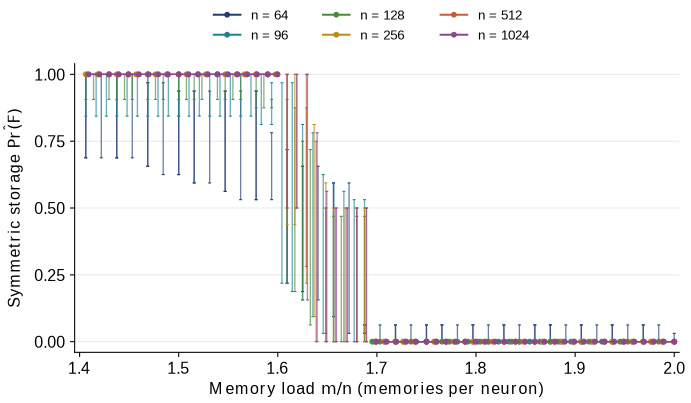
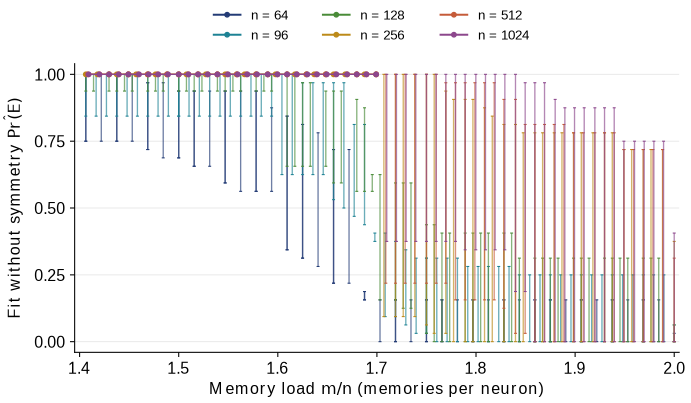
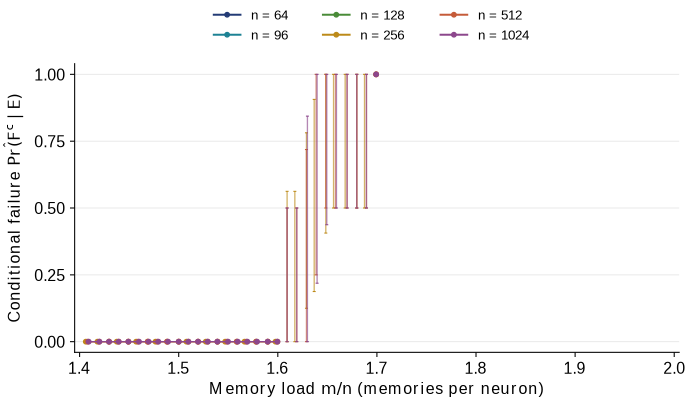
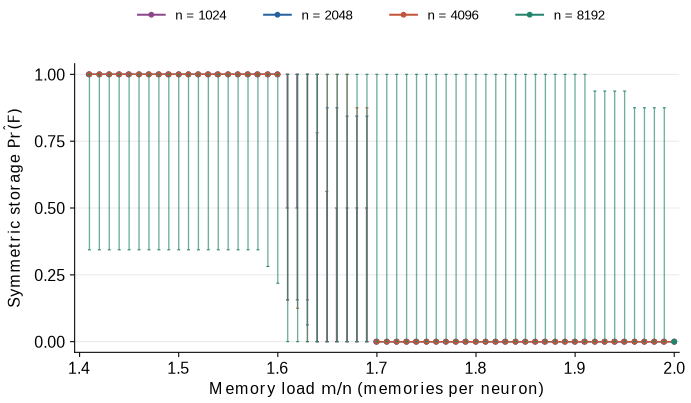
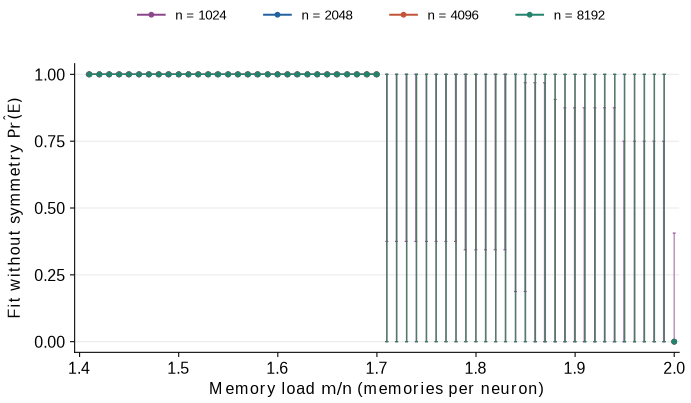
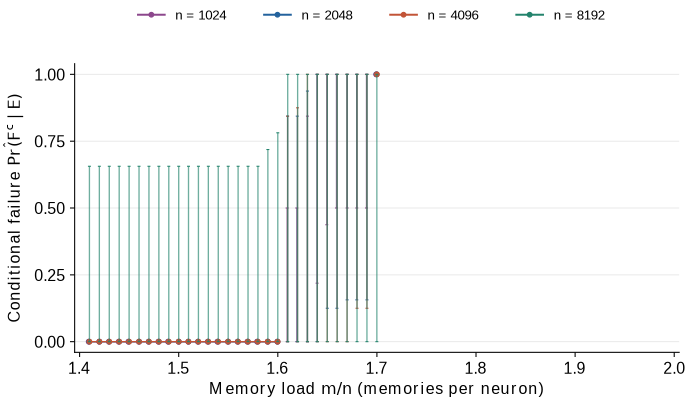
The plotted intervals apply to the historical fixed condition; the Attempt 3 dots are observed fractions, and none of the plots establishes an asymptotic endpoint.
Extended sweep
The extension targets 32 seeded streams at each \(n\in\{96\}\cup\{2^k:k=6,\ldots,13\}\), on a requested-load grid from 1.4 to 2 in steps of 0.01; prefixes within a stream remain dependent.
MLX proposes fits or full duals; original integer margins or verified residual enclosures decide acceptance, and timeouts remain unresolved.
| Neurons | Target u = 1.6 | Target u = 1.7 |
|---|---|---|
| 64 | [17,26]/32 | [1,2]/32 |
| 96 | [26,31]/32 | 0/32 |
| 128 | [28,29]/32 | 0/32 |
| 256 | 32/32 | 0/32 |
| 512 | 32/32 | 0/32 |
| 1024 | 32/32 | 0/32 |
| 2048 | 32/32 | 0/32 |
| 4096 | 32/32 | 0/32 |
| 8192 | [7,32]/32 | [0,32]/32 |
Reading the partial plots
The run is stopped; completed results are saved and restarting requires an explicit action.
Let \(S,D,U\) count confirmed successes, confirmed failures and unresolved trials.
$$S+D+U=T,\qquad\text{bar}=\left[\frac ST,\frac{S+U}{T}\right].$$
A dot has \(U=0\); bars are computational bounds.
$$n=256,\quad m=419,\quad m/n\approx1.6367.$$
$$S=1,\quad D=1,\quad U=30,\quad T=32.$$
$$\text{bar}=\left[\frac{1}{32},\frac{31}{32}\right].$$
All 32 trials pass \(E\); 30 symmetric-storage outcomes remain unresolved.
For the signed constraint matrix \(A\), accept checked witnesses:
$$A\theta>0\quad\Longrightarrow\quad F\text{ and }E,$$
$$\lambda\ge0,\quad\lambda\ne0,\quad A^\top\lambda=0\quad\Longrightarrow\quad F^c.$$
Primal acceptance uses integer-checked margins; dual acceptance uses exact arithmetic or a verified enclosure.
For \(E\), every neuron fit must pass; one checked local obstruction certifies \(E^c\subseteq F^c\).
Timeouts, rejected certificates and unattempted trials remain unknown.
For nested prefixes,
$$\begin{gathered} m_1\le m_2:\\ F(D_{m_2})\Longrightarrow F(D_{m_1}),\\ F(D_{m_1})^c\Longrightarrow F(D_{m_2})^c. \end{gathered}$$
At \(n=256\), all 32 streams have checked storage failures by
$$m=435,\qquad m/n\approx1.6992.$$
Every larger prefix therefore has \(S=U=0\).
At \(u=2\), the separate \(E\) test still has 12 unresolved trials.
Conditional points require a resolved, positive \(E\) denominator.
Certificate checks · Verified dual enclosures.
Open obligations by question
Attempt 3: twelve open obligations; historical test value \(17/10\).
Gap 2 · Q1: Lower endpoint direction
Attempt 3 · Open
For every fixed \(0<u<17/10\), prove $$\limsup_{n\to\infty}p_n(\lfloor un\rfloor)>0.$$
This is recorded obligation G2; storage through a sublinear excess above n gives no fixed load above one.
Gap 5 · Q1: Trained graph rank
Attempt 3 · Open
Decide which alternative holds: $$\exists R<\infty:\limsup_n\Pr\{\widehat E,\text{consistent},r_n\le R\}>0,$$ or $$\forall R<\infty:\Pr\{\widehat E,\text{consistent},r_n\le R\}\to0.$$
Recorded G20. The first alternative gives positive inverse-Q survival limsup and \(\alpha_+\ge9/5\); the second retires this learner. Neither is established. The G21 first/second-moment criterion is only a sufficient route to the second alternative.
Gap 12 · Q1: Full weighted primal survival
Attempt 3 · Open
Prove $$\limsup_n\Pr\{E,\gamma_*>0\}>0.$$
Recorded G5. This would yield \(\alpha_+\ge9/5\) and strictly refute 17/10. Failure of one balanced dual seed or one chosen weighting does not decide this optimized event.
Gap 1 · Q2: Upper endpoint direction
Attempt 3 · Open
For every fixed \(v>17/10\), prove $$p_n(\lfloor vn\rfloor)\longrightarrow0.$$
This is recorded obligation G1; the finite classifications and scoped construction obstructions do not prove this limit.
Gap 3 · Q2: Actual Gaussian occurrence
Attempt 3 · Open
At a specified fixed load, prove $$\mathbb E_G f(G)\longrightarrow1.$$
Recorded G13(u) is open at both 33/20 and 9/5. A lower bound for a restricted minimum cannot lower-bound the full minimum.
Gap 4 · Q2: Cube versus spherical directions
Attempt 3 · Open
At the same fixed load as occurrence, prove $$\left|\mathbb E_Cf(C)-\mathbb E f(\widetilde G)\right|\longrightarrow0.$$
Recorded G14(u). The entire-test radial normalization has vanishing error; the angular comparison is open. At 33/20, G19 is the equivalent full signed angular-plus-higher Hermite sum, with both paired cubic families retained.
Gap 7 · Q3: Exact prefix boundary
Attempt 3 · Open
Prove $$\Pr\{Q_k,\varphi_k=0\}\longrightarrow0.$$
Recorded G24 (S5.G2). Small-support exclusion leaves the dense boundary; the probability of that event remains unestimated.
Gap 8 · Q3: One-pattern birth increment
Attempt 3 · Open
Prove $$\Delta_n:=\Pr(Q_m,\neg Q_k)=p_n(k)-p_n(m)\longrightarrow0.$$
Recorded G23 (S5.G1). The exact expected repairing-pattern count is \(m\Delta_n\). Bounds for one certificate support do not upper-bound the common support intersection over every certificate.
Gap 9 · Q3: Positive prefix thinness
Attempt 3 · Open
Prove $$\Pr\{Q_k,0<\varphi_k<\alpha_n\}\longrightarrow0.$$
Recorded G25 (S5.G3). The prefix threshold is larger than \(n^{-4}\); the uniform extension theorem supplies an implication, without an occurrence estimate.
Gap 6 · Q4: All bounded storable plantings
Attempt 3 · Open
For every fixed \(K\ge2\) and finite \(U\), prove $$\sup_{p\in\mathcal M_{n,U}}\beta_{n,K}(p)\longrightarrow0,$$ or exhibit an actual bounded storable planting with positive boost limsup.
Recorded G22 (Open-B). The checked criterion gives median derivative growth if all boosts vanish. It does not give a probability-band estimate, a fixed-size window, a limiting center or an endpoint.
Gap 10 · Q4: A shrinking fixed-size window
Attempt 3 · Open
For every fixed \(0<\eta<1/2\), prove $$K_n(\eta)-K_n(1-\eta)=o(n).$$
Recorded G9. A divergent repairing-count lower bound uniformly over the probability band (G10) would suffice. Positive liminf failure at a chosen fixed load (G11), together with this window, would bound \(\alpha_+\) there; positive limsup failure alone does not.
Gap 11 · Q4: Convergence of the center
Attempt 3 · Open
Prove that some fixed \(c\) satisfies $$K_n(1/2)/n\longrightarrow c.$$
Recorded G12. Together with Gap 10 this gives \(\alpha_-=\alpha_+=c\). Median derivative growth alone supplies neither limit nor a numerical center.
What would change an endpoint bound?
At a fixed load \(u\in(1,2)\):
$$\begin{aligned} q_n(u)\longrightarrow1&\quad\Longrightarrow\quad \alpha_+\le u,\\ \limsup_n q_n(u)>0&\quad\Longrightarrow\quad \alpha_-\le u,\\ \limsup_n p_n(\lfloor un\rfloor)>0&\quad\Longrightarrow\quad \alpha_+\ge u. \end{aligned}$$
Finite classifications, small-support exclusions and restricted-construction obstructions supply none of these asymptotic premises by themselves.