Conditional symmetry experiment
Sample m distinct memories from \(\{-1,1\}^n\), where n is the number of neurons.
\(F\): some symmetric network stores all m memories.
\(F^c\): no symmetric network stores them all; c denotes complement.
\(E\): storage is possible without requiring symmetric weights.
Among sets in E, measure
$$c_n(u)=\Pr(F^c\mid E),\qquad\Pr(E)>0.$$
$$F\subseteq E.$$
$$u=\frac mn\quad\text{(memories per neuron)}.$$
Requested loads use the integer count below; the plot shows the resulting m/n.
$$\begin{gathered}n\in\{96\}\cup\{2^k:k=6,\ldots,13\},\\u\in[1.4,2],\qquad m=\lfloor un\rfloor.\end{gathered}$$
Partial T=32 snapshot · 11:12 PM Chicago, 10 November 2026. The run is stopped.
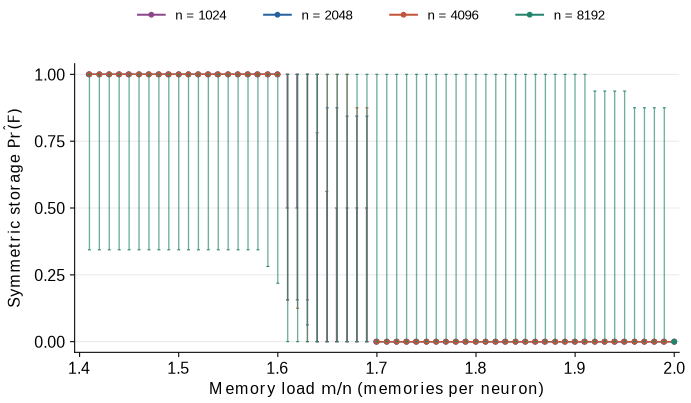
$$T=32\quad\text{target memory sets per }(n,u).$$
Q1. What do the bars mean?
For symmetric storage at one condition, let S count confirmed successes, D confirmed failures, and U unresolved or unattempted trials.
$$S+D+U=T.$$
$$\text{bar}=\left[\frac ST,\frac{S+U}{T}\right].$$
A dot means U = 0; the bars bound unfinished computations, not sampling uncertainty.
At requested load 1.64,
$$n=256,\qquad m=\lfloor1.64\cdot256\rfloor=419.$$
$$m/n\approx1.6367.$$
$$S=3,\qquad D=6,\qquad U=23.$$
$$ \left[\frac{3}{32},\frac{26}{32}\right]=[0.09375,0.81250].$$
Q2. Can we use a solver?
Yes. Strict storage is linear feasibility after rescaling the weights and fields.
$$\theta=(h,(J_{ij})_{i<j})\in\mathbb R^d.$$
$$d=n+\binom n2,\qquad A\in\{-1,0,1\}^{mn\times d}.$$
$$(A\theta)_{\mu i}=s_i^\mu\left(\sum_{j\ne i}J_{ij}s_j^\mu+h_i\right).$$
$$\begin{aligned}F&\iff\exists\theta:\ A\theta>0\\ &\iff\exists\theta:\ A\theta\ge\mathbf1.\end{aligned}$$
Attempt 3 used LP solvers; the larger sweep used MLX searches followed by certificate checks.
$$\begin{aligned} \text{variables}&=n(n+1)/2,\\ \text{inequalities}&=mn,\\ \text{nonzero coefficients}&=mn^2. \end{aligned}$$
At fixed m/n, explicitly storing A costs order \(n^3\); the MLX sweep applies its constraints without constructing A.
$$A\theta>0\quad\Longrightarrow\quad F,$$
$$\begin{gathered}\lambda\in\mathbb R^{mn},\quad\lambda\ge0,\quad\lambda\ne0,\\ A^\top\lambda=0\quad\Longrightarrow\quad F^c. \end{gathered}$$
Integer margin checks certify success; exact duals or verified error bounds certify failure; timeouts remain unknown.
LP foundations: weak duality and a worked example · Network margins and constraint rows · Verified dual enclosures.
Q3. Why are the high-load points resolved?
Q3.1. How were all 32 failures obtained?
Fix n = 256; stream r has prefix \(D_{r,k}=\{s_r^1,\ldots,s_r^k\}\), with constraint matrix \(A_{r,k}\) as in Q2.
Each stream has a checked dual at a prefix \(k_r\):
$$\begin{gathered}r=1,\ldots,32,\qquad \lambda_r\in\mathbb R^{nk_r},\\ \lambda_r\ge0,\quad\lambda_r\ne0,\quad A_{r,k_r}^\top\lambda_r=0. \end{gathered}$$
Any storing network would give the contradiction
$$0=\lambda_r^\top A_{r,k_r}\theta>0.$$
| Prefix \(k_r\) | Streams |
|---|---|
| 417 | 4 |
| 419 | 2 |
| 422 | 7 |
| 424 | 3 |
| 435 | 16 |
The nonnegative weighted-sum argument proves the contradiction.
The numerical search produced these duals; verified error bounds established exact certificates.
$$\max_r k_r=435,\qquad \frac{435}{256}\approx1.6992.$$
Q3.2. Why does failure persist at larger m? Is this easy?
For the same stream, adding memories appends constraints:
$$A_{r,m}=\begin{pmatrix}A_{r,k_r}\\C\end{pmatrix},\qquad m\ge k_r.$$
Extend the old dual by zeros on the added rows:
$$\widetilde\lambda_r=\begin{pmatrix}\lambda_r\\0\end{pmatrix}.$$
$$A_{r,m}^\top\widetilde\lambda_r=0.$$
$$\begin{gathered}435\le m\le512\\ \Longrightarrow\quad S=U=0,\quad D=32.\end{gathered}$$
Extending a known certificate is immediate; larger m alone does not make finding one easy.
A success below an intermediate prefix and a failure above it leave that prefix undecided.
Q4. Do the observed symmetry failures locate \(\alpha_-\) or \(\alpha_+\)?
For \(m=\lfloor un\rfloor\) and \(\Pr(E)>0\),
$$c_n(u)=\Pr(F^c\mid E),\qquad e_n(u)=\Pr(E).$$
$$\begin{aligned} p_n(m)=\Pr(F)&=\Pr(E)\Pr(F\mid E)\\ &=e_n(u)\,[1-c_n(u)]. \end{aligned}$$
$$\begin{aligned} \alpha_-&=\sup\{u>0:p_n(\lfloor un\rfloor)\to1\},\\ \alpha_+&=\inf\{u>0:p_n(\lfloor un\rfloor)\to0\}. \end{aligned}$$
Each limit fixes u and sends \(n\to\infty\).
| If proved at fixed load u | Endpoint consequence |
|---|---|
| \(e_n(u)\to1\) and \(c_n(u)\to0\) | \(\alpha_-\ge u\) |
| \(\limsup_n c_n(u)>0\) | \(\alpha_-\le u\) |
| \(c_n(u)\to1\) | \(\alpha_+\le u\) |
Lemma. Conditional failure bounds the nonstorage endpoint
Fix \(u>0\), and suppose \(e_n(u)>0\) eventually. Then
$$c_n(u)\longrightarrow1\quad\Longrightarrow\quad \alpha_+\le u.$$
Proof
Since \(F\subseteq E\) and \(0\le e_n(u)\le1\),
$$\begin{aligned} 0\le p_n(\lfloor un\rfloor)&=e_n(u)[1-c_n(u)]\\ &\le1-c_n(u)\longrightarrow0. \end{aligned}$$
$$\begin{gathered} u\in\{v>0:p_n(\lfloor vn\rfloor)\to0\}\\ \Longrightarrow\quad \alpha_+\le u. \end{gathered}$$
The other two implications
The identity proves the first row; for the second, use \(p_n(\lfloor un\rfloor)\le1-c_n(u)\) and monotonicity:
$$v\ge u\quad\Longrightarrow\quad p_n(\lfloor vn\rfloor)\le p_n(\lfloor un\rfloor).$$
The finite observations establish none of these limits; the known bracket is
$$1\le \alpha_-\le \alpha_+\le1.999999,$$
with the upper bound from Attempt 4, R3.
Q5. Among sets that pass every neuron test, how often does symmetry prevent storage?
Fix \(n\ge2\) and a load \(u>0\), with \(m=\lfloor un\rfloor\) and \(1\le m\le2^n\). Draw a uniform set of distinct memories:
$$D_{n,m}=\{s^1,\ldots,s^m\}\sim\operatorname{Unif}\binom{\{-1,1\}^n}{m}.$$
Each coordinate \(s_i^\mu\) is the sign neuron i must reproduce in memory \(\mu\).
Use weights \(J\) and fields \(h\), fixed across all memories:
$$J\in\mathbb R^{n\times n},\qquad h\in\mathbb R^n,\qquad J_{ii}=0\ (i\in[n]).$$
Fit without symmetry. Choose the rows of \(J\) freely:
$$\begin{gathered} E=E_n(m)=\\ \left\{\begin{array}{l} \exists(J,h):\quad J_{ii}=0\ (i\in[n]),\\ s_i^\mu((Js^\mu)_i+h_i)>0\\ \text{for every }i\in[n],\ \mu\in[m] \end{array}\right\}. \end{gathered}$$
Here \(J_{ij}\) is the weight from neuron j to neuron i; \(J_{ij}\) and \(J_{ji}\) may differ.
Fit with symmetry. Add the requirement that the two directions of every connection have the same weight:
$$\begin{gathered} F=F_n(m)=\\ \left\{\begin{array}{l}\exists(J,h):\\ J=J^\top,\quad J_{ii}=0\ (i\in[n]),\\ s_i^\mu((Js^\mu)_i+h_i)>0\\ \text{for every }i\in[n],\ \mu\in[m] \end{array}\right\}. \end{gathered}$$
$$F\subseteq E.$$
Quantity sought. Whenever \(\Pr(E)>0\), measure
$$c_n(u)=\Pr(F^c\mid E)=\frac{\Pr(E\cap F^c)}{\Pr(E)}.$$
Experiment in five steps
- Sample distinct patterns.
- Predict each neuron’s sign from the others.
- Require reciprocal weights to agree.
- Check exact witnesses.
- Count symmetry failures among cases that pass every neuron test.
Step 1. Fix a dimension and load; sample memories
A pattern is a prescribed vector of signs; its i-th coordinate is the output neuron i must reproduce.
$$n\ge2,\quad u>0,\quad m=\lfloor un\rfloor,\quad1\le m\le2^n.$$
$$D_{n,m}=\{s^1,\ldots,s^m\}\subseteq\{-1,1\}^n.$$
The partial sweep targets 32 distinct sampled sets per condition, with nested prefixes within each stream; unfinished trials remain unresolved.
$$\begin{gathered}n\in\{96\}\cup\{2^k:k=6,\ldots,13\},\\T=32\quad\text{(target)}.\end{gathered}$$
$$u\in\{1.40,1.41,\ldots,2.00\},\qquad m=\lfloor un\rfloor.$$
$$9\cdot32=288\ \text{target seeded streams}.$$
The plotted x-coordinate is the actual load m/n; nearby requested loads can produce the same memory count.
How the recorded sampling works
Each stream draws cube IDs with Python’s seeded pseudorandom generator and rejects duplicates; the ideal uniform-ID law gives a uniform ordered sample without replacement. A set ID bit decodes to spin +1, and an unset bit to −1.
$$\mathrm{seed}=202611080100000+1000n+r.$$
Prefixes within a stream are dependent; neuron tests on one sample are also dependent.
Q6. Can each neuron predict its sign from the others? (Step 2)
Choose row i of \(J\) and the field \(h_i\):
$$\underbrace{(s_j^\mu)_{j\ne i}}_{\text{input: other neurons}}\ \longmapsto\ \underbrace{s_i^\mu}_{\text{desired sign}}.$$
For a sign vector \(s\in\{-1,1\}^n\), use the weighted sum
$$H_i(s)=\sum_{j\ne i}J_{ij}s_j+h_i=(Js)_i+h_i.$$
The classifier outputs +1 when \(H_i(s)>0\) and −1 when \(H_i(s)<0\); a zero sum fails the strict storage test.
$$\begin{gathered} E_i=\left\{\begin{array}{l} \exists\big((J_{ij})_{j\ne i},h_i\big):\\ s_i^\mu H_i(s^\mu)>0\quad\forall\mu\in[m] \end{array}\right\}. \end{gathered}$$
$$E=E_n(m)=\bigcap_{i=1}^n E_i.$$
For three neurons:
$$\begin{aligned} (s_2^\mu,s_3^\mu)&\longmapsto s_1^\mu,\\ (s_1^\mu,s_3^\mu)&\longmapsto s_2^\mu,\\ (s_1^\mu,s_2^\mu)&\longmapsto s_3^\mu. \end{aligned}$$
Example 1: compute the two neuron tests · Example 2: one neuron cannot predict opposite signs from the same input.
Step 3. Require J to be symmetric
Keep the same memories and strict inequalities; now require \(J_{ij}=J_{ji}\):
$$F=F_n(m)=\left\{\exists J=J^\top,\ J_{ii}=0,\ h\in\mathbb R^n:\ s_i^\mu\left(\sum_{j\ne i}J_{ij}s_j^\mu+h_i\right)>0\ \forall i,\mu\right\}.$$
The superscript c denotes the complement, or failure, of this event:
$$F^c=\{\text{no symmetric network strictly stores all sampled patterns}\}.$$
A symmetric solution supplies a solution for every individual row:
$$F\subseteq E,\qquad E^c\subseteq F^c.$$
$$F^c=E^c\ \dot\cup\ (E\cap F^c).$$
Different weights in one asymmetric solution do not establish failure: another choice of weights might be symmetric.
| Event | Neuron tests | Symmetric test |
|---|---|---|
| \(F\) | All neuron tests pass | Feasible |
| \(E^c\) | At least one neuron test fails | Infeasible |
| \(E\cap F^c\) | All neuron tests pass | Infeasible |
Example 3: all rows fit, but symmetry forces contradictory signs for one edge.
Step 4. Accept an exact certificate
For a local row, the signed constraint matrix and parameter vector are
$$B_i\in\{-1,1\}^{m\times n},\qquad z_i=\big((J_{ij})_{j\ne i},h_i\big)\in\mathbb R^n.$$
$$B_i(\mu,:)=\big((s_i^\mu s_j^\mu)_{j\ne i},s_i^\mu\big).$$
$$E_i\iff\exists z_i:\ B_i z_i>0\iff\exists z_i:\ B_i z_i\ge\mathbf1.$$
Why a unit margin is equivalent
If every margin is positive, their finite minimum is positive; rescale all weights and the field by its reciprocal.
$$\delta=\min_{1\le\mu\le m}(B_i z_i)_\mu>0,\qquad B_i(z_i/\delta)\ge\mathbf1.$$
For the full problem, give each unordered edge one parameter:
$$d=n+\binom n2,\quad\theta=(h,(J_{ij})_{i<j})\in\mathbb R^d,\quad A\in\{-1,0,1\}^{mn\times d}.$$
$$(A\theta)_{\mu i}=s_i^\mu\left(\sum_{j\ne i}J_{ij}s_j^\mu+h_i\right).$$
The original cohort accepts integer primal or dual certificates after exact checks:
$$A\theta>0;\qquad\text{or}\qquad \lambda\ge0,\quad\lambda\ne0,\quad A^\top\lambda=0.$$
Why the dual certifies failure
If both a strict solution and a dual existed, their scalar product would be positive and zero:
$$0=(A^\top\lambda)^\top\theta=\lambda^\top A\theta>0.$$
The same test with B in place of A certifies a local obstruction; a numerical timeout remains unknown.
Numerical proposals and exact acceptance
Local LPs propose unit-margin separators; the full LP maximizes a common margin with bounded parameters. Integer or rational reconstruction and exact arithmetic decide acceptance.
$$\max_{\theta,\rho}\rho\quad\text{subject to}\quad A\theta\ge\rho\mathbf1,\quad-1\le\theta_k\le1,\quad\rho\le1.$$
A positive optimum is equivalent to strict full feasibility by rescaling; an unsuccessful numerical solve alone does not certify nonstorage.
Sweep: checked dual enclosures
The sweep uses MLX to propose networks or duals; integer margins certify success, while the following residual bound can certify an exact dual without storing huge rational entries.
Write \(S=[s^1\ \cdots\ s^m]\), \(U=[S;\mathbf1_m^\top]\), \(G=UU^\top\), and let \(\mathcal T(X)\) retain the diagonal and skew part of the first n columns of X, with zero last column.
For an integer proposal \(B\in\mathbb Z^{n\times m}\), set
$$\Delta=\mathcal T(BU^\top)-BU^\top,\qquad B_*=B+\Delta G^{-1}U.$$
$$B_*U^\top=\mathcal T(BU^\top),\qquad\lambda=S\odot B_*>0\quad\Longrightarrow\quad A^\top\lambda=0.$$
Given numerical approximations H to \(G^{-1}\) and Q to \(G^{-1}U\), verified rounding bounds enclose
$$\eta=\|I-GH\|_\infty<1,\qquad\|G^{-1}\|_\infty\le\frac{\|H\|_\infty}{1-\eta}.$$
$$\|B_*-(B+\Delta Q)\|_{\max}\le\|\Delta\|_\infty\frac{\|H\|_\infty}{1-\eta}\|U-GQ\|_{\max}.$$
Acceptance requires the lower bound for every signed entry to stay strictly positive after including floating-point rounding error; a failed check remains unknown.
For a single neuron with invertible \(B_i^\top B_i\), the same residual-enclosure check applies to
$$\lambda_*=v-B_i(B_i^\top B_i)^{-1}B_i^\top v,\qquad B_i^\top\lambda_*=0.$$
A strictly positive enclosed \(\lambda_*\) certifies \(E_i^c\), hence \(E^c\subseteq F^c\).
Step 5. Count symmetry failures only among cases that pass every neuron test
For fixed n and load, count the T sampled streams:
$$e=\#E,\qquad b=\#(E\cap F^c).$$
$$c_n(u)=\Pr(F^c\mid E),\qquad\widehat c_n(u)=\frac be\quad(e>0).$$
$$e=0:\quad\widehat c_n(u)\ \text{is undefined}.$$
Worked cell · Attempt 3, n = 96, load 1.7
Eight samples are nonstorable: four already fail a neuron test, and four pass all rows but fail symmetry.
$$e=4,\quad b=4,\quad\widehat c_{96}(1.7)=\frac44=1.$$
$$\widehat{\Pr(F^c)}=\frac88=1,\qquad\widehat{\Pr(E\cap F^c)}=\frac48=\frac12.$$
The conditional rate describes a selected subset of samples; it does not by itself locate either endpoint.
$$\Pr(F^c)=1-\Pr(E)+\Pr(E)c_n(u)\quad(\Pr(E)>0).$$
Attempt 3: recorded experiment and certification scope · Construct your own classification.