Storage capacity
Attempts 1–2 · inherited bounds from Attempt 1; current supporting results from Attempt 2
Definitions
Definition 1. Spin network
For \(n\ge2\), \(J=J^\top\in\mathbb R^{n\times n}\), \(J_{ii}=0\), and \(h\in\mathbb R^n\). $$H_i(s)=\sum_{j\ne i}J_{ij}s_j+h_i,\qquad f_{J,h}(s)_i=\sigma(H_i(s)),\qquad\sigma(t)=\begin{cases}+1,&t>0,\\-1,&t\le0.\end{cases}$$ Strict storage requires \(s_iH_i(s)>0\) for every prescribed spin and neuron.
Definition 2. Storage probability
\(D\) is uniform among the \(m\)-element subsets of \(\{-1,1\}^n\). $$p_n(m)=\Pr\{D\text{ is storable}\}.$$
Definition 3. Capacity
$$\alpha_-=\sup\{a>0:p_n(\lfloor an\rfloor)\longrightarrow1\}.$$ This supremum does not assert a sharp threshold.
Definition 4. Two limiting endpoints
$$\begin{aligned}\alpha_-&=\sup\{a>0:\\&\quad p_n(\lfloor an\rfloor)\to1\},\\[6pt]\alpha_+&=\inf\{a>0:\\&\quad p_n(\lfloor an\rfloor)\to0\}.\end{aligned}$$ These are the optimal one-sided endpoints. A single sharp constant requires \(\alpha_-=\alpha_+\); the one-sided goals do not assume equality.
Definition 5. Spin patterns
\(s^\mu\in\{-1,1\}^n\), and \(S=[s^1\ \cdots\ s^m]\in\{-1,1\}^{n\times m}\).
Definition 6. Spin couplings
\(J=J^\top\in\mathbb R^{n\times n}\), \(J_{ii}=0\), and \(h\in\mathbb R^n\). Strict stability means \(s_i^\mu((Js^\mu)_i+h_i)>0\).
Definition 7. Nonstorage certificate
The multipliers \(\lambda_i^\mu\ge0\) have total mass one and satisfy $$\sum_\mu\lambda_i^\mu s_i^\mu=0,\qquad \sum_\mu(\lambda_i^\mu+\lambda_j^\mu)s_i^\mu s_j^\mu=0\quad(i<j).$$ Their existence is equivalent to nonstorage.
Definition 8. First failure size
Choose a uniformly random ordering of all \(2^n\) distinct spin patterns:
$$X_n^1,X_n^2,\ldots,X_n^{2^n}.$$
The “prefix of length \(m\)” means the first \(m\) patterns in this list:
$$D_{n,m}=\{X_n^1,\ldots,X_n^m\},\qquad 1\le m\le2^n.$$
Add patterns one at a time; \(\tau_n\) counts how many have been added when storage first becomes impossible:
$$\begin{aligned}\tau_n=\min\{m\in\{1,\ldots,2^n\}:\\D_{n,m}\text{ is not storable}\}.\end{aligned}$$
Storage is checked anew at each size; the weights and fields may change with \(m\).
$$\begin{aligned}m<\tau_n&\ \Longrightarrow\ D_{n,m}\text{ is storable},\\m\ge\tau_n&\ \Longrightarrow\ D_{n,m}\text{ is not storable}. \end{aligned}$$
Each \(D_{n,m}\) is a uniform distinct \(m\)-set, so
$$p_n(m)=\Pr\{\tau_n>m\}.$$
Thus \(\tau_n-1\) is the largest storable prefix size; \(\tau_n\) is random because the ordering is random. The full cube is nonstorable, so the minimum exists. The recorded proofs also write \(D_m\) for \(D_{n,m}\).
Definition 9. Maximum storable subset
For a finite sample \(D\), $$L(D)=\max\{|E|:E\subseteq D\text{ is storable}\}.$$ Full storage is the event \(L(D)=|D|\).
Definition 10. Storage quantiles
$$q_n(t)=\min\{1\le m\le2^n:p_n(m)\le t\},\quad 0<t<1,\qquad c_n=q_n(1/2).$$ Heredity makes \(p_n\) nonincreasing; the full cube is nonstorable, so these quantiles exist.
Definition 11. Repair count
For a nonstorable set \(D\), $$R(D)=\{x\in D:D\setminus\{x\}\text{ is storable}\}.$$ Put \(R(D)=\varnothing\) when \(D\) stores. For a uniform distinct \(m\)-set, \(\mu_{n,m}=\mathbb E|R(D)|\).
Definition 12. Active certificate neurons
For normalized nonnegative dual multipliers, $$I_\lambda=\{i\in[n]:\sum_{\mu=1}^m\lambda_i^\mu>0\}.$$ The count concerns neuron support, not the number of patterns or positive entries.
Definition 13. Guaranteed sample size
$$c_\ast=1/55296,\qquad M_n=n+\lfloor c_\ast n/\log n\rfloor.$$ Logarithms are natural; \(M_n/n\to1\).
Hypotheses
For each \(n\ge2\), \(D\) is a uniform distinct \(m\)-element subset of \(\{-1,1\}^n\). A common real symmetric zero-diagonal \(J\) and unrestricted field \(h\in\mathbb R^n\) must satisfy $$s_i((Js)_i+h_i)>0\qquad\forall s\in D,\ i\in[n].$$ Let \(p_n(m)\) be the probability that such parameters exist.
Determine the storage endpoint \(\alpha_-\) and the nonstorage endpoint \(\alpha_+\); their values and equality remain unresolved.
Guarantee storage at a fixed load above 1, or nonstorage at a fixed load below 2.
Attempt 1: endpoint bracket. Attempt 2: sublinear-excess storage theorem.
$$\boxed{1\le \alpha_-\le \alpha_+\le2}.$$
$$\begin{gathered}M_n=n+\left\lfloor\frac{n}{55296\log n}\right\rfloor,\\p_n(M_n)\to1,\qquad M_n/n\to1.\end{gathered}$$
The excess is sublinear; neither endpoint bound is tightened. Gap 1: locate the endpoints.
Step 1. Apply the storage theorem
Attempt 2 · recorded derivation; inherited results keep their original scope
$$p_n(M_n)\to1\quad\Longrightarrow\quad \alpha_-\ge1.$$
Proved in Supporting results → Strict-storage constructions, Step 3 (full inverse construction). Storage is hereditary, so \(p_n\) is nonincreasing; for every fixed \(0<a\le1\), eventually \(\lfloor an\rfloor\le M_n\), hence $$p_n(\lfloor an\rfloor)\ge p_n(M_n)\to1.$$ Since \(M_n/n\to1\), no fixed \(a>1\) follows.
Step 2. Apply the nonstorage bound
Attempt 2 · recorded derivation; inherited results keep their original scope
$$p_n(\lfloor an\rfloor)\to0\quad(a>2),\qquad \alpha_+\le2.$$
Proved in Supporting results → First failure, repair and sharpness, Step 12, argument 3 (one-neuron counting). Full storage requires one neuron to separate its labels; Cover’s count and the iid-to-distinct transfer give $$\begin{aligned}p_n(m)&\le\Pr\{\operatorname{Bin}(m-1,1/2)\le n-1\}\\&\qquad+\binom m2 2^{-n}.\end{aligned}$$ Both terms vanish at fixed load \(a>2\). Monotonicity prevents a load with storage limit 1 from exceeding a load with storage limit 0, so \(\alpha_-\le \alpha_+\).
For a fixed load \(0<a<2\), $$\begin{aligned}\Pr\{\text{a full dual certificate exists}\}\\=1-p_n(\lfloor an\rfloor).\end{aligned}$$
Established in Attempt 2 · small neuron supports only
For every fixed \(0<a<2\), some \(\beta(a)>0\) satisfies $$\begin{aligned}\Pr\{\exists\lambda\text{ dual}:\\|I_\lambda|\le\lfloor\beta(a)n\rfloor\}\to0.\end{aligned}$$
Certificates using more neurons remain possible; their occurrence probability is unknown. Neither endpoint bound improves.
Step 3. Identify nonstorage exactly
Attempt 2 · recorded derivation; inherited results keep their original scope
Nonstorage is equivalent to nonnegative multipliers of total mass 1 satisfying $$\sum_\mu\lambda_i^\mu s_i^\mu=0\quad(i\in[n]),$$ $$\sum_\mu(\lambda_i^\mu+\lambda_j^\mu)s_i^\mu s_j^\mu=0\quad(i<j).$$
Proved in Supporting results → Full coupled certificates, Step 1 (exact convex alternative). The two equations annihilate every bias and shared-edge coefficient of the strict-margin inequalities; separation makes this alternative exhaustive. Thus certificate occurrence has probability \(1-p_n(m)\).
Step 4. Exclude small neuron supports
Attempt 2 · recorded derivation; inherited results keep their original scope
$$\begin{aligned}I_\lambda&=\{i:\sum_\mu\lambda_i^\mu>0\},\\\Pr\{\exists\lambda\text{ dual}:|I_\lambda|\le\lfloor\beta(a)n\rfloor\}&\to0.\end{aligned}$$
Proved in Supporting results → Extensive neuron support, Step 1 (closed-hull estimate and support union bound). Split certificate occurrence by its support size: $$\begin{aligned}1-p_n(m)&=\Pr\{\text{a small-support dual exists}\}\\&\quad+\Pr\{\text{a dual exists, but none has small support}\}.\end{aligned}$$ The theorem makes the first term vanish; the second remains uncontrolled.
$$\alpha_-=\alpha_+=c\quad\text{for some }c\in[1,2].$$
Established in Attempt 2 · equivalence; both probability premises remain open
For fixed \(c\in[1,2]\), $$\alpha_-=\alpha_+=c$$ $$\Longleftrightarrow\quad\begin{cases}(\tau_n-c_n)/n\xrightarrow{\Pr}0,\\c_n/n\to c,\end{cases}$$ where \(c_n=q_n(1/2)\) is the median transition size.
The shrinking window and center limit are both unproved. Gap 2; even equality alone would leave the numerical value unknown.
Step 5. Identify the transition law
Attempt 2 · recorded derivation; inherited results keep their original scope
$$p_n(m)=\Pr\{\tau_n>m\},\qquad p_n(m-1)-p_n(m)=\frac{\mu_{n,m}}m.$$
Proved in Supporting results → First failure, repair and sharpness, Step 1 (repair identity) and Step 12, argument 2 (survival law). Heredity identifies storage with survival of the first failure; deleting a uniform point from a uniform \(m\)-set gives the repair identity, with \(\mu_{n,m}=\mathbb E|R(D_m)|\).
Step 6. State the missing window premise
Attempt 2 · recorded derivation; inherited results keep their original scope
If repair means grow throughout each fixed transition band, then $$\begin{aligned}q_n(\varepsilon)-q_n(1-\varepsilon)&=o(n),\\(\tau_n-c_n)/n&\xrightarrow{\Pr}0.\end{aligned}$$
The implication is proved in Supporting results → First failure, repair and sharpness, Step 12, arguments 7–8 and 11. Under Gap 2’s unproved repair-growth premise, summing the identity in Step 5 gives $$q_n(\varepsilon)-q_n(1-\varepsilon)\le2+3n/r_n(\varepsilon)=o(n).$$ The survival law then bounds both tails around \(c_n\); no such growth estimate is established for the network.
Step 7. Separate the center limit
Attempt 2 · recorded derivation; inherited results keep their original scope
For fixed \(c\in[1,2]\), $$\begin{gathered}(\tau_n-c_n)/n\xrightarrow{\Pr}0,\quad c_n/n\to c\\\Longleftrightarrow\quad\tau_n/n\xrightarrow{\Pr}c\\\Longleftrightarrow\quad \alpha_-=\alpha_+=c.\end{gathered}$$
These equivalences are proved in Supporting results → First failure, repair and sharpness, Step 12, arguments 7–10. The triangle inequality combines window and center; conversely, the survival law forces every fixed-level quantile to converge to \(c\). The same law identifies this with storage limit 1 below \(c\) and 0 above \(c\). Step 6’s abstract counterexample shows that a shrinking window alone need not give a center limit; it is not a counterexample to this network.
Earlier three-round argument and original proof steps
Bounds and remaining questions
Attempt 1 · recorded bounds and open questions
Use the network, strict storage condition and uniform-set sampling law defined in History.
$$\alpha_-=\sup\{\alpha>0:p_n(\lfloor\alpha n\rfloor)\to1\}.$$
What does this work add to the cited literature?
| Work | Statement / criterion | Relation to this problem |
|---|---|---|
| [Cover (1965), Thm. 1, p. 326] | One classifier: transition at load \(2\). | Gives \(\alpha_-\le2\). |
| [Hillar–Sohl-Dickstein–Koepsell (2015), Thm. 2, p. 3; open problem, p. 4] | \(\alpha_-\ge1\); empirical transition between \(1.5\) and \(1.7\). | Same random-set problem; exact capacity left open. |
| [Hillar–Tran (2018), Thms. 1–2, pp. 6–7] | Many designed clique memories; noise tolerance. | Structured patterns have a different sampling law. |
| [Stojnic (2024), abstract, 2024] | Hebbian weights; retrieval allowing some errors. | Weights are prescribed by a learning rule. |
| [Ramsauer et al. (2021), abstract, 2021] | Continuous-state modern Hopfield model; exponential pattern counts. | State space and update rule differ. |
| Recorded work on these pages | \(1\le \alpha_-\le2\), plus exact finite certificates. | Recovers the capacity bracket; does not narrow it. |
This comparison is limited to the cited models and results.
What the recorded run proves
Recorded verdict — partial. For the model and sampling law defined in History, $$1\le \alpha_-\le2,\qquad p_n(n)\to1,\qquad\limsup_{n\to\infty}p_n(2n)\le1/2.$$
The existence of a sharp threshold and the proposed value near 1.6 remain unproved in this run. In the next sections, the first-failure time \(\tau_n\) and other proof notation have the definitions below.
Definitions
Definition 1. Spin network
For \(n\ge2\), \(J=J^\top\in\mathbb R^{n\times n}\), \(J_{ii}=0\), and \(h\in\mathbb R^n\). $$H_i(s)=\sum_{j\ne i}J_{ij}s_j+h_i,\qquad f_{J,h}(s)_i=\sigma(H_i(s)),\qquad\sigma(t)=\begin{cases}+1,&t>0,\\-1,&t\le0.\end{cases}$$ Strict storage requires \(s_iH_i(s)>0\) for every prescribed spin and neuron.
Definition 2. Storage probability
\(D\) is uniform among the \(m\)-element subsets of \(\{-1,1\}^n\). $$p_n(m)=\Pr\{D\text{ is storable}\}.$$
Definition 3. Capacity
$$\alpha_-=\sup\{a>0:p_n(\lfloor an\rfloor)\longrightarrow1\}.$$ This supremum does not assert a sharp threshold.
Definition 4. Two limiting endpoints
$$\alpha_-=\sup\{u>0:p_n(\lfloor un\rfloor)\to1\},\qquad \alpha_+=\inf\{a>0:p_n(\lfloor an\rfloor)\to0\}.$$ A sharp proportional threshold is equivalent to equality of these endpoints.
Definition 5. Spin patterns
\(s^\mu\in\{-1,1\}^n\), and \(S=[s^1\ \cdots\ s^m]\in\{-1,1\}^{n\times m}\).
Definition 6. Spin couplings
\(J=J^\top\in\mathbb R^{n\times n}\), \(J_{ii}=0\), and \(h\in\mathbb R^n\). Strict stability means \(s_i^\mu((Js^\mu)_i+h_i)>0\).
Definition 7. Augmented projection
$$U=\begin{bmatrix}S\\\mathbf1_m^\top\end{bmatrix},\qquad P=U(U^\top U)^{-1}U^\top$$ when \(U\) has column rank \(m\). Its last coordinate represents a free field.
Definition 8. Nonstorage certificate
The multipliers \(\lambda_i^\mu\ge0\) have total mass one and satisfy $$\sum_\mu\lambda_i^\mu s_i^\mu=0,\qquad \sum_\mu(\lambda_i^\mu+\lambda_j^\mu)s_i^\mu s_j^\mu=0\quad(i<j).$$ Their existence is equivalent to nonstorage.
Definition 9. First failure time
Uniformly order the entire spin cube and let \(\tau_n\) be the first prefix length that is not storable. $$p_n(m)=\Pr\{\tau_n>m\}.$$
Definition 10. Maximum storable subset
For a finite sample \(D\), $$L(D)=\max\{|E|:E\subseteq D\text{ is storable}\}.$$ Full storage is the event \(L(D)=|D|\).
Open gaps
Gap 1. Locate the capacity · Standalone statement
Determine the storage endpoint $$\begin{aligned}\alpha_-&=\alpha_-\\&=\sup\{a>0:\\&\quad p_n(\lfloor an\rfloor)\to1\},\end{aligned}$$ $$\alpha_-\in[1,2].$$ In particular, decide whether its value is near \(1.6\); this endpoint is defined even if no single sharp threshold exists.
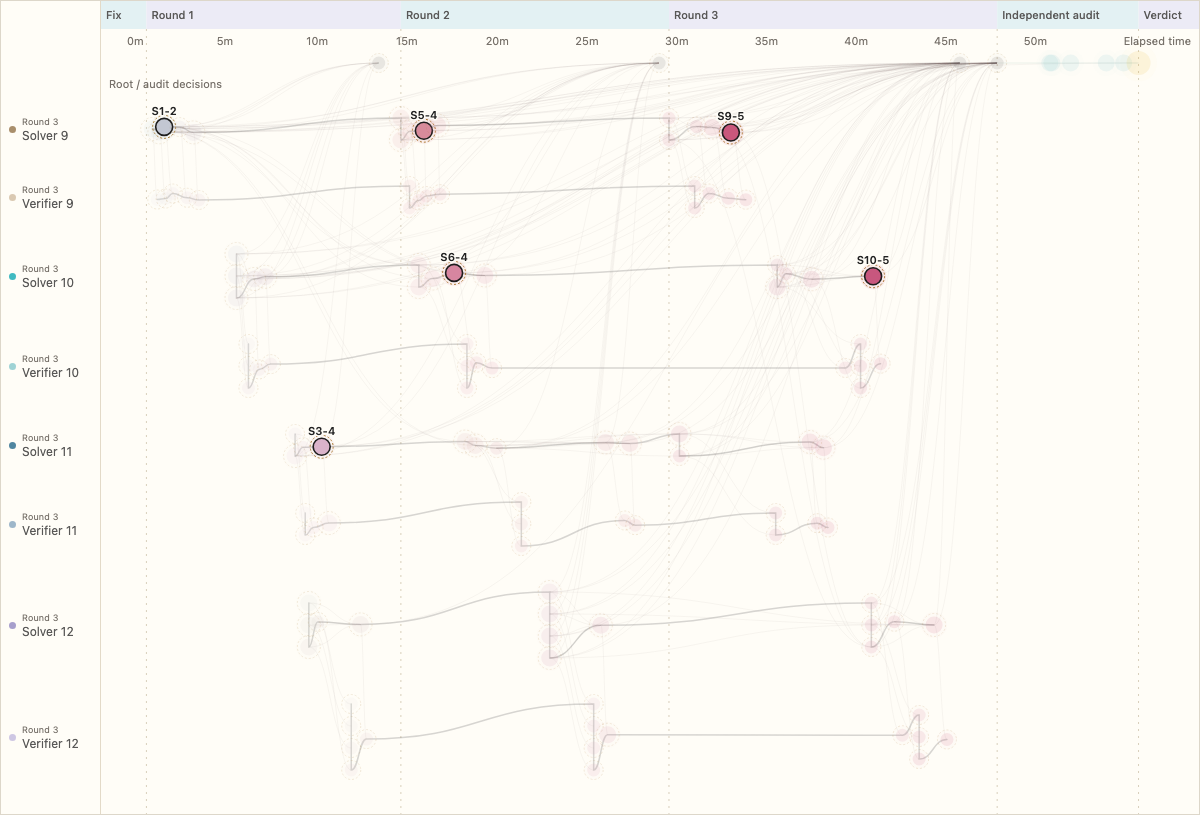
Gap 2. Prove a sharp constant threshold · Standalone statement
Determine whether $$\alpha_-=\alpha_+.$$ Equivalently, prove or refute existence of a deterministic \(c\in[1,2]\) such that, for every \(\varepsilon>0\), $$\Pr\{|\tau_n/n-c|>\varepsilon\}\longrightarrow0.$$ If it exists, this constant satisfies $$c=\alpha_-=\alpha_+=\alpha_-.$$
Gap 2(a). Defect propagation (unproved sufficient premise)
Let \(\Delta(D)=|D|-L(D)\). For every fixed \(0<a<b<2\), prove $$\Pr\{D_{\lfloor an\rfloor}\text{ not storable},\ \Delta(D_{\lfloor bn\rfloor})<n^{2/3}\}\to0.$$ The checked concentration estimate then gives a shrinking window around deterministic median locations.
Gap 2(b). Median locations (unproved sufficient premise)
For $$k_n=\min\{m:p_n(m)\le1/2\},$$ prove \(k_n/n\to c\) for a deterministic \(c\in[1,2]\). Combined with Gap 2(a), this would imply the canonical concentration obligation; neither premise is established for the network.
Repair-core growth (unproved sufficient premise for Gap2)
For a nonstorable finite set \(D\), define \(R(D)=\{x\in D:D\setminus\{x\}\text{ stores}\}\), and set it empty when \(D\) stores. For each fixed \(0<\varepsilon<1/2\), prove that some \(r_n(\varepsilon)\to\infty\) satisfies $$\mathbb E|R(D_m)|\ge r_n(\varepsilon)$$ for every \(m\in[n/2,3n]\) with \(\varepsilon\le p_n(m)\le1-\varepsilon\). Here \(D_m\) is a uniform distinct \(m\)-set. Then $$p_n(m-1)-p_n(m)=\mathbb E|R(D_m)|/m$$ gives o(n) fixed-level quantile windows, hence \((\tau_n-k_n)/n\to0\) in probability, where \(k_n=\min\{m:p_n(m)\le1/2\}\). A center limit is still needed; stopped samples have a different, size-biased law.
Attempted proofs and remaining obligations
| Route | Idea | Conditioned on | Status |
|---|---|---|---|
| Bounds | Projection + one-neuron obstruction | No extra premise for[1,2] | Incomplete target |
| Pairwise relaxation | Difference quadratic forms | None | Scoped obstruction |
| Concentration | First failure time | Gap2(a),(b) | Conditional |
| Symmetrization | Average directed classifiers | Gap1 probability estimate | Scoped failure |
Attempted proof — incomplete
1. State the strict spin constraints
Established in Attempt 1 · stated scope
For a finite spin sample \(D=\{s^1,\ldots,s^m\}\), strict storage means $$J=J^\top,\qquad J_{ii}=0,\qquad h\in\mathbb R^n,\qquad s_i^\mu((Js^\mu)_i+h_i)>0\quad\forall i,\mu.$$ The same parameters must serve every pattern.
Proof
- Use \(s^\mu\in\{-1,1\}^n\), \(J=J^\top\), \(J_{ii}=0\), and free \(h\), with margins \(s_i^\mu((Js^\mu)_i+h_i)>0\).
- For the tie rule \(\sigma(t)=+1\) for \(t>0\) and \(-1\) otherwise, a finite fixed-point family can be made strict by decreasing each field by less than its least positive field, when present. Positive-target fields stay positive and negative-target fields become negative. Strict margins directly imply fixed points.
- The constraints are strict linear inequalities in one variable per unordered edge and one independent field per neuron; no general-position assumption is used.
Sources
The derivation is self-contained; no external theorem is required.
In the attempt tree
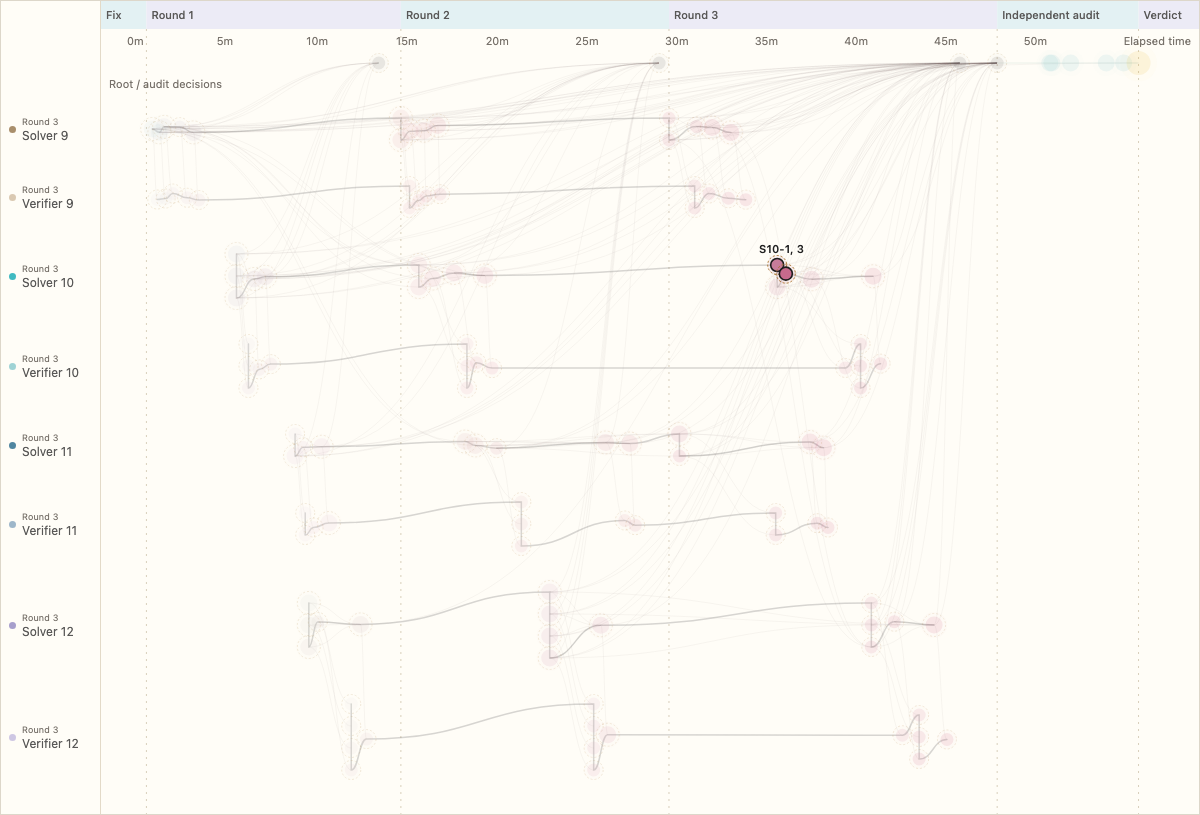
Figure 7. S1-1. 2. Identify the exact dual
Established in Attempt 1 · stated scope
Nonstorage is equivalent to $$\lambda_i^\mu\ge0,\quad\sum_{i,\mu}\lambda_i^\mu=1,\quad\sum_\mu\lambda_i^\mu s_i^\mu=0,\quad\sum_\mu(\lambda_i^\mu+\lambda_j^\mu)s_i^\mu s_j^\mu=0\ (i<j).$$
Proof
- By S1-1, write θ for the p=n(n+1)/2 parameters (J_ij for i<j, h_i), and a_iμ∈R^p for the row vector whose dot product with θ is s_i^μ(∑_{j≠i}J_ij s_j^μ+h_i). Its h_k coefficient is 1{k=i}s_i^μ and its J_kl coefficient is 1{i∈{k,l}}s_k^μ s_l^μ. The primal system is a_iμ·θ>0 for all rows.
- Put H=conv{a_iμ}. If 0∈H, the convex coefficients λ give ∑λ_i^μ a_iμ=0. A strictly feasible θ would make its dot product with this sum positive, a contradiction. If 0∉H, compactness gives a minimum-norm point z∈H with ||z||>0. For any a∈H, the one-sided derivative at t=0 of ||z+t(a−z)||² is nonnegative, so a·z≥||z||²>0. Choosing θ=z gives strict feasibility. Thus precisely one of primal strict feasibility and the normalized convex dual is possible.
- Equating the h_i and J_ij coefficients in ∑λ_i^μ a_iμ=0 gives exactly the two equations in the statement. In particular an edge equation contains λ_i^μ+λ_j^μ because the SAME variable J_ij occurs in the two neuron inequalities. There are no diagonal variables and no omitted free-field constraints.
- To prove the support bound without invoking an external theorem, start from any normalized convex representation of zero. If its positive support has size greater than p+1, the corresponding vectors (a_iμ,1)∈R^{p+1} are linearly dependent. Choose nonzero coefficients c with ∑c a=0 and ∑c=0; c has both signs. Subtract t c from λ, where t=min_{c>0}λ/c. This preserves nonnegativity, normalization and the zero vector, while deleting at least one positive coefficient. Iterate to at most p+1.
- The alternative is an exact finite certificate, not an asymptotic probability estimate; any proposed probabilistic argument must still establish the occurrence or absence of these certificates. No inherited gap is present in S1-1.
Sources
The derivation is self-contained; no external theorem is required.
In the attempt tree
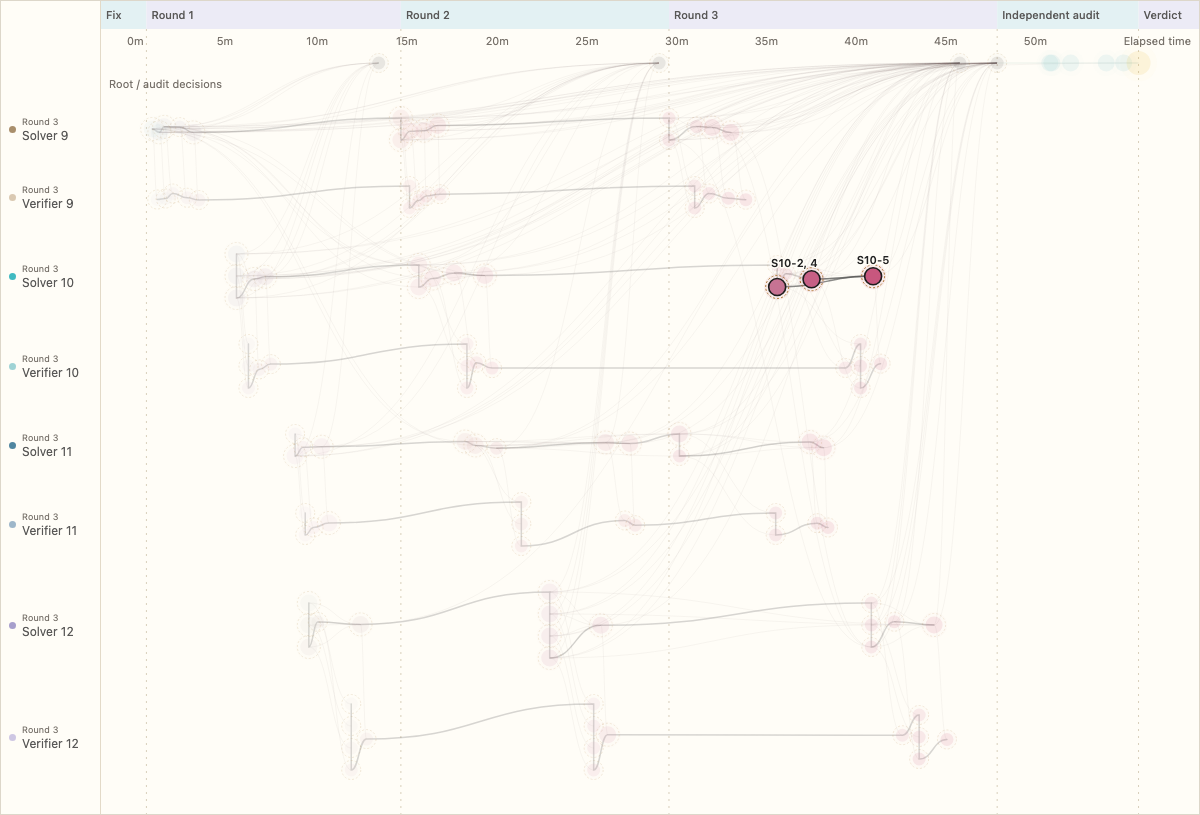
Figure 8. S1-2. 3. Augment the projection
Established in Attempt 1 · stated scope
If every deletion of an actual-neuron row of \(U\) retains full column rank, the extracted symmetric zero-diagonal \(J\) and free \(h\) satisfy $$s_i^\mu((Js^\mu)_i+h_i)=1-P_{ii}>0.$$
Proof
- Deleting any neuron row leaves rank \(m\), so \(U\) itself has full column rank and the displayed inverse exists. Thus \(P\) is the orthogonal projection onto \(\operatorname{col}U\). The constant last row is an auxiliary algebraic coordinate, not an extra neuron required to be stable.
- For every \(i\in[n]\), \(P_{ii}=\|Pe_i\|^2\le1\), with equality exactly when \(e_i\in\operatorname{col}U\). If \(Ua=e_i\), deleting neuron row \(i\) gives \(U_{-i}a=0\), hence \(a=0\), a contradiction. Therefore \(P_{ii}<1\) simultaneously for all real neurons; no condition on deletion of the constant row is needed.
- Since \(Pu^\mu=u^\mu\) for \(u^\mu=(s^\mu,1)\), its first \(n\) coordinates give \(Bs^\mu+h=s^\mu\). Subtracting the diagonal contribution gives
$$ s_i^\mu(As^\mu+h)_i=(s_i^\mu)^2(1-B_{ii})=1-P_{ii}>0. $$
- The principal block \(B\) is symmetric; hence \(A=B-\operatorname{diag}(B)\) is symmetric with zero diagonal. Take \(J=A\) and the extracted h. Its local field is \(As^\mu+h\), and Step 3 gives all nm positive margins. The auxiliary constant coordinate supplies unrestricted neuron fields.
Sources
The derivation is self-contained; no external theorem is required.
In the attempt tree
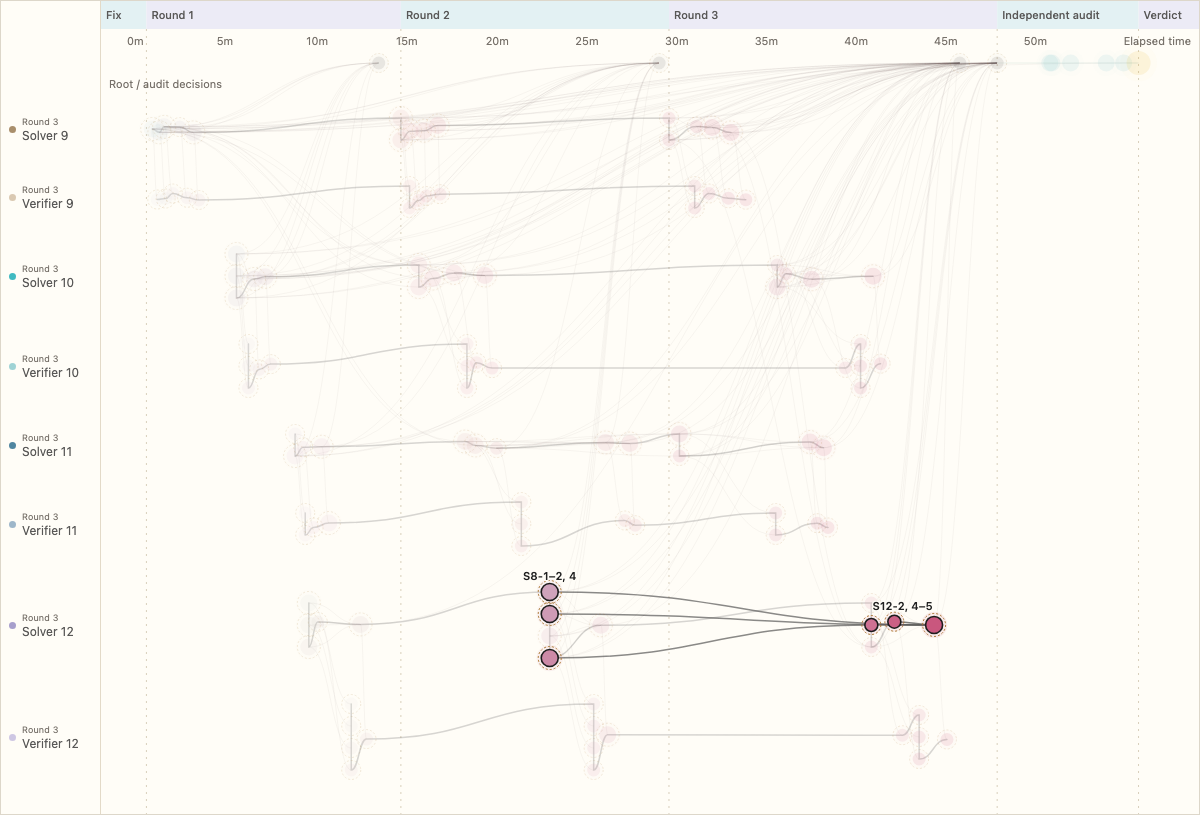
Figure 9. S5-1. 4. Include load one
Established in Attempt 1 · stated scope
Let \(q_n\) be the singularity probability of an iid \(n\times n\) sign matrix. Eventually $$1-p_n(n)\le\frac{nq_n}{1-\binom n2 2^{-n}}\to0,\qquad q_n\le(1/2+\varepsilon)^n$$ for every fixed \(0<\varepsilon<1/2\).
Proof
- Let \(r_\mu=(M_d)_{d\mu}\), and multiply column \(\mu\) of \(M_d\) by \(r_\mu\). The last row becomes all ones; the other entries become \((M_d)_{j\mu}r_\mu\), \(j<d\). Conditional on the entire last row, these \((d-1)d\) products are still independent uniform signs, and their conditional law does not depend on that row. Thus \(M_d\operatorname{diag}(r_1,\ldots,r_d)\) has exactly the law of \(N_d\). The diagonal multiplier is invertible, so their singularity probabilities agree.
- The local source is Konstantin Tikhomirov, “Singularity of random Bernoulli matrices”, Annals of Mathematics 191 (2020), 593–634, Theorem A, pp. 593–594. Its hypotheses are: fixed \(p\in(0,1/2]\), \(\varepsilon>0\), a square \(d\times d\) matrix \(B_d(p)\) with independent entries taking 1 with probability \(p\) and 0 otherwise, any shift \(a\in[-1,0]\), and \(d\ge d_{p,\varepsilon}\). Its estimate, with \(\sigma_{\min}\) the smallest singular value, is
$$ \Pr\{\sigma_{\min}(B_d(p)+a\mathbf1_d\mathbf1_d^\top)\le t/\sqrt d\} \le(1-p+\varepsilon)^d+C_{p,\varepsilon}t,\qquad t>0. $$
- Take \(p=1/2\) and \(a=-1/2\), both inside the stated ranges. The matrix
$$ M_d=2\bigl(B_d(1/2)-\tfrac12\mathbf1_d\mathbf1_d^\top\bigr) $$ has exactly iid uniform signs. Scaling by 2 multiplies \(\sigma_{\min}\) by 2 and preserves singularity. For fixed \(d\ge d_{1/2,\varepsilon}\), let \(t\downarrow0\) in Theorem A. Continuity from above of probability gives $$ q_d=\Pr\{\sigma_{\min}(B_d(1/2)-\tfrac12\mathbf1_d\mathbf1_d^\top)=0\} \le(1/2+\varepsilon)^d. $$ The source explicitly notes immediately after Theorem A that this substitution gives its equation (1), \(q_d=(1/2+o_d(1))^d\); only the displayed upper bound is needed here. In particular, choosing \(\varepsilon=1/4\) yields \(d q_d\to0\). No assertion of generic position is used.
- Both parent reports were read before writing this node and contain no open issue. First sample \(n\) patterns iid uniformly from the spin cube, so their spin matrix \(S\in\{-1,1\}^{n\times n}\) has iid uniform-sign entries. Form \(U=[S;\mathbf1_n^\top]\). For each fixed neuron \(i\), deleting its row leaves an \(n\times n\) matrix whose first \(n-1\) rows are iid signs and whose last row is all ones. By S5-2, its singularity probability is exactly \(q_n\).
- Although these deleted matrices overlap, a union bound gives
$$ \Pr\{\exists i\in[n]:\operatorname{rank}U_{-i}<n\}\le nq_n. $$ Outside this exceptional event S5-1 constructs symmetric, exactly zero-diagonal spin couplings and unrestricted fields with every signed local field strictly positive. Thus the iid probability of genuine nonstorage is at most \(nq_n\); failure of the sufficient rank test is not identified with nonstorage.
- Let \(C\) be the event that the iid patterns are distinct. Each of the \(\binom n2\) pairs collides with probability \(2^{-n}\), so \(\Pr(C)\ge1-\delta_n\). Conditional on \(C\), the ordered sample is uniform on distinct ordered lists; each unordered \(n\)-element subset has exactly \(n!\) orderings. The rank-success and storage events are invariant under permutation of the pattern columns. Therefore the conditional unordered law is exactly the one defining \(p_n(n)\), and
$$ 1-p_n(n)\le\Pr\{\text{rank test fails}\mid C\}\le\frac{nq_n}{1-\delta_n}. $$
- By S5-2, for each fixed \(\varepsilon\in(0,1/2)\), eventually \(q_n\le(1/2+\varepsilon)^n\). Also \(\delta_n\le n^2 2^{-n}/2\to0\), while \(n(1/2+\varepsilon)^n\to0\). These bounds prove \(p_n(n)\to1\) under the exact original distinct-subset law. No affine general position, neuron independence, or positive lower bound on the numerical margins was assumed.
- All four parent reports were read before writing this verdict and contain no open issue. For \(m=n\), augment each spin pattern by a constant 1. Every neuron-deleted augmented matrix has exactly the column-normalized iid-square-sign law of S5-2. The union failure bound is \(nq_n\), with \(q_n\le(1/2+\varepsilon)^n\) eventually for each fixed \(\varepsilon\in(0,1/2)\). On its complement S5-1 gives
$$ P=\begin{pmatrix}B&h\\h^\top&c\end{pmatrix},\quad A=B-\operatorname{diag}(B), $$ and every signed spin field equals \(1-P_{ii}>0\). Thus symmetry, the exactly zero diagonal, arbitrary neuron biases and all-neuron strict stability are preserved simultaneously.
- Conditioning on distinct samples costs at most the factor \((1-\binom n2 2^{-n})^{-1}\), as proved in S5-4. Hence \(p_n(n)\to1\) in the exact original model. For every \(m\le n\), couple a uniform \(n\)-element subset with a uniformly chosen \(m\)-element subset of it; the latter is uniform among all \(m\)-element cube subsets. Every subset of a storable set is stored by the same network. Therefore \(p_n(m)\ge p_n(n)\), proving the stated uniform assertion and all fixed-load success limits for \(0<\alpha\le1\). In particular \(\alpha=1\) itself now belongs to the set defining \(\alpha_-\). This endpoint inclusion does not imply a strict improvement of the supremum lower bound beyond one.
- To locate this construction's ceiling, take iid \(m\ge n+1\) patterns and look only at the first \(n+1\) augmented columns. Their \((n+1)\times(n+1)\) matrix has \(n\) iid-sign rows and a final all-ones row. By S5-2 its singularity probability is \(q_{n+1}\). If this prefix is nonsingular, the full augmented column span is \(\mathbb R^{n+1}\). Consequently
$$ \Pr_{\mathrm{iid}}\{\operatorname{rank}U<n+1\}\le q_{n+1}. $$ The event involving the full augmented rank is order invariant, even though the prefix used to bound it is not. With \(\delta_{n,m}=\binom m2 2^{-n}<1\), the same exact conditioning argument yields $$ \Pr_{\mathrm{distinct}}\{\operatorname{rank}U<n+1\} \le\frac{q_{n+1}}{1-\delta_{n,m}}. $$ For \(m=m_n=O(n)\) this tends to zero, since \(\delta_{n,m_n}\to0\) and \(q_{n+1}\to0\). By S5-3, full augmented rank makes the projector \(I_{n+1}\), hence \(A=0\), \(h=0\), and all strict margins zero. Thus this construction itself fails with probability tending to one beyond \(n\), even at \(n+1\) patterns.
- The assigned endpoint claim has no remaining gap. The team-level question still requires control of genuine symmetric feasibility at fixed loads \(\alpha>1\) and a proof or refutation of the sharp-transition probability limits. The full-span calculation only rejects this projector extraction as that missing control; it supplies no upper bound on network feasibility and neither proves nor refutes a threshold near 1.6.
- The iid success event in S2-4 is order invariant: simultaneous full column rank after each row deletion, followed by the projection construction, is unchanged by column permutation. Its failure probability is at most \(\varepsilon_{n,m}=n(2^m-1)2^{-(n-1)}\).
- Apply S2-3 to this event. Conditional on distinct patterns, the unordered set has exactly the sampling distribution defining \(p_n(m)\). Whenever the construction succeeds the set is storable, so
$$ 1-p_n(m)\le\frac{\varepsilon_{n,m}}{1-\delta_{n,m}}. $$ This proves the finite bound for the specified symmetric, exactly zero-diagonal, arbitrary-bias network.
- Fix \(0<\alpha<1\) and let \(m=\lfloor\alpha n\rfloor\). Eventually \(1\le m<n\); moreover
$$ \delta_{n,m}\le\frac{\alpha^2n^2}{2}\,2^{-n}\longrightarrow0, \qquad \varepsilon_{n,m}\le2n\,2^{-(1-\alpha)n}\longrightarrow0. $$ The finite bound and \(p_n(m)\le1\) imply the asserted probability limit.
- Thus every \(\alpha\in(0,1)\) lies in the set whose supremum defines \(\alpha_-\), proving \(\alpha_-\ge1\). No conclusion at \(\alpha=1\) is required for this supremum inference.
- The exact remaining obligation for the team-level target is to analyze feasibility above this construction's range and to prove matching probability limits, if a sharp transition exists. When the pattern span becomes all of \(\mathbb R^n\), this projection equals \(I\) and the diagonal-deleted matrix vanishes; that only shows this construction fails and gives no infeasibility bound. In particular, this argument neither proves nor refutes the proposed value near 1.6. The cited paired reports contain no open issues.
Sources
5. Bound one neuron
Established in Attempt 1 · stated scope
For admissible \(m\ge1\), $$p_n(m)\le\Pr\{\operatorname{Bin}(m-1,1/2)\le n-1\}+\binom m2 2^{-n}.$$ Hence \(p_n(\lfloor an\rfloor)\to0\) for every \(a>2\), and \(\limsup p_n(2n)\le1/2\).
Proof
- Sample m independent uniform spin vectors, temporarily allowing repeats. At neuron 1 the inputs \((s_2^\mu,\ldots,s_n^\mu)\) are independent of the iid fair labels \(s_1^\mu\). Strict storage requires affine separability of these labels.
- For arbitrary fixed features in R^d, the number of strictly affinely separable sign labelings is at most the supplied C_d(m)=2∑_{k=0}^d binom(m−1,k). To see why degeneracies cannot increase this number, select one strict classifier for each realizable labeling. There are finitely many such labelings, and a sufficiently small common perturbation of the features preserves all of these finitely many strict classifications. Choose that perturbation in affine general position and apply the supplied count there. This argument also handles repeated features.
- With d=n−1, conditioning on features therefore gives probability at most C_{n−1}(m)/2^m=P{B≤n−1}, where B is Binomial(m−1,1/2). For completeness, its lower-tail bound is P{B≤N/2−t}≤exp(−2t²/N): for independent centered Bernoulli variables, E exp(u(B−N/2))=cosh(u/2)^N≤exp(Nu²/8); apply Markov with u=−4t/N. This proves the exponential term. Only a necessary condition at neuron 1 was used; no row independence was asserted.
- The iid sample has a repeated pair with probability at most binom(m,2)2^{−n}. Its law conditioned on no repeats is a uniform ordered sample without replacement. The total variation distance from the iid law to that conditioned law equals the collision probability. Applying this to the symmetric storability event proves the displayed bound for uniform m-element subsets.
- At m=floor(αn), α>2, the tail exponent has order −n and the collision term tends to zero. Thus the probability tends to zero. This is an upper bound only and supplies neither a matching lower bound nor a sharp threshold.
- Fix neuron 1. Conditional on all predictor vectors \(z^\mu=(s_2^\mu,\ldots,s_n^\mu)\in\mathbb R^{n-1}\), its labels \(s_1^1,\ldots,s_1^m\) are iid uniform signs, independent of those predictors. Storage requires their strict affine separation by \(w\cdot z^\mu+h_1\); relaxing symmetry and every other neuron's constraints only enlarges this event.
- Put \(v^\mu=(z^\mu,1)\in\mathbb R^n\). Strict affine labelings are exactly the sign vectors of \((\theta\cdot v^\mu)_{\mu=1}^m\) with all entries nonzero, namely chambers of the central hyperplanes \(\{\theta:\theta\cdot v^\mu=0\}\). Each feasible strict sign cell is open and convex, hence a single chamber.
- For any \(m\ge1\) proper central hyperplanes in \(\mathbb R^d\), their chamber count is at most \(R(m,d)=2\sum_{k=0}^{d-1}\binom{m-1}{k}\). Here is a proof that does not require general position. For \(d=1\) the count is two; for \(m=1\) it is two. If a newly added hyperplane duplicates an earlier one it creates no chambers. Otherwise each old chamber it splits intersects the new hyperplane in a distinct chamber of the arrangement restricted to that hyperplane. The restricted arrangement has at most \(m-1\) proper central hyperplanes in dimension \(d-1\), so induction bounds the new count by \(R(m-1,d)+R(m-1,d-1)=R(m,d)\). Hyperplanes absent from a restriction can only decrease its count. This proves the upper bound in every degenerate case as well.
- Taking \(d=n\), at most \(2\sum_{k=0}^{n-1}\binom{m-1}{k}\) of the \(2^m\) equiprobable labelings pass the test, conditionally on any predictors. Averaging gives the bound. The last expression is the binomial cumulative distribution by its defining mass formula. No probabilities for different neurons have been multiplied, and the free scalar field is included in dimension \(n\).
$$p_n(m)\le\Pr\{B_{m-1}\le n-1\}+\binom m2 2^{-n}.$$ These checked parents have no open issues. This single-neuron upper bound is used once; there is no independence assertion concerning neurons.
- Put \(N=m-1\) and \(r=(n-1)/N\). When \(r<1/2\), exponential Markov inequality applied to \(e^{-tB_N}\) gives, for \(t>0\),
$$\Pr\{B_N\le Nr\}\le\exp(tNr)\left(\frac{1+e^{-t}}2\right)^N.$$ Choosing \(e^{-t}=r/(1-r)\) yields \(\Pr\{B_N\le Nr\}\le e^{-ND(r\Vert1/2)}\). For \(m=\lfloor\alpha n\rfloor\) with fixed \(\alpha>2\), eventually \(0<r<1/2\), \(N/n\to\alpha\) and \(r\to1/\alpha\). Continuity gives \(ND(r\Vert1/2)=n[\alpha D(1/\alpha\Vert1/2)+o(1)]\). The limiting rate is positive, since direct differentiation shows \(D\) has its unique minimum zero at \(1/2\).
- The collision term is \(O(n^2 2^{-n})\), so both terms tend to zero and the claimed limit follows. No \(\alpha>2\) can therefore belong to the set of loads with success limit one in the definition of \(\alpha_-\); its supremum is at most two. For \(m=2n\), symmetry of \(B_{2n-1}\) pairs each value at most \(n-1\) with one at least \(n\), giving exactly \(\Pr\{B_{2n-1}\le n-1\}=1/2\) and the boundary bound.
- The exact dual S3-3 preserves every symmetry constraint rather than dropping it. Thus a possible improvement below two would follow by proving that its displayed nonnegative certificate equations have a nonzero solution with probability tending to one at some fixed \(\alpha<2\). This stochastic assertion has not been proved here, and no conclusion below two uses it.
- This is partial progress on the shared target: the all-neuron storage probability tends to zero above two because every stored network must pass the necessary single-neuron test. These arguments give no positive linear-load success range, no zero-probability limit at a load below two, and no existence proof of a sharp constant \(\alpha_c\). The estimate \(1.6\) is neither proved nor disproved by the bound.
Sources
6. Force collective witnesses
Established in Attempt 1 · stated scope
For \(n\ge8\), \(1\le m\le2n\), and \(r=\lfloor n/8\rfloor\), $$\Pr\{\exists\text{ dual witness on at most }r\text{ patterns}\}\le\frac{2ne^{-c_0n}}{1-\binom r2 2^{-n}},$$ where \(c_0=7\log2/8-2H(1/16)>0\) and \(H(t)=-t\log t-(1-t)\log(1-t)\).
Proof
- Let \(S\in\{-1,1\}^{n\times q}\), with patterns in columns, and suppose every deleted-row matrix \(S_{-i}\) has rank \(q\). Then \(P=S(S^\top S)^{-1}S^\top\) is the orthogonal projection onto \(\operatorname{col}(S)\). If \(P_{ii}=1\), then \(e_i\in\operatorname{col}(S)\); writing \(Sc=e_i\) gives \(S_{-i}c=0\), hence \(c=0\), a contradiction. Thus \(P_{ii}<1\) for every \(i\).
- Set \(J=P-\operatorname{diag}(P)\), \(h=0\). Then J is symmetric with zero diagonal and $$s_i^\mu(Js^\mu)_i=1-P_{ii}>0.$$ This gives simultaneous strict storage with admissible fields.
- A real \(d\)-dimensional subspace \(L\subseteq\mathbb R^a\) contains at most \(2^d\) sign vectors: choose \(d\) coordinate functionals spanning \(L^*\), whose joint restriction to \(L\) is injective. For an \(a\times q\) iid sign matrix with \(q\le a\), exposing columns sequentially therefore bounds the probability that column \(j+1\) belongs to the previous span by \(2^{j-a}\), regardless of its actual dimension. The union bound gives rank-deficiency probability at most \(\sum_{j=0}^{q-1}2^{j-a}=(2^q-1)2^{-a}\).
- For iid uniform spin patterns, each \(S_{-i}\) has iid sign entries and \(a=n-1\ge q\). A union over the \(n\) deletions bounds failure of the sufficient rank condition by \(n(2^q-1)2^{-(n-1)}\). Neither row-event independence nor spin general position is assumed.
- The iid list is distinct except with probability at most \(\delta_{n,q}\), by a union over coincident pattern pairs. Conditional on distinctness, forgetting order gives exactly the uniform \(q\)-subset law, since every subset has \(q!\) equally likely orderings. Dividing the iid failure bound by \(1-\delta_{n,q}\) proves the claim. This reproduces the checked round-1 construction within its stated range, with all ingredients proved here.
- The report for S9-1, timestamped 2026-11-05T23:18:46Z, has no issues. Its single-subset bound applies since \(1\le q<n\) and \(\delta_{n,q}<1\). There are no inherited gaps.
- Select \(D\) uniformly and then a uniform \(q\)-subset \(E\subseteq D\). For each fixed cube \(q\)-subset \(A\), the number of possible supersets \(D\) is \(\binom{2^n-q}{m-q}\), independent of \(A\). Thus \(E\) is exactly uniform among the cube's \(q\)-subsets. Equivalently, a uniform ordering of \(D\) has uniform distinct-pattern marginals at every fixed \(q\)-set of positions.
- Let \(Z\) count unstorable \(q\)-subsets of \(D\). By the preceding marginal identity and linearity of expectation,
$$\mathbb EZ=\binom mq\Pr\{E\text{ is unstorable}\}\le\binom mq B_{n,q}.$$ Hence \(\Pr\{Z\ge1\}\le\binom mq B_{n,q}\). This is the union bound without any independence assumption about the subsets. The only collision conditioning needed is the \(q\)-pattern conditioning already proved in S9-1; conditioning the entire \(m\)-sample is unnecessary here.
- Storage is hereditary: the same weights and biases store every subset of a stored set. Every subset \(F\subseteq D\) with \(|F|\le q\) can be extended inside \(D\) to a \(q\)-subset. Therefore \(Z=0\) implies all such \(F\) are storable. If \(m\ge r\), then \(q=r\); if \(m<r\), then \(q=m\) and the sole \(q\)-subset is \(D\) itself. In both cases \(Z=0\) is exactly \(\mathcal U_r(D)\). The empty subset is vacuously storable. Combining Steps 3 and 4 proves the displayed bound.
- The report for S9-2, timestamped 2026-11-05T23:19:34Z, has no issues. Its proof covers the exact distinct-subset law, all smaller sizes, and \(m<r\); no inherited gaps remain. The entropy estimate
$$\binom ab\le\exp\{aH(b/a)\},\qquad0\le b\le a,$$ follows from \(\binom ab p^b(1-p)^{a-b}\le1\) at \(p=b/a\), with endpoints checked separately.
- Put \(r=\lfloor n/8\rfloor\), \(q=\min(r,m)\). Then \(1\le q\le n/8<n\). Also \(\delta_{n,q}\le\delta_{n,r}\le(n^2/128)2^{-n}<1\) for \(n\ge8\); here \(2^n\ge n^2\) for \(n\ge4\), by induction from \(n=4\). Since \(m\le2n\),
$$\binom mq\le\binom{2n}q\le\exp\{2nH(q/(2n))\}\le\exp\{2nH(1/16)\}.$$ The last step uses \(q/(2n)\le1/16\) and the monotonicity \(H'(t)=\log((1-t)/t)>0\) on \((0,1/2)\). These estimates hold even when \(m<r\), so no undefined ratio or negative binomial argument is used.
- Using \(2^q-1\le2^q\le2^{n/8}\) in S9-2, and replacing its denominator by the smaller \(1-\delta_{n,r}\), yields
$$\Pr\{\mathcal U_r(D)^c\}\le\frac{2n}{1-\delta_{n,r}}\exp\left(n\left[2H(1/16)-\frac78\log2\right]\right).$$ For \(0<t<1\), \(-(1-t)\log(1-t)\le t\), hence \(H(t)\le t\log(e/t)\). Consequently $$2H(1/16)-\frac78\log2\le\frac18\log(16e)-\frac78\log2=\frac{1-3\log2}{8}=-c<0.$$ Strict positivity of \(c\) follows, for example, from \(\log2=\int_1^2u^{-1}\,du>1/2\). This proves both explicit finite inequalities, with all floors handled by \(q\le n/8\). The denominator tends to one and the numerator tends to zero exponentially.
- For the general criterion, \(\beta\le\alpha\) ensures \(r\le m\); \(\beta<1\) ensures \(r<n\), eventually with \(r\ge1\). Write \(\alpha_n=m/n\), \(\beta_n=r/n\). The same finite bound and the entropy inequality give, for all sufficiently large \(n\),
$$\Pr\{\mathcal U_r(D)^c\}\le\frac{2n}{1-\binom r2 2^{-n}}\exp\left(n\left[\alpha_nH(\beta_n/\alpha_n)+(\beta_n-1)\log2\right]\right).$$ Continuity, including \(H(1)=0\) when \(\alpha=\beta\), makes the bracket converge to \(F(\alpha,\beta)\). The collision term tends to zero. If \(F<0\), the bracket is eventually at most \(F/2<0\), which proves exponential convergence. When \(\alpha<\beta\), the displayed entropy condition is not asserted; the finite result instead uses \(q=m\) as already proved. No claim is made at \(F=0\), and this calculation does not optimize the largest possible support fraction.
- For free spin parameters \(\theta=(J_{ij}:i<j;h_i:i\in[n])\), let \(a_{i\mu}\) be the coefficient vector of \(s_i^\mu((Js^\mu)_i+h_i)\), with symmetric \(J\) and \(J_{ii}=0\). Strict feasibility is \(a_{i\mu}\cdot\theta>0\) for all \(i,\mu\).
- Let \(K=\operatorname{conv}\{a_{i\mu}\}\). If \(0\in K\), its convex coefficients are nonnegative normalized multipliers with \(\sum\lambda_i^\mu a_{i\mu}=0\); their weighted sum contradicts any strictly positive common functional. If \(0\notin K\), let \(z\) minimize norm over the compact convex set \(K\). For every \(a\in K\), differentiating \(\|z+t(a-z)\|^2\) at \(t=0+\) gives \(z\cdot a\ge\|z\|^2>0\). Taking \(\theta=z\) proves strict feasibility. This proves the exact alternative directly.
- The coefficient of \(h_i\) in \(\sum\lambda_i^\mu a_{i\mu}\) is \(\sum_\mu\lambda_i^\mu s_i^\mu\). The coefficient of the shared edge \(J_{ij}\) is \(\sum_\mu(\lambda_i^\mu+\lambda_j^\mu)s_i^\mu s_j^\mu\), since the edge occurs in both neuron constraints. Thus the alternative is exactly the displayed system; no diagonal variable occurs.
- Nonnegativity implies \(\lambda_i^\mu=0\) for all \(i\) whenever \(\mu\notin T(\lambda)\). Restricting all sums to \(T(\lambda)\) consequently retains every equality and the normalization one. The restricted sample has a dual witness and is unstorable by Step 2. Since storage is hereditary, a hypothesis that all subsets of size at most \(r\) are storable rules out \(|T(\lambda)|\le r\). This counts distinct patterns in the support, rather than individual neuron-pattern constraints.
- The reports for S9-3 and S9-4, timestamped 2026-11-05T23:20:39Z and 2026-11-05T23:18:46Z respectively, have no issues. All their own supporting reports have likewise been read and contain no gaps or critical issues. The sample law, strict fields, free biases and zero diagonal are exactly those of the original problem.
- By S9-3, \(\mathcal U_r(D)\) fails with probability at most the displayed exponentially small quantity, uniformly for \(1\le m\le2n\). Its proof is the projection rank bound followed by the exact \(q\)-subset marginal union bound with \(q=\min(r,m)\), heredity, and a negative entropy exponent. Thus it proves simultaneous existence of a suitable strict network for every small subset; the network is allowed to vary with the subset.
- By S9-4, any dual witness supported on at most \(r\) patterns restricts to an unstorable subset of at most \(r\) distinct patterns. Conversely, if an unstorable subset \(E\subseteq D\) has size at most \(r\), its exact dual witness exists by the convex-hull alternative in S9-4; extending every multiplier by zero on \(D\setminus E\) retains normalization and all bias and shared-edge balance equations. It is therefore a dual witness for \(D\) with support at most \(r\). This proves equality of the two exceptional events, hence the stated probability bound. The same deterministic argument applies to the general entropy condition of S9-3.
- The result concerns pattern support \(T(\lambda)\), not merely the number of positive neuron-pattern multipliers: all contributions outside \(T(\lambda)\) vanish by nonnegativity. It rules out every small actual obstruction simultaneously, even though the number of potential subsets is exponential. For fixed \(\alpha>0\), \(m=\lfloor\alpha n\rfloor\ge1\) eventually; if \(m<r\), the same proof says the entire sample is storable and there can be no dual witness.
- A witness with support larger than \(r\) remains possible. The proof neither excludes these witnesses for a fixed load above one nor proves they occur with high probability for a fixed load below two. Those are the missing network-specific probability estimates needed to improve the inherited capacity interval or locate a sharp transition. Different small subsets may use different matrices, so their uniform storage cannot be promoted to full-sample feasibility. The assigned structural target is proved; the original exact-capacity and sharp-threshold targets remain unresolved.
Sources
The derivation is self-contained; no external theorem is required.
Attempted proof — incomplete
1. Test pairwise energy
Established in Attempt 1 · stated scope
Storage requires every pair difference to have positive quadratic energy. Yet $$J_H=\sum_{\mu=1}^m s^\mu(s^\mu)^\top-mI_n$$ passes all pairwise tests with high probability at every fixed linear load, including loads above two where storage fails with high probability.
Proof
- By the checked exact spin formulation S1-1, any storing network has strict signed local fields. For each distinct pair, every differing coordinate contributes a positive term to
$$ (d^{\mu\nu})^\top Jd^{\mu\nu}=\sum_i(s_i^\mu-s_i^\nu)\big((Js^\mu+h)_i-(Js^\nu+h)_i\big)>0.$$ The fields cancel, and each coordinate that differs contributes twice the sum of its two positive signed margins. Symmetry identifies this expression with the quadratic form; no diagonal variable has been introduced.
- If the displayed weighted covariance is diagonal, its inner product with zero-diagonal \(J\) vanishes; the same inner product is a nonzero nonnegative sum of the strictly positive pairwise forms. This contradiction proves nonstorage for arbitrary biases.
- Explicitly extend \(c\) symmetrically and put \(\lambda_i^\mu=\sum_{\nu\ne\mu}c_{\mu\nu}(1-s_i^\mu s_i^\nu)\). These multipliers are nonnegative. In the bias sum, each unordered pair contributes \(c_{\mu\nu}(s_i^\mu-s_i^\nu+s_i^\nu-s_i^\mu)=0\). In a shared edge sum, its contribution is \(2c_{\mu\nu}d_i^{\mu\nu}d_j^{\mu\nu}\), hence zero after summation. Their total mass is \(\sum_{\mu<\nu}c_{\mu\nu}\|d^{\mu\nu}\|^2>0\); normalizing gives precisely the checked certificate S1-2.
- For the converse concerning the pairwise relaxation, take feature vectors \(q_{\mu\nu}=(d_i^{\mu\nu}d_j^{\mu\nu})_{i<j}\). A diagonal covariance is exactly a nonzero nonnegative combination of these vectors equalling zero. If none exists, zero is outside their convex hull, and the closest-point separation argument gives an edge functional strictly positive on every \(q_{\mu\nu}\). Its coefficients define a symmetric zero-diagonal \(J\), and conversely such a \(J\) excludes a zero combination. This establishes only the pairwise relaxation alternative, not its sufficiency for storage.
- Fix a pair and condition on its two spins, at Hamming distance \(r\). Write \(d=s^\mu-s^\nu\), so \(\|d\|^2=4r\), \(d^\top s^\mu=2r\), and \(d^\top s^\nu=-2r\). For each other independent pattern, \(d^\top s^\rho\) has the distribution \(2R_\rho\), with \(R_\rho\) a sum of \(r\) independent uniform signs. The \(M=m-2\) such sums are mutually independent conditional on the pair. Therefore
$$d^\top J_Hd=8r(r-1)+4\sum_{\rho\notin\{\mu,\nu\}}(R_\rho^2-r).$$ The diagonal is exactly zero since each outer product has unit diagonal.
- For one sign sum, \(\mathbb ER^2=r\), \(\mathbb ER^4=3r^2-2r\le3r^2\). The elementary inequality \(e^{-x}\le1-x+x^2/2\), valid for \(x\ge0\), and \(1+y\le e^y\) give, for all \(t\ge0\),
$$\mathbb E e^{-t(R^2-r)}\le e^{tr}\left(1-tr+\tfrac12t^2\mathbb ER^4\right)\le\exp(3t^2r^2/2).$$ The middle quadratic is positive, as it is an upper bound for a positive expectation (or from its negative discriminant for \(r\ge1\)). No asymptotic approximation enters this bound.
- Multiplying these moment bounds and applying Markov yields
$$\Pr\left\{\sum_{\rho=1}^{M}(R_\rho^2-r)\le-u\right\}\le\exp\left(-\frac{u^2}{6Mr^2}\right),\qquad u\ge0,$$ using \(t=u/(3Mr^2)\). For \(r\ge n/4>1\), substitute \(u=2r(r-1)\) to obtain the bound \(\exp[-2(r-1)^2/(3M)]\) for a nonpositive pair quadratic form.
- The random distance is \(r\sim\operatorname{Bin}(n,1/2)\). The elementary exponential bound \(\Pr\{r<n/4\}\le e^{-n/8}\) follows from \(\mathbb E e^{t(r-n/2)}=\cosh(t/2)^n\le e^{nt^2/8}\) and Markov. Splitting on \(r\ge n/4\), then taking a union bound over all pairs, proves the displayed finite bound. For fixed \(\alpha>0\), its two exponents are negative constants times \(n\), while the prefactor is \(O(n^2)\).
- The iid sample conditioned on no collisions is the uniform ordered distinct sample, and the total variation correction is at most \(\binom m2 2^{-n}\). The event and matrix construction are invariant under pattern order, so the claimed distinct-subset transfer follows. Finally, if \(\sum c_{\mu\nu}d^{\mu\nu}(d^{\mu\nu})^\top\) were diagonal for some nonzero \(c\ge0\), its inner product with zero-diagonal \(J_H\) would be zero, contradicting the strict positivity of every pair form. This excludes only that restricted certificate family and makes no claim of all-neuron local stability.
$$p_n(m)\le\Pr\{B_{m-1}\le n-1\}+\binom m2 2^{-n}.$$ These checked parents have no open issues. This single-neuron upper bound is used once; there is no independence assertion concerning neurons.
- Put \(N=m-1\) and \(r=(n-1)/N\). When \(r<1/2\), exponential Markov inequality applied to \(e^{-tB_N}\) gives, for \(t>0\),
$$\Pr\{B_N\le Nr\}\le\exp(tNr)\left(\frac{1+e^{-t}}2\right)^N.$$ Choosing \(e^{-t}=r/(1-r)\) yields \(\Pr\{B_N\le Nr\}\le e^{-ND(r\Vert1/2)}\). For \(m=\lfloor\alpha n\rfloor\) with fixed \(\alpha>2\), eventually \(0<r<1/2\), \(N/n\to\alpha\) and \(r\to1/\alpha\). Continuity gives \(ND(r\Vert1/2)=n[\alpha D(1/\alpha\Vert1/2)+o(1)]\). The limiting rate is positive, since direct differentiation shows \(D\) has its unique minimum zero at \(1/2\).
- The collision term is \(O(n^2 2^{-n})\), so both terms tend to zero and the claimed limit follows. No \(\alpha>2\) can therefore belong to the set of loads with success limit one in the definition of \(\alpha_-\); its supremum is at most two. For \(m=2n\), symmetry of \(B_{2n-1}\) pairs each value at most \(n-1\) with one at least \(n\), giving exactly \(\Pr\{B_{2n-1}\le n-1\}=1/2\) and the boundary bound.
- The exact dual S3-3 preserves every symmetry constraint rather than dropping it. Thus a possible improvement below two would follow by proving that its displayed nonnegative certificate equations have a nonzero solution with probability tending to one at some fixed \(\alpha<2\). This stochastic assertion has not been proved here, and no conclusion below two uses it.
- This is partial progress on the shared target: the all-neuron storage probability tends to zero above two because every stored network must pass the necessary single-neuron test. These arguments give no positive linear-load success range, no zero-probability limit at a load below two, and no existence proof of a sharp constant \(\alpha_c\). The estimate \(1.6\) is neither proved nor disproved by the bound.
Sources
Attempted proof — incomplete
1. Define the exact threshold
Established in Attempt 1 · stated scope
$$1\le \alpha_-\le \alpha_+\le2.$$ A sharp threshold at \(c\) is equivalent to both \(\alpha_-=\alpha_+=c\) and \(\tau_n/n\to c\) in probability.
Proof
- The checked round-1 bounds give \((0,1)\subseteq A\) and \((2,\infty)\subseteq B\). They follow from a symmetric zero-diagonal projection construction and a one-neuron necessary condition, respectively; neither assumes independent neuron feasibility. Thus both sets are nonempty and their endpoints are finite.
- The nested uniform-subset coupling in the checked round-1 distinct-sampling lemma gives \(p_n(m+1)\le p_n(m)\). Hence \(A\) is downward closed in positive loads and \(B\) is upward closed: for fixed \(\alpha<\beta\), the integer floors have the required order for every \(n\).
- If \(\alpha<\alpha_-\), the definition of supremum supplies \(\beta\in A\) with \(\alpha<\beta\), so monotonicity gives success at \(\alpha\). If \(\alpha>\alpha_+\), choose \(\beta\in B\) with \(\beta<\alpha\) and obtain failure at \(\alpha\). If some \(b\in B\) were smaller than some \(a\in A\), monotonicity would give \(1=\lim p_n(\lfloor an\rfloor)\le\lim p_n(\lfloor bn\rfloor)=0\). Taking endpoints yields \(\alpha_-\le \alpha_+\).
- Equality of the endpoints gives the two required limits on their strict sides by Step 3. Conversely, if a constant \(c>0\) has those limits, every load below \(c\) belongs to \(A\), every load above \(c\) belongs to \(B\), and no load above \(c\) can belong to \(A\) nor any load below \(c\) to \(B\). Thus \(\alpha_-=\alpha_+=c\).
- For \(\alpha_-<\alpha<\alpha_+\), neither limit one nor limit zero holds; an intermediate limit or nonexistence of the limit is consistent. This is a quantified obstruction to inferring sharpness from the supremum alone.
- A singleton \(\{s\}\) stores with \(J=0,h=s\). Adjacent spin patterns have identical input to the neuron where their prescribed signs differ, so cannot both be stored. The full cube contains such a pair; the first nonstorable prefix therefore lies between 2 and N.
- Storage is hereditary under deletion, with the same network storing every subset. Therefore a prefix is storable precisely before its first nonstorable index. Every prefix \(D_m\) is a uniform distinct \(m\)-subset, proving \(p_n(m)=\Pr(\tau_n>m)\) exactly, with no iid replacement.
- Suppose \(\tau_n/n\to c\) in probability. For \(\alpha<c\), take \(\delta=(c-\alpha)/2\); on \(|\tau_n/n-c|<\delta\), one has \(\tau_n>\lfloor\alpha n\rfloor\). For \(\alpha>c\) the corresponding choice gives \(\tau_n\le\lfloor\alpha n\rfloor\) for sufficiently large \(n\). The two storage limits follow from Step 2.
- Conversely, suppose the sharp storage limits hold at \(c\). For \(0<\varepsilon<c\), the event \(\tau_n/n<c-\varepsilon\) is contained in \(\{\tau_n\le\lfloor(c-\varepsilon/2)n\rfloor\}\) for large \(n\), whose probability tends to zero. The event \(\tau_n/n>c+\varepsilon\) is contained in \(\{\tau_n>\lfloor(c+\varepsilon/2)n\rfloor\}\), also of probability tending to zero. Lower tails for \(\varepsilon\ge c\) are empty. Thus convergence in probability follows.
- Apply the same floor-buffer argument to the checked success limits at every load below 1 and failure limits at every load above 2. It gives the stated asymptotic interval containment. It does not concentrate that interval to one point; this is the exact missing probabilistic assertion.
Sources
The derivation is self-contained; no external theorem is required.
2. Concentrate the subset size
Established in Attempt 1 · stated scope
For uniform distinct \(m\)-samples and \(t>0\), $$\Pr\{|L(D)-\mathbb E L(D)|\ge t\}\le2e^{-2t^2/m}.$$ Concentration of \(L(D)/n\) and linear minimal-witness size alone do not control the full-storage atom \(L(D)=m\).
Proof
Let \(L(D)=\max\{|E|:E\subseteq D\text{ is storable}\}\), and \(\Delta(D)=|D|-L(D)\). Replacing one pattern changes \(L\) by at most one. For a uniform distinct \(m\)-sample, the direct completion coupling gives
$$ \Pr\{|L-\mathbb EL|\ge t\}\le2\exp(-2t^2/m). $$
The coupling swaps the two possible exposed points in the remaining completion; final sets either coincide or differ by one replacement. Hence each conditional expectation has range at most one, permitting the exponential martingale bound. This avoids a collision correction. S12-4
Concentration of \(L/n\) does not control the atom \(L=m\): the checked abstract transitive family has \(L/n\to\alpha\) for \(1<\alpha<2\) while full-storage probability stays strictly between zero and one. All its minimal forbidden sets have more than \(n\) elements, so even a deterministic linear witness-size bound does not repair this inference. This is a counterexample to a generic argument, not to network sharpness. S12-1 S12-2
Sources
3. Isolate the missing bridge
Established in Attempt 1 · stated scope
Conditional on the unproved defect bridge in Gap2(a) and the median-location convergence in Gap2(b), $$\tau_n/n\xrightarrow{\Pr}c\quad\Longrightarrow\quad \alpha_-=c\text{ with a sharp threshold}.$$ These premises are not established for the network.
Proof conditioned on Gap2(a) and Gap2(b)
For the uniform ordered cube prefixes \(D_m\), suppose one could prove, for every fixed \(0<a<b<2\),
$$ \Pr\{D_{\lfloor an\rfloor}\text{ not storable},\ \Delta(D_{\lfloor bn\rfloor})<n^{2/3}\}\longrightarrow0. $$
This bridge is unproved for the network. Conditional on it, if early nonstorage has probability bounded below along a subsequence, later defect exceeds \(n^{2/3}\) with probability bounded below. Its concentration then forces its expectation above \(n^{2/3}/2\), and the probability of zero defect tends to zero. Therefore
$$ \big(1-p_n(\lfloor an\rfloor)\big)p_n(\lfloor bn\rfloor)\longrightarrow0. $$
A finite grid of fixed loads on either side of a deterministic median index \(k_n=\min\{m:p_n(m)\le1/2\}\) then gives \((\tau_n-k_n)/n\to0\) in probability. The additional, separately unproved statement \(k_n/n\to c\) would yield \(\tau_n/n\to c\), and Step6 would prove the original sharpness target. A checked alternating-cardinality example shows why location convergence cannot be omitted. Neither bridge nor location convergence has been established for this network. S12-3 S12-5
Sources
Attempted proof — incomplete
1. Measure the skew loss
Established in Attempt 1 · stated scope
For \(K=(T-T^\top)/2\) and \(J=(T+T^\top)/2\), $$s_i^\mu((Js^\mu)_i+h_i)=s_i^\mu((Ts^\mu)_i+h_i)-s_i^\mu(Ks^\mu)_i.$$ For both output classes, unrestricted bias repair is possible exactly when the two class minima sum positively.
Proof
- The definitions give J=T−K and J_ii=K_ii=0. Consequently
$$s_i^\mu((Js^\mu)_i+h_i)=s_i^\mu((Ts^\mu)_i+h_i)-s_i^\mu(Ks^\mu)_i=r_{i\mu}-\ell_{i\mu}.$$ Strict positivity of all these finitely many quantities is precisely the fixed-point requirement in spin coordinates; equality at zero is not accepted.
- If r_*>L, every difference is at least r_*−L>0. Since |s_j^μ|=1 and K_ii=0, the triangle inequality and Cauchy–Schwarz on the n−1 off-diagonal entries give the two displayed norm bounds. They are sufficient bounds only, without any random-matrix assertion.
- Retaining h means retaining the spin field while replacing T by its symmetric part. All resulting parameters satisfy the spin model’s symmetry and zero-diagonal requirements; h remains unrestricted.
- Fix a neuron with both signs. The minimum signed margin over all its positive-target patterns is a_i+h_i. The corresponding minimum over all its negative-target patterns is b_i−h_i. Thus its overall margin is
$$M_i(h_i)=\min\{a_i+h_i,b_i-h_i\}.$$ The minimum of two real numbers is at most their average, so M_i(h_i)≤(a_i+b_i)/2 for every h_i. Equality is attained at the unique intersection h_i=(b_i−a_i)/2. This proves the exact optimized gap formula.
- Equivalently strict signs require h_i>−a_i and h_i<b_i. This open interval is nonempty exactly when a_i+b_i>0. In particular equality does not suffice. When all targets at neuron i are positive, choose h_i=1−a_i using the nonempty positive-class minimum; when all are negative choose h_i=b_i−1 using the negative-class minimum. Each gives signed margins at least one.
- Fields at different neurons are independently free parameters even though J is shared. Therefore these necessary and sufficient per-neuron conditions combine exactly, without a probabilistic independence assertion.
Sources
The derivation is self-contained; no external theorem is required.
2. Check the canonical failure
Established in Attempt 1 · stated scope
For each neuron i independently minimize $$\frac12\left(\sum_{j\ne i}T_{ij}^2+h_i^2\right)\quad\text{subject to}\quad s_i^\mu((Ts^\mu)_i+h_i)\ge1\quad(1\le\mu\le m),\quad T_{ii}=0.$$ There is a sample of m=8 distinct patterns at n=6 for which every row has a unique minimizer, all trained directed margins are at least one, and the symmetric part J=(T+Tᵀ)/2 has minimum signed margin −3/4 with the trained fields. No choice of replacement fields can make this J strictly store the sample. This finite example does not give an asymptotic probability bound or show that the sample itself is symmetrically nonstorable.
Proof
- In order μ=1,…,8, the distinct pattern rows are
$$\begin{pmatrix} 1&-1&1&-1&1&1\\ 1&1&1&1&-1&-1\\ -1&-1&1&-1&1&-1\\ -1&-1&-1&1&-1&-1\\ 1&-1&-1&1&1&1\\ -1&1&-1&-1&1&-1\\ -1&1&-1&-1&-1&1\\ 1&1&-1&-1&1&1 \end{pmatrix}.$$ The trained values are $$T=\begin{pmatrix} 0&3/4&3/4&5/4&1&1\\ 2&0&-1&-3&-2&-2\\ 2&-1&0&-1&0&-2\\ 1&-1&-1&0&-1&-1\\ 2&-1&-1&-2&0&-1\\ 2&-1/2&-3/2&-3/2&-1&0 \end{pmatrix},\qquad h=(1/4,-1,-1,0,0,-1/2)^\top.$$
- Here is a rational certificate of the asserted optimization, not just numerical output. Let v_i consist of the five off-diagonal entries of row i in increasing column order, followed by h_i; let A_i have rows ((s_i^μs_j^μ)_{j≠i},s_i^μ). The following active pattern lists I_i and corresponding strictly positive multiplier lists λ_i satisfy
$$v_i=A_{i,I_i}^\top\lambda_i,\qquad A_{i,I_i}v_i=\mathbf1,\qquad A_iv_i\ge\mathbf1.$$ The six lists (I_i;λ_i), with one-based pattern indices, are
- ((1,2,3,7,8); (7/8,3/4,9/8,9/8,7/8));
- ((1,2,3,4,6,7); (4,9/2,3/2,13/2,4,5/2));
- ((1,2,3,4,5,8); (2,2,1,5/2,1/2,3));
- ((1,2,3,5,7,8); (1,3/4,1/4,7/4,1/4,1));
- ((2,3,4,5,6,7); (1,1/2,2,2,3,5/2));
- ((2,4,5,6,7); (1,7/4,7/4,5/2,3)).
For any other feasible w, v_iᵀ(w−v_i)=λ_iᵀ(A_{i,I_i}w−1)≥0, so $$\|w\|_2^2-\|v_i\|_2^2=2v_i^\top(w-v_i)+\|w-v_i\|_2^2\ge\|w-v_i\|_2^2.$$ This proves unique minimum norm. The cited exact Fraction script checks all 48 feasibility inequalities, every displayed rational stationarity identity, and every active equality. The minimum directed margin is exactly one.
- For J=(T+Tᵀ)/2 with the trained h the minimum signed margin is exactly −3/4, at (i,μ)=(6,4). More strongly, direct rational evaluation gives (Js^4)_5=(Js^6)_5=0 while s_5^4=−1 and s_5^6=+1. Any repaired h'_5 would therefore have to be simultaneously negative and positive. Thus this particular J cannot be repaired by any fields, independently of the original trained h. The exact optimum per-neuron signed margins after free field refitting are (1,3/8,1/8,5/8,0,0).
- A bounded search over at most 120 proposed distinct samples at n=6,m=8 found this candidate on proposal 109; only two proposals had all row problems feasible. Search values were not used as proof: all stated conclusions are certified by rational arithmetic in certify_minimum_norm.py. This is an operation-level counterexample at a finite load 4/3, not a frequency estimate for random high-dimensional inputs.
Sources
The derivation is self-contained; no external theorem is required.