Storage capacity › Q1 · Storage endpoint
Strict-storage constructions
Definitions
Definition 1. Spin network
For \(n\ge2\), \(J=J^\top\in\mathbb R^{n\times n}\), \(J_{ii}=0\), and \(h\in\mathbb R^n\). $$H_i(s)=\sum_{j\ne i}J_{ij}s_j+h_i,\qquad f_{J,h}(s)_i=\sigma(H_i(s)),\qquad\sigma(t)=\begin{cases}+1,&t>0,\\-1,&t\le0.\end{cases}$$ Strict storage requires \(s_iH_i(s)>0\) for every prescribed spin and neuron.
Definition 2. Storage probability
\(D\) is uniform among the \(m\)-element subsets of \(\{-1,1\}^n\). $$p_n(m)=\Pr\{D\text{ is storable}\}.$$
Definition 3. Capacity
$$\alpha_-=\sup\{a>0:p_n(\lfloor an\rfloor)\longrightarrow1\}.$$ This supremum does not assert a sharp threshold.
Definition 4. Two limiting endpoints
$$\begin{aligned}\alpha_-&=\sup\{a>0:\\&\quad p_n(\lfloor an\rfloor)\to1\},\\[6pt]\alpha_+&=\inf\{a>0:\\&\quad p_n(\lfloor an\rfloor)\to0\}.\end{aligned}$$ These are the optimal one-sided endpoints. A single sharp constant requires \(\alpha_-=\alpha_+\); the one-sided goals do not assume equality.
Definition 5. Spin patterns
\(s^\mu\in\{-1,1\}^n\), and \(S=[s^1\ \cdots\ s^m]\in\{-1,1\}^{n\times m}\).
Definition 6. Spin couplings
\(J=J^\top\in\mathbb R^{n\times n}\), \(J_{ii}=0\), and \(h\in\mathbb R^n\). Strict stability means \(s_i^\mu((Js^\mu)_i+h_i)>0\).
Definition 7. Nonstorage certificate
The multipliers \(\lambda_i^\mu\ge0\) have total mass one and satisfy $$\sum_\mu\lambda_i^\mu s_i^\mu=0,\qquad \sum_\mu(\lambda_i^\mu+\lambda_j^\mu)s_i^\mu s_j^\mu=0\quad(i<j).$$ Their existence is equivalent to nonstorage.
Definition 8. First failure size
Choose a uniformly random ordering of all \(2^n\) distinct spin patterns:
$$X_n^1,X_n^2,\ldots,X_n^{2^n}.$$
The “prefix of length \(m\)” means the first \(m\) patterns in this list:
$$D_{n,m}=\{X_n^1,\ldots,X_n^m\},\qquad 1\le m\le2^n.$$
Add patterns one at a time; \(\tau_n\) counts how many have been added when storage first becomes impossible:
$$\begin{aligned}\tau_n=\min\{m\in\{1,\ldots,2^n\}:\\D_{n,m}\text{ is not storable}\}.\end{aligned}$$
Storage is checked anew at each size; the weights and fields may change with \(m\).
$$\begin{aligned}m<\tau_n&\ \Longrightarrow\ D_{n,m}\text{ is storable},\\m\ge\tau_n&\ \Longrightarrow\ D_{n,m}\text{ is not storable}. \end{aligned}$$
Each \(D_{n,m}\) is a uniform distinct \(m\)-set, so
$$p_n(m)=\Pr\{\tau_n>m\}.$$
Thus \(\tau_n-1\) is the largest storable prefix size; \(\tau_n\) is random because the ordering is random. The full cube is nonstorable, so the minimum exists. The recorded proofs also write \(D_m\) for \(D_{n,m}\).
Definition 9. Maximum storable subset
For a finite sample \(D\), $$L(D)=\max\{|E|:E\subseteq D\text{ is storable}\}.$$ Full storage is the event \(L(D)=|D|\).
Definition 10. Storage quantiles
$$q_n(t)=\min\{1\le m\le2^n:p_n(m)\le t\},\quad 0<t<1,\qquad c_n=q_n(1/2).$$ Heredity makes \(p_n\) nonincreasing; the full cube is nonstorable, so these quantiles exist.
Definition 11. Repair count
For a nonstorable set \(D\), $$R(D)=\{x\in D:D\setminus\{x\}\text{ is storable}\}.$$ Put \(R(D)=\varnothing\) when \(D\) stores. For a uniform distinct \(m\)-set, \(\mu_{n,m}=\mathbb E|R(D)|\).
Definition 12. Active certificate neurons
For normalized nonnegative dual multipliers, $$I_\lambda=\{i\in[n]:\sum_{\mu=1}^m\lambda_i^\mu>0\}.$$ The count concerns neuron support, not the number of patterns or positive entries.
Definition 13. Guaranteed sample size
$$c_\ast=1/55296,\qquad M_n=n+\lfloor c_\ast n/\log n\rfloor.$$ Logarithms are natural; \(M_n/n\to1\).
Statement
Established in Attempt 2; Attempt 1 established storage through n patterns.
For uniform distinct patterns and one real symmetric zero-diagonal network with free fields, $$M_n=n+\left\lfloor\frac{n}{55296\log n}\right\rfloor,\qquad p_n(M_n)\longrightarrow1.$$ Since \(M_n/n\to1\), this gives no fixed storage load above one.
Used in the storage-capacity argument.
Attempt 2 · ten-round results
Step1. Inverse covariance escapes saturation
Established in Attempt 2 · stated scope
Let \(S\in\{-1,1\}^{n\times m}\), \(U=[S;\mathbf1_m^\top]\), and assume \(U\) has full row rank \(n+1\). Set \(Q=(UU^\top)^{-1}\), let the auxiliary index be \(a=n+1\), and define $$ A_{ij}=-Q_{ij}\ (i\ne j\le n),\qquad A_{ii}=0,\qquad h_i=-Q_{ia}. $$ For each neuron \(i\), write \(y_i=(s_i^1,\ldots,s_i^m)^\top\), let \(H_i=U_{-i}\), and put $$ R_i=I_m-H_i^\top(H_iH_i^\top)^{-1}H_i,\qquad r_i=R_i y_i. $$ Then the exact signed spin margins are $$ s_i^\mu((As^\mu)_i+h_i)=Q_{ii}(1-s_i^\mu r_{i\mu}). $$ Thus strict storage by this ansatz is equivalent to \(s_i^\mu r_{i\mu}<1\) for all \(i,\mu\). For iid sign patterns, conditionally on \(H_i\), if \(q_{i\mu}=(R_i)_{\mu\mu}\in(0,1)\), then $$ \Pr\{s_i^\mu r_{i\mu}\ge1\mid H_i\}\le \exp\!\left[-\frac{1-q_{i\mu}}{2q_{i\mu}}\right]. $$ The bound concerns the residual event even when \(U\) is singular; a separate full-row-rank event is required for the inverse construction. For any \(0<\eta<1\), define \(G_i\) to mean that \(H_i\) has full row rank and every \(q_{i\mu}\le\eta\). Then $$ \Pr_{\rm iid}\{\text{inverse construction undefined or fails}\} \le \Pr\{\operatorname{rank}U<n+1\}+\sum_{i=1}^n\Pr(G_i^c)+nm\exp\!\left[-\frac{1-\eta}{2\eta}\right]. $$ Whenever \(H_i\) has full row rank, \(\operatorname{tr}R_i=m-n\); hence \(\max_\mu q_{i\mu}\ge(m-n)/m\). In particular the displayed uniform-diagonal Hoeffding criterion cannot certify success at any fixed load \(m/n\to\alpha>1\). This last statement is a limitation of that bound, not failure of the ansatz or network infeasibility.
Proof
- The full row rank of \(U\) makes \(C=UU^\top\) positive definite, so \(Q=C^{-1}\) is symmetric positive definite. Each \(H_i\) consists of \(n\) rows from an independent set of \(n+1\) rows, and therefore has full row rank. Consequently \(R_i\) is the orthogonal projector onto \(\ker H_i\), of rank \(m-n\).
- Partition \(C\) into row/column \(i\) and the remaining indices. Its blocks are \(y_i^\top y_i\), \(y_i^\top H_i^\top\), and \(H_iH_i^\top\). Block inversion gives
$$ Q_{ii}=(y_i^\top R_i y_i)^{-1}>0,\qquad Q_{i,-i}=-Q_{ii}y_i^\top H_i^\top(H_iH_i^\top)^{-1}. $$ Multiplying this entire inverse row by \(U\) yields $$ (QU)_{i\mu}=Q_{ii}(R_i y_i)_\mu=Q_{ii}r_{i\mu}. $$
- For \(u^\mu=(s^\mu,1)\), removal of \(Q_{ii}\) from the neuron block gives
$$ (As^\mu+h)_i=Q_{ii}s_i^\mu-(Qu^\mu)_i. $$ Multiplication by \(s_i^\mu\) proves the margin identity. Symmetry and the exact zero diagonal are built into \(A\). Use the spin matrix \(J=A\) directly. Therefore every strict inequality is in the original model, with a single shared symmetric weight matrix and free neuron biases.
- This inverse ansatz is precisely the first nonzero ridge term after projector saturation. For any \(\lambda>0\), the regularized augmented projector satisfies
$$ P_\lambda=U(U^\top U+\lambda I_m)^{-1}U^\top =I_{n+1}-\lambda(C+\lambda I_{n+1})^{-1}. $$ This follows, for example, by multiplying \((C+\lambda I)U=U(U^\top U+\lambda I)\) by the indicated inverses. Extracting its off-diagonal neuron block and neuron-to-auxiliary block, then dividing all fields by \(\lambda>0\), gives exactly the negative off-diagonal and auxiliary entries of \((C+\lambda I)^{-1}\). They converge to the displayed \(A,h\) as \(\lambda\downarrow0\). If the limiting margins are all strictly positive, finiteness of the \(nm\) inequalities and continuity give a positive, possibly sample-dependent \(\lambda_0\) such that every \(0<\lambda<\lambda_0\) also succeeds. At \(\lambda=0\), the unscaled projector is the identity and has zero extracted fields; the derivative contains information discarded by that exact value.
- For iid patterns, the row \(y_i\) is an iid Rademacher vector independent of \(H_i\). On the event that \(H_i\) has full row rank, condition on \(H_i\) and then on \(s_i^\mu\). The product
$$ s_i^\mu r_{i\mu}=q_{i\mu}+\sum_{\nu\ne\mu}(R_i)_{\mu\nu}s_i^\mu s_i^\nu $$ is a constant plus a sum of independent centered Rademacher variables. The projector identity \(R_i^2=R_i\) gives $$ \sum_{\nu\ne\mu}(R_i)_{\mu\nu}^2=q_{i\mu}-q_{i\mu}^2. $$ The elementary inequality \(\cosh t\le e^{t^2/2}\), exponential Markov inequality, and optimization of the exponential parameter give the displayed upper tail. For \(q=0\), the projector row is zero and the residual failure probability is zero. The constant row belongs to \(H_i\), so its rowspace projector has diagonal at least \(1/m\); thus \(q\le1-1/m<1\).
- Since \(G_i\) is determined by \(H_i\), the conditional bound in Step 5 remains valid when multiplied by its indicator. Summing over all \(i,\mu\), and adjoining the singular-\(U\) and \(G_i^c\) events, gives the finite iid bound. This is a union bound; no independence between different neurons or different inequalities is asserted. Finally \(\operatorname{tr}R_i=m-n\) proves the diagonal lower bound. At fixed load \(\alpha>1\), any \(\eta\) bounding all the diagonals satisfies \(\eta\ge(m-n)/m\to(\alpha-1)/\alpha>0\); hence the last term of this sufficient upper bound cannot tend to zero. This does not provide a lower bound on actual failure probability.
Sources
The recorded argument is self-contained; its exact dependencies remain linked.
In the attempt tree
Figure 3. S1-1. Step2. Inverse covariance stores n plus one
Established in Attempt 2 · stated scope
In the exact distinct-subset sampling model of the canonical problem, $$ p_n(n+1)\longrightarrow1. $$ More precisely, let \(m=n+1\), let \(q_d\) denote the singularity probability of a \(d\times d\) iid uniform-sign matrix, and let \(C,C_1\) be the constants in Nguyen–Vu, Normal vector of a random hyperplane, Theorem 1.4, largest-coordinate bound (6), in the IAS author PDF. For any fixed \(K\ge C_1\) with \(K/C>5\), put \(t=K\log m\). For all sufficiently large \(n\), so \(t<m\), the inverse-covariance construction described and proved below has iid failure probability at most $$ q_m+nq_n+Cn m^{2-K/C}+nm\exp\!\left[-\frac{m-t}{2t}\right]. $$ Its failure probability under the distinct-subset law is at most this quantity divided by \(1-\binom m2 2^{-n}\), whenever the denominator is positive. Every displayed term tends to zero. This additive one-pattern extension does not imply \(\alpha_->1\), and no fixed positive excess load is established.
Proof
- Source and exact normalization. The IAS author PDF of Hoi H. Nguyen and Van H. Vu, Normal vector of a random hyperplane, p.1 defines \(A\) as an \((N-1)\times N\) matrix with iid entries of a real mean-zero variance-one random variable. Its p.2 defines subgaussianity by the tail bound (5). On p.3, Theorem 1.4, largest-coordinate part (6), states that there exist constants \(C,C_1>0\), depending only on that entry law, such that for a unit normal vector \(v\) to its rows and \(t\ge C_1\log N\),
$$ \Pr\{\|v\|_\infty\ge\sqrt{t/N}\}\le CN^2e^{-t/C}. $$ Uniform signs are explicitly included as Example 1.1 on p.1 and meet the normalized subgaussian assumptions. We use this quantitative inequality, not an informal reading of the paper's subsequent overwhelming-probability phrase. The sign ambiguity of a one-dimensional real normal does not affect its infinity norm. Rank failures are bounded separately below. The checked inherited square-sign bound S5-2 gives \(q_d\le(1/2+\varepsilon)^d\) for every fixed \(\varepsilon\in(0,1/2)\) and all large \(d\); its full proof and verifier report were read. That inherited bound follows from Tikhomirov's Theorem A with \(p=1/2,a=-1/2\) and is not a new result here.
- First sample \(m=n+1\) patterns iid and form \(U=[S;\mathbf1_m^\top]\). A rectangular iid-sign matrix \(M\) of size \(n\times m\), with its columns multiplied by the respective signs in its last row, has exactly the law of \(H_i=U_{-i}\): the last row becomes constant one, and conditional on that row all remaining entries remain independent uniform signs. Multiplication by a diagonal sign matrix preserves rank and every diagonal entry of the orthogonal kernel projector. It also preserves the infinity norm of a one-dimensional unit normal. Thus the source theorem with \(N=m\), whose matrix size is \((m-1)\times m=n\times m\), applies to \(H_i\) after this normalization, without requiring spin general position.
- The first \(n\) columns of \(H_i\) form an \(n\times n\) matrix with \(n-1\) iid sign rows and a constant row. The same column-normalization argument for a square iid-sign matrix makes its singularity probability exactly \(q_n\). Therefore \(\Pr\{\operatorname{rank}H_i<n\}\le q_n\). On full rank its kernel is one-dimensional; write its projector as \(R_i=v_i v_i^\top\). By Step 2 and source bound (6), if \(G_i\) denotes full rank together with \(\max_\mu(R_i)_{\mu\mu}\le t/m\), then
$$ \Pr(G_i^c)\le q_n+Cm^2e^{-t/C}. $$ This can be understood by applying the source estimate to any measurable unit-normal selection in the iid-sign matrix and then separating the rank-deficient event. The event of a large normal on full rank is independent of that selection.
- The square augmented matrix \(U\) has \(n=m-1\) iid-sign rows and a constant last row, so the same normalization gives \(\Pr\{\operatorname{rank}U<m\}=q_m\). On its full-rank event set \(Q=(UU^\top)^{-1}\), \(A_{ij}=-Q_{ij}\) for distinct neuron indices, \(A_{ii}=0\), and \(h_i=-Q_{i,m}\). For completeness, block inversion in row \(i\) gives
$$ Q_{ii}=(y_i^\top R_i y_i)^{-1}>0,\qquad (QU)_{i\mu}=Q_{ii}(R_i y_i)_\mu. $$ Consequently the symmetric zero-diagonal spin network has exact signed margins $$ s_i^\mu((As^\mu)_i+h_i)=Q_{ii}\bigl(1-s_i^\mu(R_i y_i)_\mu\bigr). $$ This derivation uses no unchecked same-round parent.
- Conditional on \(H_i\), the entries of \(y_i\) are independent uniform signs. If \(q=(R_i)_{\mu\mu}\le\eta=t/m\), the residual product is \(q+\sum_{\nu\ne\mu}(R_i)_{\mu\nu}s_i^\mu s_i^\nu\). Conditional also on \(s_i^\mu\), these summands are independent centered Rademachers and their squared coefficients sum to \(q(1-q)\), by \(R_i^2=R_i\). Using \(\cosh z\le e^{z^2/2}\) and exponential Markov inequality gives
$$ \Pr\{s_i^\mu(R_i y_i)_\mu\ge1\mid H_i\} \le e^{-(1-q)/(2q)}\le e^{-(1-\eta)/(2\eta)} $$ on \(G_i\), with probability zero when \(q=0\). Importantly, we do not condition on the full matrix \(U\) being invertible when applying this independence argument. We simply adjoin its exceptional event afterward.
- A union bound over the \(n\) events \(G_i^c\), the \(nm\) residual inequalities, and singularity of \(U\) proves
$$ \Pr_{\rm iid}\{\text{undefined or failed construction}\} \le q_m+nq_n+Cn m^2e^{-t/C}+nm e^{-(m-t)/(2t)}. $$ Putting \(t=K\log m\) gives the stated expression. The inherited exponential square-singularity bound makes the first two terms vanish; \(K/C>5\) makes the third vanish; and the fourth vanishes because its negative logarithm grows as \(m/(2K\log m)\), faster than \(\log(nm)\). Hence all neurons and all patterns succeed strictly at once with probability tending to one. There is no assumption that the individual neuron events are independent.
- Let \(D\) denote distinctness of the iid patterns. A pairwise collision union bound gives \(\Pr(D)\ge1-\delta\), \(\delta=\binom m2 2^{-n}\). Conditional on \(D\), the unordered set is uniform among the \(m\)-element cube subsets. The construction depends only on \(UU^\top\), so it is unchanged by a column permutation; its success event is order-invariant. Thus its distinct-subset failure probability is bounded by the iid bound divided by \(1-\delta\). Since \(m=n+1\), \(\delta\to0\), proving \(p_n(n+1)\to1\) in the exact original model. Full strict margins are obtained without perturbing zero fields. This result only extends the boundary by one sample; it leaves every fixed \(\alpha>1\), the exact capacity, sharp-threshold existence, and the suggested value 1.6 unresolved.
Sources
Tikhomirov, Theorem A, pp. 593–594: use p=1/2, scalar shift−1/2, then let the least-singular-value parameter decrease to0.
Nguyen–Vu, Theorem 1.4(6), p. 3: codimension one; the larger-kernel estimate is proved in the run.
In the attempt tree
Figure 4. S1-2. Step 3. A logarithmic excess window stores
Established in Attempt 2 · stated scope
For a uniform set of distinct spin patterns,
$$\begin{gathered} B=432,\\[4pt]c_*=(128B)^{-1}=1/55296,\\[6pt] M_n=n+\left\lfloor\frac{c_*n}{\log n}\right\rfloor,\\[8pt] \boxed{\inf_{1\le m\le M_n}p_n(m)\longrightarrow1}. \end{gathered}$$
Logarithms are natural; \(M_n/n\to1\), so this gives \(\alpha_-\ge1\).
Why does \(B=432\) appear? It is the explicit bound derived below.
Proof
Q1. How does a small kernel projection give a strictly positive storage margin?1. Construct one symmetric network
First sample independent uniform signs, allowing repeats, and set
$$\begin{gathered} m=n+k,\quad k\ge1,\qquad S=[s^1\ \cdots\ s^m],\\[4pt] U=\begin{bmatrix}S\\\mathbf1_m^\top\end{bmatrix},\qquad Q=(UU^\top)^{-1},\\[6pt] J_{ij}=-Q_{ij}\ (i\ne j\le n),\\[4pt] J_{ii}=0,\qquad h_i=-Q_{i,n+1}. \end{gathered}$$
The inverse exists when \(U\) has full row rank; then \(J=J^\top\) and \(J_{ii}=0\).
2. Bound the kernel projection
For an iid-sign matrix \(Z\in\mathbb R^{(m-k)\times m}\), let \(R_Z\) project orthogonally onto \(\ker Z\); no rank assumption is needed.
$$\begin{gathered} 2k\le\ell\le m,\qquad a=\min(c_{\rm HW}/8,1)>0,\\[6pt] \Pr\!\left\{\max_{j\le m}(R_Z)_{jj}>\frac{432\ell}{m}\right\} \le4m^2e^{-a\ell}. \end{gathered}$$
Why \(B=432\)? Open the kernel-bound derivation
The number comes from the following estimates; the cited concentration theorem supplies \(c_{\rm HW}\), not the numerical value 432.
For each \(j\), partition the other indices into \(q=\lfloor(m-1)/(\ell-1)\rfloor\) disjoint groups \(G\) of size \(L=\ell-1\), discarding the remainder.
Let \(P\) project onto the orthogonal complement of the columns outside \(\{j\}\cup G\), and let \(X_G\) contain the columns in \(G\).
$$\begin{aligned}d=\operatorname{rank}P&\ge(m-k)-(m-\ell)\\&=\ell-k\ge\ell/2.\end{aligned}$$
Conditional on the outside columns, \(P\) is fixed and the inside columns remain independent signs.
Rudelson–Vershynin, Theorem 1.1, with the paper's moment norm \(K=1\), gives
$$\begin{gathered} \mathbb E(z_j^\top Pz_j)=d,\\[4pt]\|P\|=1,\qquad\|P\|_{\rm HS}^2=d,\\[5pt] \Pr\{\|Pz_j\|_2^2<d/2\mid\text{outside}\}\\[3pt] \le2e^{-c_{\rm HW}d/4}\le2e^{-a\ell}. \end{gathered}$$
A \(1/4\)-net in each of the two unit spheres has at most \(9^d\) and \(9^L\) points; for fixed unit \(u\in\operatorname{range}P\) and \(w\in\mathbb R^L\),
$$\begin{gathered}\mathbb E e^{t u^\top X_Gw}\le e^{t^2/2},\\[5pt] \Pr\{|u^\top X_Gw|>3\sqrt{d+L}\}\\[3pt]\le2e^{-9(d+L)/2}.\end{gathered}$$
The union bound and the factor 2 from approximating both unit vectors give
$$\begin{aligned} \Pr\{\|PX_G\|>6\sqrt{d+L}\mid\text{outside}\} &\le2e^{-(9/2-\log9)(d+L)}\\ &\le2e^{-2(d+L)}\le2e^{-a\ell}. \end{aligned}$$
There are at most \(m^2\) pairs \((j,G)\); both bounds therefore hold for every pair except on probability \(4m^2e^{-a\ell}\).
On this event, every unit \(v\in\ker Z\) satisfies
$$Pz_jv_j+PX_Gv_G=0,$$
$$\begin{aligned} |v_j|^2 &\le\frac{36(d+L)}{d/2}\|v_G\|_2^2\\[4pt] &=72\left(1+\frac Ld\right)\|v_G\|_2^2 \le216\|v_G\|_2^2. \end{aligned}$$
Some disjoint group has \(\|v_G\|_2^2\le1/q\), and
$$\frac1q\le\frac{2(\ell-1)}{m-1}\le\frac{2\ell}{m}.$$
Thus
$$\begin{gathered} 72=6^2/(1/2),\\[4pt]1+L/d\le3,\qquad 1/q\le2\ell/m,\\[6pt] \boxed{B=72\cdot3\cdot2=432}. \end{gathered}$$
$$ (R_Z)_{jj}=\sup_{\substack{v\in\ker Z\\\|v\|_2=1}}|v_j|^2\le\frac{B\ell}{m}.$$
The supremum is zero for a zero kernel; 432 is a sufficient constant, with no optimality claim.
3. Apply the bound after deleting each neuron row
Write \(H_i=U_{-i}\), \(y_i=(s_i^1,\ldots,s_i^m)^\top\), and \(R_i=\operatorname{proj}_{\ker H_i}\); \(y_i\) is independent of \(H_i\).
Multiplying each column of an iid-sign \(n\times m\) matrix \(Z\) by its last entry gives the law of \(H_i\), with
$$D^2=I,\qquad \ker(ZD)=D\ker Z,\qquad R_{ZD}=DR_ZD.$$
Its projector diagonal is unchanged, so the union bound gives
$$\eta=\frac{B\ell}{m}<1,\qquad \Pr\{\exists i,\mu:(R_i)_{\mu\mu}>\eta\}\le4nm^2e^{-a\ell}.$$
4. Express every strict margin
On full row rank of \(U\), the Schur complement gives
$$\begin{gathered} Q_{ii}=(y_i^\top R_i y_i)^{-1}>0,\\[5pt] (QU)_{i\mu}=Q_{ii}(R_i y_i)_\mu,\\[6pt] \boxed{s_i^\mu((Js^\mu)_i+h_i) =Q_{ii}\bigl[1-s_i^\mu(R_i y_i)_\mu\bigr]}. \end{gathered}$$
Condition only on \(H_i\), and put \(r=(R_i)_{\mu\mu}\); its constant row implies \(r\le1-1/m<1\).
$$\begin{gathered} s_i^\mu(R_i y_i)_\mu =r+\sum_{\nu\ne\mu}(R_i)_{\mu\nu}s_i^\mu s_i^\nu,\\[5pt] \sum_{\nu\ne\mu}(R_i)_{\mu\nu}^2=r(1-r). \end{gathered}$$
The remaining signs are independent after also fixing \(s_i^\mu\); their exponential-moment bound yields
$$\Pr\{s_i^\mu(R_i y_i)_\mu\ge1\mid H_i\} \le\begin{cases}e^{-(1-r)/(2r)},&r>0,\\0,&r=0.\end{cases}$$
This includes zero margins as failures and uses no conditioning on full rank.
5. Combine the three failure events
Let \(q_d\) be the singularity probability of an iid-sign \(d\times d\) matrix; Tikhomirov's Theorem A gives \(q_d=(1/2+o(1))^d\to0\).
The first \(n+1\) columns of \(U\) have the law of a square sign matrix after column normalization, so
$$\Pr\{\operatorname{rank}U<n+1\}\le q_{n+1}.$$
Rank failure, a large projector diagonal, and a failed residual inequality therefore give
$$\begin{aligned} \Pr_{\rm iid}\{\text{inverse undefined or storage fails}\} &\le q_{n+1}+4nm^2e^{-a\ell}\\[4pt] &\quad+nm\exp\!\left[-\frac{1-\eta}{2\eta}\right]. \end{aligned}$$
6. Choose the excess and take the limit
$$\begin{gathered} c_*=(128B)^{-1},\quad k=\lfloor c_*n/\log n\rfloor,\quad m=n+k,\\[4pt] \ell=2k+\lceil(8/a)\log m\rceil. \end{gathered}$$
For sufficiently large \(n\),
$$\begin{gathered} 1\le k,\quad2k\le\ell\le m\le2n,\\[4pt] \ell\le\frac{4c_*n}{\log n},\qquad \eta\le\frac{4Bc_*}{\log n}=\frac1{32\log n},\\[6pt] 4nm^2e^{-a\ell}\le4nm^{-6}\to0,\\[4pt] nm e^{-(1-\eta)/(2\eta)}\le2e^{1/2}n^{-14}\to0. \end{gathered}$$
The factor 128 is a sufficient safety choice for these inequalities; no optimal coefficient is claimed.
7. Return to distinct subsets
Conditioning the iid list on no repeated columns gives the uniform distinct-subset law and divides the failure bound by at most
$$\left(1-\binom m2 2^{-n}\right)^{-1}\longrightarrow1.$$
Storage is hereditary, so
$$\inf_{1\le t\le M_n}p_n(t)=p_n(M_n)\longrightarrow1.$$
The excess grows as \(n/\log n\); storage at any fixed load \(\alpha>1\) remains unproved by this construction.
Sources
Rudelson–Vershynin, Theorem 1.1, p. 2: independent centered signs; projector rank controls the quadratic-form norms.
Tikhomirov, Theorem A, pp. 593–594: use p=1/2, scalar shift−1/2, then let the least-singular-value parameter decrease to0.
In the attempt tree
Figure 5. S1-3. Step4. Capacity-two source transfer is missing
Established in Attempt 2 · stated scope
This is a bounded source/normalization audit, not a capacity theorem. Davey–Adams (2004), the supplied 23-page author manuscript, Section 4.1 (PDF pp.4–5), attributes equal fully symmetric/asymmetric capacity to Nardulli–Pasquariello (1991); Section 6.1 (PDF p.10) asserts the value \(2N\) for unbiased random patterns. The inspected manuscript does not supply the original 1991 proof. The locally supplied 1991 file is publisher HTML, not that paper's PDF; the public institutional record examined has no attached full text. An original theorem/proof establishing the canonical strict all-pattern probability limits was not recovered in this audit.
The source models cannot be identified solely by the word capacity. In particular, the supplied 2004 manuscript's Section 2 (PDF p.2) excludes diagonal terms but retains the current spin on a zero-field tie, and permits nonnegative aligned local fields as stable. That convention by itself allows \(A=0,h=0\) to fix every spin state, whereas the strict zero-self-interaction spin rule cannot fix even two patterns differing in just one coordinate. Thus a weak fixed-point statement with this tie convention does not imply canonical strict storage.
A sufficient lower-bound transfer, if authenticated from the original or proved separately, would be: for each fixed \(\alpha<2\), under iid uniform spin patterns \(s^1,\ldots,s^{\lfloor\alpha n\rfloor}\), $$ \Pr\!\left\{\exists A=A^\top,\ A_{ii}=0,\ h\in\mathbb R^n: \min_{i,\mu}s_i^\mu\Bigl(\sum_{j\ne i}A_{ij}s_j^\mu+h_i\Bigr)>0\right\}\longrightarrow1. $$ Zero spin biases would suffice for this lower transfer. A typical-coordinate, thermal-retrieval, nonnegative-margin, or finite-simulation conclusion alone is not this theorem. No claim is made here that the unavailable original has any of those limitations; they remain unverified obligations.
Proof
- Exact source chain and version. The local Davey–Adams PDF was text-extracted and the relevant complete sections read. It is a 23-page author manuscript (PDF metadata title ConstraintsPaper-Revised.doc), rather than the 20-page published journal pagination; all locators here use its one-based PDF pages. Section 4.1 starts on PDF p.4 and continues on p.5; it attributes the equality of symmetric and asymmetric capacities to G. Nardulli and G. Pasquariello, Domains of attraction of neural networks at finite temperature, J. Phys. A 24(5) (1991), 1103–1117, DOI 10.1088/0305-4470/24/5/024. Section 6.1, PDF p.10, asserts capacity 2N for unbiased random patterns and then studies attraction/convergence. Its reference list, PDF p.23, confirms the cited title and journal entry. The exact short source extracts and full locators are preserved in
exchange/S1/sources/capacity-two-source-ledger.json; they authenticate the citation and assertions, not the missing proof.
- What the 2004 manuscript does and does not establish. Its Section 2, PDF p.2, gives spin states, the off-diagonal local field, the zero-threshold default, and an update that keeps the previous spin when the field equals its threshold. It calls a pattern stable when every aligned field is nonnegative. Section 4.1 describes symmetry-preserving perceptron updates and states convergence if a suitable symmetric solution exists. Convergence conditional on feasibility does not establish the random feasibility probability for a fixed linear load: logically, an implication \(\text{feasible}\Rightarrow\text{algorithm eventually finds weights}\) supplies no lower bound on \(\Pr\{\text{feasible}\}\). The capacity sentences are neither a reproduced numbered theorem with finite-n probability nor a supplied derivation of the original claim. This is an audit of the inspected material, not a judgement on the unseen 1991 proof.
- Under a stay-on-tie rule, \(J=0,h=0\) fixes every spin state with all margins zero. Under our strict rule, adjacent patterns require opposite field signs at their differing neuron, which sees identical other-neuron inputs. Thus weak stability alone does not transfer to strict storage. A positive diagonal would also change the question: \(J=I,h=0\) gives positive signed fields on the entire cube, while removing that diagonal destroys them. The uninspected source therefore needs both strictness and zero-diagonal hypotheses.
- Original-body availability, with bounded conclusions. The local 1991 file has HTML markup, publisher metadata, an abstract and a subscription-access message; it is not a PDF. Its abstract describes symmetric Edinburgh training at finite temperature and thermal-noise/attraction-domain behavior, but contains no inspected capacity theorem or proof. The author institution's CNR record,
https://iris.cnr.it/handle/20.500.14243/208319, was read through the web reader and explicitly lists no associated files under its file heading. The INFN author bibliography, entry [132], confirms the bibliographic details but links only the DOI. The current OpenAlex record W2017019099 reports closed access, no best open location, and no indexed repository full text; this index statement is not a global absence proof. A public ADS full-text URL attempt returned HTTP403 XML, and a fresh publisher /pdf request led to bot-management HTML rather than a PDF. The Semantic Scholar API attempt returned HTTP429, from which no access conclusion follows. The ledger records actual requests, response types, exact URLs and search queries; it distinguishes web-reader-visible CNR metadata from a separate shell HTTP403 response. No original article body or appendix was obtained, no capacity-two proof was inspected, and no original result number is fabricated.
- What must be checked before using the older value. The unavailable original must supply, or a separate rigorous argument must prove, the symmetric shared-edge constraint, zero diagonal, permitted thresholds/normalizations, exact iid pattern law, and the order of temperature/size limits. It must identify whether the success event requires every neuron of every pattern to be strictly stable, and provide the asymptotic probability for that event rather than only a typical-coordinate or overlap observable. The original mathematical proof, including any appendix and every approximation needed to turn it into a probability theorem, must be read and checked; the present record cannot decide whether it uses rigorous probability, replica reasoning, a limiting field distribution, numerical evidence, or some other method. These are unknown properties of an unavailable source, not accusations that the source makes a particular mistake.
- Sufficient transfer and its exact proof. Suppose the iid strict-spin theorem displayed in the statement is established for a given fixed \(\alpha\), with \(m=\lfloor\alpha n\rfloor\). For each successful sample choose its symmetric zero-diagonal \(A\) and spin bias \(h\). Take J=A and the supplied free h. Their strict spin margins already establish storage. A zero-field theorem is a permitted special case; a row-norm convention is sufficient only if it supplies strictly positive margins. For iid patterns, no-collision probability is at least \(1-\delta_n\), \(\delta_n=\binom m2 2^{-n}=o(1)\). The storage event is order-invariant, so conditioning on distinctness gives the canonical unordered-subset law and
$$ 1-p_n(m)\le\frac{\Pr_{\rm iid}\{\text{no strict spin solution}\}}{1-\delta_n}\longrightarrow0. $$ This is a complete conditional transfer, with no spin general-position assumption or product of neuron probabilities. Its sole mathematical premise is the unverified iid strict-spin theorem, not a citation agreement.
- Why weaker asymptotics do not fill that premise. If one learned only \(\Pr(E_{i\mu}^c)\to0\) for a chosen pair, the union bound over \(nm=\Theta(n^2)\) inequalities need not vanish. This failure of inference can be seen without assumptions on neural networks: among \(L\to\infty\) coordinates choose exactly one uniformly random failure. Every fixed coordinate fails with probability \(1/L\to0\), while the probability that all coordinates succeed is zero. Thus a marginal-success statement does not imply all-pattern storage without an adequate uniform error rate or another joint argument. A statement about retrieval of patterns already stored likewise does not itself prove that the entire random sample is storable at a claimed load. None of these weaker claims is attributed here to the unseen original. They explain the precise strength of the missing transfer.
- Disposition limited to this audit. The source chain has been authenticated as an older capacity-two attribution in the 2004 manuscript, but not authenticated at original theorem/proof level. The 1991 body and appendix remain unavailable among the examined lawful public sources; a subscription/institutional or author-provided copy could change that status. The exact missing lower assertion is the all-neuron/all-pattern strict-spin probability theorem in the statement, or another theorem strong enough to imply it with a proved normalization and sampling transfer. An upper statement for a restricted zero-bias model would not alone give the canonical free-field upper limit either; its allowed class and quantifiers must be checked separately. No conclusion that capacity two is false, true, novel, or globally unresolved follows from this bounded search. The previously checked inverse-covariance and sublinear-window proofs are left unchanged and are not reproved or used as evidence about the older claim.
Sources
Davey–Adams, §6.1, manuscript p. 10: later attribution; the original 1991 proof body was not authenticated.
In the attempt tree
Figure 6. S1-4. - Exact source chain and version. The local Davey–Adams PDF was text-extracted and the relevant complete sections read. It is a 23-page author manuscript (PDF metadata title ConstraintsPaper-Revised.doc), rather than the 20-page published journal pagination; all locators here use its one-based PDF pages. Section 4.1 starts on PDF p.4 and continues on p.5; it attributes the equality of symmetric and asymmetric capacities to G. Nardulli and G. Pasquariello, Domains of attraction of neural networks at finite temperature, J. Phys. A 24(5) (1991), 1103–1117, DOI 10.1088/0305-4470/24/5/024. Section 6.1, PDF p.10, asserts capacity 2N for unbiased random patterns and then studies attraction/convergence. Its reference list, PDF p.23, confirms the cited title and journal entry. The exact short source extracts and full locators are preserved in
Step5. Blind uniform-kernel reconstruction
Established in Attempt 2 · stated scope
Let c be the absolute constant in Rudelson–Vershynin Theorem 1.1 for moment-norm K=1, put L=max{1,(log 5+2)/c}, a=min{c/8,3}, D=96(1+L) and gamma=1/(64D). For an r by m iid-sign matrix A with q=m-r>=1, let P be its orthogonal kernel projector. Whenever ell is an integer with 1<=ell<=m-1 and ell>=2(q-1), $$ \Pr\{\max_jP_{jj}>D\ell/m\}\le4m^2e^{-a\ell}. $$ This holds at every rank and uniformly over all unit kernel vectors. With k=floor(gamma n/log n), m=n+k, the inverse augmented covariance gives one symmetric zero-diagonal network with unrestricted biases storing all m iid patterns, and then a uniform distinct m-subset, with probability tending to one. More specifically, for ell=ceil(max{2k,(6/a)log m}) and delta=D ell/m<1, the iid failure probability is at most $$ 2^{1-k}+4n m^{-4}+nm e^{-(1-\delta)/(2\delta)}. $$ Consequently alpha_sym>=1. This does not prove any fixed-load improvement above one, a sharp threshold, or a verdict on 1.6.
Proof
S21 blind Stage A — 2026-11-07T22:42:29Z
Canonical problem read in full and acknowledged for solver S21, round 6. SHA256: 69b4558a16b8a4697d8efd749176ee1ac4951d5da70dde0ca4ea739c3fc6a120. Before this checkpoint I have not read current-run returns, reports, drafts, code, or carry-forward results. Mathematical source reads were restricted to the two primary PDFs below; instructions and my own extracted source text were also read.
Sources: Nguyen–Vu, Normal vector of a random hyperplane, Theorem 1.4(6), pp. 3, and Section 3.1, pp. 8–10 (PDF SHA256 0f08d3ff65d523d2c8c8a363a1385dbc174c972ad28d597757f6ace50e15ed71); Rudelson–Vershynin, Hanson-Wright inequality and sub-gaussian concentration, October 1, 2013, Theorem 1.1, p. 2 (PDF SHA256 2165c7de3fea4e46b2af60154955fceefedbf255b248d638ba49fff7a64eaa62).
Claim and scope
For some absolute gamma>0 and k=floor(gamma n/log n), m=n+k iid uniform sign patterns admit, with probability 1-o(1), a strictly stable symmetric zero-diagonal network with free biases. The same holds for a uniform distinct m-subset. This proves a construction at excess order n/log n and the capacity lower bound alpha_sym>=1. It gives no fixed positive epsilon with success at (1+epsilon)n, no sharp threshold, and no conclusion about the proposed 1.6.
The proof below is my independent extension of Nguyen–Vu's block projection idea, not an application of its codimension-one theorem to a larger kernel. In particular, it proves a uniform statement for all kernel vectors and does not assume full rank when bounding kernel projectors.
Complete numbered derivation
- Primary concentration input. Let c>0 be an absolute constant in Rudelson–Vershynin Theorem 1.1 for independent mean-zero Rademacher coordinates with their moment-definition psi_2 norm K=1. Thus for deterministic symmetric M and any t>0,
$$\Pr\{|\xi^TM\xi-\operatorname{tr}M|\ge t\}\le 2\exp[-c\min(t^2/\|M\|_F^2,t/\|M\|)].$$
The weak-inequality form follows from the printed strict-inequality form by a limit from below. No numerical value of c is supplied by the source. Define
$$L=\max\{1,(\log5+2)/c\},\quad a=\min\{c/8,3\},\quad D=96(1+L),\quad \gamma=(64D)^{-1}.$$
These are positive absolute constants, with gamma deliberately small.
- Rank-free kernel bound: objects and block partition. Let A be an r by m iid Rademacher matrix, r<m, and P its orthogonal kernel projector. Put q=m-r. Choose an integer ell with
$$1\le\ell\le m-1,\qquad \ell\ge2(q-1).$$
For each coordinate j partition the other m-1 columns into t=floor((m-1)/ell) deterministic blocks B, each of size b between ell and 2ell-1 (start with t blocks of size ell and distribute the remainder). For every block let H be the span of all columns outside B union {j}, and let R project onto H-perp in R^r. Its rank d obeys
$$d=r-\dim H\ge r-(m-1-b)=b-q+1\ge b/2\ge\ell/2.$$
This is a deterministic inequality; failure of column rank only increases d. Condition solely on the columns defining H. The entries of A_B and column c_j remain independent Rademachers.
- Concentration uniform over the block coefficient. Theorem 1.1 for R gives
$$\Pr\{\|Rc_j\|^2<d/2\mid H\}\le2e^{-cd/4}.$$
For a fixed unit y in R^b, concatenate the rb entries of A_B. Then ||RA_By||^2 is the quadratic form with matrix yy^T tensor R; its trace is d, operator norm 1, and squared Frobenius norm d. Hence
$$\Pr\{\|RA_By\|^2>d+L(d+b)\mid H\}\le2e^{-cL(d+b)}.$$
A deterministic 1/2-net of the b-sphere has cardinality at most 5^b (the usual disjoint-ball volume proof). The approximation inequality ||T||<=2 max_net||Ty|| therefore gives
$$\Pr\{\|RA_B\|^2>4(1+L)(d+b)\mid H\}\le2e^{-2(d+b)}.$$
Indeed cL>=log5+2 and b log5-cL(d+b)<=-2(d+b). Both probabilities are uniform in the conditioned columns and random d, so they can be integrated without any rank event.
- Simultaneous kernel quantifier. On the two good events of step 3, every x in ker A satisfies
$$x_jRc_j=-RA_Bx_B,$$
and, since b/d<=2,
$$|x_j|^2\le8(1+L)(1+b/d)\|x_B\|^2\le24(1+L)\|x_B\|^2.$$
Union-bound the step-3 failures over all j and their deterministic blocks; there are at most m^2 pairs. Because d>=ell/2 and b>=ell, the total failure probability is at most
$$4m^2e^{-a\ell}.$$
On the resulting single event these inequalities hold for every block and every x in ker A. For each unit x choose a block with ||x_B||^2<=1/t, using disjointness of the blocks. This choice can depend on x because all block inequalities already hold simultaneously. Since t>= (m-1)/(2ell),
$$\sup_{\substack{x\in\ker A\\\|x\|=1}}|x_j|^2\le48(1+L)\ell/(m-1)\le D\ell/m.$$
The supremum equals P_jj. Thus
$$\Pr\{\max_jP_{jj}>D\ell/m\}\le4m^2e^{-a\ell}.$$
Taking ell=ceil(max{2(q-1),(6/a)log m}) when ell<=m-1 yields failure at most 4m^{-4} and max P_jj=O((q+log m)/m). This is rank-free and uniform over all unit vectors of the kernel, rather than a statement for one selected null vector.
- Augmented sign matrix and constant row. Let S be n by m with iid sign entries and Z=[S;1^T], an (n+1) by m matrix. For neuron i, let A_i consist of the n-1 random rows other than row i, let P_i project onto ker A_i, and let Q_i project onto the kernel of [A_i;1^T]. Deterministically Q_i<=P_i as orthogonal projectors, so (Q_i)_mu,mu<=(P_i)_mu,mu. Both are functions only of the rows other than i. Applying step 4 to A_i with r=n-1, q=k+1, and
$$\ell=\left\lceil\max\{2k,(6/a)\log m\}\right\rceil,$$
gives, simultaneously for all i,mu,
$$0\le(Q_i)_{\mu\mu}\le\delta:=D\ell/m,$$
with failure probability <=4n m^{-4}. No random normalization of the constant row is required and no distributional claim about a deterministic-one row is being made.
- Full-row-rank event. A d-dimensional linear subspace of R^m contains at most 2^d cube points: choose d coordinate functionals which are injective on the subspace. Start with the all-one row and expose n random rows. On previous independence, when exposing row i the span has dimension i and the dependence probability is at most 2^{i-m}. Consequently
$$\Pr\{\operatorname{rank}Z<n+1\}\le\sum_{i=1}^n2^{i-m}<2^{n+1-m}=2^{1-k}.$$
This event is added as an unconditional failure probability; no concentration estimate is conditioned on it.
- Inverse augmented covariance construction. On full rank let B=(ZZ^T)^{-1}. Define symmetric zero-diagonal spin couplings J_ij=-B_ij for distinct i,j<=n and biases h_i=-B_i,n+1. Schur complement, equivalently the residual of row i after projection onto all other augmented rows, gives
$$(BZ)_{i\mu}=B_{ii}(Q_i s_i)_\mu,\qquad B_{ii}>0.$$
Here s_i is the m-vector comprising row i. Therefore every signed spin margin is
$$s_i^\mu[(Js^\mu)_i+h_i]=B_{ii}\{1-s_i^\mu(Q_i s_i)_\mu\}.$$
Strict stability follows if every bracket is positive. The displayed J,h are the required symmetric zero-diagonal spin parameters.
- All-coordinate tail with valid conditioning. Conditional on all rows other than i, Q_i is fixed and row s_i is an independent sign vector. With u=(Q_i)_mu,mu, conditioning additionally on s_i^mu leaves
$$s_i^\mu(Q_i s_i)_\mu=u+\sum_{\nu\ne\mu}(Q_i)_{\mu\nu}s_i^\mu s_i^\nu,$$
a centered Rademacher sum plus u, with variance proxy sum_{nu!=mu}(Q_i)_mu,nu^2=u-u^2. By cosh z<=exp(z^2/2) and exponential Markov,
$$\Pr\{s_i^\mu(Q_i s_i)_\mu\ge1\mid Q_i\}\le\exp[-(1-u)/(2u)]\quad(0<u<1).$$
For u=0 the quantity is zero and the failure probability is zero. If delta<1, intersecting with the row-measurable event max_mu(Q_i)_mu,mu<=delta and integrating gives an unconditional bound exp[-(1-delta)/(2delta)] for each coordinate on that event. The rank event and other neurons' good events are never included in the conditioning. A final union bound, using no neuron independence, gives
$$\Pr\{\hbox{construction fails}\}\le2^{1-k}+4n m^{-4}+nm\exp[-(1-\delta)/(2\delta)].$$
- Explicit small excess and distinct sampling. For k=floor(gamma n/log n), the constants of step 1 imply, for all sufficiently large n, ell<=m-1 and delta<=1/(16 log m), since delta log m tends to 2D gamma=1/32. Therefore the failure bound is at most
$$2^{1-k}+4n m^{-4}+e^{1/2}m^{-6}=o(1).$$
For iid patterns the collision probability is at most binom(m,2)2^{-n}. Conditioning on no collision produces a uniform ordered distinct sample; the conditional failure probability is at most the preceding failure bound divided by 1-binom(m,2)2^{-n}, which is still o(1). Forgetting order produces the required uniform subset. Heredity under taking subsets also proves success for every fixed alpha<=1 by padding to m=n+k, hence alpha_sym>=1.
- Failure point for the original target. No step above proves success for k=epsilon n with epsilon fixed. The diagonal bound is then only O(epsilon), so the elementary all-coordinate tail is a constant of order exp(-C/epsilon), which cannot be union-bounded over nm coordinates. Failure of that bound is not a proof of network infeasibility. Nguyen–Vu Theorem 1.4 is a codimension-one theorem; its remark about future growing-codimension extensions supplies no usable uniform theorem at k=O(n/log n). The uniform result needed here was proved directly in steps 2–4. The exact capacity, fixed-load improvement over 1, sharp threshold, and proposed 1.6 remain unresolved.
Sources
Rudelson–Vershynin, Theorem 1.1, p. 2: independent centered signs; projector rank controls the quadratic-form norms.
In the attempt tree
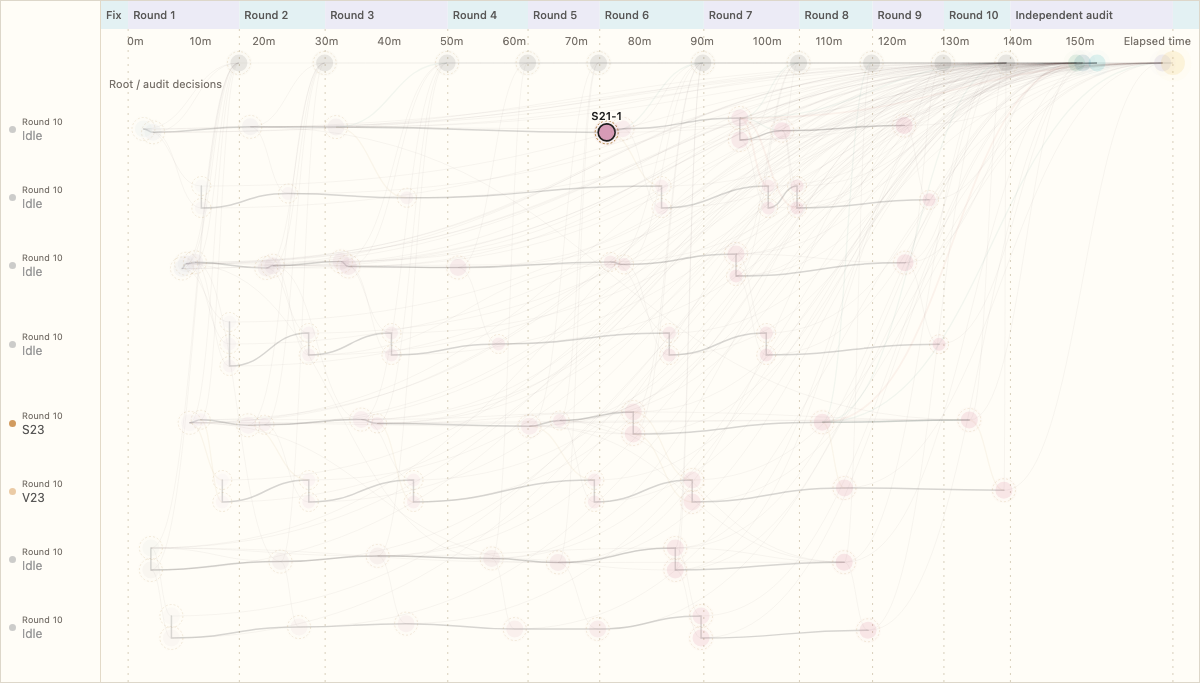
Figure 7. S21-1. Step6. Inverse construction survives challenge
Established in Attempt 2 · stated scope
The complete S1-3 theorem holds under its stated hypotheses: with B=432 and c_*=1/55296, $$ M_n=n+\lfloor c_* n/\log n\rfloor,\qquad p_n(M_n)\longrightarrow1, \qquad\inf_{1\le m\le M_n}p_n(m)\longrightarrow1. $$ The original rank-free bound Pr{max_j(R_Z)_jj>B ell/m}<=4m^2 exp(-a ell) for iid (m-k) by m signs and 2k<=ell<=m is valid. The finite iid failure bound q_(n+1)+4nm^2 exp(-a ell)+nm exp[-(1-eta)/(2eta)] and its distinct-law conditioning are valid. No critical issue was found. At full row rank, trace R_i=k forces any uniform diagonal majorant eta>=k/m, so the displayed Hoeffding union-bound term is at least nm exp[-n/(2k)] and cannot vanish at any fixed k/n->epsilon>0. This limitation does not imply failure of the construction or network infeasibility and leaves exact capacity and sharpness open.
Proof
- Check scope and gate. I read the complete immutable S1-3 unit, verified its exchange node equals its return node, and read the full V1-3 report before dependent use. I also read S1-1, its V1-1 check, inherited [[three-round-paired:S5-2]], its [[three-round-paired:V5-2]] check, the primary Tikhomirov Theorem A on printed pp.593–594, and
drafts/round-5.md. This unit audits the complete original S1-3 argument independently of any new same-round solver unit. Its disposition is holds, with no critical mathematical issue found. It does not adopt the other claims in the round-five draft as audited inputs.
- Hanson–Wright convention. Rudelson–Vershynin, Hanson-Wright inequality and sub-gaussian concentration, October 1, 2013, p.1 defines the moment norm used in Theorem 1.1, p.2. For a Rademacher variable, sup_{p>=1} p^{-1/2}(E|xi|^p)^{1/p}=1. Thus K=1 is valid. If P is an orthogonal rank-d projector, E z^TPz=d, ||P||=1, and ||P||_F^2=d. At deviation d/2, the theorem gives Pr{||Pz||^2<d/2}<=2 exp(-c_HW d/4), exactly as stated. The event has a strict deviation, so no atom-at-threshold issue arises. The choice a=min(c_HW/8,1) is sufficient for every subsequent comparison.
- Rank-free projected dimension and conditional inputs. For the claimed Z of size (m-k) by m, assumptions k>=1 and 2k<=ell<=m imply ell>=2. For fixed j, groups G have L=ell-1>=1 elements, with q=floor((m-1)/L)>=1. The projector P is determined only by the m-ell outside columns. Regardless of rank, d=rank P>=(m-k)-(m-ell)=ell-k>=ell/2. The inside columns remain independent iid signs under conditioning on the outside columns. A deficient outside matrix increases d. Hence no exceptional rank event is omitted from the kernel estimate.
- Every net constant. Conditional on the outside columns, Euclidean 1/4-nets in range P and R^L have at most 9^d and 9^L points, respectively. They may be selected separately for each conditioning outcome; the sign sample space is finite. For fixed unit u,v the bilinear form u^T PZ_G v=u^TZ_Gv is a linear sum of independent signs with squared coefficient sum 1. The cosh bound gives a two-sided tail 2 exp(-t^2/2). At t=3 sqrt(d+L), the union over net pairs is at most
$$2\exp[-(9/2-\log9)(d+L)]\le2e^{-2(d+L)}.$$
For M=PZ_G, its image lies in range P. The exact two-term telescoping expansion between unit u,v and their net points has error at most ||M||/2, proving ||M||<=2 max_net|u^TMv|. Thus ||PZ_G||<=6 sqrt(d+L), with the stated failure. Since d+L>=ell/2+ell-1>=ell and a<=1, that failure is <=2 exp(-a ell). The single-column lower failure is also <=2 exp(-a ell), since d>=ell/2.
- Uniform kernel quantifier and the number 432. There are m q<=m^2 predetermined pairs (j,G). On the single event where both bounds hold for every pair, fix any unit v in ker Z. Projection of Zv=0 gives Pz_j v_j+PZ_G v_G=0. Therefore
$$|v_j|^2\le\frac{36(d+L)}{d/2}\|v_G\|^2\le216\|v_G\|^2,$$
because L/d<=2. For the disjoint groups, at least one has mass at most 1/q. Since floor x>=x/2 for x>=1,
$$1/q\le2(\ell-1)/(m-1)\le2\ell/m,$$
where the last inequality is exactly ell<=m. This proves |v_j|^2<=432 ell/m for all j and all unit v simultaneously. The later selection of a small-mass block is valid because the matrix event already contains every block. Finally the diagonal of the orthogonal kernel projector is sup_{unit v in ker Z}|v_j|^2. The exceptional probability is <=4m^2 exp(-a ell). The kernel is nonzero here because k>=1, but the claimed zero-kernel convention would also be valid. No codimension-one theorem or random-rotation premise is used.
- Constant-row normalization at every rank. For an iid n by m sign matrix Z, put D=diag(Z_{n,1},...,Z_{n,m}). Conditional on its last row, the other entries of ZD are independent fair signs with a law independent of that row, and its last row equals 1. Thus ZD has exactly the law of H_i=U_{-i}. Since D is orthogonal, ker(ZD)=D ker Z, and its orthogonal projector is D R_Z D. Its diagonal agrees with R_Z at every rank. Applying the kernel bound to each marginal H_i, with n=m-k rows, and taking a union over i gives 4nm^2 exp(-a ell). This transformation need not be coupled simultaneously across all H_i. In the actual original sample, y_i is independent of H_i; marginal normalization does not replace this fact or introduce a false joint independence assertion.
- Rank source and prefix rank. For m=n+k and k>=1, the first n+1 augmented columns exist. Their square matrix is the normalized iid-sign law, hence singular with probability q_{n+1}. If rank U<n+1 then this square prefix is singular, proving the rank exception bound without a row-deletion factor n. Tikhomirov, Singularity of random Bernoulli matrices, Annals of Mathematics 191 (2020), Theorem A, printed pp.593–594, applies to square iid Bernoulli(p), fixed p in (0,1/2], shift s in [-1,0], and all positive t once dimension is sufficiently large for fixed p,epsilon. With p=1/2, s=-1/2, twice the shifted matrix is iid sign. Letting t decrease to zero gives q_d<=(1/2+epsilon)^d for sufficiently large d, matching the inherited checked unit. Thus q_{n+1}->0. If any H_i has rank<n, adjoining y_i cannot produce full (n+1)-row rank; there is no additional uncovered deletion-rank event.
- Exact original-model fields. On full row rank, Q=(UU^T)^{-1} is symmetric positive definite and each H_i has full row rank. Schur complement gives
$$Q_{ii}=(y_i^TR_i y_i)^{-1}>0,\qquad (QU)_{i\mu}=Q_{ii}(R_i y_i)_\mu.$$
For off-diagonal A_ij=-Q_ij, A_ii=0, h_i=-Q_i,n+1, we have (As^mu+h)_i=Q_ii s_i^mu-(QU)_i,mu. Multiplying by s_i^mu yields the displayed margin Q_ii[1-s_i^mu(R_i y_i)_mu]. Take J=A directly. Thus the construction preserves symmetry, has exactly zero diagonal, uses only allowed free biases, and controls every prescribed spin by a strict positive margin when every residual product is <1.
- Tail conditioning and the exact failure union. Define R_i as the orthogonal projector at every rank and G_i={max_mu(R_i)_mu,mu<=eta}. It depends only on H_i. Because 1 is in row(H_i), q=(R_i)_mu,mu<=1-1/m<1. Conditional on H_i and s_i^mu,
$$s_i^\mu(R_i y_i)_\mu=q+T,\quad T=\sum_{\nu\ne\mu}(R_i)_{\mu\nu}s_i^\mu s_i^\nu,\quad \sum_{\nu\ne\mu}(R_i)_{\mu\nu}^2=q(1-q).$$
The remaining signs are independent. At q>0, Chernoff with parameter 1/q yields Pr{T>=1-q|H_i,s_i^mu}<=exp[-(1-q)/(2q)]; at q=0 its projector row is zero, so the event is impossible. This bound is established without conditioning on rank U or the intersection of all G_j. Since the tail function increases in q, Pr(G_i intersect {residual_i,mu>=1})<=exp[-(1-eta)/(2eta)]. Undefined-or-failed construction is contained in the union of rank failure, any G_i complement, and these nm individual intersections. This gives precisely
$$q_{n+1}+4nm^2e^{-a\ell}+nm e^{-(1-\eta)/(2\eta)}.$$
Ties are included among failures. No dependence across neurons or patterns has been ignored.
- Asymptotic constants. With B=432, c_*=1/(128B)=1/55296, k=floor(c_* n/log n), m=n+k and ell=2k+ceil((8/a)log m), eventually ell<=4c_*n/log n<=m, m<=2n, and eta=B ell/m<=1/(32 log n). The additive term O(log n) is negligible compared with n/log n for every fixed a>0. The unknown Hanson–Wright constant affects the onset in n, and does not invalidate the explicit c_*. We have a ell>=8log m, giving the coherence exception <=4n m^{-6}; the tail exception is <=2 exp(1/2)n^{-14}. Both vanish, as does q_{n+1}. Every displayed arithmetic constant in the original unit survives this check.
- Sampling, monotonicity and exact target scope. For iid columns, collision probability is <=binom(m,2)2^{-n}. Conditional on no collision, forgetting order gives exactly the uniform distinct-subset law; dividing the iid failure bound by 1-binom(m,2)2^{-n} is valid whenever positive and tends to no loss for m=O(n). Selecting a uniform smaller subset of a uniform M_n-subset gives the exact smaller subset law, and the same weights store it. Thus the infimum over all 1<=m<=M_n tends to one. Since M_n/n->1, this proves the lower bound 1 and a growing excess window, and no fixed-alpha improvement, exact capacity, sharp threshold, or decision on 1.6. On full rank trace R_i=m-n=k. Hence any uniform diagonal majorant eta obeys eta>=k/m; the corresponding union-bound term satisfies
$$nm e^{-(1-\eta)/(2\eta)}\ge nm e^{-n/(2k)}.$$
At k/n->epsilon>0 this cannot tend to zero. This is a rigorous obstruction to that particular sufficient bound, not evidence that the inverse ansatz or the full network fails. The draft's lower-bound section retains the correct scope; the draft's other routes are outside this check.
- Independent finite algebra check and disposition. My standard-library Fraction script
scripts/S21/challenge_r6.pyexhausts all 256 iid 2 by 4 sign matrices: ranks 1 and 2 occur 32 and 224 times, and projector conjugacy under normalization holds for every matrix. Exhausting the 256 spin samples with n=2,m=4 gives 168 augmented full-row-rank samples, 1344 exact signed-margin/Boolean-conversion checks, and 2048 all-rank projector variance checks, all passing. These are finite exact checks and do not prove an asymptotic theorem. Combined with the complete analytic argument above, they leave no critical issue in S1-3. The present conclusion is a fresh scoped challenge verdict, not the run's final independent all-step audit and not a solution of the original capacity problem.
Sources
Rudelson–Vershynin, Theorem 1.1, p. 2: independent centered signs; projector rank controls the quadratic-form norms.
Tikhomirov, Theorem A, pp. 593–594: use p=1/2, scalar shift−1/2, then let the least-singular-value parameter decrease to0.
In the attempt tree
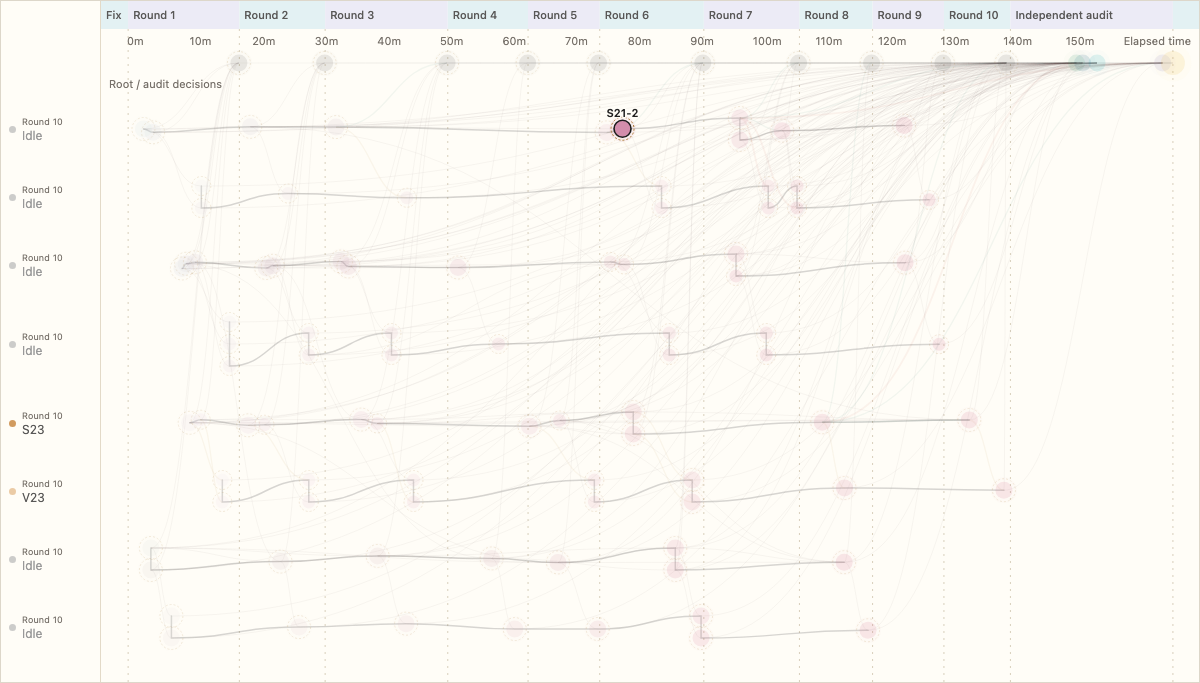
Figure 8. S21-2. - Check scope and gate. I read the complete immutable S1-3 unit, verified its exchange node equals its return node, and read the full V1-3 report before dependent use. I also read S1-1, its V1-1 check, inherited [[three-round-paired:S5-2]], its [[three-round-paired:V5-2]] check, the primary Tikhomirov Theorem A on printed pp.593–594, and
Step7. Weighted residual and spectral proxy limit
Attempt 2 · as-written claim; audit finding retained
As-written audit finding: As written this complete batch is erroneous at bodyStep9: weight-rule equivariance is asserted necessary for the raw construction event to descend to an unordered set. A positive data/order-dependent scalar D=c(S)I makes Q_D=Q_I/c(S), preserving every margin sign and undefined/failure event while violating equivariance. All displayed weighted residual, conditional tail and spectral results remain true: independently checked oblique orientation, Schur transpose, positive-diagonal endpoints, exact cosh law under off-row coefficient measurability, weighted variance, row-conditional union, diagonal similarity and eigenvalue/Frobenius lower bound. Independently reproduced48 residual/spectral,192 variance,504 full-rank weight pairs,4032 margins/conversions. Existing complete replacementS21-5 correctly separates event invariance from sufficient weight equivariance and proves arbitrary-ordered-rule nonstorage transfer. Its scalar witness and144 sample/permutation cases independently reproduce. The preserved provisional precheck initially overlooked this one sentence; detection occurred when readingS21-5, before any paired V21 report. The final grade records the original error, not a retroactive first-pass discovery. Existing correction: S21-5.
Let U=[S;1^T], let D=diag(w_mu)>0, and on rank U=n+1 put Q=(UDU^T)^{-1}, J=-offdiag(Q) on the real-neuron block, h_i=-Q_i,n+1. For H_i=U_{-i}, define P_i=proj ker(H_iD^{1/2}) at every rank and M_i=D^{-1/2}P_iD^{1/2}. Then the exact original-model signed margins are $$ s_i^\mu((Js^\mu)_i+h_i)=Q_{ii}[1-s_i^\mu(M_i y_i)_\mu]. $$ With iid sign rows and independent external randomness R, if M_i is measurable with respect to F_{-i}=sigma(R,y_j:j!=i), in particular if D is, set p_i,mu=(M_i)_mu,mu<1 and v_i,mu=sum_{nu!=mu}(M_i)_mu,nu^2. The conditional residual failure probability is at most the exact product-cosh Chernoff expression, and at most exp[-(1-p_i,mu)^2/(2v_i,mu)] when v_i,mu>0; at v=0 it is zero. Thus the all-coordinate iid failure probability is at most Pr(rank U<n+1)+sum_i,mu E b_i,mu, where rho_i,mu=v_i,mu/(1-p_i,mu)^2 and b_i,mu=exp[-1/(2rho_i,mu)] with b=0 at rho=0.
For any H containing a constant row, with rank r in [1,m-1], and every positive D, these same deterministic residual objects obey $$ \sum_{\mu=1}^m\frac{v_\mu}{(1-p_\mu)^2}\ge\frac{m(m-r)}r, \qquad\max_\mu\frac{v_\mu}{(1-p_\mu)^2}\ge\frac{m-r}r. $$ Consequently, at m=n+k>n, the quadratic-moment upper-bound expression satisfies sum_i,mu b_i,mu>=n exp[-n/(2k)], pointwise for every positive common D. It cannot tend to zero at any fixed k/n->epsilon>0. This is an obstruction only to that sufficient bound, not a lower bound on actual failure or network infeasibility.
Recorded argument — superseded where identified
- Objects and original network. Let S be an n by m sign matrix, U=[S;1^T], and D=diag(w_1,...,w_m) with every w_mu>0. Assume rank U=n+1 only when defining Q=(UDU^T)^{-1}. Set J_ij=-Q_ij for distinct real-neuron indices, J_ii=0, h_i=-Q_i,n+1. The matrix J is symmetric with zero diagonal and field Js+h. Positive weights preserve rank: rank(UDU^T)=rank U, whether or not D was selected adaptively.
- The correct weighted residual at every rank. Write y_i=(s_i^1,...,s_i^m)^T and H_i=U_{-i}. Define P_i to be the orthogonal projector onto ker(H_i D^{1/2}), at every rank, and put
$$M_i=D^{-1/2}P_iD^{1/2},\qquad p_{i\mu}=(P_i)_{\mu\mu}=(M_i)_{\mu\mu}.$$
This M_i is generally an oblique, rather than orthogonal, projector. When H_i has full row rank,
$$P_i=I-D^{1/2}H_i^T(H_iDH_i^T)^{-1}H_iD^{1/2},$$ $$M_i=I-H_i^T(H_iDH_i^T)^{-1}H_iD.$$
The constant row guarantees P_i sqrt(w)=0, hence M_i1=0 and
$$0\le p_{i\mu}\le1-\frac{w_\mu}{\sum_\nu w_\nu}<1.$$
This bound is valid at every rank because the rowspace of H_i D^{1/2} contains sqrt(w).
- Schur complement gives the exact signed margins. On full rank U, every H_i has full row rank. Block inversion gives
$$Q_{ii}=\left[y_i^TD^{1/2}P_iD^{1/2}y_i\right]^{-1}>0,$$ $$Q_{i,-i}=-Q_{ii}y_i^TDH_i^T(H_iDH_i^T)^{-1},$$ $$(QU)_{i\mu}=Q_{ii}(M_i y_i)_\mu.$$
The last formula follows by transposing the entire inverse row: y_i^T[I-DH_i^T(H_iDH_i^T)^{-1}H_i]=(M_i y_i)^T. Therefore every original signed spin field is
$$s_i^\mu((Js^\mu)_i+h_i) =Q_{ii}\left[1-s_i^\mu(M_i y_i)_\mu\right].$$
Thus this weighted ansatz succeeds strictly if and only if all nm residual products are <1. A residual tie at one is a failure. No stability condition is imposed on the auxiliary coordinate.
- Valid leave-one-row-out conditional tail. Now suppose S has iid Rademacher entries and R is independent external randomness, if used. Put F_{-i}=sigma(R,y_j:j!=i). If M_i is F_{-i}-measurable, the following conditional estimate is valid; a sufficient condition is that D itself is F_{-i}-measurable. Conditional on F_{-i} and additionally on s_i^mu,
$$s_i^\mu(M_i y_i)_\mu=p_{i\mu}+T_{i\mu},\qquad T_{i\mu}=\sum_{\nu\ne\mu}(M_i)_{\mu\nu}s_i^\mu s_i^\nu.$$
The signs in the sum are conditionally independent. Its exact conditional moment generating function is the product of coshes, since cosh is even. With
$$v_{i\mu}=\sum_{\nu\ne\mu}(M_i)_{\mu\nu}^{,2} =\sum_{\nu\ne\mu}\frac{w_\nu}{w_\mu}(P_i)_{\mu\nu}^{,2},$$
Chernoff gives
$$\Pr\{s_i^\mu(M_i y_i)_\mu\ge1\mid F_{-i}\} \le\inf_{\theta>0}e^{-\theta(1-p_{i\mu})} \prod_{\nu\ne\mu}\cosh\!\left(\theta(M_i)_{\mu\nu}\right) \le\exp\!\left[-\frac{(1-p_{i\mu})^2}{2v_{i\mu}}\right]$$
when v_{i,mu}>0. The last inequality uses cosh t<=exp(t^2/2) and minimizes at theta=(1-p)/v. If v=0, M_i1=0 forces p=0, the residual product is zero, and its failure probability is zero. No rank-U or global good event is imposed in this conditioning.
- Variance is not the unweighted projector variance. Idempotence of P_i gives sum_{nu!=mu}(P_i)_mu,nu^2=p(1-p), but the variance for M_i is weighted. In particular,
$$\frac{w_{\min}}{w_\mu}p(1-p) \le v_{i\mu}\le\frac{w_{\max}}{w_\mu}p(1-p).$$
If kappa=w_max/w_min and p<=eta<1, the displayed quadratic-moment bound is at most exp[-(1-eta)/(2 kappa eta)]. Replacing v by p(1-p) for a nonconstant D is not justified. The exact product-cosh bound in Step 4 may be strictly better than its quadratic relaxation.
- Finite all-neuron estimate with correct conditioning. Suppose each induced M_i is F_{-i}-measurable. Define
$$\rho_{i\mu}=\frac{v_{i\mu}}{(1-p_{i\mu})^2},\qquad b_{i\mu}=\begin{cases}e^{-1/(2\rho_{i\mu})},&\rho_{i\mu}>0,\\0,&\rho_{i\mu}=0.\end{cases}$$
All these objects are well-defined even at deficient rank. Undefined-or-failed construction is contained in rank-U failure and the union of the nm residual failure events. Integrating the individual row-conditional bounds, then taking one union bound, yields
$$\Pr_{\rm iid}\{\text{undefined or failed weighted ansatz}\} \le\Pr\{\operatorname{rank}U<n+1\}+\sum_{i,\mu}\mathbb E b_{i\mu}.$$
An individual F_{-i}-measurable good-event indicator may be inserted before integration. Conditioning on a global event involving the target row is not permitted by this proof. No neuron independence is assumed.
- A spectral constraint valid for every positive weighting. Fix any real H with a constant row, rank r in [1,m-1], and positive D; write P=proj ker(HD^{1/2}), M=D^{-1/2}PD^{1/2}, p_mu=P_mu,mu, v_mu=sum_{nu!=mu}M_mu,nu^2, and k=m-r. Then
$$\boxed{\quad\sum_{\mu=1}^m\frac{v_\mu}{(1-p_\mu)^2}\ge\frac{km}{r}, \qquad\max_\mu\frac{v_\mu}{(1-p_\mu)^2}\ge\frac{k}{r}.\quad}$$
To prove this, let C=diag(1-p_mu), define A=C^{-1}(M-diag p), and T=diag(sqrt(w_mu(1-p_mu))). The matrix B=TAT^{-1} is symmetric, with zero diagonal and entries
$$B_{\mu\nu}=\frac{P_{\mu\nu}}{\sqrt{(1-p_\mu)(1-p_\nu)}}\quad(\mu\ne\nu),$$ $$B=C^{-1/2}(P-\operatorname{diag}p)C^{-1/2},\qquad I-B=C^{-1/2}(I-P)C^{-1/2}.$$
The last matrix is positive semidefinite with rank r. Hence B has exactly k eigenvalues equal to one. Its remaining r real eigenvalues sum to -k, since tr B=0. Their squared sum is at least k^2/r by Cauchy–Schwarz. Thus
$$\|B\|_F^2\ge k+k^2/r=km/r.$$
Because B=TAT^{-1}, for every unordered pair of distinct coordinates,
$$A_{\mu\nu}^2+A_{\nu\mu}^2 =B_{\mu\nu}^2\left[(T_{\nu\nu}/T_{\mu\mu})^2 +(T_{\mu\mu}/T_{\nu\nu})^2\right]\ge2B_{\mu\nu}^2.$$
The diagonal entries are zero, so ||A||_F^2>=||B||_F^2. The squared norm of row mu of A is exactly v_mu/(1-p_mu)^2, proving both inequalities. This argument is deterministic and requires no row-measurability assumption on D.
- What the constraint rules out, and what it leaves open. At m=n+k with k>=1, any H_i has a constant row and rank r_i<=n<m. Step 7 gives some coordinate with rho_i,mu>=(m-r_i)/r_i>=k/n. Consequently the quadratic-moment numbers themselves satisfy, pointwise for every positive D,
$$\sum_{i,\mu}b_{i\mu}\ge n\exp[-n/(2k)].$$
At k/n->epsilon>0 this expression cannot tend to zero. Even a condition-number-free, coordinatewise use of the exact weighted variance followed by a sum of these Hoeffding bounds cannot prove all-coordinate success at fixed excess. This is a lower bound on the upper-bound expression, not on actual failure probability. It neither proves failure of the weighted inverse construction nor network infeasibility. The exact product-cosh estimate, a valid analysis of target-row-dependent weights, or a different joint-residual argument remain possible; none is established here at fixed epsilon.
- Distinct sampling and finite checks. For m=O(n), iid collision probability is at most delta=binom(m,2)2^{-n}. Conditional on no collisions, ordered patterns have the exact uniform distinct law. Any order-invariant construction or storage guarantee transfers by dividing an iid failure upper bound by at most 1-delta; a pattern-weight rule must transform equivariantly under relabeling for its raw construction event to be treated as a function of the unordered sample. Independently of that issue, nonstorage itself is order invariant and is contained in weighted-ansatz failure whenever the ansatz is defined. My Fraction script
scripts/S21/weighted_r7.pychecks 48 weighted residual matrices (all 16 possible other rows at n=2,m=4 and three positive weight profiles), 192 variance identities/bounds, all 48 spectral constraints, and 4032 exact signed-margin/Boolean-conversion identities on 504 full-rank sample/weight pairs. All assertions pass. These finite checks support the algebra; Steps 1–8 prove the general statements. No new proportional-capacity or sharpness result is asserted.
Sources
The recorded argument is self-contained; its exact dependencies remain linked.
In the attempt tree
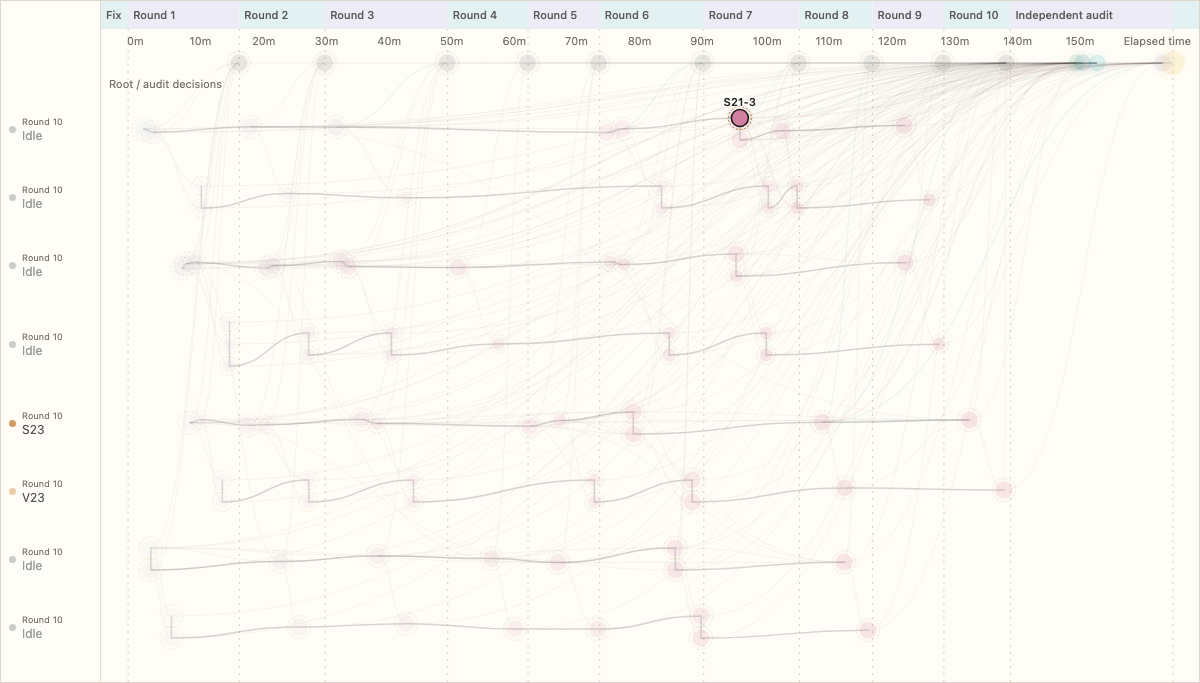
Figure 9. S21-3. Step8. Common weights constrain conditioning
Established in Attempt 2 · stated scope
For independent uniform sign rows Y_1,...,Y_n with full product support and independent external randomness R, $$ \bigcap_{i=1}^n\sigma(R,Y_j:j\ne i)=\sigma(R)\quad\text{modulo null sets}. $$ Thus a common positive diagonal D measurable off every tested row is a function of R alone, and the same conclusion holds for its normalized shape if that shape is what is measurable. Adaptive scalar multiplication is an explicit harmless exception to the stronger, false claim that D-measurability itself is necessary: D=c(S)D_0 induces the same residuals and margin signs as D_0.
The claimed independent-sign tail after conditioning on general adaptive weights is false. At n=2,m=3 let D(Y)=diag(2 if Y_nu=1 else 1). Conditional on H=[(1,1,-1);(1,1,1)] and D=diag(2,1,2), the tested row is deterministically Y=(1,-1,1). The augmented matrix has full rank and distinct columns. Its weighted residual in coordinate 2 has p=2/3, v=4/9 and signed value 4/3; hence its conditional failure probability is 1, contradicting the invalid value exp[-(1-p)^2/(2v)]=exp(-1/8)<1. This refutes only the conditional-tail prescription, not the weighted family or original-network feasibility.
Proof
- Precise product-sigma-field statement. Let Y_1,...,Y_n be independent random rows, each uniform on the full sign cube {−1,1}^m, and let R be independent external randomness. Complete all sigma fields with respect to this product law. For n>=2,
$$\bigcap_{i=1}^n\sigma(R,Y_j:j\ne i)=\sigma(R)\quad\text{modulo null sets}.$$
In particular, a common positive diagonal D measurable with respect to every leave-one-row-out field must equal a function D_0(R) almost surely. With no external random seed, D is almost surely deterministic. This claim concerns a product iid row law before distinctness conditioning.
- Proof, including null sets and unbounded weights. First take a bounded random variable f measurable with respect to every field on the left. For each i, choose a version f_i(R,Y_{-i}) equal to f almost surely. There are only finitely many full row configurations, each with positive probability under the product law. By independence of R, equality almost surely implies that, outside one null set of R-values, every full row configuration satisfies f(r,y)=f_i(r,y_{-i}) for every i. Thus changing any one row leaves f(r,y) unchanged. Any two full configurations can be joined by n such one-row changes, so f(r,y)=g(r). Hence f is sigma(R)-measurable modulo null sets. The reverse inclusion is immediate. For each finite positive diagonal entry of D apply this result to the bounded one-to-one transform w/(1+w), then invert the transform; there are finitely many entries, so the common null set remains null. This proves the matrix claim with no integrability assumption.
- Normalized shape, and the correct limitation of this obstruction. Multiplying D by any positive scalar c multiplies (UDU^T)^{-1} by c^{-1}, preserving every strict margin sign. Therefore data-adaptive scaling of a deterministic shape is harmless: D=c(S)D_0 can fail to be leave-one-row-out measurable while inducing exactly the same weighted residual matrices and signs as D_0. If the normalized shape D/tr D is itself required to be measurable off every row, the theorem forces that shape to depend only on R. This excludes nontrivial common shape adaptation under that sufficient measurability prescription. It does not show that measurability of D is necessary for a correct tail: the induced residual coefficients may be measurable even if D is not, as the scalar example demonstrates. It also does not exclude a different decoupling proof for genuinely adaptive coefficients.
- Why conditioning on an adaptive common D is not a repair. Consider the original allowed dimensions n=2,m=3. Let the tested first row be Y=(Y_1,Y_2,Y_3), let the other row be Z, and define one common positive pattern matrix
$$D(Y)=\operatorname{diag}(w_1,w_2,w_3),\qquad w_\nu=\begin{cases}2,&Y_\nu=1,\\1,&Y_\nu=-1.\end{cases}$$
This rule observes the tested row, and D reveals all three of its signs. Conditional on the positive-probability event Z=(1,1,-1) and D=diag(2,1,2), we know Y=(1,-1,1) exactly. Thus the tested row is not iid Rademacher under this conditioning. The augmented U has full rank and its three patterns are distinct on this event.
- An exact numerical violation of the invalid conditional tail. Put H=[Z;1^T]. In the first two coordinates H has identical columns. Weighted regression of Y onto the rowspace of H therefore fits their weighted mean (2·1+1·(-1))/3=1/3, and fits the third coordinate exactly. Its residual is
$$M Y=(2/3,-4/3,0)^T,\qquad M=I-H^T(HDH^T)^{-1}HD.$$
In coordinate mu=2, M_22=2/3 and M_21=-2/3, with no other off-diagonal coefficient. Hence
$$Y_2(MY)_2=4/3,\qquad p=2/3,\qquad v=4/9,$$ $$\Pr\{Y_2(MY)_2\ge1\mid H,D=\operatorname{diag}(2,1,2)\}=1.$$
The incorrectly transplanted independent-sign bound would be
$$\exp[-(1-p)^2/(2v)]=e^{-1/8}<1,$$
an explicit contradiction. Directly, UDU^T has first row (5,-1,3), the full matrix is [[5,-1,3],[-1,5,1],[3,1,5]], and its inverse has first row (3/8,1/8,-1/4). The tested ansatz margin in coordinate 2 is -1/8=(3/8)(1-4/3), confirming that the residual calculation corresponds to the stated original-model inverse ansatz. This single sample is only a counterexample to the conditional-tail prescription, not a capacity theorem.
- What remains available. An independent random D, a deterministic D, or coefficient matrices actually measurable off each tested row admit the usual conditional sign calculation. A common D selected using all rows generally does not. Separate row-specific weights can be individually leave-one-out measurable, but inverses built with different D_i have no automatic shared-edge identity Q^{(i)}_{ij}=Q^{(j)}_{ji}; assembling them needs a new symmetry and margin argument. Uniform distinct sampling does not restore a product row law: prove an iid guarantee first and transfer by the collision bound binom(m,2)2^{-n}, rather than asserting conditional independence after deleting repeats. The product-sigma-field result and the explicit counterexample are the proved obstruction here; no weighted-family infeasibility or original-network infeasibility is inferred.
- Exact check and remaining target. The independent Fraction script
scripts/S21/weighted_r7.pyverifies full augmented rank, p=2/3, v=4/9, signed residual 4/3 and exponent 1/8 for the displayed adaptive example. The general intersection theorem is proved by Steps 1–2, rather than inferred from finite enumeration. A fixed-epsilon lower bound would still require a new valid analysis of genuinely adaptive weights, or a different sufficient certificate overcoming the all-coordinate problem while preserving symmetry, free biases and zero self-interactions. This unit determines no exact capacity, threshold sharpness, or status of 1.6.
Sources
The recorded argument is self-contained; its exact dependencies remain linked.
In the attempt tree
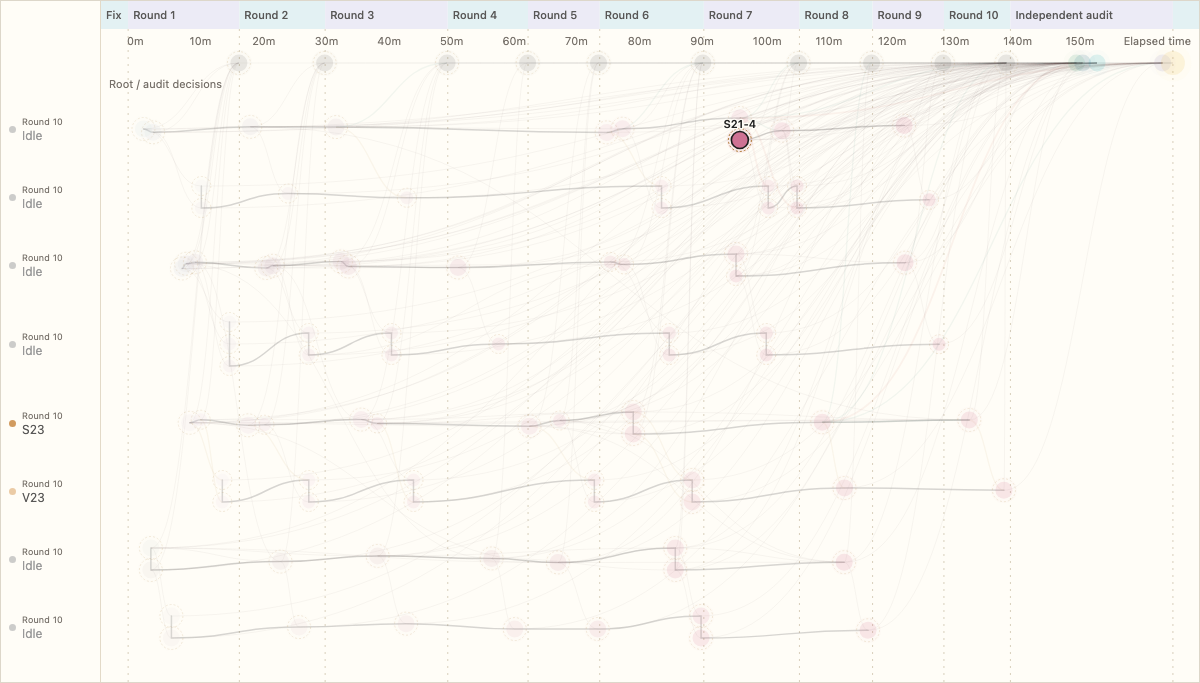
Figure 10. S21-4. Step9. Weighted theorem with correct sampling
Established in Attempt 2 · stated scope
Let U=[S;1^T], D=diag(w_mu)>0, and, on rank U=n+1, Q=(UDU^T)^{-1}, J=-offdiag(Q) on the real-neuron block, h_i=-Q_i,n+1. Put H_i=U_{-i}, P_i=proj ker(H_iD^{1/2}) at every rank, M_i=D^{-1/2}P_iD^{1/2}, and y_i=(s_i^1,...,s_i^m)^T. Then every original signed margin is $$ s_i^\mu((Js^\mu)_i+h_i)=Q_{ii}[1-s_i^\mu(M_i y_i)_\mu]. $$ For iid sign rows and independent external randomness R, if M_i is measurable with respect to F_{-i}=sigma(R,y_j:j!=i), the conditional residual failure probability is bounded by the exact product-cosh Chernoff expression and by exp[-(1-p_i,mu)^2/(2v_i,mu)] for v_i,mu>0, where $$ p_{i\mu}=(M_i)_{\mu\mu}<1,\qquad v_{i\mu}=\sum_{\nu\ne\mu}(M_i)_{\mu\nu}^2 =\sum_{\nu\ne\mu}\frac{w_\nu}{w_\mu}(P_i)_{\mu\nu}^2. $$ At v=0 the failure probability is zero. If all M_i have that measurability, Pr_iid(undefined or failed ansatz)<=Pr(rank U<n+1)+sum_i,mu E b_i,mu, with rho_i,mu=v_i,mu/(1-p_i,mu)^2 and b_i,mu=exp[-1/(2rho_i,mu)] at rho>0, b=0 at rho=0.
For every real H containing a constant row, rank r in [1,m-1], and every positive D, its corresponding residuals obey $$ \sum_\mu\frac{v_\mu}{(1-p_\mu)^2}\ge\frac{m(m-r)}r,\qquad \max_\mu\frac{v_\mu}{(1-p_\mu)^2}\ge\frac{m-r}r. $$ Thus at m=n+k>n the pointwise quadratic-proxy sum is at least n exp[-n/(2k)] and cannot vanish at fixed k/n->epsilon>0. This only obstructs that sufficient bound.
A raw construction event descends to unordered distinct samples exactly when that event is permutation invariant. Weight-rule equivariance is sufficient, not necessary: the nonequivariant rule D(S)=c(S)I with c(S)=2 if s_1^1=+1 and 1 otherwise preserves exactly the unweighted raw success/failure event by positive scaling. Irrespective of raw-event invariance, genuine nonstorage is invariant and contained in undefined-or-failed ansatz for every ordered weight choice. Consequently any valid iid ansatz-failure bound epsilon implies $$ 1-p_n(m)\le\frac{\epsilon}{1-\binom m2 2^{-n}} $$ when the denominator is positive. No fixed-excess capacity, ansatz infeasibility or original-network infeasibility conclusion is asserted.
Proof
- Objects and original network. Let S be an n by m sign matrix, U=[S;1^T], and D=diag(w_1,...,w_m) with every w_mu>0. Assume rank U=n+1 only when defining Q=(UDU^T)^{-1}. Set J_ij=-Q_ij for distinct real-neuron indices, J_ii=0, h_i=-Q_i,n+1. The matrix J is symmetric with zero diagonal and field Js+h. Positive weights preserve rank: rank(UDU^T)=rank U, whether or not D was selected adaptively.
- The correct weighted residual at every rank. Write y_i=(s_i^1,...,s_i^m)^T and H_i=U_{-i}. Define P_i to be the orthogonal projector onto ker(H_i D^{1/2}), at every rank, and put
$$M_i=D^{-1/2}P_iD^{1/2},\qquad p_{i\mu}=(P_i)_{\mu\mu}=(M_i)_{\mu\mu}.$$
This M_i is generally an oblique, rather than orthogonal, projector. When H_i has full row rank,
$$P_i=I-D^{1/2}H_i^T(H_iDH_i^T)^{-1}H_iD^{1/2},$$ $$M_i=I-H_i^T(H_iDH_i^T)^{-1}H_iD.$$
The constant row guarantees P_i sqrt(w)=0, hence M_i1=0 and
$$0\le p_{i\mu}\le1-\frac{w_\mu}{\sum_\nu w_\nu}<1.$$
This bound is valid at every rank because the rowspace of H_i D^{1/2} contains sqrt(w).
- Schur complement gives the exact signed margins. On full rank U, every H_i has full row rank. Block inversion gives
$$Q_{ii}=\left[y_i^TD^{1/2}P_iD^{1/2}y_i\right]^{-1}>0,$$ $$Q_{i,-i}=-Q_{ii}y_i^TDH_i^T(H_iDH_i^T)^{-1},$$ $$(QU)_{i\mu}=Q_{ii}(M_i y_i)_\mu.$$
The last formula follows by transposing the entire inverse row: y_i^T[I-DH_i^T(H_iDH_i^T)^{-1}H_i]=(M_i y_i)^T. Therefore every original signed spin field is
$$s_i^\mu((Js^\mu)_i+h_i) =Q_{ii}\left[1-s_i^\mu(M_i y_i)_\mu\right].$$
Thus this weighted ansatz succeeds strictly if and only if all nm residual products are <1. A residual tie at one is a failure. No stability condition is imposed on the auxiliary coordinate.
- Valid leave-one-row-out conditional tail. Now suppose S has iid Rademacher entries and R is independent external randomness, if used. Put F_{-i}=sigma(R,y_j:j!=i). If M_i is F_{-i}-measurable, the following conditional estimate is valid; a sufficient condition is that D itself is F_{-i}-measurable. Conditional on F_{-i} and additionally on s_i^mu,
$$s_i^\mu(M_i y_i)_\mu=p_{i\mu}+T_{i\mu},\qquad T_{i\mu}=\sum_{\nu\ne\mu}(M_i)_{\mu\nu}s_i^\mu s_i^\nu.$$
The signs in the sum are conditionally independent. Its exact conditional moment generating function is the product of coshes, since cosh is even. With
$$v_{i\mu}=\sum_{\nu\ne\mu}(M_i)_{\mu\nu}^2 =\sum_{\nu\ne\mu}\frac{w_\nu}{w_\mu}(P_i)_{\mu\nu}^2,$$
Chernoff gives
$$\Pr\{s_i^\mu(M_i y_i)_\mu\ge1\mid F_{-i}\} \le\inf_{\theta>0}e^{-\theta(1-p_{i\mu})} \prod_{\nu\ne\mu}\cosh\!\left(\theta(M_i)_{\mu\nu}\right) \le\exp\!\left[-\frac{(1-p_{i\mu})^2}{2v_{i\mu}}\right]$$
when v_{i,mu}>0. The last inequality uses cosh t<=exp(t^2/2) and minimizes at theta=(1-p)/v. If v=0, M_i1=0 forces p=0, the residual product is zero, and its failure probability is zero. No rank-U or global good event is imposed in this conditioning.
- Variance is not the unweighted projector variance. Idempotence of P_i gives sum_{nu!=mu}(P_i)_mu,nu^2=p(1-p), but the variance for M_i is weighted. In particular,
$$\frac{w_{\min}}{w_\mu}p(1-p) \le v_{i\mu}\le\frac{w_{\max}}{w_\mu}p(1-p).$$
If kappa=w_max/w_min and p<=eta<1, the displayed quadratic-moment bound is at most exp[-(1-eta)/(2 kappa eta)]. Replacing v by p(1-p) for a nonconstant D is not justified. The exact product-cosh bound in Step 4 may be strictly better than its quadratic relaxation.
- Finite all-neuron estimate with correct conditioning. Suppose each induced M_i is F_{-i}-measurable. Define
$$\rho_{i\mu}=\frac{v_{i\mu}}{(1-p_{i\mu})^2},\qquad b_{i\mu}=\begin{cases}e^{-1/(2\rho_{i\mu})},&\rho_{i\mu}>0,\\0,&\rho_{i\mu}=0.\end{cases}$$
All these objects are well-defined even at deficient rank. Undefined-or-failed construction is contained in rank-U failure and the union of the nm residual failure events. Integrating the individual row-conditional bounds, then taking one union bound, yields
$$\Pr_{\rm iid}\{\text{undefined or failed weighted ansatz}\} \le\Pr\{\operatorname{rank}U<n+1\}+\sum_{i,\mu}\mathbb E b_{i\mu}.$$
An individual F_{-i}-measurable good-event indicator may be inserted before integration. Conditioning on a global event involving the target row is not permitted by this proof. No neuron independence is assumed.
- A spectral constraint valid for every positive weighting. Fix any real H with a constant row, rank r in [1,m-1], and positive D; write P=proj ker(HD^{1/2}), M=D^{-1/2}PD^{1/2}, p_mu=P_mu,mu, v_mu=sum_{nu!=mu}M_mu,nu^2, and k=m-r. Then
$$\boxed{\quad\sum_{\mu=1}^m\frac{v_\mu}{(1-p_\mu)^2}\ge\frac{km}{r}, \qquad\max_\mu\frac{v_\mu}{(1-p_\mu)^2}\ge\frac{k}{r}.\quad}$$
To prove this, let C=diag(1-p_mu), define A=C^{-1}(M-diag p), and T=diag(sqrt(w_mu(1-p_mu))). The matrix B=TAT^{-1} is symmetric, with zero diagonal and entries
$$B_{\mu\nu}=\frac{P_{\mu\nu}}{\sqrt{(1-p_\mu)(1-p_\nu)}}\quad(\mu\ne\nu),$$ $$B=C^{-1/2}(P-\operatorname{diag}p)C^{-1/2},\qquad I-B=C^{-1/2}(I-P)C^{-1/2}.$$
The last matrix is positive semidefinite with rank r. Hence B has exactly k eigenvalues equal to one. Its remaining r real eigenvalues sum to -k, since tr B=0. Their squared sum is at least k^2/r by Cauchy–Schwarz. Thus
$$\|B\|_F^2\ge k+k^2/r=km/r.$$
Because B=TAT^{-1}, for every unordered pair of distinct coordinates,
$$A_{\mu\nu}^2+A_{\nu\mu}^2 =B_{\mu\nu}^2\left[(T_{\nu\nu}/T_{\mu\mu})^2 +(T_{\mu\mu}/T_{\nu\nu})^2\right]\ge2B_{\mu\nu}^2.$$
The diagonal entries are zero, so ||A||_F^2>=||B||_F^2. The squared norm of row mu of A is exactly v_mu/(1-p_mu)^2, proving both inequalities. This argument is deterministic and requires no row-measurability assumption on D.
- What the constraint rules out, and what it leaves open. At m=n+k with k>=1, any H_i has a constant row and rank r_i<=n<m. Step 7 gives some coordinate with rho_i,mu>=(m-r_i)/r_i>=k/n. Consequently the quadratic-moment numbers themselves satisfy, pointwise for every positive D,
$$\sum_{i,\mu}b_{i\mu}\ge n\exp[-n/(2k)].$$
At k/n->epsilon>0 this expression cannot tend to zero. Even a condition-number-free, coordinatewise use of the exact weighted variance followed by a sum of these Hoeffding bounds cannot prove all-coordinate success at fixed excess. This is a lower bound on the upper-bound expression, not on actual failure probability. It neither proves failure of the weighted inverse construction nor network infeasibility. The exact product-cosh estimate, a valid analysis of target-row-dependent weights, or a different joint-residual argument remain possible; none is established here at fixed epsilon.
- Correct raw-event sampling condition and its sufficient weight rule. Write S^pi=S Pi for a column-permutation matrix Pi. A raw construction event E on ordered distinct samples can be viewed as an event on unordered subsets exactly when its indicator is permutation invariant: E(S Pi)=E(S) for every Pi (with the external seed fixed, if one is used). This raw-event invariance is the relevant condition. Equivariance of the weight rule,
$$D(S\Pi)=\Pi^T D(S)\Pi,$$
is sufficient, but is not necessary. For sufficiency, U(S Pi)=U(S)Pi, so
$$U(S\Pi)D(S\Pi)U(S\Pi)^T=U(S)D(S)U(S)^T.$$
Thus Q, J and h are unchanged when defined, rank failure is unchanged, and the list of signed margins is merely permuted. The success and undefined-or-failed events are consequently invariant. Conversely, to define a raw event on the unordered set its value must agree on all orderings of that set; this is necessity of event invariance, not necessity of weight-rule equivariance.
- V21's scalar counterexample to necessity, with proof. Define, for every S,
$$c(S)=\begin{cases}2,&s_1^1=1,\\1,&s_1^1=-1,\end{cases} \qquad D(S)=c(S)I_m.$$
On full augmented rank, positive homogeneity gives
$$Q_{D(S)}=\left[c(S)UU^T\right]^{-1} =c(S)^{-1}(UU^T)^{-1}.$$
Every extracted coupling, bias and signed margin is multiplied by the same positive scalar c(S)^{-1}; its sign is therefore exactly the unweighted sign. Rank deficiency is also unchanged. Since UU^T is invariant under column permutations, the raw success and undefined-or-failed events equal the unweighted invariant events for all samples. Nevertheless, with
$$S=\begin{pmatrix}1&-1&1\\1&1&-1\end{pmatrix},$$
whose augmented U has determinant 4, swapping the first two columns changes c(S) from 2 to 1. Hence D(S Pi)=I_3 while Pi^T D(S)Pi=2I_3. The rule is not equivariant, and its raw construction event is invariant. This is precisely the counterexample supplied by V21; it refutes the earlier necessity clause without changing any weighted margin, conditional-tail or spectral formula. The same scalar invariance is included in the already-checked S21-4.
- Exact distinct-law transfer, including arbitrary ordered weight rules. Let C be the no-collision event for iid columns and put
$$\delta=\binom m2 2^{-n},\qquad \Pr(C)\ge1-\delta.$$
Conditional on C, all ordered distinct lists are uniform, and forgetting order gives a uniform distinct m-subset. If a raw failure event F is permutation invariant, its conditional probability is the failure probability of the corresponding unordered-sample construction, and any iid bound Pr(F)<=epsilon gives Pr(F|C)<=epsilon/(1-delta) when delta<1. This transfer statement requires invariance of F; equivariance of D is only one sufficient way to get it.
A weaker storage-law transfer needs neither raw-event invariance nor weight-rule equivariance. Let N be genuine nonstorage of all patterns in the ordered sample. This event is invariant and does not depend on the chosen positive weighting or on external randomness. For every ordered choice of weights, N is contained in the undefined-or-failed weighted-ansatz event F: a defined successful ansatz is one of the allowed storing networks. Therefore, for any positive ordered weighting rule and every valid iid bound Pr(F)<=epsilon,
$$1-p_n(m)=\Pr_{\rm iid}(N\mid C) \le\frac{\Pr_{\rm iid}(F\cap C)}{\Pr(C)} \le\frac{\epsilon}{1-\delta}\qquad(\delta<1).$$
This remains true if F itself depends on the ordering, because the containment holds for each ordering separately. At m=O(n), delta tends to zero. It does not justify applying conditional iid-row tails after conditioning on C or on a target-row-dependent D.
- Checked conditioning scope and existing exact checks. I read the entire S21-4 unit and its no-issue V21-4 report before using its qualified conditioning conclusion. Its product-sigma-field theorem concerns the iid full-support product law: a common D measurable off every row depends only on independent external randomness. Adaptive scalar scaling is harmless because it leaves the induced residuals and margin signs unchanged, as proved again in Step 10. Its full-rank three-pattern example demonstrates that conditioning on a general adaptive D can reveal the tested row and invalidate an independent-sign tail. These statements hold in their checked limited scope, so on[S21-4]=holds. The self-contained derivations in Steps 1–8 do not adopt the failed S21-3 as a premise.
The unchanged solver script
scripts/S21/weighted_r7.pypreviously checked 48 weighted residual matrices, 192 variance identities/bounds, all 48 spectral constraints, and 4032 exact signed-margin/Boolean identities on 504 full-rank sample/weight pairs. The full V21 round-seven report independently reproduced those counts. V21's immutable scalar-counterexample artifact reports 144 exact full-rank n=2,m=3 sample/permutation checks. I read that artifact and its script and did not rerun or alter either; the universal scaling proof is Step 10, not an inference from enumeration. These finite results support the algebra and do not establish a capacity asymptotic.- Exact replacement scope and notation. This is a complete corrected replacement for S21-3, linked only through corrects and on rather than by a parent dependency. It retains every valid displayed weighted-margin, all-rank residual, conditional-tail, finite-union and spectral-proxy conclusion, and replaces the false weight-equivariance necessity with Steps 9–11. The two malformed superscripts
^{,2}in the earlier variance display are replaced here by ordinary squares^2; they denote the squared residual and projector entries and introduce no new quantity or mathematical change. Original units, returns, scripts and reports remain unchanged. The bound in Step 8 still concerns an upper-bound expression, not actual ansatz failure or network infeasibility. Fixed-positive-excess success, exact capacity, a sharp threshold and the suggested value 1.6 remain unresolved.
Sources
Rudelson–Vershynin, Theorem 1.1, p. 2: independent centered signs; projector rank controls the quadratic-form norms.
In the attempt tree
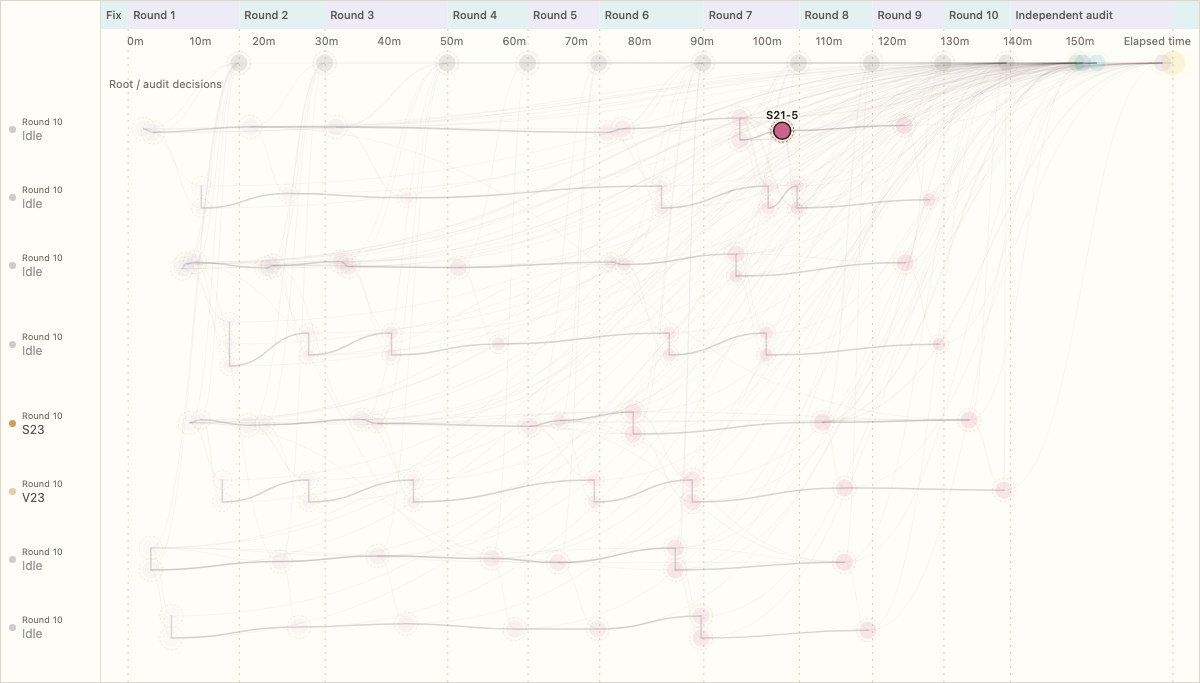
Figure 11. S21-5. Step10. Ridge retains the spectral proxy barrier
Established in Attempt 2 · stated scope
For any n by m sign matrix S, D=diag(w_mu)>0 and lambda>0, the ridge inverse Q=(UDU^T+lambda I)^{-1}, U=[S;1^T], exists at every augmented rank. Set J_ij=-Q_ij off the neuron diagonal, J_ii=0, h_i=-Q_i,n+1. For H_i=U_{-i}, define $$ L_i=D^{1/2}H_i^T(H_iDH_i^T+\lambda I)^{-1}H_iD^{1/2},\quad P_i=I-L_i,\quad M_i=D^{-1/2}P_iD^{1/2}. $$ The complement L_i is a positive contraction with rank r_i=rank H_i; P_i is positive definite, generally nonprojective. The constant row gives c_i,mu=(L_i)_mu,mu in (0,1). With p_i,mu=1-c_i,mu and A_i=diag(c_i,mu)^{-1}(M_i-diag p_i,mu), every exact original signed field is $$ s_i^\mu((Js^\mu)_i+h_i) =Q_{ii}[1-s_i^\mu(M_i y_i)_\mu] =Q_{ii}c_{i\mu}[1-s_i^\mu(A_i y_i)_\mu]. $$ If the induced normalized A_i is measurable off the tested iid neuron row, with independent external randomness allowed, the conditional residual failure probability is bounded by $$ \inf_{\theta>0}e^{-\theta}\prod_{\nu\ne\mu}\cosh(\theta(A_i)_{\mu\nu}) \le b_{i\mu},\quad \rho_{i\mu}=\sum_{\nu\ne\mu}(A_i)_{\mu\nu}^2, $$ where b_i,mu=exp[-1/(2rho_i,mu)] for rho>0 and b=0 at rho=0. If every A_i meets that measurability, Pr_iid(ridge ansatz fails)<=sum_i,mu E b_i,mu, with no rank exception. A sufficient parameter condition is that the common pair (D,lambda) is measurable off the tested row; this is not claimed necessary.
For every symmetric positive semidefinite contraction L of rank r in [1,m] with positive diagonal c, and every positive D, the normalized A constructed as above is diagonally similar to the symmetric zero-diagonal matrix $$ B=I-\operatorname{diag}(c)^{-1/2}L\operatorname{diag}(c)^{-1/2}. $$ Thus tr B=0, I-B is positive semidefinite of rank r, and $$ \sum_\mu\rho_\mu\ge\frac{m(m-r)}r,\qquad \max_\mu\rho_\mu\ge\frac{m-r}r. $$ Consequently at m=n+k>n, for every positive D and lambda and every sample, $$ \sum_{i,\mu}b_{i\mu}\ge n\exp[-n/(2k)]. $$ The quadratic-moment coordinate union estimate cannot vanish at fixed k/n->epsilon>0. This is not a lower bound on actual failure and proves neither ridge/weighted-family failure nor full-network infeasibility. The exact product-cosh, joint and valid adaptive analyses remain open. Any valid unconditional iid failure upper bound transfers to distinct-subset nonstorage through division by 1-binom(m,2)2^{-n} when positive, without unnecessary weight-rule equivariance.
Proof
- Scope and checked inputs. I reread the complete canonical problem, recomputed its matching SHA256, and recorded the round-nine full-read acknowledgment before mathematical work. I read the entire corrected S21-5 and its no-issue V21-5 report, and S21-4 and its no-issue V21-4 report. The present complete batch derives the ridge case directly: it uses neither the failed S21-3 as a premise nor any unchecked same-round claim. Its conclusion is a limitation of a specified sufficient upper-bound expression, not actual ridge-network failure or a solution of the original capacity problem.
- A ridge inverse exists at every augmented rank. Let S be any n by m sign matrix, U=[S;1^T], D=diag(w_1,...,w_m)>0 and lambda>0, all finite. Define
$$Q=(UDU^T+\lambda I_{n+1})^{-1},\qquad J_{ij}=-Q_{ij}\ (i\ne j\le n),\quad J_{ii}=0,\quad h_i=-Q_{i,n+1}.$$
The covariance plus ridge is positive definite for every S, so Q is symmetric positive definite without any rank assumption on U. The spin field is represented directly by J,h:
The displayed J,h define the spin field directly.
Thus the construction uses one shared symmetric matrix, has exactly zero self-interactions, and has unrestricted neuron biases. The auxiliary coordinate has no stability requirement. These pointwise facts hold even when the common D and lambda depend on S.
- The ridge residual and its low-rank complement. For neuron i write y_i=(s_i^1,...,s_i^m)^T, H_i=U_{-i}, and define
$$K_i=H_iDH_i^T+\lambda I_n,\qquad X_i=H_iD^{1/2},$$ $$L_i=X_i^T(X_iX_i^T+\lambda I_n)^{-1}X_i,\qquad P_i=I_m-L_i,\qquad M_i=D^{-1/2}P_iD^{1/2}.$$
The matrix L_i is a positive semidefinite contraction of rank r_i=rank H_i. It has eigenvalues sigma^2/(sigma^2+lambda) on the nonzero singular directions of X_i, and zero on ker X_i. Hence 0<=L_i<I, and P_i is positive definite with
$$P_i=\lambda(X_i^TX_i+\lambda I_m)^{-1},\qquad 0<P_i\le I.$$
The inverse identity follows by multiplying I-X_i^T(X_iX_i^T+lambda I)^{-1}X_i by X_i^TX_i+lambda I; the product is lambda I. None of these statements requires independent rows or full rank. The residual itself has rank m and is generally not a projector; its complement L_i, rather than P_i, retains rank r_i.
- The constant row supplies exactly the needed positive diagonal. Let
$$c_{i\mu}=(L_i)_{\mu\mu},\qquad p_{i\mu}=(P_i)_{\mu\mu}=(M_i)_{\mu\mu}=1-c_{i\mu}.$$
If h_{i\mu} is column mu of H_i, then
$$c_{i\mu}=w_\mu h_{i\mu}^TK_i^{-1}h_{i\mu}.$$
The auxiliary all-one row makes every h_{i,mu} nonzero. Since K_i is positive definite, c_i,mu>0; since P_i is positive definite, c_i,mu<1. Thus both c and p lie in (0,1) for every finite positive lambda and every sample. In particular, the normalization by c below is always defined. Here 1<=r_i<=min(n,m). For a general H without a constant row the same conclusion requires every column nonzero; a zero column gives c_mu=0 and must be excluded from the normalized statement. The actual network ensemble has no such zero column.
- Exact all-pattern margins by Schur complement, including deficient U. The blocks of UDU^T+lambda I in row i and the other indices give the positive Schur complement
$$\beta_i=\lambda+y_i^TDy_i-y_i^TDH_i^TK_i^{-1}H_iDy_i =\lambda+y_i^TD^{1/2}P_iD^{1/2}y_i>0.$$
Block inversion yields
$$Q_{ii}=\beta_i^{-1}>0,\qquad Q_{i,-i}=-Q_{ii}y_i^TDH_i^TK_i^{-1},$$ $$(QU)_{i\mu}=Q_{ii}(M_i y_i)_\mu,\qquad M_i=I-H_i^TK_i^{-1}H_iD.$$
The transpose orientation in the last identity follows from y_i^T[I-DH_i^TK_i^{-1}H_i]=(M_i y_i)^T. Removing the neuron diagonal gives, for every i,mu,
$$s_i^\mu((Js^\mu)_i+h_i) =Q_{ii}[1-s_i^\mu(M_i y_i)_\mu].$$
This is an equality at every augmented rank, rather than a conditional identity on an invertibility event for U.
- Normalized coefficients give the exact strict criterion. Let C_i=diag(c_i,mu) and define the zero-diagonal matrix
$$A_i=C_i^{-1}\bigl(M_i-\operatorname{diag}(p_{i\mu})\bigr).$$
Because the diagonal sign square is one,
$$s_i^\mu((Js^\mu)_i+h_i) =Q_{ii}c_{i\mu}\left[1-s_i^\mu(A_i y_i)_\mu\right].$$
The prefactor is positive. Strict storage by the ridge ansatz is therefore equivalent to all nm normalized residual products being <1. Equality at one is counted as failure. Put
$$v_{i\mu}=\sum_{\nu\ne\mu}(M_i)_{\mu\nu}^2 =\sum_{\nu\ne\mu}\frac{w_\nu}{w_\mu}(P_i)_{\mu\nu}^2, \qquad\rho_{i\mu}=\sum_{\nu\ne\mu}(A_i)_{\mu\nu}^2 =\frac{v_{i\mu}}{c_{i\mu}^2}.$$
- Ridge boundary cases cannot be copied from the projector argument. Since P_i is a positive contraction, P_i^2<=P_i, and
$$\sum_{\nu\ne\mu}(P_i)_{\mu\nu}^2 =(P_i^2)_{\mu\mu}-p_{i\mu}^2\le p_{i\mu}(1-p_{i\mu}).$$
Equality is no longer automatic. Also M_i H_i^T=lambda H_i^TK_i^{-1}; if e_a selects the constant row of H_i, then
$$M_i1_m=\lambda H_i^TK_i^{-1}e_a,$$
which generally is nonzero because the auxiliary coordinate is also ridge-penalized. Zero off-diagonal variance need not force p=0. For example H=[[1,-1],[1,1]], D=I_2 and lambda=1 give M=P=I_2/3, with v=0, p=1/3 and M1=1/3. At v=0 the normalized row of A is zero, so its failure probability is zero simply because the residual product equals p<1. This treats the endpoint without an incorrect M1=0 inference. The assumption lambda>0 is essential to the no-rank-exception construction: at lambda=0 the original inverse can fail to exist, and the already-checked unregularized theorem applies only under its own full-rank hypotheses. At m<=n the ridge construction is still defined, but no positive-excess barrier is asserted.
- The exact conditional tail and its sufficient measurability. Now take iid sign rows and independent external randomness R. For each i let F_{-i}=sigma(R,y_j:j!=i). Assume the induced normalized matrix A_i is F_{-i}-measurable; it suffices that M_i is, and in particular that the pair (D,lambda) is. Conditional on F_{-i} and then on s_i^mu, the variable
$$Z_{i\mu}=s_i^\mu(A_i y_i)_\mu =\sum_{\nu\ne\mu}(A_i)_{\mu\nu}s_i^\mu s_i^\nu$$
is a sum of independent centered signs with fixed coefficients. Its conditional moment generating function is exactly the product of coshes. Evenness removes dependence on the additionally fixed target sign. Consequently
$$\Pr\{Z_{i\mu}\ge1\mid F_{-i}\} \le\inf_{\theta>0}e^{-\theta} \prod_{\nu\ne\mu}\cosh\!\left(\theta(A_i)_{\mu\nu}\right) \le b_{i\mu},$$ $$b_{i\mu}=\begin{cases} \exp[-1/(2\rho_{i\mu})],&\rho_{i\mu}>0,\\ 0,&\rho_{i\mu}=0. \end{cases}$$
The second bound follows from cosh t<=exp(t^2/2) and minimization at theta=1/rho; at rho=0, Z=0. If M_i itself is measurable, the equivalent unnormalized bound is exp[-(1-p)^2/(2v)] at v>0. Measurability of A_i alone is enough even if the positive prefactor Q_ii c_i,mu is target-row-dependent. No conditioning on a global success, rank, or other-neuron good event is used. The bounds are not valid merely because a target-row-dependent D or lambda has been conditioned on.
- A rank-free all-neuron probability estimate. Let F be failure of this ridge ansatz, with a tie included. The construction is always defined for positive D,lambda, and Step 6 gives
$$F=\bigcup_{i,\mu}\{Z_{i\mu}\ge1\}.$$
When every A_i has the above row measurability, integrating each conditional estimate and taking one union gives
$$\Pr_{\rm iid}(F)\le\sum_{i,\mu}\mathbb E b_{i\mu}.$$
There is no augmented-rank exception. Different neurons and patterns are not declared independent. Individual F_{-i}-measurable event indicators may be inserted before integration, but an all-neuron event generally depends on the target row and cannot be added to the conditioning without a new proof.
- The proposed positive-contraction geometry is valid. More generally, let L be any symmetric positive semidefinite contraction with rank r in [1,m], and assume every diagonal c_mu=L_mu,mu>0. Put P=I-L, M=D^{-1/2}PD^{1/2}, C=diag(c_mu), A=C^{-1}(M-diag(1-c_mu)), and T=diag(sqrt(w_mu c_mu)). Direct cancellation gives the symmetric zero-diagonal matrix
$$B=TAT^{-1}=I-C^{-1/2}LC^{-1/2},\qquad B_{\mu\nu}=-\frac{L_{\mu\nu}}{\sqrt{c_\mu c_\nu}}\quad(\mu\ne\nu).$$
Thus tr B=0, and I-B is positive semidefinite of rank exactly r, even though P need not be a projector. This proves the precise proposed extension. In fact its spectral conclusion only uses positive semidefiniteness, rank and positive diagonal of L. The ridge matrix L_i in Step 3 meets all these hypotheses at every rank of H_i.
- The complete sum-rho inequality for contractions. Write k=m-r. The nullity of I-B is k, so B has exactly k eigenvalues equal to one. Its remaining r real eigenvalues sum to -k because tr B=0. Cauchy–Schwarz therefore gives
$$\|B\|_F^2\ge k+k^2/r=\frac{m(m-r)}r.$$
This includes r=m, when k=0 and the bound is the valid trivial zero bound. For each unordered pair of coordinates, B=TAT^{-1} and symmetry give
$$A_{\mu\nu}^2+A_{\nu\mu}^2 =B_{\mu\nu}^2\left[(T_{\nu\nu}/T_{\mu\mu})^2 +(T_{\mu\mu}/T_{\nu\nu})^2\right]\ge2B_{\mu\nu}^2.$$
Both matrices have zero diagonal. Consequently
$$\boxed{\quad \sum_{\mu=1}^m\rho_\mu=\|A\|_F^2 \ge\|B\|_F^2\ge\frac{m(m-r)}r,\qquad \max_\mu\rho_\mu\ge\frac{m-r}r.\quad}$$
Rank zero is excluded by the positive diagonal hypothesis. The actual constant-row matrices guarantee r_i>=1, so no denominator is zero. This is a deterministic inequality and does not assume parameter measurability or any random-matrix law.
- Exact probability scope of the obstruction. At m=n+k>n, r_i<=n<m for every sample, even a deficient one. Step 11 yields some coordinate for each neuron with rho_i,mu>=(m-r_i)/r_i>=k/n. Since exp[-1/(2rho)] increases in rho>0,
$$\sum_{i,\mu} b_{i\mu}\ge n\exp[-n/(2k)]$$
pointwise for every common positive D and lambda, including choices depending on all rows and on n. For fixed k/n->epsilon>0 this expression cannot tend to zero, and neither can its expectation. Therefore the valid coordinatewise quadratic-moment union estimate in Step 9 cannot establish all-coordinate success at such a fixed excess, for any ridge or weight choice to which its conditioning applies. If that conditioning does not apply, Step 9 is unavailable in the first place. This is a lower bound on the sufficient upper-bound expression, never on Pr(F). It proves neither failure of the ridge/weighted ansatz nor original-network infeasibility. Exact product-cosh estimates, joint residual arguments and correctly decoupled adaptive analyses remain open alternatives.
- Adaptive parameters and sampling retain the checked limited scope. The product-sigma-field conclusion of checked S21-4 applies to the common pair (D,lambda) if that pair is required to be measurable off every iid neuron row: bounded entrywise transforms show that it must then depend only on the external independent seed. That is merely a sufficient parameter prescription; the weaker induced-coefficient condition of Step 8 is what the proof actually uses. A joint positive scaling (D,lambda) -> (a(S)D,a(S)lambda) gives Q -> Q/a(S) and leaves M_i,A_i unchanged. Hence adaptive parameters need not themselves satisfy that sufficient prescription when the induced coefficients do. Scaling D alone at a fixed lambda instead changes the effective ratio lambda/a(S), so the unregularized scalar argument cannot simply be reused in that form.
For uniform distinct sampling let C be no iid collision, delta=binom(m,2)2^{-n}, and N true nonstorage. Conditional on C, forgetting order gives exactly the canonical uniform subset law. For every ordered positive parameter choice, N is contained in F. Thus any valid iid ridge-failure upper bound epsilon_n implies
$$1-p_n(m)=\Pr_{\rm iid}(N\mid C) \le\frac{\Pr_{\rm iid}(F)}{1-\delta} \le\frac{\epsilon_n}{1-\delta}\qquad(\delta<1).$$
This uses no unnecessary equivariance condition on the parameter rule, as in corrected S21-5. It transfers an unconditional iid bound; it does not assert iid rows after conditioning on distinctness or adaptive parameters. At m=O(n), delta tends to zero.
- Exact sanity checks and final scope. My standard-library Fraction script
scripts/S21/ridge_r9.pyexhausts all n=2 sign samples with m=1,2,3,4 against three positive weight profiles and lambda in {1/2,1,3}: 3060 sample/weight/ridge cases, including 1332 with deficient augmented rank. It verifies 22536 exact signed-margin, normalized-margin and Boolean-field identities. The 270 sign-other-row/weight/ridge case loops, representing 258 unique geometries because the three m=1 weight profiles coincide, satisfy the normalized-rank and spectral/Frobenius inequalities. All 882 exact conditional-sign distribution checks have mean zero and the stated variance. A further 99 rational polynomial-row cases, with deliberately redundant rows and ridge values 1/100,2,100, pass the same geometry checks. The displayed v=0,p=1/3 constant-row example is checked exactly. Every assertion passes. These finite calculations support the algebra; Steps 2–13 supply the general proof. This broader ridge family has the proposed spectral sufficient-bound barrier, but fixed-positive-excess success, exact capacity, sharpness and the proposed value 1.6 remain unresolved.
Sources
Rudelson–Vershynin, Theorem 1.1, p. 2: independent centered signs; projector rank controls the quadratic-form norms.
In the attempt tree
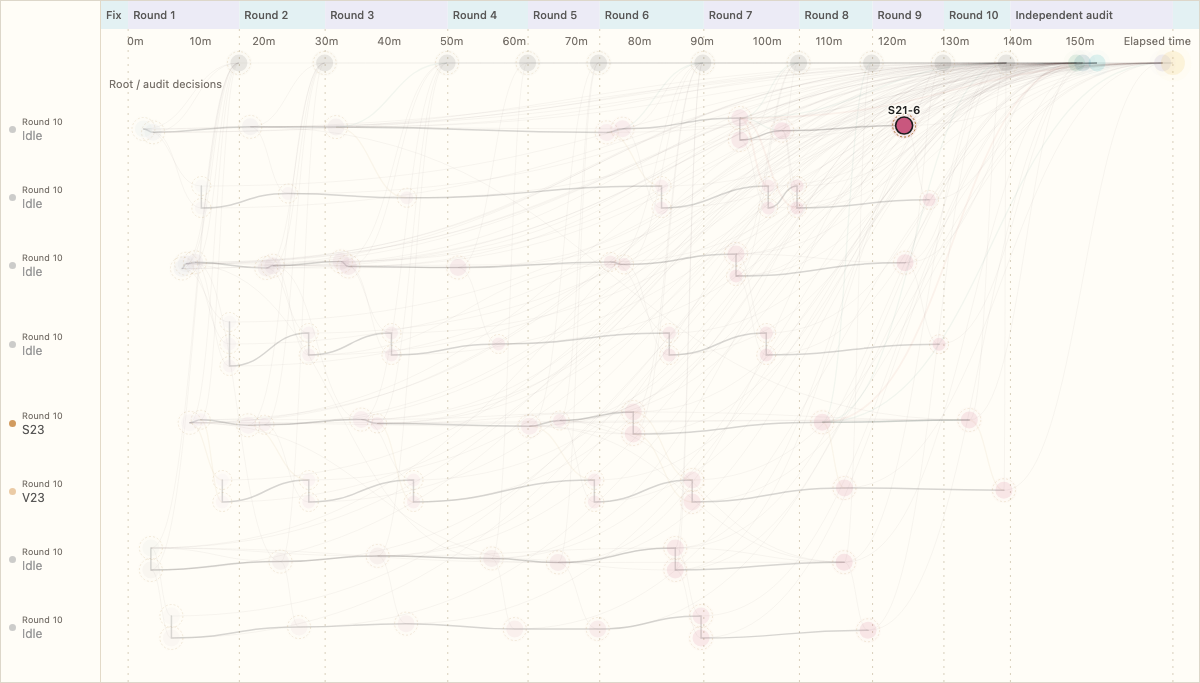
Figure 12. S21-6.
Earlier three-round supporting results
Q1. How does a projection produce a storing network?
Definitions
Definition 1. Spin network
For \(n\ge2\), \(J=J^\top\in\mathbb R^{n\times n}\), \(J_{ii}=0\), and \(h\in\mathbb R^n\). $$H_i(s)=\sum_{j\ne i}J_{ij}s_j+h_i,\qquad f_{J,h}(s)_i=\sigma(H_i(s)),\qquad\sigma(t)=\begin{cases}+1,&t>0,\\-1,&t\le0.\end{cases}$$ Strict storage requires \(s_iH_i(s)>0\) for every prescribed spin and neuron.
Definition 2. Storage probability
\(D\) is uniform among the \(m\)-element subsets of \(\{-1,1\}^n\). $$p_n(m)=\Pr\{D\text{ is storable}\}.$$
Definition 3. Capacity
$$\alpha_-=\sup\{a>0:p_n(\lfloor an\rfloor)\longrightarrow1\}.$$ This supremum does not assert a sharp threshold.
Definition 4. Two limiting endpoints
$$\alpha_-=\sup\{u>0:p_n(\lfloor un\rfloor)\to1\},\qquad \alpha_+=\inf\{a>0:p_n(\lfloor an\rfloor)\to0\}.$$ A sharp proportional threshold is equivalent to equality of these endpoints.
Definition 5. Spin patterns
\(s^\mu\in\{-1,1\}^n\), and \(S=[s^1\ \cdots\ s^m]\in\{-1,1\}^{n\times m}\).
Definition 6. Spin couplings
\(J=J^\top\in\mathbb R^{n\times n}\), \(J_{ii}=0\), and \(h\in\mathbb R^n\). Strict stability means \(s_i^\mu((Js^\mu)_i+h_i)>0\).
Definition 7. Augmented projection
$$U=\begin{bmatrix}S\\\mathbf1_m^\top\end{bmatrix},\qquad P=U(U^\top U)^{-1}U^\top$$ when \(U\) has column rank \(m\). Its last coordinate represents a free field.
Definition 8. Nonstorage certificate
The multipliers \(\lambda_i^\mu\ge0\) have total mass one and satisfy $$\sum_\mu\lambda_i^\mu s_i^\mu=0,\qquad \sum_\mu(\lambda_i^\mu+\lambda_j^\mu)s_i^\mu s_j^\mu=0\quad(i<j).$$ Their existence is equivalent to nonstorage.
Definition 9. First failure time
Uniformly order the entire spin cube and let \(\tau_n\) be the first prefix length that is not storable. $$p_n(m)=\Pr\{\tau_n>m\}.$$
Definition 10. Maximum storable subset
For a finite sample \(D\), $$L(D)=\max\{|E|:E\subseteq D\text{ is storable}\}.$$ Full storage is the event \(L(D)=|D|\).
Statement
Attempt 1 · supporting result in its stated scope
Projection construction and its random-sample consequence. Let \(1\le m\le n\), \(S=[s^1\ \cdots\ s^m]\in\{-1,1\}^{n\times m}\). Set \(U=[S^\top\ \mathbf1_m]^\top\in\mathbb R^{(n+1)\times m}\). If deleting any of its first \(n\) rows leaves column rank \(m\), define
$$P=U(U^\top U)^{-1}U^\top=\begin{pmatrix}B&h\\h^\top&c\end{pmatrix},\qquad J=B-\operatorname{diag}(B).$$
Then \(J\) is symmetric with zero diagonal, and
$$s_i^\mu((Js^\mu)_i+h_i)=1-P_{ii}>0\qquad(1\le i\le n,\ 1\le\mu\le m).$$
Thus one network stores every supplied pattern. For uniform distinct random patterns, the rank condition holds with probability tending to one at \(m=n\); consequently
$$p_n(n)\longrightarrow1,\qquad \alpha_-\ge1.$$
The construction's loss of strict margins beyond \(n\) does not imply nonstorage by other networks.
Proof and supporting results
Step 1. Projection stores row-deletion-full patterns
Established in Attempt 1 · stated scope
Let \(S=[s^1\ \cdots\ s^m]\in\{-1,1\}^{n\times m}\), where \(1\le m<n\). Suppose every matrix obtained by deleting one row has column rank \(m\). Then the spin patterns \(s^\mu\) admit symmetric zero-diagonal spin couplings and fields with every signed local field strictly positive.
Proof
- The hypothesis implies \(S\) has column rank \(m\). Set
$$ P=S(S^\top S)^{-1}S^\top,\qquad A=P-\operatorname{diag}(P_{11},\ldots,P_{nn}). $$ Thus \(P\) is the orthogonal projection onto \(\operatorname{col}(S)\), and \(A\) is symmetric with zero diagonal.
- Since \(P\) is an orthogonal projection, \(P_{ii}=\|Pe_i\|^2\le1\), with equality exactly when \(e_i\in\operatorname{col}(S)\). Such membership would give \(Sc=e_i\), so deleting row \(i\) gives \(S_{-i}c=0\), hence \(c=0\) and the contradiction \(Sc=e_i\). Consequently \(P_{ii}<1\) for every \(i\).
- Since \(Ps^\mu=s^\mu\),
$$ s_i^\mu(As^\mu)_i=1-P_{ii}>0 \qquad (i\in[n],\ \mu\in[m]). $$
- Take \(J=A\), \(h=0\). The displayed positive spin margins give simultaneous strict storage, with a symmetric zero-diagonal matrix; no threshold tie remains.
Sources
The derivation is self-contained; no external theorem is required.
In the attempt tree
Figure 22. S2-1. Step 2. Elementary Bernoulli rank estimate
Established in Attempt 1 · stated scope
If \(B\) is an \(r\times m\) matrix of independent uniform signs and \(1\le m\le r\), then $$ \Pr\{\operatorname{rank}B<m\}\le (2^m-1)2^{-r}. $$
Proof
- A real \(d\)-dimensional linear subspace \(L\subseteq\mathbb R^r\) contains at most \(2^d\) points of \(\{-1,1\}^r\): choose \(d\) coordinate functionals whose restrictions form a basis of \(L^*\). Their joint restriction is injective on \(L\), and each cube point maps into \(\{-1,1\}^d\). For \(d=0\) the same bound is immediate.
- Expose columns \(b^1,\ldots,b^m\) successively. Given the first \(j\) columns, their span has dimension at most \(j\), so independence and Step 1 give
$$ \Pr\{b^{j+1}\in\operatorname{span}(b^1,\ldots,b^j)\mid b^1,\ldots,b^j\}\le2^{j-r}. $$
- Rank deficiency implies that some column belongs to the span of its predecessors. A union bound yields
$$ \Pr\{\operatorname{rank}B<m\}\le\sum_{j=0}^{m-1}2^{j-r}=(2^m-1)2^{-r}. $$ No continuous-distribution or general-position hypothesis is used.
Sources
The derivation is self-contained; no external theorem is required.
In the attempt tree
Figure 23. S2-2. Step 3. Distinct sampling inherits iid success
Established in Attempt 1 · stated scope
For \(m\) independent uniform samples from \(\{-1,1\}^n\), let \(C\) be the event that they are all distinct. Then $$ \Pr(C^c)\le\delta_{n,m}:=\binom m2 2^{-n}. $$ If \(\delta_{n,m}<1\), and an order-invariant property fails with iid probability at most \(\varepsilon\), its failure probability for a uniform \(m\)-element subset is at most \(\varepsilon/(1-\delta_{n,m})\).
Proof
- Each fixed pair of independent uniform patterns agrees with probability \(2^{-n}\); a union bound over pairs proves the collision estimate.
- Conditional on \(C\), each ordered list of distinct cube points has the same probability. Every \(m\)-element subset has exactly \(m!\) such orderings, so forgetting order gives the uniform subset law.
- For an order-invariant success event \(E\),
$$ \Pr(E^c\mid C)=\frac{\Pr(E^c\cap C)}{\Pr(C)}\le\frac{\varepsilon}{1-\delta_{n,m}}. $$ This transfer needs no independence among neurons or among feasibility conditions.
Sources
The derivation is self-contained; no external theorem is required.
In the attempt tree
Figure 24. S2-3. Step 4. Simultaneous storage below dimension
Established in Attempt 1 · stated scope
Let \(1\le m<n\), and sample \(m\) independent uniform spin patterns in dimension \(n\). There is an explicit symmetric zero-diagonal construction whose probability of failing to store every pattern strictly is at most $$ \varepsilon_{n,m}=n(2^m-1)2^{-(n-1)}. $$
Proof
- Let \(S\in\{-1,1\}^{n\times m}\) be the spin-pattern matrix. For each fixed neuron \(i\), deleting row \(i\) leaves an \((n-1)\times m\) matrix with independent uniform sign entries. By S2-2,
$$ \Pr\{\operatorname{rank}(S_{-i})<m\}\le(2^m-1)2^{-(n-1)}. $$
- A union bound over \(i\in[n]\) gives
$$ \Pr\{\exists i:\operatorname{rank}(S_{-i})<m\}\le\varepsilon_{n,m}. $$ The events are allowed to depend arbitrarily on one another.
- Outside this exceptional event, S2-1 supplies the explicit weights
$$ P=S(S^\top S)^{-1}S^\top,\qquad A=P-\operatorname{diag}(P),\qquad J=A,\qquad h=0. $$ Every one of the \(nm\) spin signed local fields equals \(1-P_{ii}>0\). Thus all patterns are simultaneously stored, proving the failure bound.
- On the exceptional event the construction may be left undefined or replaced by any fixed zero-diagonal matrix; the bound states only that it succeeds outside that event. It makes no inference from construction failure to network infeasibility. Both cited reports were read and have no open issues.
Sources
The derivation is self-contained; no external theorem is required.
In the attempt tree
Figure 25. S2-4. Step 5. The symmetric capacity is at least one
Established in Attempt 1 · stated scope
For \(1\le m<n\) with \(\delta_{n,m}=\binom m2 2^{-n}<1\), $$ p_n(m)\ge1-\frac{n(2^m-1)2^{-(n-1)}}{1-\binom m2 2^{-n}}. $$ Consequently, for every fixed \(0<\alpha<1\), $$ \lim_{n\to\infty}p_n(\lfloor\alpha n\rfloor)=1, \qquad \alpha_-\ge1. $$ This does not determine the exact capacity or establish existence of a sharp threshold.
Proof
- The iid success event in S2-4 is order invariant: simultaneous full column rank after each row deletion, followed by the projection construction, is unchanged by column permutation. Its failure probability is at most \(\varepsilon_{n,m}=n(2^m-1)2^{-(n-1)}\).
- Apply S2-3 to this event. Conditional on distinct patterns, the unordered set has exactly the sampling distribution defining \(p_n(m)\). Whenever the construction succeeds the set is storable, so
$$ 1-p_n(m)\le\frac{\varepsilon_{n,m}}{1-\delta_{n,m}}. $$ This proves the finite bound for the specified symmetric, exactly zero-diagonal, arbitrary-bias network.
- Fix \(0<\alpha<1\) and let \(m=\lfloor\alpha n\rfloor\). Eventually \(1\le m<n\); moreover
$$ \delta_{n,m}\le\frac{\alpha^2n^2}{2}\,2^{-n}\longrightarrow0, \qquad \varepsilon_{n,m}\le2n\,2^{-(1-\alpha)n}\longrightarrow0. $$ The finite bound and \(p_n(m)\le1\) imply the asserted probability limit.
- Thus every \(\alpha\in(0,1)\) lies in the set whose supremum defines \(\alpha_-\), proving \(\alpha_-\ge1\). No conclusion at \(\alpha=1\) is required for this supremum inference.
- The exact remaining obligation for the team-level target is to analyze feasibility above this construction's range and to prove matching probability limits, if a sharp transition exists. When the pattern span becomes all of \(\mathbb R^n\), this projection equals \(I\) and the diagonal-deleted matrix vanishes; that only shows this construction fails and gives no infeasibility bound. In particular, this argument neither proves nor refutes the proposed value near 1.6. The cited paired reports contain no open issues.
Sources
The derivation is self-contained; no external theorem is required.
In the attempt tree
Figure 26. S2-5. Step 6. Bias augmentation gives strict projection
Established in Attempt 1 · stated scope
Let \(S=[s^1\ \cdots\ s^m]\in\{-1,1\}^{n\times m}\), \(1\le m\le n\), and let \(U=[S^\top\ \mathbf1_m]^\top\in\mathbb R^{(n+1)\times m}\). Suppose \(\operatorname{rank}U_{-i}=m\) for all neuron rows \(i\in[n]\). Set $$ P=U(U^\top U)^{-1}U^\top=\begin{pmatrix} B&h\\h^\top&c\end{pmatrix},\quad A=B-\operatorname{diag}(B). $$ Then \(A=A^\top\), \(A_{ii}=0\), and all spin signed margins are exactly $$ s_i^\mu((As^\mu)_i+h_i)=1-P_{ii}>0. $$
Proof
- Deleting any neuron row leaves rank \(m\), so \(U\) itself has full column rank and the displayed inverse exists. Thus \(P\) is the orthogonal projection onto \(\operatorname{col}U\). The constant last row is an auxiliary algebraic coordinate, not an extra neuron required to be stable.
- For every \(i\in[n]\), \(P_{ii}=\|Pe_i\|^2\le1\), with equality exactly when \(e_i\in\operatorname{col}U\). If \(Ua=e_i\), deleting neuron row \(i\) gives \(U_{-i}a=0\), hence \(a=0\), a contradiction. Therefore \(P_{ii}<1\) simultaneously for all real neurons; no condition on deletion of the constant row is needed.
- Since \(Pu^\mu=u^\mu\) for \(u^\mu=(s^\mu,1)\), its first \(n\) coordinates give \(Bs^\mu+h=s^\mu\). Subtracting the diagonal contribution gives
$$ s_i^\mu(As^\mu+h)_i=(s_i^\mu)^2(1-B_{ii})=1-P_{ii}>0. $$
- The principal block \(B\) is symmetric; hence \(A=B-\operatorname{diag}(B)\) is symmetric with zero diagonal. Take \(J=A\) and the extracted h. Its local field is \(As^\mu+h\), and Step 3 gives all nm positive margins. The auxiliary constant coordinate supplies unrestricted neuron fields.
Sources
The derivation is self-contained; no external theorem is required.
In the attempt tree
Figure 27. S5-1. Step 7. Normalized square signs stay nonsingular
Established in Attempt 1 · stated scope
Let \(M_d\) be a \(d\times d\) matrix of iid uniform signs, \(q_d=\Pr\{M_d\text{ singular}\}\), and let \(N_d\) have iid uniform signs in its first \(d-1\) rows and a final all-ones row. Then $$ \Pr\{N_d\text{ singular}\}=q_d. $$ For every fixed \(0<\varepsilon<1/2\), there exists \(d_\varepsilon\) such that $$ q_d\le(1/2+\varepsilon)^d\qquad(d\ge d_\varepsilon). $$
Proof
- Let \(r_\mu=(M_d)_{d\mu}\), and multiply column \(\mu\) of \(M_d\) by \(r_\mu\). The last row becomes all ones; the other entries become \((M_d)_{j\mu}r_\mu\), \(j<d\). Conditional on the entire last row, these \((d-1)d\) products are still independent uniform signs, and their conditional law does not depend on that row. Thus \(M_d\operatorname{diag}(r_1,\ldots,r_d)\) has exactly the law of \(N_d\). The diagonal multiplier is invertible, so their singularity probabilities agree.
- The local source is Konstantin Tikhomirov, “Singularity of random Bernoulli matrices”, Annals of Mathematics 191 (2020), 593–634, Theorem A, pp. 593–594. Its hypotheses are: fixed \(p\in(0,1/2]\), \(\varepsilon>0\), a square \(d\times d\) matrix \(B_d(p)\) with independent entries taking 1 with probability \(p\) and 0 otherwise, any shift \(a\in[-1,0]\), and \(d\ge d_{p,\varepsilon}\). Its estimate, with \(\sigma_{\min}\) the smallest singular value, is
$$ \Pr\{\sigma_{\min}(B_d(p)+a\mathbf1_d\mathbf1_d^\top)\le t/\sqrt d\} \le(1-p+\varepsilon)^d+C_{p,\varepsilon}t,\qquad t>0. $$
- Take \(p=1/2\) and \(a=-1/2\), both inside the stated ranges. The matrix
$$ M_d=2\bigl(B_d(1/2)-\tfrac12\mathbf1_d\mathbf1_d^\top\bigr) $$ has exactly iid uniform signs. Scaling by 2 multiplies \(\sigma_{\min}\) by 2 and preserves singularity. For fixed \(d\ge d_{1/2,\varepsilon}\), let \(t\downarrow0\) in Theorem A. Continuity from above of probability gives $$ q_d=\Pr\{\sigma_{\min}(B_d(1/2)-\tfrac12\mathbf1_d\mathbf1_d^\top)=0\} \le(1/2+\varepsilon)^d. $$ The source explicitly notes immediately after Theorem A that this substitution gives its equation (1), \(q_d=(1/2+o_d(1))^d\); only the displayed upper bound is needed here. In particular, choosing \(\varepsilon=1/4\) yields \(d q_d\to0\). No assertion of generic position is used.
Sources
In the attempt tree
Figure 28. S5-2. Step 8. Full augmented span makes projection zero
Established in Attempt 1 · stated scope
For \(U=[(s^1,1)\ \cdots\ (s^m,1)]\in\mathbb R^{(n+1)\times m}\), let \(P\) be the orthogonal projection onto \(\operatorname{col}U\). If \(\operatorname{rank}U=n+1\), then extracting the off-diagonal neuron block and the neuron-to-constant block gives zero weights and zero biases, hence zero signed margins. Moreover, the sufficient condition that every neuron-row deletion retain full column rank is impossible for \(m>n\). Neither fact implies that the patterns are unstorable by another network.
Proof
- Full row rank gives \(\operatorname{col}(U)=\mathbb R^{n+1}\), hence \(P=I_{n+1}\), \(B=I_n\), \(h=0\). The extraction \(J=A=B-\operatorname{diag}(B)\) therefore gives \(J=0,h=0\), with all strict margins zero.
- If \(m>n\), each deleted-neuron matrix has only \(n\) rows and therefore cannot have column rank \(m\). At \(m>n+1\), the inverse formula using \((U^\top U)^{-1}\) is unavailable, but the orthogonal projector still exists uniquely, so Step 1 still applies whenever the augmented span is full.
- The argument concerns only this particular projector and extraction rule. Storability allows every real symmetric zero-diagonal weight matrix and every bias vector, so failure of this rule does not imply infeasibility. In particular, a proposed fixed load above one cannot be excluded by this dimension calculation.
Sources
In the attempt tree
Figure 29. S5-3. Step 9. Distinct n-pattern samples store with high probability
Established in Attempt 1 · stated scope
Let \(q_n\) be the singularity probability of an iid \(n\times n\) uniform-sign matrix and \(\delta_n=\binom n2 2^{-n}\). For \(n\ge2\) with \(\delta_n<1\), $$ 1-p_n(n)\le\frac{nq_n}{1-\delta_n}. $$ Consequently, for each fixed \(0<\varepsilon<1/2\), for all sufficiently large \(n\), $$ 1-p_n(n)\le\frac{n(1/2+\varepsilon)^n}{1-\binom n2 2^{-n}}\longrightarrow0. $$
Proof
- Both parent reports were read before writing this node and contain no open issue. First sample \(n\) patterns iid uniformly from the spin cube, so their spin matrix \(S\in\{-1,1\}^{n\times n}\) has iid uniform-sign entries. Form \(U=[S;\mathbf1_n^\top]\). For each fixed neuron \(i\), deleting its row leaves an \(n\times n\) matrix whose first \(n-1\) rows are iid signs and whose last row is all ones. By S5-2, its singularity probability is exactly \(q_n\).
- Although these deleted matrices overlap, a union bound gives
$$ \Pr\{\exists i\in[n]:\operatorname{rank}U_{-i}<n\}\le nq_n. $$ Outside this exceptional event S5-1 constructs symmetric, exactly zero-diagonal spin couplings and unrestricted fields with every signed local field strictly positive. Thus the iid probability of genuine nonstorage is at most \(nq_n\); failure of the sufficient rank test is not identified with nonstorage.
- Let \(C\) be the event that the iid patterns are distinct. Each of the \(\binom n2\) pairs collides with probability \(2^{-n}\), so \(\Pr(C)\ge1-\delta_n\). Conditional on \(C\), the ordered sample is uniform on distinct ordered lists; each unordered \(n\)-element subset has exactly \(n!\) orderings. The rank-success and storage events are invariant under permutation of the pattern columns. Therefore the conditional unordered law is exactly the one defining \(p_n(n)\), and
$$ 1-p_n(n)\le\Pr\{\text{rank test fails}\mid C\}\le\frac{nq_n}{1-\delta_n}. $$
- By S5-2, for each fixed \(\varepsilon\in(0,1/2)\), eventually \(q_n\le(1/2+\varepsilon)^n\). Also \(\delta_n\le n^2 2^{-n}/2\to0\), while \(n(1/2+\varepsilon)^n\to0\). These bounds prove \(p_n(n)\to1\) under the exact original distinct-subset law. No affine general position, neuron independence, or positive lower bound on the numerical margins was assumed.
Sources
In the attempt tree
Figure 30. S5-4. Step 10. Bias augmentation proves boundary success
Established in Attempt 1 · stated scope
Under the stated symmetric zero-diagonal, free-field conventions, $$ p_n(n)\longrightarrow1,\qquad \inf_{1\le m\le n}p_n(m)\longrightarrow1,\qquad \alpha_-\ge1. $$ For any integer sequence \(m_n=O(n)\) with \(m_n\ge n+1\), the augmented pattern span is all of \(\mathbb R^{n+1}\) with probability tending to one under the distinct-subset law, so the specified orthogonal-projection extraction gives zero strict margins with probability tending to one. This last conclusion concerns only the construction; the exact capacity, sharp-threshold existence, and the suggested value 1.6 remain unresolved.
Proof
- All four parent reports were read before writing this verdict and contain no open issue. For \(m=n\), augment each spin pattern by a constant 1. Every neuron-deleted augmented matrix has exactly the column-normalized iid-square-sign law of S5-2. The union failure bound is \(nq_n\), with \(q_n\le(1/2+\varepsilon)^n\) eventually for each fixed \(\varepsilon\in(0,1/2)\). On its complement S5-1 gives
$$ P=\begin{pmatrix}B&h\\h^\top&c\end{pmatrix},\quad A=B-\operatorname{diag}(B), $$ and every signed spin field equals \(1-P_{ii}>0\). Thus symmetry, the exactly zero diagonal, arbitrary neuron biases and all-neuron strict stability are preserved simultaneously.
- Conditioning on distinct samples costs at most the factor \((1-\binom n2 2^{-n})^{-1}\), as proved in S5-4. Hence \(p_n(n)\to1\) in the exact original model. For every \(m\le n\), couple a uniform \(n\)-element subset with a uniformly chosen \(m\)-element subset of it; the latter is uniform among all \(m\)-element cube subsets. Every subset of a storable set is stored by the same network. Therefore \(p_n(m)\ge p_n(n)\), proving the stated uniform assertion and all fixed-load success limits for \(0<\alpha\le1\). In particular \(\alpha=1\) itself now belongs to the set defining \(\alpha_-\). This endpoint inclusion does not imply a strict improvement of the supremum lower bound beyond one.
- To locate this construction's ceiling, take iid \(m\ge n+1\) patterns and look only at the first \(n+1\) augmented columns. Their \((n+1)\times(n+1)\) matrix has \(n\) iid-sign rows and a final all-ones row. By S5-2 its singularity probability is \(q_{n+1}\). If this prefix is nonsingular, the full augmented column span is \(\mathbb R^{n+1}\). Consequently
$$ \Pr_{\mathrm{iid}}\{\operatorname{rank}U<n+1\}\le q_{n+1}. $$ The event involving the full augmented rank is order invariant, even though the prefix used to bound it is not. With \(\delta_{n,m}=\binom m2 2^{-n}<1\), the same exact conditioning argument yields $$ \Pr_{\mathrm{distinct}}\{\operatorname{rank}U<n+1\} \le\frac{q_{n+1}}{1-\delta_{n,m}}. $$ For \(m=m_n=O(n)\) this tends to zero, since \(\delta_{n,m_n}\to0\) and \(q_{n+1}\to0\). By S5-3, full augmented rank makes the projector \(I_{n+1}\), hence \(A=0\), \(h=0\), and all strict margins zero. Thus this construction itself fails with probability tending to one beyond \(n\), even at \(n+1\) patterns.
- The assigned endpoint claim has no remaining gap. The team-level question still requires control of genuine symmetric feasibility at fixed loads \(\alpha>1\) and a proof or refutation of the sharp-transition probability limits. The full-span calculation only rejects this projector extraction as that missing control; it supplies no upper bound on network feasibility and neither proves nor refutes a threshold near 1.6.
Sources
In the attempt tree
Figure 31. S5-5. Step 11. Projection stores every load below one
Established in Attempt 1 · stated scope
For m iid uniform spin patterns with \(1\le m\le n-1\), there is a symmetric zero-diagonal network with all patterns strictly stable except on an event of probability at most \(n2^{m-n+1}\). Under distinct-subset sampling, $$p_n(m)\ge1-n2^{m-n+1}-\binom m2 2^{-n}.$$ Thus \(p_n(\lfloor\alpha n\rfloor)\to1\) for every fixed \(0<\alpha<1\), and \(\alpha_-\ge1\).
Proof
- First prove a cube-slice bound. If L is an r-dimensional linear subspace of \(\mathbb R^N\), there is a choice of r coordinate functionals whose restriction to L is injective: choose r independent rows of a matrix for a basis of L. The induced coordinate projection injects \(L\cap\{\pm1\}^N\) into \(\{\pm1\}^r\). Consequently this intersection has at most \(2^r\) points, also for r=0.
- If an \(N\times m\) iid sign matrix has columns exposed sequentially, the kth column, conditional on all earlier columns, belongs to their span with probability at most \(2^{k-1-N}\), by step 1. A union bound gives probability of failure of full column rank at most \(\sum_{k=1}^m2^{k-1-N}<2^{m-N}\). This proof needs no continuous general-position assumption.
- Let S be the \(n\times m\) spin-pattern matrix. Delete row i to obtain \(S_{-i}\). Each such matrix is an \((n-1)\times m\) iid sign matrix. By step 2 and a union bound, all n matrices have full column rank outside an event of probability at most \(n2^{m-(n-1)}\). No independence among the n rank events is asserted.
- On this event S has full column rank. Let \(P=S(S^\top S)^{-1}S^\top\), the orthogonal projection onto its column span, and define \(J=P-\operatorname{diag}(P)\), \(h=0\). This J is symmetric and has exactly zero diagonal. For every stored column, \(Ps^\mu=s^\mu\), so
$$s_i^\mu(Js^\mu)_i=1-P_{ii}.$$
- The quantity \(P_{ii}=\|Pe_i\|^2\) lies in [0,1] and equals 1 exactly when \(e_i\in\operatorname{col}(S)\). If \(Sa=e_i\), then \(S_{-i}a=0\); full column rank of \(S_{-i}\) forces a=0, a contradiction. Therefore \(P_{ii}<1\) simultaneously for every i, proving all nm strict inequalities.
- The constructed \((J,0)\) is an admissible spin network, so the strictly positive margins in Step 4 already prove storage; no diagonal or field constraint has been relaxed.
- Conditional on an iid pattern list being distinct, its unordered set is uniform. The probability of a collision is at most \(\binom m2 2^{-n}\); conditioning changes any event probability by at most this amount, as follows by the two-term total-probability identity. This yields the claimed lower bound. For fixed \(\alpha<1\), both errors tend to zero exponentially up to polynomial factors. Every such alpha therefore belongs to the defining set of \(\alpha_-\).
- This proof is self-contained; it does not cite a projection-paper assertion with unchecked zero-field, diagonal, or tie conventions. The original projection literature is background only. Its guarantee that patterns are ground states would by itself not prove strict local stability, since zero flip-energy gaps must be excluded.
Sources
The derivation is self-contained; no external theorem is required.
In the attempt tree
Figure 32. S4-3. Step 12. Full pattern rank does not force strictness
Established in Attempt 1 · stated scope
For every \(n\ge2\), the two spin vectors \(u=(1,1,\ldots,1)\), \(v=(-1,1,\ldots,1)\) are linearly independent but cannot both be strictly stable in any zero-diagonal threshold network, even with asymmetric weights and arbitrary biases. For their span projection P, \(P_{11}=1\). Thus linear independence of the pattern columns alone does not justify strict stability after removing a projection diagonal.
Proof
- The vectors u and v are not scalar multiples when n is at least two, so they are linearly independent. Their difference is \(u-v=2e_1\), so \(e_1\) belongs to their linear span. The orthogonal projection P onto this span therefore satisfies \(Pe_1=e_1\) and \(P_{11}=1\).
- A zero-diagonal neuron's local field depends only on the other coordinates and its fixed bias. At neuron 1, u and v have identical other coordinates but opposite desired outputs. Their local fields at this neuron coincide, so they cannot satisfy the two opposite strict sign requirements. In fact they cannot be simultaneous fixed points under the original deterministic tie convention either.
- For the diagonal-deleted projection \(J=P-\operatorname{diag}(P)\), \(Ju\) and \(Jv\) both have zero first coordinate: from \(Pu=u\) and \(Pv=v\), the first signed margin is \(1-P_{11}=0\). A ground-state statement allowing zero one-spin energy gaps would not exclude this example. A strictly positive gap needs its own hypothesis or proof.
- The accessible APS publisher abstract for Personnaz, Guyon and Dreyfus, Phys. Rev. A 34, 4217 (1986), DOI 10.1103/PhysRevA.34.4217, identifies a projection rule and ground states in zero external field. Its fulltext endpoint returned HTTP 401 when checked; an EDP primary 1985 predecessor endpoint returned HTTP 403. No result number or convention from either unchecked body is invoked here. The counterexample is a direct argument about the present model, not a claim that a published theorem with all its original conventions is false.
Sources
The derivation is self-contained; no external theorem is required.
In the attempt tree
Figure 33. S4-4. Step 13. Rigorous interval with an unresolved middle
Established in Attempt 1 · stated scope
The stated symmetric zero-diagonal model with unrestricted real fields satisfies $$\lim_{n\to\infty}p_n(\lfloor\alpha n\rfloor)=1\quad(0<\alpha<1),\qquad \lim_{n\to\infty}p_n(\lfloor\alpha n\rfloor)=0\quad(\alpha>2),$$ so \(1\le \alpha_-\le2\). The existence of an \(\alpha_c\) with both claimed one-sided limits, and its value if it exists, remain unestablished by these results; the conjectural 1.6 remains neither proved nor refuted.
Proof
- The finite strict system is exactly the matrix system in S4-2, including one shared variable per unordered edge and one free field per neuron. Gordan's alternative therefore gives an exact obstruction criterion with nonnegative, nonzero dual multipliers. It supplies no distributional estimate for the probability of that obstruction.
- For \(m=\lfloor\alpha n\rfloor\), \(0<\alpha<1\), S4-3 bounds failure by
$$n2^{m-n+1}+\binom m2 2^{-n}\longrightarrow0.$$ The proof constructs one symmetric zero-diagonal matrix and fields whose all-neuron, all-pattern margins are strictly positive. Hence \(p_n(m)\to1\), and the supremum definition yields \(\alpha_-\ge1\). This does not claim a result at \(\alpha=1\).
- For fixed \(\alpha>2\), S4-1 bounds feasibility by one neuron's affine dichotomy probability plus the collision error. The dichotomy count is an upper bound for the cube; no general-position equality is used. The binomial tail and collision error vanish, proving \(p_n(m)\to0\) and \(\alpha_-\le2\). Neuron feasibility events are not multiplied.
- The source audit in S4-4 shows why a historical projection guarantee cannot be imported solely from an abstract or from pattern-column independence: two spin patterns differing at one coordinate is independent but has a zero projection margin and is actually infeasible in this model. The lower-bound proof instead excludes every \(e_i\) from the pattern span via full rank after every row deletion, so this strictness obstruction is resolved for the event it uses. No unchecked projection-paper body is required.
- For each fixed n, \(p_n(m)\) is nonincreasing in m: order all cube vertices uniformly at random and take successive initial sets; storage of a set implies storage of every subset. This finite monotonicity together with steps 2–3 confines any sharp threshold, if it exists, to [1,2]. It does not imply that the transition width divided by n tends to zero, nor that probabilities above the capacity supremum tend to zero.
- The exact remaining obligation is a model-specific asymptotic probability theorem for the coupled system in step 1 at loads in [1,2], strong enough to establish matching one/zero limits and a single transition point. Neither Cover counting, the projection construction, nor Gordan's deterministic alternative supplies that theorem. The supplied value 1.6 has no measurements or cited argument and is consistent with the proved interval; it cannot be promoted to a conclusion.
Sources
The derivation is self-contained; no external theorem is required.
In the attempt tree
Figure 34. S4-5.