Storage capacity › Q1 · Storage endpoint
Q1. Does averaging directed weights preserve stored patterns?
Definitions
Definition 1. Spin network
For \(n\ge2\), \(J=J^\top\in\mathbb R^{n\times n}\), \(J_{ii}=0\), and \(h\in\mathbb R^n\). $$H_i(s)=\sum_{j\ne i}J_{ij}s_j+h_i,\qquad f_{J,h}(s)_i=\sigma(H_i(s)),\qquad\sigma(t)=\begin{cases}+1,&t>0,\\-1,&t\le0.\end{cases}$$ Strict storage requires \(s_iH_i(s)>0\) for every prescribed spin and neuron.
Definition 2. Storage probability
\(D\) is uniform among the \(m\)-element subsets of \(\{-1,1\}^n\). $$p_n(m)=\Pr\{D\text{ is storable}\}.$$
Definition 3. Capacity
$$\alpha_-=\sup\{a>0:p_n(\lfloor an\rfloor)\longrightarrow1\}.$$ This supremum does not assert a sharp threshold.
Definition 4. Two limiting endpoints
$$\alpha_-=\sup\{u>0:p_n(\lfloor un\rfloor)\to1\},\qquad \alpha_+=\inf\{a>0:p_n(\lfloor an\rfloor)\to0\}.$$ A sharp proportional threshold is equivalent to equality of these endpoints.
Definition 5. Spin patterns
\(s^\mu\in\{-1,1\}^n\), and \(S=[s^1\ \cdots\ s^m]\in\{-1,1\}^{n\times m}\).
Definition 6. Spin couplings
\(J=J^\top\in\mathbb R^{n\times n}\), \(J_{ii}=0\), and \(h\in\mathbb R^n\). Strict stability means \(s_i^\mu((Js^\mu)_i+h_i)>0\).
Definition 7. Augmented projection
$$U=\begin{bmatrix}S\\\mathbf1_m^\top\end{bmatrix},\qquad P=U(U^\top U)^{-1}U^\top$$ when \(U\) has column rank \(m\). Its last coordinate represents a free field.
Definition 8. Nonstorage certificate
The multipliers \(\lambda_i^\mu\ge0\) have total mass one and satisfy $$\sum_\mu\lambda_i^\mu s_i^\mu=0,\qquad \sum_\mu(\lambda_i^\mu+\lambda_j^\mu)s_i^\mu s_j^\mu=0\quad(i<j).$$ Their existence is equivalent to nonstorage.
Definition 9. First failure time
Uniformly order the entire spin cube and let \(\tau_n\) be the first prefix length that is not storable. $$p_n(m)=\Pr\{\tau_n>m\}.$$
Definition 10. Maximum storable subset
For a finite sample \(D\), $$L(D)=\max\{|E|:E\subseteq D\text{ is storable}\}.$$ Full storage is the event \(L(D)=|D|\).
Statement
Attempt 1 · supporting result in its stated scope
Exact margin loss. Let \(T\in\mathbb R^{n\times n}\) have zero diagonal, \(h\in\mathbb R^n\), and \(s^1,\ldots,s^m\in\{-1,1\}^n\), with \(m\ge1\). Define
$$J=\tfrac12(T+T^\top),\qquad K=\tfrac12(T-T^\top),$$
$$r_{i\mu}=s_i^\mu((Ts^\mu)_i+h_i),\qquad\ell_{i\mu}=s_i^\mu(Ks^\mu)_i.$$
The symmetric zero-diagonal network \((J,h)\) has signed margins
$$s_i^\mu((Js^\mu)_i+h_i)=r_{i\mu}-\ell_{i\mu}.$$
It strictly stores the sample with this field exactly when \(\min_{i,\mu}(r_{i\mu}-\ell_{i\mu})>0\). Positive directed margins alone do not suffice; finite counterexamples below remain infeasible for the averaged \(J\) even after replacing its fields. No random-sample estimate controlling this loss above load one is established here.
Proof and supporting results
Step 1. Exact signed loss under symmetrization
Established in Attempt 1 · stated scope
Let T be any real zero-diagonal n×n matrix, h∈R^n, and s^μ∈{−1,1}^n. Define $$J=(T+T^\top)/2,\qquad K=(T-T^\top)/2,$$ $$r_{i\mu}=s_i^\mu((Ts^\mu)_i+h_i),\qquad \ell_{i\mu}=s_i^\mu(Ks^\mu)_i.$$ Then J is symmetric with zero diagonal and its signed margins with the same spin field h are exactly r_{iμ}−ℓ_{iμ}. Thus it strictly stores the sample with this h iff min_{i,μ}(r_{iμ}−ℓ_{iμ})>0. In particular r_*:=min r_{iμ}>L:=max ℓ_{iμ} suffices. Also $$\max_{i,\mu}|\ell_{i\mu}|\le \min\{\max_i\|K_{i\cdot}\|_1,\sqrt{n-1}\max_i\|K_{i\cdot}\|_2\}.$$
Proof
- The definitions give J=T−K and J_ii=K_ii=0. Consequently
$$s_i^\mu((Js^\mu)_i+h_i)=s_i^\mu((Ts^\mu)_i+h_i)-s_i^\mu(Ks^\mu)_i=r_{i\mu}-\ell_{i\mu}.$$ Strict positivity of all these finitely many quantities is precisely the fixed-point requirement in spin coordinates; equality at zero is not accepted.
- If r_*>L, every difference is at least r_*−L>0. Since |s_j^μ|=1 and K_ii=0, the triangle inequality and Cauchy–Schwarz on the n−1 off-diagonal entries give the two displayed norm bounds. They are sufficient bounds only, without any random-matrix assertion.
- Retaining h means retaining the spin field while replacing T by its symmetric part. All resulting parameters satisfy the spin model’s symmetry and zero-diagonal requirements; h remains unrestricted.
Sources
The derivation is self-contained; no external theorem is required.
In the attempt tree
Figure 56. S10-1. Step 2. Row separation need not survive averaging
Established in Attempt 1 · stated scope
For n=3 take s^+=1, s^−=−1, h=0, and $$T=\begin{pmatrix}0&1&1\\-4&0&5\\-4&5&0\end{pmatrix},\qquad J=\frac{T+T^\top}{2}=\begin{pmatrix}0&-3/2&-3/2\\-3/2&0&5\\-3/2&5&0\end{pmatrix}.$$ Both directed signed-margin vectors equal (2,1,1). Both averaged signed-margin vectors with the preserved spin bias h=0 equal (−3,7/2,7/2). Moreover no spin field h' can repair J on this pair. An additional example uses directed couplings \(T/2\) with field \((T\mathbf1-\mathbf1)/2\), then symmetric couplings \(J/2\) with field \((J\mathbf1-\mathbf1)/2\). Its directed signed margins are \((1/2,1/2,1/2)\) at \(-\mathbf1\) and \((3/2,1/2,1/2)\) at \(+\mathbf1\); the symmetric first-neuron margin at \(+\mathbf1\) is \(-7/2\). This second comparison changes the spin field. Neither comparison proves nonstorage of the sample by every symmetric network.
Proof
- Row sums of T are (2,1,1), so at s^+ and s^− multiplication by the target sign gives the same positive vector (2,1,1). Row sums of J are (−3,7/2,7/2), giving the stated negative first coordinate after symmetrization while preserving h exactly.
- With an arbitrary replacement h'_1, the first-neuron signed margins at s^+ and s^− are respectively −3+h'_1 and −3−h'_1. Positivity would require h'_1>3 and h'_1<−3 simultaneously. Thus refitting any of the free biases cannot repair this J.
- The extra comparison in the statement uses \(T/2\), field \((1/2,0,0)\), and \(J/2\), field \((-2,5/4,5/4)\). At \(-\mathbf1\) both field vectors equal \((-1/2,-1/2,-1/2)\). At \(+\mathbf1\) the directed fields are \((3/2,1/2,1/2)\), and the symmetric fields are \((-7/2,3,3)\). These exact rational identities express the source-coordinate variant entirely in spins; this comparison changes h.
- The patterns 000 and 111 themselves are easily storable: spin weights A_ij=1 for i≠j and h=0 give signed margins 2. The counterexample therefore concerns the operation T↦(T+Tᵀ)/2, not a nonstorage certificate or an asymptotic obstruction.
Sources
The derivation is self-contained; no external theorem is required.
In the attempt tree
Figure 57. S10-2. Step 3. Exact repair criterion for free biases
Established in Attempt 1 · stated scope
Let J be a fixed real symmetric zero-diagonal matrix and let s^1,…,s^m be any nonempty spin sample. For each neuron that has both target signs define $$a_i=\min_{\mu:s_i^\mu=+1}(Js^\mu)_i,\qquad b_i=\min_{\mu:s_i^\mu=-1}[-(Js^\mu)_i],\qquad g_i=(a_i+b_i)/2.$$ There exists h∈R^n making all sample patterns strict fixed points for this J iff g_i>0 for every neuron having both signs; neurons with only one sign impose no restriction on J. At a mixed-sign neuron, g_i is the maximum achievable minimum signed margin over all scalar h_i, attained at h_i=(b_i−a_i)/2. Thus g_i=0 is a genuine failure of strict feasibility for this fixed J.
Proof
- Fix a neuron with both signs. The minimum signed margin over all its positive-target patterns is a_i+h_i. The corresponding minimum over all its negative-target patterns is b_i−h_i. Thus its overall margin is
$$M_i(h_i)=\min\{a_i+h_i,b_i-h_i\}.$$ The minimum of two real numbers is at most their average, so M_i(h_i)≤(a_i+b_i)/2 for every h_i. Equality is attained at the unique intersection h_i=(b_i−a_i)/2. This proves the exact optimized gap formula.
- Equivalently strict signs require h_i>−a_i and h_i<b_i. This open interval is nonempty exactly when a_i+b_i>0. In particular equality does not suffice. When all targets at neuron i are positive, choose h_i=1−a_i using the nonempty positive-class minimum; when all are negative choose h_i=b_i−1 using the negative-class minimum. Each gives signed margins at least one.
- Fields at different neurons are independently free parameters even though J is shared. Therefore these necessary and sufficient per-neuron conditions combine exactly, without a probabilistic independence assertion.
Sources
The derivation is self-contained; no external theorem is required.
In the attempt tree
Figure 58. S10-3. Step 4. Minimum-norm row training can also fail
Established in Attempt 1 · stated scope
For each neuron i independently minimize $$\frac12\left(\sum_{j\ne i}T_{ij}^2+h_i^2\right)\quad\text{subject to}\quad s_i^\mu((Ts^\mu)_i+h_i)\ge1\quad(1\le\mu\le m),\quad T_{ii}=0.$$ There is a sample of m=8 distinct patterns at n=6 for which every row has a unique minimizer, all trained directed margins are at least one, and the symmetric part J=(T+Tᵀ)/2 has minimum signed margin −3/4 with the trained fields. No choice of replacement fields can make this J strictly store the sample. This finite example does not give an asymptotic probability bound or show that the sample itself is symmetrically nonstorable.
Proof
- In order μ=1,…,8, the distinct pattern rows are
$$\begin{pmatrix} 1&-1&1&-1&1&1\\ 1&1&1&1&-1&-1\\ -1&-1&1&-1&1&-1\\ -1&-1&-1&1&-1&-1\\ 1&-1&-1&1&1&1\\ -1&1&-1&-1&1&-1\\ -1&1&-1&-1&-1&1\\ 1&1&-1&-1&1&1 \end{pmatrix}.$$ The trained values are $$T=\begin{pmatrix} 0&3/4&3/4&5/4&1&1\\ 2&0&-1&-3&-2&-2\\ 2&-1&0&-1&0&-2\\ 1&-1&-1&0&-1&-1\\ 2&-1&-1&-2&0&-1\\ 2&-1/2&-3/2&-3/2&-1&0 \end{pmatrix},\qquad h=(1/4,-1,-1,0,0,-1/2)^\top.$$
- Here is a rational certificate of the asserted optimization, not just numerical output. Let v_i consist of the five off-diagonal entries of row i in increasing column order, followed by h_i; let A_i have rows ((s_i^μs_j^μ)_{j≠i},s_i^μ). The following active pattern lists I_i and corresponding strictly positive multiplier lists λ_i satisfy
$$v_i=A_{i,I_i}^\top\lambda_i,\qquad A_{i,I_i}v_i=\mathbf1,\qquad A_iv_i\ge\mathbf1.$$ The six lists (I_i;λ_i), with one-based pattern indices, are
- ((1,2,3,7,8); (7/8,3/4,9/8,9/8,7/8));
- ((1,2,3,4,6,7); (4,9/2,3/2,13/2,4,5/2));
- ((1,2,3,4,5,8); (2,2,1,5/2,1/2,3));
- ((1,2,3,5,7,8); (1,3/4,1/4,7/4,1/4,1));
- ((2,3,4,5,6,7); (1,1/2,2,2,3,5/2));
- ((2,4,5,6,7); (1,7/4,7/4,5/2,3)).
For any other feasible w, v_iᵀ(w−v_i)=λ_iᵀ(A_{i,I_i}w−1)≥0, so $$\|w\|_2^2-\|v_i\|_2^2=2v_i^\top(w-v_i)+\|w-v_i\|_2^2\ge\|w-v_i\|_2^2.$$ This proves unique minimum norm. The cited exact Fraction script checks all 48 feasibility inequalities, every displayed rational stationarity identity, and every active equality. The minimum directed margin is exactly one.
- For J=(T+Tᵀ)/2 with the trained h the minimum signed margin is exactly −3/4, at (i,μ)=(6,4). More strongly, direct rational evaluation gives (Js^4)_5=(Js^6)_5=0 while s_5^4=−1 and s_5^6=+1. Any repaired h'_5 would therefore have to be simultaneously negative and positive. Thus this particular J cannot be repaired by any fields, independently of the original trained h. The exact optimum per-neuron signed margins after free field refitting are (1,3/8,1/8,5/8,0,0).
- A bounded search over at most 120 proposed distinct samples at n=6,m=8 found this candidate on proposal 109; only two proposals had all row problems feasible. Search values were not used as proof: all stated conclusions are certified by rational arithmetic in certify_minimum_norm.py. This is an operation-level counterexample at a finite load 4/3, not a frequency estimate for random high-dimensional inputs.
Sources
The derivation is self-contained; no external theorem is required.
In the attempt tree
Figure 59. S10-4. Step 5. Exact random margin-skew gap is still open
Attempt 1 · open argument
For iid uniform spin patterns with m=⌊αn⌋, let F be the event that all the row quadratic programs in S10-4 are feasible. On F take their unique minimizing zero-diagonal T and fields h, and put J=(T+Tᵀ)/2. With r,ℓ from S10-1, define $$\Gamma_i=\frac12\left[\min_{\mu:s_i^\mu=+1}(r_{i\mu}-\ell_{i\mu})+\min_{\mu:s_i^\mu=-1}(r_{i\mu}-\ell_{i\mu})\right]$$ when neuron i has both target signs, and Γ_i=+∞ otherwise. Let $$q_{\rm row}=\Pr(F^c),\qquad q_{\rm skew}=\Pr(F\cap\{\min_i\Gamma_i\le0\}),\qquad \delta_{n,m}=\binom m2 2^{-n}.$$ For δ_{n,m}<1 the exact distinct-subset storage probability satisfies the rigorously proved conditional-construction bound $$1-p_n(m)\le\frac{q_{\rm row}+q_{\rm skew}}{1-\delta_{n,m}}.$$ The still-open random estimate q_row+q_skew→0 at any fixed α>1 would prove α_sym≥α. No such estimate is established here, and neither a sharp transition nor a conclusion about 1.6 follows.
Attempted argument
- The reports of S10-1–S10-4 were read before this node and contain no issues. The data domain is finite for each n,m. On each feasible row problem the strictly convex coercive objective has a unique minimizer: its feasible set is nonempty, closed and convex, and every objective sublevel set is compact. Thus the row rule defines a deterministic selector without adding any distributional or general-position assumption. On F^c the proposed algorithm is declared unsuccessful; this convention does not assert that the sample is nonstorable.
- On F every directed margin r_iμ is at least one. By S10-1 the symmetrized margins with the trained fields are exactly r_iμ−ℓ_iμ. For the mixed-sign neuron i these quantities have positive-class minimum a_i+h_i and negative-class minimum b_i−h_i in the notation of S10-3. Their sum cancels h_i. Hence Γ_i=(a_i+b_i)/2 is exactly the maximum possible minimum signed margin after arbitrary refitting of that neuron's field, and not an approximation or norm bound.
- By S10-3 there exist fields h' making this J strictly store every sample pattern iff all Γ_i>0; single-class neurons can always be assigned fields giving margin at least one. The optimizing mixed-class fields are h'_i=(b_i−a_i)/2. The symmetric spin parameters have unrestricted fields. Consequently the proposed row-training, averaging and bias-refitting algorithm succeeds exactly on F∩{min_i Γ_i>0}, and its iid failure probability is q_row+q_skew.
- Let C be the event that all m iid patterns are distinct. A collision union bound gives P(C)≥1−δ_n,m. Conditional on C, every ordered list of distinct cube patterns has the same probability. The row rule, its symmetric part, its gaps, and storage itself are invariant under pattern-order permutations, because the optimization constraints are unchanged and the minimizer is unique. Forgetting order therefore gives the exact uniform m-subset law. Network nonstorage is contained in the algorithm's failure event, so
$$1-p_n(m)\le\Pr(\text{algorithm fails}\mid C)\le\frac{q_{\rm row}+q_{\rm skew}}{1-\delta_{n,m}}.$$ For fixed linear load δ_n,m→0, proving the claimed stochastic estimate would establish success at that α and therefore α_sym≥α by its supremum definition. This would still not prove sharpness.
- A stronger but simpler sufficient random estimate is
$$\Pr(F^c)+\Pr\{F\cap\{\max_{i,\mu}\ell_{i\mu}\ge1\}\}\longrightarrow0,$$ because r_iμ≥1 then makes every fixed-field margin positive. Norm bounds from S10-1 give further sufficient events, but give no probability for them. Alternatively exchangeability and a union bound, without row independence, show that $$n\left[\Pr(F_1^c)+\Pr\{F\cap\{\Gamma_1\le0\}\}\right]\longrightarrow0$$ is sufficient, where F_1 is feasibility of neuron one's row problem. This identifies the required all-neuron tail scale; a typical positive margin or a constant-probability per-neuron result does not imply it. The learned T depends on the entire same sample S, so no independence or generic subgaussian tail for ℓ is supplied by the original hypotheses.
- There is no deterministic replacement for that missing estimate based on row feasibility alone. S10-2 gives strict row separators whose symmetric part is not repairable by any fields even though a different symmetric network stores its patterns. S10-4 strengthens the obstruction to the explicit unique minimum-norm selector used here: at n=6,m=8 it has all r≥1, but averaged minimum margin −3/4 and exact repaired gaps zero at two neurons. Neither finite example implies that q_skew stays positive as n→∞; each rules out only automatic averaging. The route therefore stops at the two jointly required random controls q_row→0 and q_skew→0 for some fixed α>1. These are new open obligations, not assumptions imported into the original problem.
Sources
The derivation is self-contained; no external theorem is required.
In the attempt tree
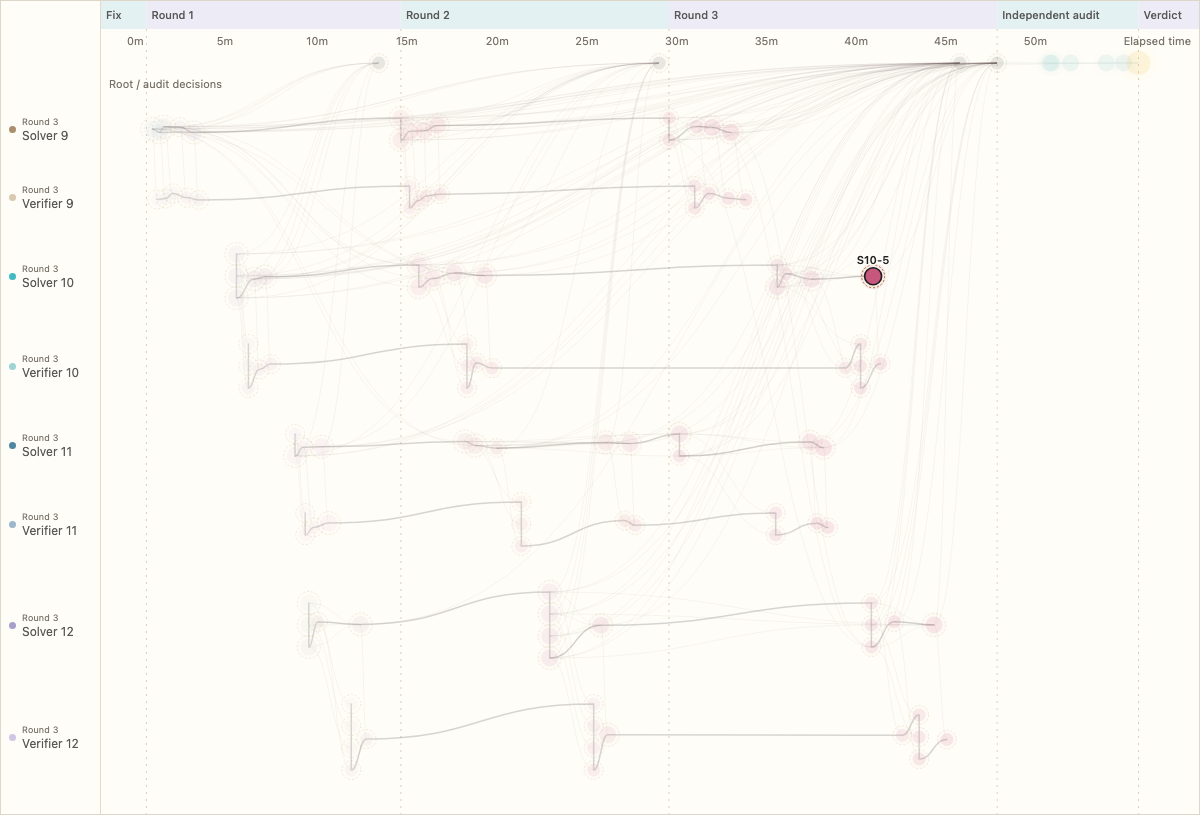
Figure 60. S10-5.