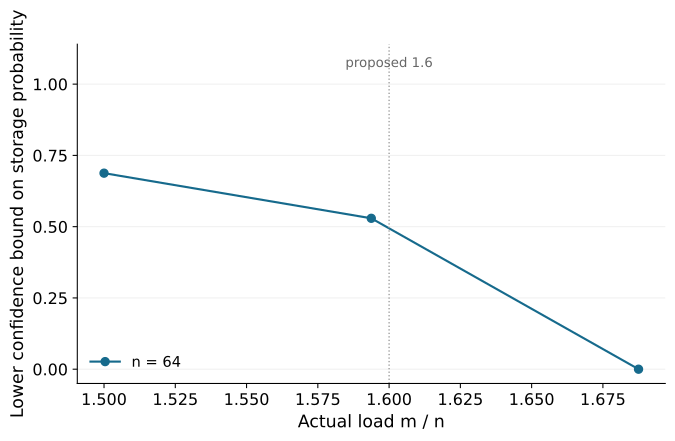
Storage capacity › Q5 · Finite evidence
Exact finite evidence
Definitions
Definition 1. Spin network
For \(n\ge2\), \(J=J^\top\in\mathbb R^{n\times n}\), \(J_{ii}=0\), and \(h\in\mathbb R^n\). $$H_i(s)=\sum_{j\ne i}J_{ij}s_j+h_i,\qquad f_{J,h}(s)_i=\sigma(H_i(s)),\qquad\sigma(t)=\begin{cases}+1,&t>0,\\-1,&t\le0.\end{cases}$$ Strict storage requires \(s_iH_i(s)>0\) for every prescribed spin and neuron.
Definition 2. Storage probability
\(D\) is uniform among the \(m\)-element subsets of \(\{-1,1\}^n\). $$p_n(m)=\Pr\{D\text{ is storable}\}.$$
Definition 3. Capacity
$$\alpha_-=\sup\{a>0:p_n(\lfloor an\rfloor)\longrightarrow1\}.$$ This supremum does not assert a sharp threshold.
Definition 4. Two limiting endpoints
$$\begin{aligned}\alpha_-&=\sup\{a>0:\\&\quad p_n(\lfloor an\rfloor)\to1\},\\[6pt]\alpha_+&=\inf\{a>0:\\&\quad p_n(\lfloor an\rfloor)\to0\}.\end{aligned}$$ These are the optimal one-sided endpoints. A single sharp constant requires \(\alpha_-=\alpha_+\); the one-sided goals do not assume equality.
Definition 5. Spin patterns
\(s^\mu\in\{-1,1\}^n\), and \(S=[s^1\ \cdots\ s^m]\in\{-1,1\}^{n\times m}\).
Definition 6. Spin couplings
\(J=J^\top\in\mathbb R^{n\times n}\), \(J_{ii}=0\), and \(h\in\mathbb R^n\). Strict stability means \(s_i^\mu((Js^\mu)_i+h_i)>0\).
Definition 7. Nonstorage certificate
The multipliers \(\lambda_i^\mu\ge0\) have total mass one and satisfy $$\sum_\mu\lambda_i^\mu s_i^\mu=0,\qquad \sum_\mu(\lambda_i^\mu+\lambda_j^\mu)s_i^\mu s_j^\mu=0\quad(i<j).$$ Their existence is equivalent to nonstorage.
Definition 8. First failure size
Choose a uniformly random ordering of all \(2^n\) distinct spin patterns:
$$X_n^1,X_n^2,\ldots,X_n^{2^n}.$$
The “prefix of length \(m\)” means the first \(m\) patterns in this list:
$$D_{n,m}=\{X_n^1,\ldots,X_n^m\},\qquad 1\le m\le2^n.$$
Add patterns one at a time; \(\tau_n\) counts how many have been added when storage first becomes impossible:
$$\begin{aligned}\tau_n=\min\{m\in\{1,\ldots,2^n\}:\\D_{n,m}\text{ is not storable}\}.\end{aligned}$$
Storage is checked anew at each size; the weights and fields may change with \(m\).
$$\begin{aligned}m<\tau_n&\ \Longrightarrow\ D_{n,m}\text{ is storable},\\m\ge\tau_n&\ \Longrightarrow\ D_{n,m}\text{ is not storable}. \end{aligned}$$
Each \(D_{n,m}\) is a uniform distinct \(m\)-set, so
$$p_n(m)=\Pr\{\tau_n>m\}.$$
Thus \(\tau_n-1\) is the largest storable prefix size; \(\tau_n\) is random because the ordering is random. The full cube is nonstorable, so the minimum exists. The recorded proofs also write \(D_m\) for \(D_{n,m}\).
Definition 9. Maximum storable subset
For a finite sample \(D\), $$L(D)=\max\{|E|:E\subseteq D\text{ is storable}\}.$$ Full storage is the event \(L(D)=|D|\).
Definition 10. Storage quantiles
$$q_n(t)=\min\{1\le m\le2^n:p_n(m)\le t\},\quad 0<t<1,\qquad c_n=q_n(1/2).$$ Heredity makes \(p_n\) nonincreasing; the full cube is nonstorable, so these quantiles exist.
Definition 11. Repair count
For a nonstorable set \(D\), $$R(D)=\{x\in D:D\setminus\{x\}\text{ is storable}\}.$$ Put \(R(D)=\varnothing\) when \(D\) stores. For a uniform distinct \(m\)-set, \(\mu_{n,m}=\mathbb E|R(D)|\).
Definition 12. Active certificate neurons
For normalized nonnegative dual multipliers, $$I_\lambda=\{i\in[n]:\sum_{\mu=1}^m\lambda_i^\mu>0\}.$$ The count concerns neuron support, not the number of patterns or positive entries.
Definition 13. Guaranteed sample size
$$c_\ast=1/55296,\qquad M_n=n+\lfloor c_\ast n/\log n\rfloor.$$ Logarithms are natural; \(M_n/n\to1\).
Statement
Attempt 2 recertified the same 168 samples from Attempt 1; no new trials were added.
Exact primal or dual witnesses classify the 168 historical samples: $$96\text{ stored},\qquad67\text{ local obstructions},\qquad5\text{ symmetry-only obstructions},\qquad0\text{ unresolved}. $$ Attempt 1 had certified 96 stored samples and retained the other 72 as unknown; these finite classifications do not locate an asymptotic endpoint.
Used in the storage-capacity argument.
Attempt 2 · ten-round results
Step1. Exact signed certificates for both outcomes
Established in Attempt 2 · stated scope
Let distinct spin patterns be \(s^1,\ldots,s^m\in\{-1,1\}^n\). Index columns by unordered edges \(\{i,j\}\) and neuron biases \(h_i\), and rows by \((\mu,i)\). Set \(A_{(\mu,i),\{i,j\}}=s_i^\mu s_j^\mu\), with the same coefficient in row \((\mu,j)\), and \(A_{(\mu,i),h_i}=s_i^\mu\), with all other entries zero. An integer vector \(t\) with \(At>0\) certifies storage in the spin model. An integer vector \(w\ge0\), \(w\ne0\), with \(A^Tw=0\) certifies nonstorage, with exact normalized dual \(\lambda=w/\sum w\). The executable implementation checks these conditions exactly and returns unresolved if neither check succeeds.
Proof
- Write \(t=(J,h)\) with \(J_{ij}=J_{ji}\) and \(J_{ii}=0\). Direct multiplication gives
$$ (At)_{\mu i}=s_i^\mu\left(\sum_{j\ne i}J_{ij}s_j^\mu+h_i\right). $$
- For the tie rule \(\sigma(t)=+1\) for \(t>0\) and \(-1\) otherwise, a finite fixed-point family can be made strict by decreasing each field by less than its least positive field, when present. Positive-target fields stay positive and negative-target fields become negative. Strict margins directly imply fixed points. Thus fixed-point existence and strict feasibility agree for finite samples under this tie convention.
- If \(A^Tw=0\), \(w\ge0\), and \(w\ne0\), any alleged strict realization gives
$$ 0=t^TA^Tw=w^TAt>0, $$ a contradiction. The supplied integer denominator \(q=\sum w>0\) makes \(\lambda=w/q\) nonnegative, normalized, and exactly annihilated by \(A^T\).
- For candidate generation the implementation maximizes \(\rho\) subject to \(At\ge\rho\mathbf1\), \(\|t\|_\infty\le1\), and \(0\le\rho\le1\) using SciPy 1.18.1 / HiGHS, and separately seeks \(\lambda\ge0\), \(A^T\lambda=0\), \(\mathbf1^T\lambda=1\). A strictly positive candidate margin is converted to an integer vector by scaling/rounding and checked using Python integers. A dual candidate is reconstructed by rational ratios or exact Fraction Gaussian elimination on its support; denominators are cleared and the entire integer annihilation is checked. Failed reconstruction never licenses a negative verdict. The LP constraints alone and their floating residuals are not certificates.
certify.pytests every signed design row for dimensions 2 through 7 against an independently assembled symmetric matrix/local-field calculation using random integer coefficients. Invalid positive and negative witnesses are explicitly rejected. For the adjacent control \(n=4\), pattern IDs \([0,1]\), equal unit weights on rows \((0,0)\) and \((1,0)\) sum to zero. For the complement control IDs \([0,15]\), all six edge coefficients equal one, all biases vanish, and every signed margin equals three. Both controls are certified as predicted.
- The sampler repeatedly draws a uniform ID in \(\{0,\ldots,2^n-1\}\) and rejects previously seen IDs. Conditional on a new draw, each unseen ID has equal probability, so the ordered distinct sample is uniform and its unordered set is uniform among \(m\)-subsets. PRNG seeds make implementation runs reproducible, rather than furnishing mathematical randomness. Tests enforce distinctness and all six 2-of-4 subsets occur in a deterministic 6000-seed smoke test, with counts 974, 1034, 1019, 939, 1010, 1024. That smoke test checks an implementation symptom; the rejection-sampling argument establishes uniformity under ideal uniform draws.
Sources
The recorded argument is self-contained; its exact dependencies remain linked.
In the attempt tree
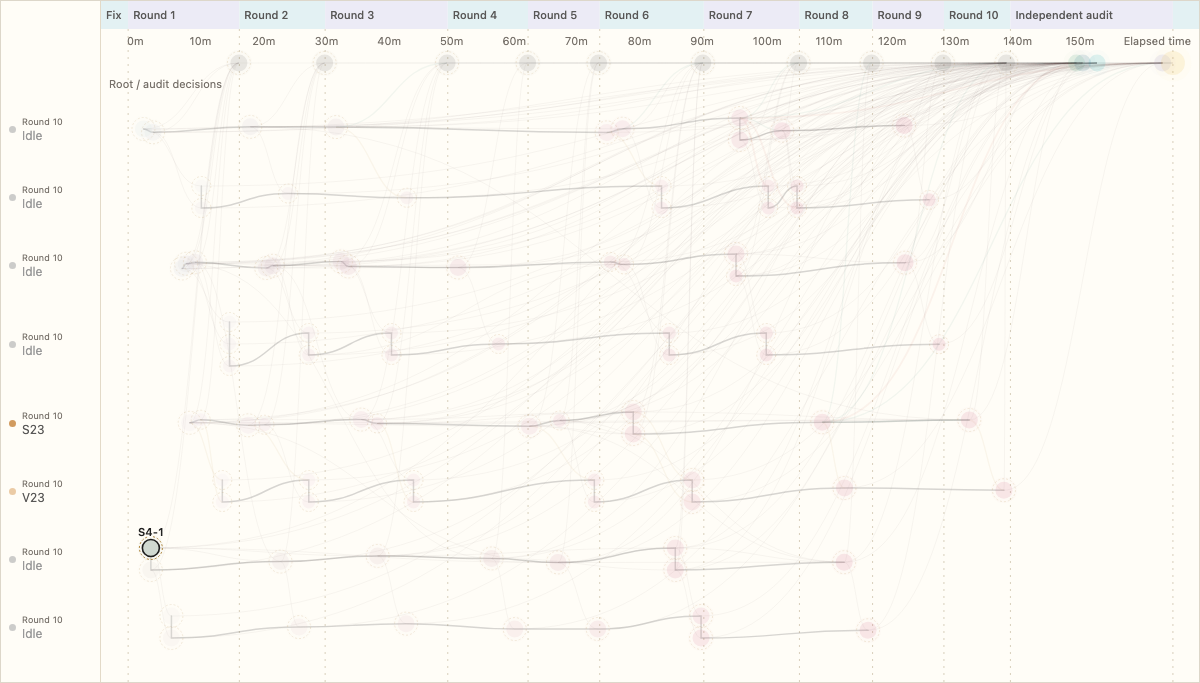
Figure 38. S4-1. Step2. Seventy-four exactly decided instances
Established in Attempt 2 · stated scope
Using six reproducible distinct-uniform pattern samples per cell at \(n\in\{4,8,12,16\}\) and loads \(m/n\in\{1,1.5,2\}\), the certified positive counts are respectively \((0,0,0)\), \((2,0,0)\), \((4,3,0)\), and \((6,0,0)\), out of six per cell; all remaining cases are certified negative and none unresolved. The 72 random cases contain 15 positives and 57 negatives; adding one positive complement control and one negative adjacent control yields 16 positives and 58 negatives. Thirteen random negative sets have minimum Hamming distance at least two, and one has minimum distance three. These are finite computations, not an asymptotic capacity bound.
Proof
- Each random cell uses \(m=\alpha n\), \(\alpha\in\{1,1.5,2\}\), trials \(r=0,\ldots,5\), and seed
$$ 2026110700+10000n+100m+r. $$ IDs are serialized integers; coordinate i is +1 for a set bit and −1 otherwise (least significant position i=0). Every ID list and full spin matrix, candidate LP vectors, solver statuses, exact certificate, elapsed time, backend, and matrix hash is stored in
round1-grid.json. Independent cells are separate samples; the load cells are not nested subsets. CPU/BLAS/OpenMP thread limits were set to four before imports; no ML framework or cooling sleeps were used.- For each case, exact validation used the integer matrix with edge coefficient \(s_i s_j\) shared by rows of both endpoints and bias coefficient \(s_i\). A positive integer vector \(t\) satisfies every row strictly with the integer entries interpreted directly as J,h. A negative integer vector \(w\ge0\) has positive total and exactly \(A^Tw=0\); a hypothetical strict realization would give \(w^TAt>0=0\). Thus the finite outcomes are statements about network feasibility, not failure of a chosen construction. The verification CLI replayed all 74 saved certificates successfully.
- A small explicit nonadjacent negative is
random-n8-m12-t0, seed 2026191900, IDs
$$ [250,145,213,33,106,88,19,139,10,157,230,229]. $$ The entire set has minimum distance two. Give unit weights to zero-based rows \([4,52,60,68,76,92]\), namely neuron \(i=4\) at pattern indices \([0,6,7,8,9,11]\), and zero elsewhere. The corresponding pattern IDs are \([250,19,139,10,157,229]\). Directly, $$ \sum s_4=0,\qquad \sum s_4s_j=0\quad(j\ne4) $$ over these six patterns; consequently \(A^Tw=0\) and \(\lambda=w/6\) is an exact nonstorage certificate. This is not an adjacency obstruction.
- The 13 nonadjacent negatives are distributed across cells \((n,m)=(8,12),(12,24),(16,24),(16,32)\) with counts \(3,1,3,6\). In
random-n16-m32-t3, seed 2026273903, the minimum pair distance is three, and an exact nonnegative annihilator has support 134 and denominator 72016134492359344748.random-n16-m24-t1has support 137 and denominator 358851704920399978. These large denominators were recovered by exact support elimination, not accepted from small numerical residuals. Full integer vectors and pattern IDs are retained in the data.
- The sum of per-case measured LP/certificate times is 1.2426505833864212 seconds; the largest case took 0.27440129197202623 seconds. These times exclude Python startup and most JSON writing and do not constitute a benchmark. The six runs at each cell are too few to estimate a critical load, and small-dimensional adjacency probabilities substantially contaminate several cells.
- An additional completed diagnostic, preserved in
round1-local-probes.json, solves the independent neuron problems with exact integer checks. For neuron \(i\), its row at pattern \(\mu\) is
$$ B_i(\mu)=\big((s_i^\mu s_j^\mu)_{j\ne i},s_i^\mu\big)\in\{-1,1\}^n. $$ All 728 local problems were exactly decided: 496 positive and 232 negative. All 58 symmetric-negative cases have at least one exact local-negative certificate; all 16 symmetric-positive cases have exact positive certificates for every local problem. No sampled set isolates a failure caused only by symmetry. The independent-neuron diagnostic has separate candidate vectors and complete integer certificates, and its verification CLI replayed all 74 cases. This observation does not imply that independent local feasibility always permits symmetric weights.
- Heuristic followup candidate (not proved or inferred asymptotically): if \(L\) means every \(B_i\) is strictly feasible and \(S\) means a symmetric strict realization exists, then for uniform distinct random sets one could test
$$ q_n(\alpha)=\Pr(S^c\mid L)\longrightarrow0\qquad(1<\alpha<2). $$ The current sample has no symmetry-only negatives among only 16 locally feasible cases across mixed cells, so it gives weak evidence and does not justify this candidate. A concrete falsification program is to sample many fresh sets at fixed loads 1.5, 1.6 and 1.75 for increasing \(n\), retain the \(L\) cases using exact local-positive certificates, and seek exact symmetric-negative duals. Finding any such sample falsifies the finite implication \(L\Rightarrow S\) at that dimension; a persistent positive conditional fraction would oppose the asymptotic candidate. No claim about \(\alpha_-\) or sharpness follows from this batch.
Sources
The recorded argument is self-contained; its exact dependencies remain linked.
In the attempt tree
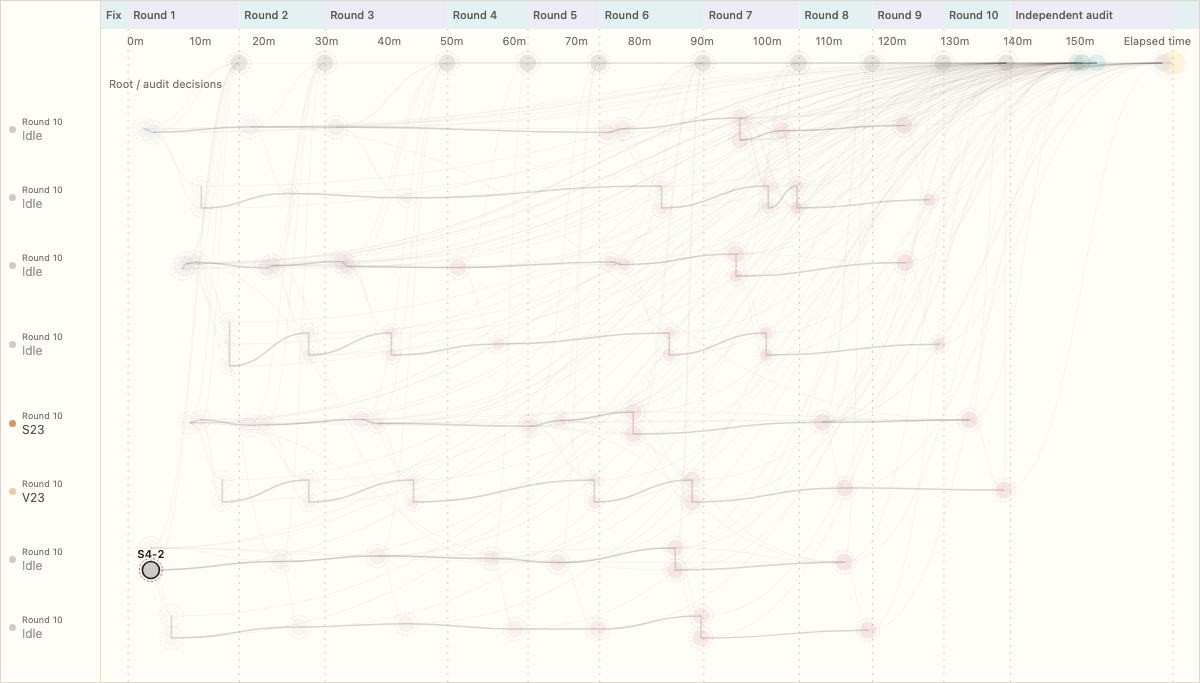
Figure 39. S4-2. Step3. Held-out local-feasibility search has no gap
Established in Attempt 2 · stated scope
For a prespecified 160-proposal held-out distinct-pattern search at dimensions \(8,12,16,24\) and loads near \(1.25\)–\(1.75\), every proposal was exactly decided. There were 61 sets for which every independent neuron had an exact strictly positive integer classifier; every such set also had a symmetric exact strictly positive integer realization. The remaining 99 proposals had exact nonnegative rational nonstorage certificates, embedded from individual-neuron obstructions. There were zero symmetry-only negative selections and zero unresolved proposals. These are finite held-out results and establish no capacity or sharp-threshold theorem.
Proof
- Exact model and classification. For a distinct ID set \(D\), coordinate i is +1 when its serialized bit is set, and −1 otherwise. For shared symmetric edge coefficients \(J_{ij}=J_{ji}\), \(J_{ii}=0\), and free fields \(h_i\), define
$$ (At)_{\mu i}=s_i^\mu\left(\sum_{j\ne i}J_{ij}s_j^\mu+h_i\right),\qquad t=(J,h). $$ The single-neuron matrix is $$ B_i(\mu)=\big((s_i^\mu s_j^\mu)_{j\ne i},s_i^\mu\big). $$ Write \(L(D)\) for strict feasibility of every \(B_i\), and \(S(D)\) for strict feasibility of \(A\). Every accepted positive outcome has an explicitly stored integer vector with all integer margins positive; every accepted negative has integer weights \(w\ge0\), \(q=\sum w>0\), and exactly \(A^Tw=0\), encoding \(\lambda=w/q\). Such a dual contradicts any \(At>0\) by \(0=w^TAt>0\). The checked previous units S4-1 and S4-2 justify the implemented exact framework; no unchecked current-round unit is used.
- Prespecified held-out plan. Before the first proposal,
heldout_r2.pywrote the complete plan and selection rule toround2-heldout.json. The plan consists of 12 proposals for each pair
$$ n\in\{8,12,16,24\},\qquad m/n\in\{1.25,1.5,1.75\}, $$ plus 16 proposals at \((n,m)=(24,33)\): \(144+16=160\) new proposals. For cell trial \(r=0,\ldots,R_{n,m}-1\) the held-out seed is $$ 202611072000000+10000n+100m+r. $$ This base differs from round one. Each proposal draws uniform integer IDs with rejection of duplicates. Conditional on an unseen draw, all remaining IDs are equiprobable; hence under ideal uniform draws the resulting unordered set is uniform among \(m\)-subsets. Fixed PRNG seeds provide reproducibility. No proposals were added, removed, mutated, replaced, or adaptively retained in the frequency denominators.
- Exact selection and retained failures. Every independent neuron of every proposal is solved; all candidate vectors and exact certificates are retained. If any local problem is certified negative, its local dual is embedded in the full row set by putting its weights only on rows \((\mu,i)\) at that neuron. Exact full annihilation is checked before assigning symmetric nonstorage. If every local problem is certified positive, the full symmetric LP is solved and its resulting integer primal or rational dual is checked. The selection event is exactly \(L(D)\cap S(D)^c\), with both sides certified. Unresolved local or symmetric outcomes would remain in the data and denominators. No floating LP status or residual is used as a nonstorage certificate.
- Measured cells. In row order \(n=(8,12,16,24)\) and column order \(m/n=(1.25,1.5,1.75)\), the numbers of locally feasible proposals are
$$ \begin{pmatrix} 0&0&0\\ 8&3&0\\ 12&3&0\\ 12&7&0 \end{pmatrix} \qquad\text{out of 12 per cell}. $$ Exactly the same matrix gives symmetric-positive counts. The extra \((24,33)\) cell has 16 locally feasible and 16 symmetric-positive proposals out of 16. Consequently there are 61 symmetric-positive and 99 symmetric-negative random proposals, no symmetry-only selection, and no unresolveds. All 2544 local problems are exactly decided: 2195 positive, 349 negative. The locally feasible proposals contain 1212 positive local classifiers. In particular, at fixed load \(1.5\), only \(0,3,3,7\) locally feasible proposals occur at the four dimensions; mixing these cells cannot estimate one asymptotic conditional probability.
- Held-out code/data and bounded work. Every proposal is retained with its seed, ordered distinct IDs, spins, signed-matrix hash, all local candidates/certificates, the symmetric certificate, selection decision, minimum Hamming distance and elapsed time. The backend is SciPy 1.18.1 / HiGHS with four CPU/BLAS/OpenMP threads set before imports. Each LP has a five-second limit; each exact dual reconstruction has a three-second interruption budget. No timeout occurred. The measured sum of per-proposal work times is 5.904747374239378 seconds, with maximum 0.15940291702281684 seconds; these exclude interpreter startup and most JSON serialization and are not a benchmark. The verification CLI replayed all seeds and exactly checked every retained local and symmetric witness. Its pair-restricted dual diagnostic was prespecified for selected symmetry-only cases; since none were selected, no random pair search was performed.
- Crafted positive control for the detector. I read the full checked S2-3 before use and replayed its eight dimension-seven pattern IDs
$$ [32,63,53,13,81,97,88,86]. $$ Its seven independent integer classifiers are all strictly positive, while its full nonnegative integer dual has denominator 10 and only active neurons \(0\) and \(4\) (zero-based). It is labeled
checked-S2-3-crafted-controland excluded from all 160 random denominators and all reported random/local totals. For its unnormalized dual blocks, direct moment multiplication gives only off-diagonal moments \(M_{04}=2\), \(M_{40}=-2\) and diagonal moments \(M_{00}=6\), \(M_{44}=4\), with all bias moments zero. Thus a strictly feasible directed classifier at neuron 0 must satisfy \(2J_{04}>0\), while one at neuron 4 must satisfy \(-2J_{40}>0\); the shared symmetric edge cannot meet both. The control's minimum active-neuron count is exactly two: one active neuron would yield a dual contradicting that neuron's stored strict positive classifier, and its displayed two-active-neuron dual attains two. This confirms that the search can recognize a symmetry-only obstruction, without interpreting a crafted case as a random observation.- Structural conjecture for a future test, not a result. Let \(K(D)\) be the minimum number of active neurons among nonzero nonnegative full symmetric duals, with \(K=\infty\) when none exists. A narrower candidate than automatic symmetrization is
$$ \Pr\!\left\{K(D)\le2\mid L(D)\right\}\longrightarrow0 \quad\text{at }m=\lfloor\alpha n\rfloor,\quad1<\alpha<2. $$ This is heuristic and unproved; the present finite search does not establish it, and larger-support obstructions could remain even if it were true. A concrete held-out test would enumerate all active pairs on locally feasible sets at fixed loads for growing dimensions, using exact pair-supported duals as positives and exact primal witnesses to exclude each tested pair. Any found pair-supported example refutes a finite universal \(L\Rightarrow K>2\) assertion; a proposed asymptotic decay would require a probability theorem or a quantitatively justified limiting analysis beyond finite samples. The crafted control already refutes the unrestricted deterministic implication \(L\Rightarrow S\). Neither these measurements nor the conjecture determines \(\alpha_-\) or establishes a sharp threshold.
Sources
The recorded argument is self-contained; its exact dependencies remain linked.
In the attempt tree
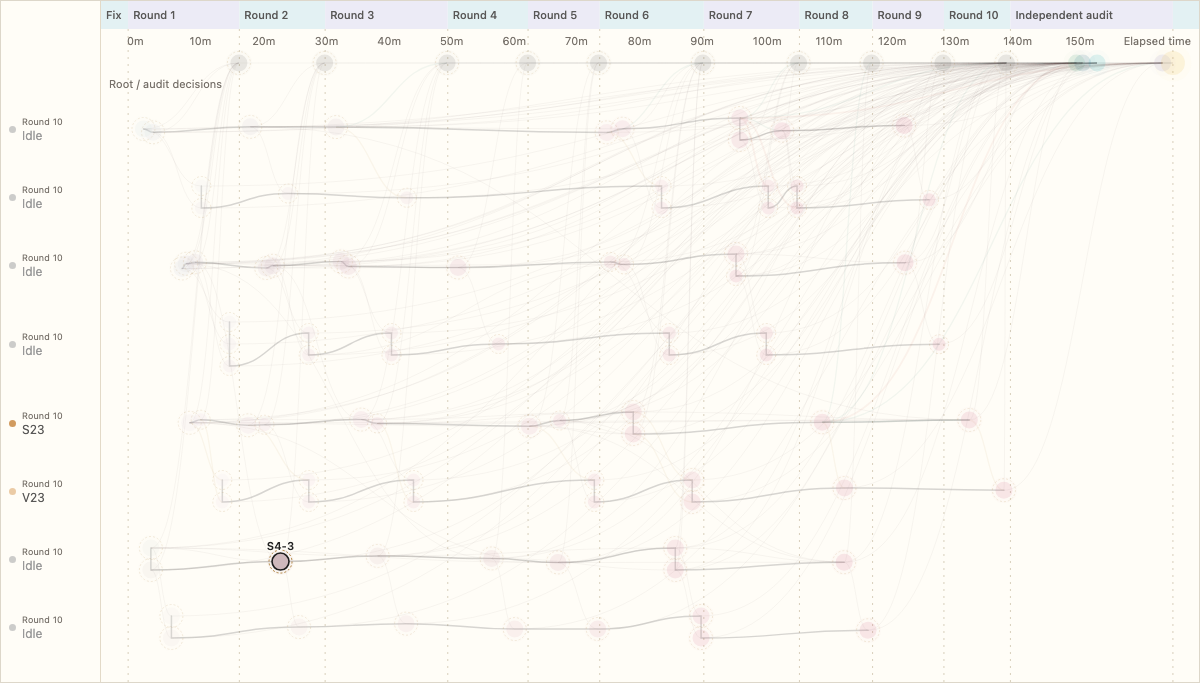
Figure 40. S4-3. Step4. Original cohort gains 72 exact negatives
Established in Attempt 2 · stated scope
In a new follow-up on the exact same 168 samples from the original S7/S11 finite experiments, all 96 original positive certificates replay and verify, and all 72 originally unknown samples receive exact nonstorage certificates. Of the 72 negatives, 67 have an exact single-neuron obstruction, while five have exact positive classifiers at every individual neuron and an exact full symmetric nonstorage dual. There are zero unresolved cases. The five produced symmetry-only witnesses occur at \((16,25)\), \((32,51)\), \((48,76)\) and twice at \((64,108)\). This is re-certification of a fixed cohort, not 168 new independent trials.
Proof
- Original cohort, new certification protocol. The inputs are exactly the 144 lines of the old S7
trials.jsonland the 24 lines of the old S11trials.jsonl, in their original order. Their original outcomes remain 96 certified stored and 72 unknown under that old positive-only protocol. This follow-up uses the same 168 seeds, dimensions and pattern samples; it does not add independent trials, replace the old record, or reinterpret numerical zero margins as certified nonstorage. A manifest of the 104 input/source/certificate files was hashed before and after; every hash is unchanged. The old run is read-only throughout.
- Exact original sampler replay. I read both original
run_experiment.pyandfeasibility.pyfiles completely and copied their sampling semantics exactly:
$$ R=\operatorname{default\_rng}(\mathrm{seed}),\qquad S=2R.\operatorname{integers}(0,2,(m,n),\mathrm{dtype}=\mathrm{int8})-1. $$ If any two rows of this whole array coincide, the entire array is discarded and redrawn. This differs from drawing ID-by-ID and rejecting individual repeated patterns. All 168 replays were distinct on their first array draw. At all 96 originally certified-positive cases, the complete ordered replayed spin matrix equals the original certificate's saved spin matrix exactly; dimensions and every originally recorded minimum integer margin also agree. For the 72 old-unknown cases, their original sampler and recorded seed determine the replay. Under ideal iid uniform signs, whole-array conditioning on distinctness makes each ordered distinct sample equiprobable, and forgetting order gives the canonical uniform subset law. Replaying a fixed seed does not provide a second stochastic observation.
- Exact certificates and original network conventions. For spin patterns, define the full signed matrix by
$$ (At)_{\mu i}=s_i^\mu\left(\sum_{j\ne i}J_{ij}s_j^\mu+h_i\right),\quad J_{ij}=J_{ji},\quad J_{ii}=0. $$ The one-neuron matrix is \(B_i(\mu)=((s_i^\mu s_j^\mu)_{j\ne i},s_i^\mu)\). Every positive certificate is an integer vector with all signed margins strictly positive. The substitution
The signed matrix retains symmetry, zero diagonal, and all free spin fields. Each negative certificate has integer \(w\ge0\), \(q=\sum w>0\), and exactly \(A^Tw=0\); then \(\lambda=w/q\) is rational, normalized and nonnegative. A strict realization would give \(0=w^TAt>0\). Every accepted full certificate was independently checked by Python-integer direct local fields or edge/bias moment sums, not accepted from LP residuals or from the exact backend's own claimed solution.
- Local-first reclassification. The 96 original stored certificates were all validated again. For each of the other 72 cases, neurons were scanned in increasing index until the first exact negative certificate, or through all neurons otherwise. A local negative with weights \(v_\mu\) is embedded as \(w_{\mu i}=v_\mu\) at that neuron and zero on all other neuron rows; its incident edge and bias equations are exactly the local equations, so it is a full symmetric nonstorage certificate. There were 949 measured local problems: 882 exact positives and 67 exact negatives, none unresolved. Hence 67 of the 72 old-unknown cases were certified nonstorable without a full symmetric solve. The other five each have exact strictly positive integer classifiers at every neuron; a full symmetric rational dual was recovered for all five. There are no newly certified stored cases beyond the old 96 and no unresolved cases.
- Per-cell final counts. All counts below belong to the original stochastic cohorts; the symmetry-only column counts exact full negatives with every independent local classifier positive.
Table 1. Follow-up classifications of the original fixed cohort. \((n,m)\) Stored Nonstored Unresolved Symmetry-only \((16,19)\) 11 1 0 0 \((16,22)\) 10 2 0 0 \((16,25)\) 4 8 0 1 \((16,28)\) 0 12 0 0 \((32,38)\) 12 0 0 0 \((32,44)\) 12 0 0 0 \((32,51)\) 4 8 0 1 \((32,57)\) 0 12 0 0 \((48,57)\) 12 0 0 0 \((48,67)\) 12 0 0 0 \((48,76)\) 4 8 0 1 \((48,86)\) 0 12 0 0 \((64,96)\) 8 0 0 0 \((64,102)\) 7 1 0 0 \((64,108)\) 0 8 0 2 The final totals are 96 stored, 72 nonstored and zero unresolved; the five symmetry-only cases are included in the 72 negatives.
- Produced witness structure. These are supports of the witnesses produced by the solver; no minimum-support assertion is made.
Table 2. Supports of the five produced symmetry-only witnesses. \((n,m)\); seed Multiplier entries Active neurons Active patterns \((16,25)\); 22021115 39 3 22 \((32,51)\); 23621108 529 32 51 \((48,76)\); 25221105 96 2 64 \((64,108)\); 26831205 2081 64 108 \((64,108)\); 26831210 2081 64 108 At \((n,m)=(48,76)\), seed 25221105, the active neurons are zero-based \(5,15\). For its unnormalized integer dual define $$ M_{ij}=\sum_\mu w_{\mu i}s_i^\mu s_j^\mu. $$ Its bias moments vanish, and its active rows have zero exterior moments. The only off-diagonal moments are $$ M_{5,15}=580509918824268136021293598000, \qquad M_{15,5}=-M_{5,15}. $$ A strictly feasible directed classifier at neuron 5 must therefore have \(J_{5,15}>0\), while one at neuron 15 must have \(J_{15,5}<0\); symmetry conflicts with these forced signs. This is a finite obstruction found in an original random sample, not merely a crafted control. The dimension-32 full dual uses all 32 neurons, and the two dimension-64 witnesses use all 64 neurons and all 108 patterns. Their integer denominators have respectively 123, 803 and 802 decimal digits. Exact Python annihilation checks every coefficient irrespective of denominator size.
- Bounded recovery and reproducible CLI. The local LP/reconstruction limits were 5/3 seconds. The first full symmetric LPs used at most 15 seconds each for primal and dual and five seconds for Fraction reconstruction. A dimension-32 Fraction recovery timed out; its saved numerical support was recovered by exact
python-flint 0.9.0, followed by Python-integer full annihilation. The two dimension-64 cases also hit the initial 15-second LP limits and one 20-second IPM primal/dual attempt each. Their final bounded 45-second primal-IPM runs yielded candidate dual multipliers; their measured LP work times were 21.827327084029093 and 21.970505874953233 seconds. The exact backend recovered each 2081-entry basis in 1.8367123330244794 and 1.849445250001736 seconds, respectively, within a hard 30-second worker subprocess cap. These are stored work timings, not a machine benchmark. Exact recovery uses a rational Dixon solve on the saved support (with modular row selection when rectangular), clears denominators, and then independently validates every full integer moment. No tolerance becomes a negative certificate.
The exact backend was installed only into
/private/tmp/hopfield-s4-r3-venv; four CPU/BLAS/OpenMP threads are set before imports and FLINT is capped at four threads. There are no fixed cooling sleeps or ML workloads. The complete CLI sequence isrecert_original_r3.py --out FILE --local-only,recert_original_r3.py --out FILE --continue-full,finish_r3.py --cohort FILE,last_ipm_r3.py --cohort FILE, andrecert_original_r3.py --out FILE --verify, using the scipy task interpreter for orchestration and the separate temporary FLINT interpreter for exact workers. All candidates, original trial records, original and replayed pattern information, accepted certificates, bounded retry records, input hashes and decisions are retained. The final verification CLI replayed all 168 samplers and checked all 96 positive plus 72 negative full witnesses and all 949 measured local witnesses.- What this settles. The original fixed cohort now has exact outcomes at every case under this new follow-up protocol. Five cases rigorously separate all independent-neuron feasibility from symmetric feasibility. This does not turn the original cohorts into new trials, establish any one-sided asymptotic probability limit, estimate a critical load from five selected cases, or determine capacity or sharpness. The full canonical target remains open.
Sources
The recorded argument is self-contained; its exact dependencies remain linked.
In the attempt tree
Figure 41. S4-4. - Original cohort, new certification protocol. The inputs are exactly the 144 lines of the old S7
Step5. Three known obstructions need residuals
Established in Attempt 2 · stated scope
For the five checked symmetry-only cohort cases, the normalized \(Z=0\) family from S2-2 is exactly infeasible at \((n,m,\mathrm{seed})=(16,25,22021115),(32,51,23621108),(48,76,25221105)\), with rational Farkas certificates and exact centered Gram data. It remains unresolved for the two \((64,108)\) cases, seeds 26831205 and 26831210, after bounded LP attempts. Therefore every normalized full dual in the first three cases has a nonzero residual \(Z\) in the checked parameterization. The five full-storage classifications remain exactly negative; no reduced-family failure is called storage.
Proof
- Fixed five cases and checked scope. I read the full checked S2-2 parameterization and S4-4 cohort unit before implementation. The five inputs are precisely the previously checked symmetry-only cases, ordered by dimension and then seed. Each already has exact strict positive classifiers at every individual neuron and a full symmetric nonstorage certificate. This round asks only whether the sufficient \(Z=0\) dual family is feasible; it does not create new pattern samples or change any full-network classification. The round-three input file was opened read-only and its before/after SHA256 agrees exactly.
- Exact centered construction, without floating Gram inversion. Put the spin matrix in neuron-by-pattern orientation, \(S\in\{-1,1\}^{n\times m}\), and define
$$ Q=I_m-\frac{\mathbf1\mathbf1^T}{m},\qquad A=SQ,\qquad v=S\mathbf1, $$ $$ C=mS-v\mathbf1^T=mA,\qquad H=mSS^T-vv^T=mAA^T. $$ An exact rational Dixon solve computes $$ B=H^{-1}C=(AA^T)^{-1}A=\frac TD,\qquad D\in\mathbb Z_{>0},\ T\in\mathbb Z^{n\times m}. $$ For all five inputs, independent Python-integer arithmetic verifies every entry of $$ HT=DC,\qquad T\mathbf1=0,\qquad TS^T=DI_n. $$ The last two identities give \(T A^T=DI_n\), so the centered matrix has row rank \(n\); \(H\) is invertible and the first identity identifies the specific centered Gram-inverse \(B\), rather than an arbitrary right inverse. The full exact integer \(C,H,T,D\) are retained for every input.
- The tested normalized family and what feasibility would mean. With \(R=\operatorname{diag}(r)\) and \(K^T=-K\), the reduced system is
$$ r\ge0,\qquad \mathbf1^Tr=1,\qquad \lambda=S\odot((R+K)B)\ge0. $$ It has \(n(n+1)/2\) real variables (the \(n\) diagonal masses and the upper triangle of \(K\)). The sign inequalities are linear. The verified identities \(B\mathbf1=0\) and \(BS^T=I_n\) would imply, for \(U=(R+K)B\), $$ U\mathbf1=0,\qquad US^T=R+K, $$ $$ \sum_{i,\mu}\lambda_i^\mu=\operatorname{tr}(US^T)=1,\qquad \sum_\mu\lambda_i^\mu s_i^\mu=0, $$ $$ \sum_\mu(\lambda_i^\mu+\lambda_j^\mu)s_i^\mu s_j^\mu=0\quad(i<j). $$ These are exactly the bias, shared-edge and mass equations of a full nonnegative symmetric zero-diagonal dual. Thus any accepted feasible-family result would require exact rational \(r,K\) and an exact nonnegative \(lambda\), followed by every full-equation check. A dimension-two all-four-pattern control, \(S=((-1,-1),(1,-1),(-1,1),(1,1))^T\), has \(B=S/4\), \(r=(1,0)\) and \(K=0\); its exact feasible certificate, mass and full moment equations pass. This explicit control is outside all five measured-case denominators.
- Exact Farkas certificate for a negative family result. Write the integer-scaled sign system as
$$ S\odot((R+K)T)\ge0, $$ and let \(y_{i\mu}\ge0\) be integer sign multipliers, \(z_i\ge0\) integer multipliers for \(r_i\ge0\), and \(q>0\) an integer scale. Define $$ M_{ij}=\sum_\mu y_{i\mu}s_i^\mu T_{j\mu}. $$ The accepted negative certificates satisfy every exact identity $$ M_{ij}=M_{ji}\quad(i<j),\qquad M_{ii}+Dz_i=-qD\quad(i\le n). $$ Indeed any feasible reduced point would give $$ \begin{aligned} 0&\le\sum_{i,\mu}y_{i\mu}s_i^\mu((R+K)T)_{i\mu}+D\sum_i z_i r_i\\ &=\sum_i r_i(M_{ii}+Dz_i)+\sum_{i<j}K_{ij}(M_{ij}-M_{ji})\\ &=-qD\sum_i r_i=-qD<0, \end{aligned} $$ a contradiction. This is an exact Farkas witness for the sign system together with its trace normalization. The three accepted certificates actually have \(z=0\), but the implemented checker permits any nonnegative \(z\). Numerical LP infeasibility is never itself a family certificate.
- Measured outcomes.
Table 1. Exact outcomes for the normalized \(Z=0\) family. \((n,m)\) Original seed Family outcome \((16,25)\) 22021115 Exact infeasible \((32,51)\) 23621108 Exact infeasible \((48,76)\) 25221105 Exact infeasible \((64,108)\) 26831205 Unresolved \((64,108)\) 26831210 Unresolved The first three certificates have 136, 528 and 1176 positive sign multipliers, respectively; their \(q\) scales have 93, 620 and 1669 decimal digits. All signs, all off-diagonal symmetry equalities and every normalized trace coefficient are checked with Python integers, independently of FLINT's solve. The exact recovery work times were 0.005218083038926125, 0.12963283306453377 and 1.0365654580527917 seconds. These stored timings are not a benchmark. Both dimension-64 inputs have exact \(B\) matrices and remain unresolved at the family level: no feasible rational point or exact Farkas vector was recovered within the bounded LP attempts. Their full-network classifications remain exactly nonstorable by the previous checked full duals.
- Bounded protocol and complete attempts.
z0_r4.pywrites the ordered five-case plan and input hash, constructs exact centered data, and tries the trace-normalized family LP with a 20-second cap. Any numerical feasible point is merely a candidate: an exact supported rational solve must recover \(r,K\), and the independent checker must validate all signs and full bias/edge/mass equations. If no feasible exact point is accepted, a separate nonnegative Farkas LP seeks the identities in step 4, again capped at 20 seconds. A hard 40-second exact-worker subprocess cap bounds reconstruction from its numerical support. Exact solutions are recovered by rational Dixon solve, with modular selection of independent equations where needed; all original integer equations are then checked, so modular selection cannot license an invalid witness.
The two unresolved dimension-64 cases each receive one additional 20-second IPM Farkas attempt in
z0_retry_r4.py; all these attempts time out without a candidate and no further extension is made. The data preserve each original LP status, candidate when supplied, exact-worker result/status, the two retry histories and every exact coefficient. The smaller family LP statuses include floating infeasibility, numerical error and timeout; only their separate exact Farkas identities determine the final negative-family outcomes. Four CPU/BLAS/OpenMP and FLINT threads are enforced; there are no ML workloads or fixed cooling sleeps.The reproducible CLI is
z0_r4.py --source ROUND3 --out ROUND4, followed byz0_retry_r4.py --out ROUND4andz0_r4.py --source ROUND3 --out ROUND4 --verify, under/private/tmp/hopfield-s4-r3-venv/bin/python. The final CLI independently rechecks all five exact centered constructions and all three Farkas vectors. A further saved self-check validates the explicit feasible control, rejects corrupted copies of every centered matrix and every accepted Farkas witness plus an invalid control, and confirms the source input hash is unchanged.- Structural consequence and remaining gap. By the checked complete parameterization S2-2, every normalized full dual has
$$ U=(R+K)B+Z,\qquad Z\mathbf1=0,\quad ZA^T=0. $$ For the three exactly excluded cases, \(Z=0\) would give a point of the family contradicted in step 4. Consequently every full certificate for each of those three cases has \(Z\ne0\); their known full duals therefore require the omitted residual. This conclusion is not drawn for the two unresolved family cases. A negative reduced-family test is not a storage certificate, and all five original networks remain exactly negative. No new stochastic trials, threshold estimate, capacity bound or sharp-threshold claim is produced.
Sources
The recorded argument is self-contained; its exact dependencies remain linked.
In the attempt tree
Figure 42. S4-5. Step6. Prefix failures and four repair cores checked
Established in Attempt 2 · stated scope
For six reproducible uniform-distinct ordered paths at each \(n\in\{8,12,16,24\}\) sampled through \(2n\), the pilot has 23 exact first-failure times and one certified interval \(\tau\in[25,28]\) at \(n=16\), replicate2; no right-censoring occurs. Every exact time has adjacent positive/negative certificates. On the first exactly located path at each size, all single-pattern deletions are exactly decided: \((n,\tau,|R|)=(8,4,2),(12,13,4),(16,27,11),(24,41,12)\). These are stopped-sample diagnostics and yield no fixed-size probability or (RC) claim.
Proof
- Prespecified paths and sampling. Before any solve, the code saves all 24 paths: six at each \(n\in\{8,12,16,24\}\), with replicate \(r=0,\ldots,5\) and seed
$$ 202611075000000+1000n+r. $$ For each path it draws the complete ordered distinct prefix \((X_1,\ldots,X_{2n})\) by uniform ID proposals in \(\{0,\ldots,2^n-1\}\), rejecting only previously accepted IDs. IDs encode coordinate \(i\) in bit \(i\). After \(k\) accepted IDs, every unseen ID has conditional probability \(1/(2^n-k)\) on the next acceptance; therefore every distinct ordered length-\(2n\) prefix has the same probability under ideal uniform draws. Such a prefix is the beginning of a uniform cube ordering; each fixed-length unordered prefix has the required distinct-subset law. Separately seeded PRNG streams provide reproducibility, not a mathematical proof of ideal PRNG independence. No path is redrawn because of any solver outcome, and all complete ordered prefixes, seeds and query records are retained.
- Pointwise first-failure certification, independent of a sampling theorem. Write \(D_m=\{X_1,\ldots,X_m\}\) and let \(\mathcal H\) be the storable sets in the canonical model. Storage is hereditary: one symmetric zero-diagonal network with its free biases stores all subsets of its stored set. A singleton is explicitly strictly stored by zero edges and biases equal to its spin vector. The full cube is not storable, since a pair differing only at coordinate \(i\) has identical neuron-\(i\) input fields but opposite required outputs. Thus a completion of any sampled prefix has a finite first failure
$$ \tau=\min\{m:D_m\notin\mathcal H\},\qquad 2\le\tau\le2^n. $$ If an exact stored prefix has length \(L\) and an exact nonstored prefix has length \(U\), then heredity gives $$ L+1\le\tau\le U. $$ In particular, adjacent certificates at \(\tau-1\) and \(\tau\) prove the exact first-failure time without solving every earlier prefix. The pilot starts with the explicit singleton and tests the sampled cap \(2n\); if that cap is nonstored it bisects the certified bracket. A solver-unknown midpoint stops the bisection with its valid interval. A stored cap would give right-censoring \(\tau>2n\), with deterministic upper bound \(2^n\). No right-censoring occurred in this batch.
- Exact network outcomes and bounded computation. Each queried set uses the signed shared-edge matrix
$$ (At)_{\mu i}=s_i^\mu\left(\sum_{j\ne i}J_{ij}s_j^\mu+h_i\right),\qquad J^T=J,\quad J_{ii}=0. $$ An integer \(t\) with \(At>0\) is a strict storage witness. An integer \(w\ge0\), \(q=\sum w>0\), with \(A^Tw=0\) is an exact nonstorage witness, because any strict realization would imply \(0=w^TAt>0\). These are exactly the checked finite alternatives S4-1 and S4-4, not a special weight construction.
The backend scans independent neurons for an inexpensive exact local obstruction and embeds it when found. Otherwise it solves the full symmetric primal/dual; every accepted outcome is independently validated by integer local fields or full integer edge/bias moments. Each LP is capped at five seconds and Fraction reconstruction at three seconds; a saved full dual support may get one ten-second hard-capped FLINT reconstruction. The overall pilot work cap is 240 seconds and did not bind. Four CPU/BLAS/OpenMP threads are set before imports; no ML or fixed cooling pauses are used. The recorded pilot work time before final verification is 27.142613042029552 seconds, including intermediate checkpoint writes; it is not a benchmark.
- First-failure outcomes.
Table 1. Certified first-failure times, in seed/replicate order. \(n\) Six path outcomes 8 4, 3, 4, 7, 4, 9 12 13, 17, 19, 17, 19, 16 16 27, 25, [25,28], 23, 24, 23 24 41, 38, 38, 37, 42, 33 There are 23 exact times and one genuine solver interval. At \(n=16\), replicate 2, prefixes of lengths 24 and 28 are exactly stored and nonstored, respectively, giving \(\tau\in[25,28]\). Its queried midpoint of length 26 had a floating zero margin and a floating dual with a negative coefficient; the candidate's positive support did not yield an exact normalized nonnegative certificate. Neither floating status nor failed reconstruction was converted to a verdict. No failure-time value is imputed there.
All 162 queried prefix records are retained: 85 positive, 76 negative and one unresolved. Every one of the 23 exact times has an explicit stored certificate at \(\tau-1\) and a nonstorage certificate at \(\tau\), not merely a numerical boundary. The six paths within each size are separate seeded paths; queried prefixes within a path are nested dependent sets, not independent fixed-load trials. No threshold curve or asymptotic fit is made.
- Repair definition, predetermined selection and valid bounds. After completing the 24 paths, the predetermined rule selects the first replicate with an exact \(\tau\) at each size. This is replicate zero at every size. For its first-failure set \(A=D_\tau\), use the prior checked definition S3-1
$$ R(A)=\{X_j\in A:A\setminus\{X_j\}\in\mathcal H\}. $$ The following facts are fully derived here; no same-round S3 theorem is a premise. The final arriving point belongs to \(R(A)\) because deleting it gives \(D_{\tau-1}\), which is stored. Thus the maximum stored subset has size \(\tau-1\), but the other repairs still need certificates.
For a produced full nonstorage dual, let $$ P=\{j:\exists i\text{ with }w_{ji}>0\} $$ be its pattern support, with zero-based indices. If \(j\notin P\), deleting that pattern removes only zero multiplier rows. Restricting the old vector preserves its positive mass, all nonnegative entries and every zero edge/bias coefficient; it is an exact nonstorage certificate for the deletion. Hence \(R(A)\subseteq P\). Every deletion inside \(P\) is tested by the exact backend except the final-point deletion, whose adjacent-prefix positive witness is reused. These are produced-witness supports, not asserted minimum supports.
More generally, if deletion tests yield certified-positive index set \(C\), certified-negative index set \(N\), and unresolved set \(U\), then directly from the definition $$ C\subseteq R(A)\subseteq C\cup U,\qquad |C|\le|R(A)|\le|C|+|U|. $$ All deletions resolved in this batch, so all four repair sets and counts are exact.
- Deletion outcomes.
Table 2. Exact deletion diagnostics on the first exactly located path at each size. \(n\) \( au\) Produced dual pattern support \(|P|\) Repair count \(|R|\) 8 4 2 2 12 13 4 4 16 27 16 11 24 41 25 12 In zero-based indices of the saved first-failure prefix, the exact repair sets are $$ \begin{aligned} n=8:&\quad \{2,3\},\\ n=12:&\quad \{1,4,11,12\},\\ n=16:&\quad \{1,4,5,8,10,12,16,17,21,23,26\},\\ n=24:&\quad \{0,2,4,6,7,8,9,22,23,25,30,40\}. \end{aligned} $$ The 85 deletion records contain 29 positive and 56 negative outcomes, with zero unresolveds. Of these decisions, 38 nonrepairs inherit exact restricted duals outside \(P\), four repairs reuse the adjacent stored-prefix certificate, and 43 deletion sets are newly solved. All retained inherited certificates are checked on the actual deleted set; their timing metadata identify the original prefix measurement or no-new-solve provenance rather than treating them as new solver work.
- Verification, reproducibility and sampling limit.
prefix_pilot_r5.py --out FILEexecutes the fixed pilot;prefix_pilot_r5.py --out FILE --verifyreplays all full ordered prefixes, checks every accepted full certificate, validates each exact adjacency or interval, and checks the prescribed repair selection, deletion sets and bounds. The saved self-validation additionally checks all 2299 retained local-certificate records (2218 positive and 81 negative, including repeated records attached to inherited queries) and rejects corrupted copies of all 246 accepted full witnesses. There are 247 prefix/deletion outcome records in total, but only 24 random paths and four selected stopped-set diagnostics; these numbers are not interchangeable trial denominators.
The repair measurements are on computationally selected stopped samples \(D_\tau\), not uniform fixed-size samples \(D_m\). They are not pooled as an estimate of \(\mathbb E|R(D_m)|\), and they establish neither the repair-core growth condition (RC), divergence of a fixed-load expected repair count, a threshold location nor sharpness. The completed contribution is the finite exact first-failure/deletion pilot, with its one honest interval and all certificates preserved.
Sources
The recorded argument is self-contained; its exact dependencies remain linked.
In the attempt tree
Figure 43. S4-6. Step7. Blind checker replays all full outcomes
Established in Attempt 2 · stated scope
For the saved evidence underlying S4-4 and S4-6, an independently designed exact checker verifies: (i) the same168 original cases give96 stored and72 nonstored, with949 valid local records and five all-local-feasible symmetry-only negatives; (ii) the247 prefix/deletion records give114 stored,132 nonstored and one unresolved, with2299 valid local records; (iii) all24 ordered path seeds and168 original sample seeds replay,23 first failures are exact, and the remaining interval is [25,28]; (iv) the four selected stopped sets have repair counts2,4,11,12. All414 accepted full witnesses also pass the unchanged pre-evidence checker. No new stochastic trials or asymptotic conclusions are asserted.
Proof
- Blind gate and precise checked scope. I read the entire canonical problem, recomputed its required SHA256, and recorded the S24 solver/round6 acknowledgment with the skill helper before substantive work. At 2026-11-07T22:46:56Z, before reading any inherited implementation, data, return, report or draft, I saved the independent design and executable checker in
exchange/S24/blind-r6.mdandscripts/S24/exact_core_r6.py, with hashes inexchange/S24/blind-r6.sha256. The executable SHA256 is1fd3ef10c9ff56415e92b4368019e1d3e20528612b21831214388e68867ab363; it remains unchanged. It explicitly passed singleton, adjacent-pair and complement-pair cases at dimensions2,3,4, in Boolean and spin coordinates, and rejected three malformed certificates. Only after this gate did I read the complete S4-4/S4-5/S4-6 bodies, paired reports and round-five draft. No inherited validator was imported or executed; none was used to design the blind core. The judgments recorded here cover exact certificate, sample-replay and stopping/deletion conclusions, not a reproduction of historical optimization runtimes or every earlier source claim.
- Exact model and integer alternatives. For distinct spin patterns s^u, let E be the unordered neuron pairs and put theta=(J_e,h_i). The signed row indexed by (u,i) has coefficient s_i^u s_j^u on incident edge {i,j}, zero on other edges, and s_i^u on bias h_i. Thus
$$ (A\theta)_{ui}=s_i^u\left(\sum_{j\ne i}J_{ij}s_j^u+h_i\right),\qquad J_{ij}=J_{ji},\quad J_{ii}=0. $$ An integer theta with A theta>0 proves strict storage. An integer w>=0 with q=sum w>0 and A^T w=0 proves nonstorage, since a hypothetical strict theta would give 0=w^T A theta>0. These alternatives are exhaustive: either zero is in the convex hull of the finite signed rows, or its nearest hull point v satisfies a_row dot v>=||v||^2>0. A minimal-support convex representation of zero uses linearly independent augmented rational columns (a_row,1), hence rational coefficients; clearing denominators yields integer w. Strict real primal feasibility has rational solutions by density and can likewise be rescaled and cleared to integer margins at least one. No floating residual is a certificate.
- Two independent exact implementations of the full checks. The later file-format adapter computes original spin signed fields with Python integers for every positive vector, and full bias/shared-edge moment sums for every negative vector. Specifically, for pattern-major w,
$$ \beta_i=\sum_u w_{ui}s_i^u=0,\qquad \sum_u(w_{ui}+w_{uj})s_i^u s_j^u=0\quad(i<j),\qquad\sum w=q>0. $$ Recorded integer minimum margins and dual denominators are checked exactly. Separately,
replay_frozen_core_r6.pysends every full accepted certificate through the unchanged pre-evidence core, using its full signed matrix and its Boolean conversion, without the later sparse adapter. All415 outcome records are inspected:414 accepted witnesses pass and the remaining certificate is null/unresolved. The supplementary pass completed at2026-11-07T22:51:29Z; its measured52.991504166 seconds is a check timing, not a historical benchmark.frozen-core-replay-r6.jsonrecords its unchanged core hash and all outcome denominators.- Original cohort and all its local problems. I independently reconstruct all144 S7 and24 S11 prescribed (n,m,seed) triples, compare every complete original trial object and raw-line hash, and rerun the original whole-array sampler with NumPy2.5.4: draw an int8 array of shape(m,n), map to signs, and redraw the entire array on any duplicate. All168 seeded arrays match saved spins, Boolean IDs, sample hashes and draw counts; all succeed on the first draw. All96 old-positive arrays, vectors and exact minimum margins also match the separate original certificate files. The104-file saved before/after manifest agrees with current hashes, which remain unchanged during replay. Conditional rejection of a whole iid uniform array gives equal probabilities to every ordered distinct array, hence the canonical uniform subset law after forgetting order. This is a fixed-cohort follow-up, not168 new draws.
Every local signed row is ((s_i^u s_j^u)_{j!=i},s_i^u). All949 retained local problems are checked directly:882 strict positives and67 exact nonnegative annihilators. Each locally obstructed full negative equals its local dual embedded only at that neuron's full rows. For each of the other five negatives all n local classifiers are present and positive. The reproduced support triples (positive entries, active neurons, active patterns) are (39,3,22), (529,32,51), (96,2,64), (2081,64,108), (2081,64,108), at seeds22021115,23621108,25221105,26831205,26831210. The entire full-negative integer vectors, including their very large denominators, pass without truncation. For seed25221105 the only nonzero off-diagonal moments M_ij=sum_u w_ui s_i^u s_j^u are M_5,15=a and M_15,5=-a, where a=580509918824268136021293598000. Weighted positive directed margins therefore force opposite signs on those two directed edge weights, contradicting symmetry. No minimum-support assertion is made. Recounting every original cell gives exactly96 stored,72 nonstored and zero unresolved.
- Fresh sampler replay of the saved24 paths. For each n in {8,12,16,24} and replicate r=0,...,5, I independently implement power-of-two rejection with
getrandbits(n+1)and reject repeated accepted IDs. With seed202611075000000+1000n+r this reproduces every complete ordered length2n list exactly; coordinate i is bit i. Under ideal uniform proposals, if k vertices are already accepted, a given unseen vertex is next with probability sum_{a>=0}(k/2^n)^a/2^n=1/(2^n-k). Thus every ordered distinct prefix has equal probability. This proves the ideal sampler law; replay of separately seeded PRNGs alone does not prove stochastic independence.
- Stopping and deletion statements are pointwise consequences of certificates. Storage is hereditary; a singleton uses zero edges and bias equal to its spin; the full cube is infeasible because adjacent vertices require opposite outputs at a neuron with identical other-neuron inputs. For a saved path define D_m as its first m points and tau as its first nonstored prefix. Any stored D_L and nonstored D_U give L+1<=tau<=U. I follow every saved bisection midpoint, outcome update and stop. All23 exact times have explicit adjacent witnesses, and all caps are negative, so no right censoring occurs. The other path, n16-r2, has a stored length24 and a nonstored length28, preserving tau in[25,28]. The162 prefix records split85/76/1 into positive/negative/unresolved.
For each n the prescribed first exactly located replicate is r=0. If P is the produced negative dual's pattern support, then deleting any point outside P leaves the restricted dual unchanged and nonzero; hence the repair set R={j:D_tau minus point j is stored} is contained in P. I check all85 actual deleted ID lists and certificates, not only support sizes. Their29 positives and56 negatives establish exact repair counts2,4,11,12 at (n,tau)=(8,4),(12,13),(16,27),(24,41). The exact index sets are saved in the replay evidence and agree with the original records. There are38 restricted-negative reuses, four adjacent-positive reuses and43 newly solved deletion records in the historical protocol; copied local records and timing origins match their sources. All2299 retained local records pass:2218 positives and81 negatives, including repeated copies. Thus247 full outcomes means162 dependent prefix queries plus85 selected deletion records, not247 independent trials.
- The unresolved numerical candidate is rejected without classifying its sample. Its saved raw dual has minimum -8.762569488930672e-8 and therefore is not nonnegative. Select its135 rows whose proposed coefficients exceed1e-9. Using the frozen integer matrix, independent elimination modulo the prime1000000007 gives rank135. A135-minor nonzero modulo that prime is a nonzero integer determinant, so the135 rows are also independent over Q. Hence no nonzero dual, normalized or otherwise, is supported on those selected rows. This invalidates that proposed support, not all possible dual supports or all primal solutions. The null certificate, unresolved outcome and interval[25,28] are retained.
- Corruptions, reconciled denominators and limits. The later exact parser rejects one deliberately changed coefficient in every accepted full and local witness:168+949=1117 copies in the cohort, and246+2299=2545 in the pilot, total3662 rejections. For primal copies an overwhelming wrong-sign bias destroys a signed margin; for dual copies a single multiplier increase (with the mass updated) destroys a bias identity. These are check tests, not new observations. Across both datasets there are415 full outcome records,414 accepted full witnesses,3248 retained local witnesses,192 replayed saved seed paths and zero new stochastic trials. The finite certificate conclusions of the cited units hold within this scope. No historical optimization execution or timing is rerun, no uniform fixed-load repair expectation is estimated, and no limit defining capacity, sharpness or the proposed1.6 value follows. All original-target asymptotic gaps remain open.
Sources
The recorded argument is self-contained; its exact dependencies remain linked.
In the attempt tree
Figure 44. S24-1. - Blind gate and precise checked scope. I read the entire canonical problem, recomputed its required SHA256, and recorded the S24 solver/round6 acknowledgment with the skill helper before substantive work. At 2026-11-07T22:46:56Z, before reading any inherited implementation, data, return, report or draft, I saved the independent design and executable checker in
Step8. Family exclusions survive fresh replay
Established in Attempt 2 · stated scope
For the five saved centered cases in S4-5, all identities HT=DC, T1=0 and TS^T=DI hold exactly. At seeds22021115,23621108,25221105, the saved integer Farkas multipliers exactly exclude the normalized zero-residual family S odot((diag(r)+K)B)>=0, r>=0, sum r=1, K^T=-K, B=T/D. Every normalized full dual at those three cases therefore has nonzero residual Z. The two dimension64 family records remain unresolved. This conclusion uses no other same-round node.
Proof
- Independent derivation and objects. After the blind canonical-only gate, I read the complete claimed reduced-family statement, derivation and paired report. Before reading any inherited family validator, I independently expanded the coefficients and saved
exchange/S24/family-derivation-r6.md; no inherited validator was subsequently imported or executed. Orient S as neuron-by-pattern, let Q=I-11^T/m, A=SQ, and define
$$ v=S1,\qquad C=mS-v1^T=mA,\qquad H=mSS^T-vv^T=mAA^T. $$ The saved B is represented as T/D with integer T and positive integer D. From the original spin arrays I recompute every C and H entry, then check every coefficient in HT=DC, T1=0 and TS^T=DI. In the data adapter, flattened sign multipliers use pattern-major index u n+i; an initial neuron-major decoding assumption was corrected before the successful replay, without modifying any inherited data.
- Exact identification and rank, for all five cases. Since T1=0, T A^T=TQ S^T=TS^T=DI. Therefore A has row rank n and H=mAA^T is invertible. The remaining identity gives uniquely
$$ B=T/D=H^{-1}C=(AA^T)^{-1}A,\qquad B1=0,\quad BS^T=I. $$ Every equality passes for cases (n,m,seed)=(16,25,22021115),(32,51,23621108),(48,76,25221105),(64,108,26831205),(64,108,26831210). The right-inverse product itself is also evaluated by the unchanged blind integer matrix-product checker. Corrupting T_00 by one is rejected in each case. These are exact Gram-inverse identities, not floating rank estimates or arbitrary right inverses.
- Family meaning and freshly derived Farkas coefficients. Put R=diag(r) and U_0=(R+K)B, where r_i>=0, sum r_i=1, and upper entries of skew K are free signed variables. B1=0 and BS^T=I give U_01=0 and U_0 S^T=R+K. Thus lambda=S odot U_0>=0 would satisfy all full bias and shared-edge dual equations and have total mass trace(R+K)=1. It would certify full nonstorage. D>0 makes its sign inequalities equivalent to S odot((R+K)T)>=0.
Take integer sign weights y_iu>=0 and integer mass weights z_i>=0. Direct expansion defines $$ M_{ij}=\sum_u y_{iu}S_{iu}T_{ju}. $$ The coefficient on r_i is M_ii, while the coefficient on free K_ij is M_ij-M_ji. If a positive integer q satisfies M_ij=M_ji for i<j and M_ii+D z_i=-qD for every i, every family-feasible point would obey $$ 0\le\sum_{i,u}y_{iu}S_{iu}((R+K)T)_{iu}+D\sum_i z_i r_i =\sum_i r_i(M_{ii}+Dz_i)+\sum_{i<j}K_{ij}(M_{ij}-M_{ji}) =-qD\sum_i r_i=-qD<0, $$ a contradiction. This coefficient argument proves the certificate implication, including free-skew signs and trace normalization, independently of any LP status.
- Every accepted family certificate and every unresolved record. The Python-integer checker verifies all y,z signs, q>0, all M symmetry identities and every diagonal identity for the first three cases. Their positive sign-weight supports are136,528,1176 and q has93,620,1669 decimal digits, respectively. All stored z vanish, although the checker allows any nonnegative z. Increasing q by one is independently rejected in each case. The two dimension64 records have null certificates and outcome unresolved; no numerical status is promoted to family feasibility or infeasibility. The separately saved four-pattern dimension-two cube control also passes: B=S/4, r=(1,0), K=0 gives lambda's first row identically1/4 and second row zero, with exact positive mass and zero full bias/shared-edge moments. It is a feasible dual-family control, not a stored-network control, and is outside the five case denominators. Thus the totals are five verified centered inverses, three exact family exclusions, two unresolved family records, one separate feasible-family control and eight rejected inverse/Farkas corruptions.
- Residual necessity, without assuming a full-storage conclusion. Any normalized full dual lambda>=0 has U=lambda odot S, U1=0 and US^T=R+K, where r_i=sum_u lambda_iu>=0, sum r_i=1, and K is skew by the shared-edge identities. Define
$$ Z=U-(R+K)B. $$ The exact B identities give Z1=0 and ZA^T=0. If Z were zero at one of the three excluded cases, its (r,K) would satisfy the family contradicted in step3. Therefore every normalized full dual there has Z nonzero. This is a structural necessity for existing full duals; an excluded sufficient family never proves that the network is storable. No such residual conclusion is assigned to the two unresolved family cases. All arguments in this unit are self-contained and require no unchecked same-round node. The finite exclusions supply neither an occurrence probability for collective witnesses nor capacity or sharp-threshold limits.
Sources
The recorded argument is self-contained; its exact dependencies remain linked.
In the attempt tree
Figure 45. S24-2. - Independent derivation and objects. After the blind canonical-only gate, I read the complete claimed reduced-family statement, derivation and paired report. Before reading any inherited family validator, I independently expanded the coefficients and saved
Step9. Sixteen fixed-layer repair bounds measured
Established in Attempt 2 · stated scope
A new prespecified pilot consists of eight distinct-pattern sets at each fixed layer (n,m)=(16,24),(24,38), separate from every original168-case and24 stopped-path record. All16 full sets are exactly classified:2 stored/6 nonstored and4 stored/4 nonstored, respectively. For r(D)=0 on stored D and the number of single-deletion repairs on nonstored D, the all-eight realized sample mean is exactly9/4 on the first layer and lies in[27/8,31/8] on the second. All296 deletions of the ten nonstored sets are retained:45 stored,247 nonstored,4 unresolved. Under ideal independent uniform-set sampling within each layer, simultaneous95% confidence bounds for the two uniform-layer means are[0,14.809975] and[0,23.761627], rounded outward. No RC-growth, capacity or sharpness conclusion is asserted.
Proof
- Contract and frozen new cohort. I reread the entire canonical Setting, Assumed, Target, Files, Web, Criterion and Checklist, recomputed the matching SHA256, and appended the S24 solver/round8 read-full acknowledgment with the skill helper before substantive work. I read the complete cited S3-7/S3-8 proof units and paired reports; the full S24-1/S4-6 material had been read in round6, and the previous S24-1 report supplied in this brief has no open finite-certificate issue. Their original-target asymptotic gaps remain open. This unit rederives every finite inference it needs and uses no unchecked same-round theorem.
Before any new solve, at2026-11-07T23:14:48Z, I saved all16 complete ordered pattern lists, seeds, fixed layers, algorithms, work limits and inferential plan to
exchange/S24/fixed-layer-r8-plan.json, SHA2560a277a838bbc9e9f6014bf93dea2855e47dc86c65f3328713e2cc0c9de54dac1. With b=8 per layer, seeds are $$ 202611078800000+1000n+r,\qquad r=0,\ldots,7,\quad n\in\{16,24\}. $$ All16 seeds are absent from the425 prior seed values extracted from the saved S4/S24 pilot/replay inputs; that source manifest is retained in the frozen plan. No unordered sampled set repeats within a layer. No current outcome changes a seed, pattern, layer, cohort size or membership. These are16 new seeded sets, distinct from the original168 fixed-cohort cases and24 stopped paths, rather than recertification counts.- Sampling law and reproducible implementation. Each case initializes
random.Random(seed), repeatedly proposesrandrange(2**n), and rejects only IDs already accepted in that case until m distinct IDs have been accepted. Coordinate i is bit i. Recorded versions are Python3.12.14, random state format3, NumPy2.5.4, SciPy1.18.1 and python-flint0.9.0; full Python build information and every ordered list are retained. After k accepted vertices under ideal independent uniform proposals from N=2^n, a specified unseen vertex is the next acceptance with probability
$$ \sum_{a\ge0}(k/N)^a/N=1/(N-k). $$ Consequently each distinct ordered m-tuple has probability1/(N)_m, and forgetting its order gives the exact uniform m-subset law, without an iid-to-distinct approximation. Independent ideal streams give independent cases within a fixed layer. The actual fixed PRNG/seed transcript establishes reproducibility, not a proof that deterministic streams have the ideal independence assumed in the confidence theorem below. The layer choices were fixed from earlier pilot information, not current outcomes; all16 current cases remain in the denominators regardless of computational difficulty.
- Every accepted network conclusion has an exact witness. For spin patterns write theta=(J_ij for i<j,h_i), with symmetric shared J and J_ii=0. The signed matrix is defined by
$$ (A\theta)_{ui}=s_i^u\left(\sum_{j\ne i}J_{ij}s_j^u+h_i\right). $$ An integer theta with every entry of A theta positive certifies strict storage. An integer w>=0 with q=sum w>0 and $$ \sum_u w_{ui}s_i^u=0,\qquad \sum_u(w_{ui}+w_{uj})s_i^u s_j^u=0\quad(i<j) $$ certifies nonstorage: summing hypothetical strict margins against w would give a positive number equal to the zero combination of every free bias and shared edge.
The LP matrix is built from the pre-evidence round6 checker. Candidate primals are rounded and accepted only after exact positive margins; candidate dual supports undergo rational reconstruction and are accepted only after every full integer moment vanishes and q>0. The separate direct Boolean-field/moment checker validates every accepted vector independently of the LP solver. Finally, the unchanged blind round6 core checks every accepted witness again, including exact minimum margins and denominators. Failed reconstruction or a numerical zero margin supplies no classification.
- Repair intervals are deterministic even with informative failures. Define
$$ r(D)=\begin{cases} 0,&D\text{ is storable},\\ \#\{j:D\setminus\{X_j\}\text{ is storable}\},&D\text{ is nonstorable}. \end{cases} $$ For an exactly nonstored D, let T be the PATTERN support of its produced full dual: j lies in T iff some neuron multiplier w_ji is positive. If j is outside T, deleting j removes only zero multipliers, leaving a nonnegative nonzero annihilator. This exactly certifies a nonrepair. Let P,F,U be the deletion indices with exact positive, exact negative and unresolved outcomes. Then $$ P\subseteq R(D)\subseteq T\setminus F=P\cup U, \qquad |P|\le r(D)\le|P|+|U|. $$ The equality here uses complete retained deletion records: every index outside T has its restricted negative witness. A certified stored full set has r=0 by the stated convention; its stored deletions are not counted as repairs. A full outcome left unknown would retain[0,m], since neither side of its piecewise definition is known. All16 full outcomes resolve in this run. These arguments use produced pattern supports, not neuron supports or a minimum-support assumption.
- Bounded schedule, exact reconstruction and retained unknowns. The script first attempts all16 full sets, then explicitly retains every deletion for each of the ten nonstored sets. The57 outside-support deletions inherit restricted exact duals; all239 inside-support deletions are attempted in a round-robin order across those sets. There are255 primal LPs (16 full plus239 deletion attempts) and204 subsequent dual LPs. Each LP is capped at5 seconds. Cheap ratio recovery has a0.5-second guard; a supported rational FLINT solve has a hard3-second subprocess cap. Its modular equation selection can only propose a rational candidate: every original coefficient and nonnegative integer sign is checked before acceptance. The123 successful FLINT recoveries and77 successful ratio recoveries produce200 new negative witnesses;57 further negative records are restrictions. Four exact-worker attempts fail and remain unresolved, with raw candidates, request hashes, commands and error traces retained. Their zero supported solutions fail positive-mass normalization; no failed candidate is converted into nonstorage.
All312 outcome records are retained:16 full records and296 deletions. Accepted records total308=16+45+247. Each of these308 full/deletion witnesses also passes the unchanged blind core and rejects its own deliberately corrupted copy through the direct exact checker. The read-only
--verifyCLI independently reruns all deterministic checks without generating samples or optimization candidates. Source hashes, every worker request/result and all raw query histories are retained. The four unresolved deletions are at n24:replicate1 indices28,35;replicate2 index27;replicate6 index25. Unknowns are neither discarded nor assigned a sign.- All-case results, in replicate order. The full classifications are2 stored/6 nonstored at(16,24) and4 stored/4 nonstored at(24,38). The complete repair intervals, including r=0 for every stored set, are
$$ \begin{aligned} (16,24):&\quad 0,0,0,5,5,1,2,5,\\ (24,38):&\quad 0,[2,4],[4,5],0,0,0,[4,5],17. \end{aligned} $$ In particular the first n16 set is exactly nonstored and has zero single-deletion repairs; a stopped-first-failure cohort would omit such a set. Exact lower/upper sums are18/18 and27/31. Dividing by the prespecified8 in each layer gives9/4 exactly and[27/8,31/8]. The complete ten nonstored-set deletion transcripts contain45 strict positives,247 exact negatives and4 unresolved records. Full sets, deletion records and solver calls are different counts; the312 records are not312 independent random observations.
- Simultaneous finite inference derived for the uniform-layer mean. For one predetermined layer define
$$ \mu_{n,m}=\mathbb E_{D\sim\operatorname{Unif}\binom{\{-1,1\}^n}{m}}r(D),\qquad Y_a=r(D_a)/m\in[0,1],\quad a=1,\ldots,b, \qquad b=8. $$ Under independent ideal uniform-set sampling, the Y_a are independent with common mean mu_(n,m)/m. For any[0,1]-valued Y, the log mgf of Y-EY has zero value/derivative at zero and second derivative equal to a tilted variance at most1/4: under every tilt, E Y^2<=E Y and therefore Var(Y)<=E Y(1-E Y)<=1/4. Integrating twice gives log E exp(t(Y-EY))<=t^2/8. Independence and Chernoff optimization yield $$ \Pr\left(\left|b^{-1}\sum_aY_a-\mu_{n,m}/m\right|>h\right) \le2e^{-2bh^2}. $$ For the two fixed layers L=2 and delta=0.05, take $$ h=\sqrt{\frac{\log(2L/\delta)}{2b}} =\sqrt{\frac{\log80}{16}}=0.5233322698507302. $$ Each layer then has failure probability at most delta/L; a union bound, with no need for independence between layers, gives simultaneous coverage at least95%. If exact pointwise certificate bounds are l_a<=r(D_a)<=u_a, their all-eight averages lbar,ubar enclose the latent realized sample mean on every outcome, even if timeouts depend on that sample or a shared work budget. On the above confidence event, $$ \max(0,\bar l-mh)\le\mu_{n,m}\le\min(m,\bar u+mh). $$ No missing-at-random assumption, independence between deletion queries, or stopped-sample correction is needed. Fixed b=8 and retention of every case are essential. The ideal-sampling qualification from step2 remains explicit for the deterministic PRNG transcript.
Table 1. All-eight repair means and simultaneous95% bounds for the ideal uniform-layer means. Layer(n,m) Realized sample-mean interval Uniform-layer mean95% interval (16,24) 9/4 [0,14.809975] (24,38) [27/8,31/8] [0,23.761627] Count radii are24h=12.559974476417526 and38h=19.886626254327748; reported interval endpoints are rounded outward to six decimals. The wide bounds are the stipulated bounded-Hoeffding result, not a precision claim from the16-case pilot.
- Measured resources, reproducibility and original-target limits. The complete pilot, including internal final exact verification, ran from2026-11-07T23:16:34Z to23:17:17Z with measured work time43.1752707909327 seconds, below the240-second cap. New optimization would stop starting after220 seconds to reserve verification time; this guard did not bind. CPU/BLAS/OpenMP and FLINT thread caps are four, all workloads are sequential LP/exact workers, and no ML or fixed cooling pauses are used. All25 in-run thermal readings are nominal, every memory reading reports91% free, and neither pressure guard binds. Nominal/fair readings do not force pauses; the code stops new optimization only after confirmed serious/critical readings or repeated critically low measured free memory, retaining broad exact intervals if that happens. These are measured run records, not a performance benchmark.
The plan digest remains unchanged, executed script/worker hashes match saved metadata, and the completed read-only verification reproduces all counts. This is a new finite uniform-layer pilot, not a threshold curve and not a stopped-core average. Four deletion feasibility questions remain open. Neither these finite means nor their broad confidence bounds prove infinite-n repair-core growth(RC), a proportional sharp window, convergence of the normalized transition center, any exact capacity or the suggested1.6 value. All original mathematical target obligations remain open.
Sources
The recorded argument is self-contained; its exact dependencies remain linked.
In the attempt tree
Figure 46. S24-3.
Earlier three-round supporting results
Q1. What can a finite trial certify about storage?
Definitions
Definition 1. Spin network
For \(n\ge2\), \(J=J^\top\in\mathbb R^{n\times n}\), \(J_{ii}=0\), and \(h\in\mathbb R^n\). $$H_i(s)=\sum_{j\ne i}J_{ij}s_j+h_i,\qquad f_{J,h}(s)_i=\sigma(H_i(s)),\qquad\sigma(t)=\begin{cases}+1,&t>0,\\-1,&t\le0.\end{cases}$$ Strict storage requires \(s_iH_i(s)>0\) for every prescribed spin and neuron.
Definition 2. Storage probability
\(D\) is uniform among the \(m\)-element subsets of \(\{-1,1\}^n\). $$p_n(m)=\Pr\{D\text{ is storable}\}.$$
Definition 3. Capacity
$$\alpha_-=\sup\{a>0:p_n(\lfloor an\rfloor)\longrightarrow1\}.$$ This supremum does not assert a sharp threshold.
Definition 4. Two limiting endpoints
$$\alpha_-=\sup\{u>0:p_n(\lfloor un\rfloor)\to1\},\qquad \alpha_+=\inf\{a>0:p_n(\lfloor an\rfloor)\to0\}.$$ A sharp proportional threshold is equivalent to equality of these endpoints.
Definition 5. Spin patterns
\(s^\mu\in\{-1,1\}^n\), and \(S=[s^1\ \cdots\ s^m]\in\{-1,1\}^{n\times m}\).
Definition 6. Spin couplings
\(J=J^\top\in\mathbb R^{n\times n}\), \(J_{ii}=0\), and \(h\in\mathbb R^n\). Strict stability means \(s_i^\mu((Js^\mu)_i+h_i)>0\).
Definition 7. Augmented projection
$$U=\begin{bmatrix}S\\\mathbf1_m^\top\end{bmatrix},\qquad P=U(U^\top U)^{-1}U^\top$$ when \(U\) has column rank \(m\). Its last coordinate represents a free field.
Definition 8. Nonstorage certificate
The multipliers \(\lambda_i^\mu\ge0\) have total mass one and satisfy $$\sum_\mu\lambda_i^\mu s_i^\mu=0,\qquad \sum_\mu(\lambda_i^\mu+\lambda_j^\mu)s_i^\mu s_j^\mu=0\quad(i<j).$$ Their existence is equivalent to nonstorage.
Definition 9. First failure time
Uniformly order the entire spin cube and let \(\tau_n\) be the first prefix length that is not storable. $$p_n(m)=\Pr\{\tau_n>m\}.$$
Definition 10. Maximum storable subset
For a finite sample \(D\), $$L(D)=\max\{|E|:E\subseteq D\text{ is storable}\}.$$ Full storage is the event \(L(D)=|D|\).
Statement
Attempt 1 · supporting result in its stated scope
Exact feasibility and conservative uncertainty. For a nonempty sample \(s^1,\ldots,s^m\in\{-1,1\}^n\), let \(d=n(n+1)/2\) and \(\theta=((J_{ij})_{i<j},(h_i)_{i=1}^n)\in\mathbb R^d\). Define \(A\in\mathbb R^{mn\times d}\) by
$$(A\theta)_{(\mu,i)}=s_i^\mu\left(\sum_{j\ne i}J_{ij}s_j^\mu+h_i\right),\qquad J_{ji}=J_{ij},\quad J_{ii}=0.$$
Then
$$\rho_*:=\max\{\rho:A\theta\ge\rho\mathbf1,\ |\theta_j|\le1,\ 0\le\rho\le1\}>0\quad\Longleftrightarrow\quad D\text{ storable}.$$
Here \(D=\{s^\mu:1\le\mu\le m\}\). A saved integer vector \(z\in\mathbb Z^d\) with \(\min(Az)>0\), checked in exact arithmetic, certifies storage; an uncertified numerical result remains unknown.
For \(N\) independent uniform distinct-set trials, let \(K\) count valid storage certificates. For \(0<\eta<1\), define \(L_\eta(0)=0\) and, for \(1\le k\le N\), the unique root in \((0,1)\) of
$$\sum_{j=k}^N\binom Nj L_\eta(k)^j(1-L_\eta(k))^{N-j}=\eta.$$
Then \(\Pr\{L_\eta(K)\le p_n(m)\}\ge1-\eta\). Unknown trials supply no upper bound below one, and finite trials do not establish an asymptotic threshold.
Proof and supporting results
Step 1. Box margin exactly detects strict storage
Established in Attempt 1 · stated scope
For a nonempty finite spin sample, put p=n(n+1)/2 and θ=(J_ij:i<j;h_i:i∈[n]). Let A_(μn+i),edge(k,l)=1{i∈{k,l}}s_k^μs_l^μ and A_(μn+i),field(k)=1{i=k}s_i^μ. Then the maximum ρ over Aθ≥ρ1, |θ_j|≤1, 0≤ρ≤1 exists and is positive exactly when the original spin sample is storable.
Proof
- The exact spin conversion in S1-1, whose paired report in the supplied handoff has no issue, gives storability exactly when Aθ>0. Each undirected edge appears once as a variable and in the constraints of both endpoints; no self-edge variable occurs. The n field variables are independent.
- The box LP is nonempty, since (θ,ρ)=(0,0) is feasible, and its closed bounded feasible set is compact, so its continuous objective attains a maximum. If that maximum is positive, its optimizer satisfies every strict inequality.
- Conversely let θ* satisfy all strict inequalities, and let δ=min_r(Aθ*)_r>0. Set c=1/max(1,||θ*||_∞) and θ=cθ*. Then |θ_j|≤1 and Aθ≥cδ1. Choosing ρ=min(1,cδ)>0 gives an allowed LP point. This is a homogeneous scaling argument; the bound on h therefore does not restrict arbitrary original biases.
- The vector theta specifies symmetric zero-diagonal J and unrestricted h; every positive row is precisely a required spin margin. Thus no additional parameter conversion is needed.
Sources
The derivation is self-contained; no external theorem is required.
In the attempt tree
Figure 61. S7-1. Step 2. Shared-edge indexing and exact certificates
Established in Attempt 1 · stated scope
The copied feasibility.py builds the exact signed-constraint matrix in edge order np.triu_indices(n,1), followed by n free fields; its whole-sample rejection sampler is uniform on ordered distinct patterns under ideal independent uniform random bits. Every saved certificate with positive Python-integer minimum margin proves storability of its saved sample. Numerical zero margins and solver failures prove no nonstorage claim.
Proof
- For each pattern μ, np.triu_indices(n,1) lists one coordinate for each unordered pair i<j. The scalar q_e=s_i^μs_j^μ is written at rows μn+i and μn+j in the same edge column e. These are different rows, so COO-to-CSR conversion creates no unintended duplicate coefficient. Each row receives n−1 incident-edge entries, no diagonal entry, and its independent field entry s_i^μ in column e_count+i. Thus the sparse product is exactly s_i^μ(∑_{j≠i}J_ij s_j^μ+h_i).
- The candidate sends [-A,1] and right-hand side zero to linprog, with the last objective coefficient −1, edge/field bounds [−1,1], and last-variable bounds [0,1]. These are precisely the stated signed-margin inequalities and objective; this line checks their implementation only, without assuming that a solver's floating-point answer proves feasibility or infeasibility.
- Before rejection, every ordered m-tuple has equal probability 2^(−nm). Conditioning on no repeated pattern leaves every ordered distinct tuple equally likely. Forgetting order multiplies each m-subset's probability by the same m!, so it gives exactly the requested subset law. All requested m are below 2^n. Deterministic seeded NumPy output implements a reproducible pseudorandom experiment; probabilistic interpretations additionally use the usual ideal independent-random-sample model.
- The candidate multiplies floating weights by 10^7 and rounds, but subsequently converts every coordinate to a Python integer and recomputes every sparse row dot product as a Python integer. Matrix entries are exactly ±1 or zero, so this last check has no numerical tolerance or integer overflow. If the minimum is positive, the integer vector itself is strictly feasible; no accuracy assumption about the floating weights is needed. The saved spins and integer vector permit independent validation using direct symmetric local fields.
- Interpret the certified integers directly as J and h. Exact positivity gives every prescribed fixed point. Positive scaling does not change strict signs; rounding can fail for a feasible sample, so a numerical zero or timeout without an exact dual remains unknown.
Sources
The derivation is self-contained; no external theorem is required.
In the attempt tree
Figure 62. S7-2. Step 3. Unknown trials permit lower bounds only
Established in Attempt 1 · stated scope
Fix n,m and N independently uniform distinct-subset samples. Let K be the number with independently valid exact storage certificates, so K is at most the unobserved number Y of storable samples. For η∈(0,1), let L(0)=0 and, for k≥1, define L(k) by ∑_{j=k}^N binom(N,j)L(k)^j(1−L(k))^(N−j)=η. Then Pr{L(K)≤p_n(m)}≥1−η. No upper bound below one follows merely by declaring uncertified trials failures. Deterministic seeded PRNG outputs do not by themselves prove the independent sampling hypothesis.
Proof
- A genuine exact positive certificate implies storability, so K≤Y samplewise. Under the stated ideal independent pattern sampling, Y has Binomial(N,p_n(m)) law. The certification mechanism may even have history-dependent failures or timeouts; no independence assumption about certificate production is needed for K≤Y.
- For each k≥1, the binomial upper tail is continuous strictly increasing from zero to one as its probability parameter runs from zero to one. Thus L(k) is uniquely defined, and L(k) is nondecreasing in k because the tail decreases when k increases.
- Put p=p_n(m). If no integer k has L(k)>p, then the desired coverage is automatic. Otherwise let k* be the least such integer. Monotonicity gives {L(Y)>p}={Y≥k*}. Since p<L(k*), its probability is strictly less than the tail at L(k*), which equals η. Hence Pr{L(Y)≤p}≥1−η. Since L(K)≤L(Y), the same inequality holds for K.
- This is a one-sided, per-condition statement. It has no simultaneous coverage guarantee across the twelve conditions. An uncertified sample may be storable, so no complementary nonstorage or upper-probability statement follows. The seeded numerical experiment only approximates the independent ideal sampling model and will report that condition explicitly; the algebraic truth of its exact individual certificates does not depend on that model.
Sources
The derivation is self-contained; no external theorem is required.
In the attempt tree
Figure 63. S7-3. Step 4. 144 trials with exact positive witnesses
Established in Attempt 1 · stated scope
n=16: m=19,22,25,28; exact-positive counts=11,10,4,0 out of12 per condition; actual loads=1.1875,1.375,1.5625,1.75. n=32: m=38,44,51,57; exact-positive counts=12,12,4,0 out of12 per condition; actual loads=1.1875,1.375,1.59375,1.78125. n=48: m=57,67,76,86; exact-positive counts=12,12,4,0 out of12 per condition; actual loads=1.1875,1.3958333,1.5833333,1.7916667. Classifications: {"numerical_optimum_without_exact_storage_certificate": 63, "storage_exact_certificate": 81}. These are finite observations, not an asymptotic threshold.
Proof
- The exact bounded LP from S7-1 was run on twelve seeded, whole-sample-rejected pattern draws for each of the twelve specified n/load conditions, with actual m=floor(requested_load*n). The edge/field and sampler implementation were checked in S7-2. n=16: m=19,22,25,28; exact-positive counts=11,10,4,0 out of12 per condition; actual loads=1.1875,1.375,1.5625,1.75. n=32: m=38,44,51,57; exact-positive counts=12,12,4,0 out of12 per condition; actual loads=1.1875,1.375,1.59375,1.78125. n=48: m=57,67,76,86; exact-positive counts=12,12,4,0 out of12 per condition; actual loads=1.1875,1.3958333,1.5833333,1.7916667.
- Final classifications are {"numerical_optimum_without_exact_storage_certificate": 63, "storage_exact_certificate": 81}. A numerical optimum without a positive integer certificate is unresolved, including numerical zero. No numerical failure or zero is treated as exact nonstorage. Every stored_exact count refers to a saved positive Python-integer certificate.
- The local independent direct-field audit checked all 81 certificates, saved minimum margins, exact Boolean inverse fields, distinctness and seed replay; all passed. The smallest signed integer margin was 17497. The independent dense-row oracle agreed with the sparse matrix in seven dimensions n=2,...,8. Runnable audit and raw certificate files are archived internally in scripts/S7/results; these are finite constructive certificates, not floating tolerances.
- Versions were Python 3.12.14, NumPy 2.5.4, SciPy 1.18.1, HiGHS 1.12.0, macOS arm64. Every main trial used method='highs', four solver threads, BLAS thread caps four, and a sixty-second solver cap. The sum of measured LP-call times was 448.426 seconds. Before/after each useful condition block, clock, thermal state and memory-pressure queries were logged; observed thermal states were ['nominal']. No cooling sleep or thermal work suspension occurred.
- The internal summary reports one-sided pointwise95% lower bounds computed by S7-3, with unknown outcomes counted as uncertified. Those probability statements are conditional on ideal independent random draws; deterministic NumPy seeds provide reproducibility and do not prove independence. They give no upper bound below one and no simultaneous twelve-condition coverage claim. No result here estimates an asymptotic critical load.
Sources
The derivation is self-contained; no external theorem is required.
In the attempt tree
Figure 64. S7-4. Step 5. Finite evidence leaves the threshold open
Established in Attempt 1 · stated scope
The finite LP and exact-positive certificate experiment is verified under the original symmetric zero-diagonal free-field conventions. Near requested load 1.6, n=16, m=25, actual load=1.5625: 4/12 exact storage certificates, 8 unresolved; n=32, m=51, actual load=1.59375: 4/12 exact storage certificates, 8 unresolved; n=48, m=76, actual load=1.5833333: 4/12 exact storage certificates, 8 unresolved. This neither proves nor disproves a critical load 1.6 or any sharp proportional threshold.
Proof
- By S7-1, compact bounding of every J,h coordinate does not change strict feasibility: a positive optimum exists exactly for stored samples. This is the correct finite problem under the previously checked spin formulation.
- By S7-2, the code uses one shared variable for each undirected edge, no diagonal variables, and n independent fields. Its ideal rejection-sampling law is uniform on distinct subsets, and every exact positive integer vector is a genuine network certificate for every sampled pattern and neuron.
- The full finite computation S7-4 therefore supplies constructive positive evidence for its certified instances. n=16, m=25, actual load=1.5625: 4/12 exact storage certificates, 8 unresolved; n=32, m=51, actual load=1.59375: 4/12 exact storage certificates, 8 unresolved; n=48, m=76, actual load=1.5833333: 4/12 exact storage certificates, 8 unresolved. Numerical zeros, solver limits and all other uncertified results remain unknown; none is a proof that its sample is not storable.
- Under ideal independent sample draws, S7-3 turns the count of these guaranteed true positives into conservative one-sided lower confidence bounds. This does not supply upper bounds or prove any finite-n probability exactly, and seeded PRNG reproducibility is separately stated.
- Passing from these three fixed dimensions to the defining n→∞ limits requires new uniform probabilistic control of structured symmetric feasibility or its exact dual. Neither the finite witnesses nor these one-sided confidence bounds provide that control. The original exact capacity, sharpness and proposed value 1.6 remain unresolved. There is no inherited critical issue in the finite support nodes; the remaining gap is the original asymptotic target.
Sources
The derivation is self-contained; no external theorem is required.
In the attempt tree
Figure 65. S7-5. Step 6. IPM replication retains exact storage LP
Established in Attempt 1 · stated scope
For any nonempty saved sign sample, scripts/S11/feasibility.py implements max rho subject to A theta >= rho 1, |theta_j| <= 1 and 0 <= rho <= 1, with one shared undirected edge variable and n free fields. Positive saved Python-integer margins prove strict storage of the saved sample under symmetric zero-diagonal spin couplings and unrestricted fields. All uncertified outcomes remain unknown.
Proof
- The supplied no-issue V7-1 and V7-2 reports establish S7-1 and S7-2 under exactly the original symmetric zero-diagonal free-field conventions. I read their full statements and implementation, then compared the candidate scripts/R/feasibility-ipm-benchmark.py with the copied scripts/S11/feasibility.py. The latter is a byte-for-byte copy; relative to S7 the only solver changes are method highs-ipm and thread cap two.
- For each pattern mu and pair i<j, matrix(spins) puts s_i*s_j in both endpoint rows of one edge column. The field column e+i has s_i only in its own row; there is no diagonal-edge column. Thus (A theta)_(mu,i)=s_i*((Js)_i+h_i), with J symmetric and diagonal zero. The objective -rho, augmented inequalities [-A,1]<=0, bounds and zero right side implement exactly the compact LP in S7-1.
- A positive strict vector can be divided by max(1,its infinity norm), scaling h together with J, so parameter bounds never exclude a strictly storable finite sample. Conversely rho>0 gives every signed local field positive.
- For each successful numerical optimizer the code rounds 10^7 times each coordinate, converts each to an unbounded Python integer, and computes every signed row by Python-integer additions and multiplications. The sparse coefficients are exactly +/-1. A minimum greater than zero is therefore an exact certificate independently of floating solver accuracy. Scaling is unnecessary for its implication.
- Whole-tuple rejection of duplicate sign rows conditions equal-mass iid ordered samples on distinctness and therefore yields the uniform subset model after forgetting order. The experiment uses deterministic NumPy seeds for reproducibility; statistical interpretations separately assume ideal independent draws. Numerical optimum zero, timeout or failed integer rounding gives no exact nonstorage witness and is classified unknown.
Sources
The derivation is self-contained; no external theorem is required.
In the attempt tree
Figure 66. S11-1. Step 7. Three-condition conservative uncertainty
Established in Attempt 1 · stated scope
For each of the three conditions let K be its exact-certificate count among N=8 independent ideal uniform subset samples, and define L_eta(0)=0 and sum_(j=k)^8 binom(8,j)L_eta(k)^j(1-L_eta(k))^(8-j)=eta for k>=1. Then P{L_eta(K)<=p_64(m)}>=1-eta. Choosing eta=0.05 gives pointwise 95% coverage; choosing eta=0.05/3 gives simultaneous coverage at least 95% for all three conditions by a union bound, even without independence between conditions. These probability claims are conditional on the ideal sampling model, not consequences of deterministic PRNG seeds.
Proof
- The checked S7-3, with supplied no-issue report V7-3, applies to any finite N and eta in (0,1), so applies with N=8 at each of m=96,102,108. Its required hypothesis is independent ideal uniform distinct-subset samples within the condition. Validity of exact individual integer certificates is algebraic and needs no randomness hypothesis.
- In more detail, if Y is the number of truly storable samples then K<=Y deterministically and Y has Binomial(8,p_64(m)) distribution. The binomial upper-tail inversion L_eta is monotone in k. The first k for which L_eta(k)>p has binomial tail probability at p at most eta, proving P(L_eta(Y)>p)<=eta; K<=Y then gives the stated conservative endpoint. Unknown outcomes are not declared failures.
- At eta=0.05/3, the union of the three possible lower-bound coverage failures has probability at most 3*eta=0.05. No cross-condition independence is used. Pointwise eta=0.05 endpoints have no 95% simultaneous interpretation.
- The upper endpoint remains 1 in every condition because all uncertified samples might be storable. Neither finite lower confidence bounds nor their simultaneous version supplies a limiting capacity or a sharp threshold.
Sources
The derivation is self-contained; no external theorem is required.
In the attempt tree
Figure 67. S11-2. Step 8. Larger held-out LP replication completed
Established in Attempt 1 · stated scope
At n=64, m=96 (requested load1.5, actual1.5) gives8 exact storage certificates and0 unknowns; m=102 (requested1.6, actual1.59375) gives7 exact certificates and1 unknown; m=108 (requested1.7, actual1.6875) gives0 exact certificates and8 unknowns. All24 solver statuses are0, with no timeout. Pointwise95% lower endpoints are0.6876560219,0.5293205914,0; simultaneous three-condition95% lower endpoints are0.5994198128,0.4441094856,0, conditional on independent ideal draws within each condition. No storage upper endpoint below1 follows.
Proof
- I read the no-issue reports for S11-1 and S11-2, both timed2026-11-05T23:23:17Z, before writing this node. The former establishes the correct finite LP and exact certificate implication, while the latter establishes the conditional conservative confidence calculation; neither supplies an asymptotic theorem.
- The completed experiment contains precisely eight cases for each requested load1.5,1.6,1.7 at n=64, with m=floor(64*requested_load)=96,102,108. Seed=20261205+100000*n+1000*round(100*requested_load)+rep for rep=0,...,7. All24 seeds are unique, disjoint from every S7 seed and distinct from the excluded root benchmark seed26821119. No prior benchmark outcome is counted. The same bounded-margin LP was solved with highs-ipm, two solver/BLAS threads and a60-second solver cap per trial.
- The exact certificate counts are8,7,0, respectively. All24 solver statuses are0; all9 uncertified optima are numerical zero or near zero (one is about -1.67e-16). They remain unknown, with no exact dual witness and no numerical nonstorage inference. The raw trial records preserve every case rather than selecting positive outcomes.
- The no-solve audit_and_summarize.py verifies the complete24-case Cartesian accounting, exact m and actual ratios, disjoint seeds, all34 coefficient basis vectors on complete cubes n=2,...,5, and every saved certificate. It independently decodes each symmetric zero-diagonal integer J and field h, computes all signed spin fields and all Boolean inverse-map fields by Python-integer arithmetic, checks dimensions, integer types, distinctness, seeded sample replay and the exact saved minimum. All15 positive certificates pass; their smallest exact signed integer margin is72035. The verifier also independently audited all15 certificates without LP reruns.
- By S11-2, inversion of the N=8 binomial tail gives pointwise95% lower endpoints (0.6876560219336321,0.5293205913988683,0) and, using eta=0.05/3, simultaneous three-condition95% lower endpoints (0.5994198127882362,0.4441094856220157,0). These are conditional on ideal independent uniform subset draws within each condition; deterministic PRNG seeds provide reproducibility and do not prove that probabilistic hypothesis. Every upper endpoint from certificates alone remains1.
- The measured LP-call times sum to412.96699241676833 seconds. The run began2026-11-05T23:17:28Z and finished2026-11-05T23:24:23Z. Versions are Python3.12.14, NumPy2.5.4, SciPy1.18.1, HiGHS1.12.0 on macOS26.6.2 arm64. Eight before/after/start/finish thermal and /usr/bin/memory_pressure -Q records all report nominal thermal state,128GiB total memory and37–39% free memory. There was no cooling pause or resource suspension. Script hashes and successful/denied hardware-query metadata are retained.
- These witnesses prove strict storage only for their15 finite samples, under exactly the original symmetry, zero diagonal and free-field conventions. The9 remaining samples are unresolved. The finite frequencies and lower confidence endpoints neither determine alpha_sym nor prove or refute a sharp threshold or the value1.6.
Sources
The derivation is self-contained; no external theorem is required.
In the attempt tree
Figure 68. S11-3. Step 9. Finite evidence leaves capacity unresolved
Established in Attempt 1 · stated scope
The held-out24-trial larger-size replication is verified under the original symmetric zero-diagonal free-field conventions. At n=64, m=96,102,108, exact positive counts are8,7,0 out of8 and unknown counts0,1,8. In particular at actual load102/64=1.59375 there are7 exact storage witnesses and1 unresolved sample. These finite data neither prove nor refute alpha_sym=1.6 or the existence of a sharp proportional threshold.
Proof
- I read every supporting report before this verdict; S11-1, S11-2 and S11-3 have no open issue. The exact LP implication in S11-1 respects one shared edge per unordered pair, zero self-interactions and independent free spin fields. A positive integer witness gives all signed fields strictly positive. Thus each accepted witness proves storage of its entire finite sample, rather than only a typical coordinate.
- The completed independently checked computation S11-3 supplies15 such witnesses:8 at m=96,7 at m=102,0 at m=108. Exactly24 fresh cases were run, eight per condition, with no benchmark reuse and no seed overlap with S7. All nine other outcomes are numerical-zero or near-zero optima, and remain unknown because no exact nonnegative dual witness is available. This proves the finite computational assignment without converting a numerical zero or a failed construction into network infeasibility.
- Under ideal independent uniform subset draws within each condition, S11-2 applies to the exact-positive counts even though uncertified samples might be storable. The pointwise95% lower bounds are0.6876560219,0.5293205914,0, and the simultaneous three-condition95% lower bounds are0.5994198128,0.4441094856,0. The uniform distinct-subset law follows from whole-tuple rejection, while deterministic seeded PRNG output itself supplies no proof of independence. No probability upper endpoint below1 is inferred.
- The original capacity is defined by limits of p_n(floor(alpha*n)) as n tends to infinity, and a sharp threshold additionally requires the success and failure limits on both sides of a common constant. A finite set of checked witnesses at n=64, even combined with earlier finite dimensions, is not a bound on this entire sequence. No justified continuation from these data determines either asymptotic limit.
- Exact remaining obligation: obtain uniform probabilistic control of the actual structured strict-feasibility event A(S)theta>0 (or its exact nonnegative dual) along m=floor(alpha*n), enough to identify the supremum of success loads and separately prove the corresponding common success/failure threshold. This is a missing theorem about the original network, not a new hypothesis. The present experiment proves neither that1.6 is the capacity nor that it is not.
Sources
The derivation is self-contained; no external theorem is required.
In the attempt tree
Figure 69. S11-4.