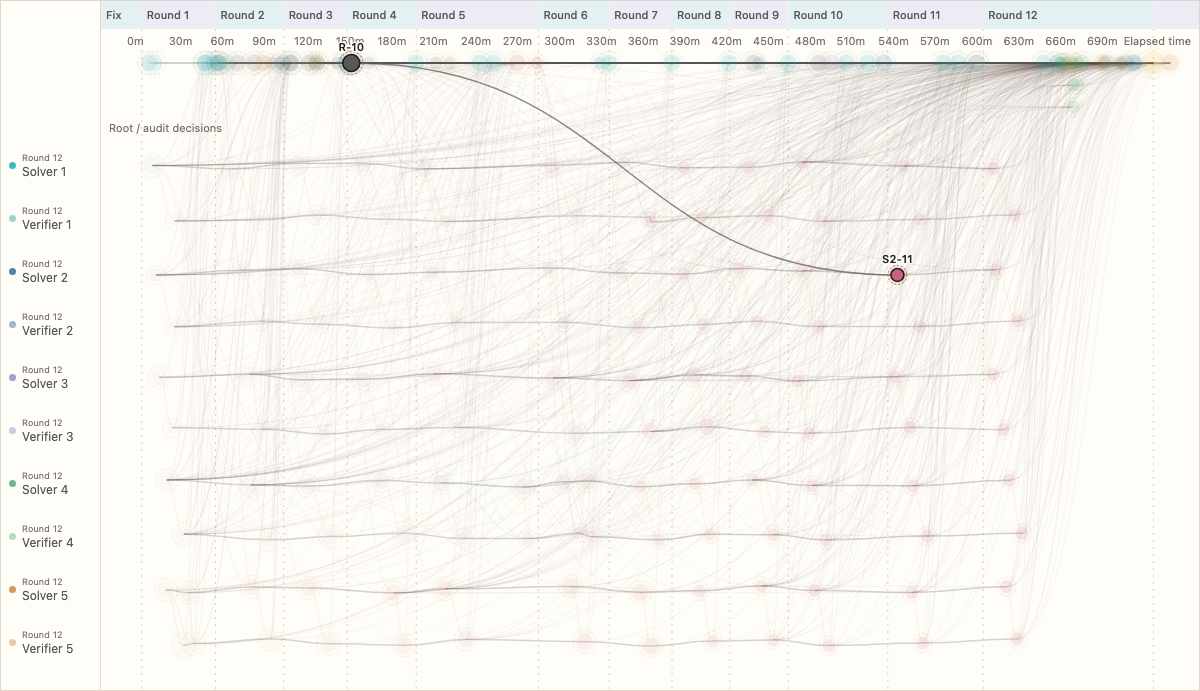
Open after Attempt 3; supporting results carry their own attempt labels
Definitions
Definition 1. Patterns
For integers \(n\ge2\), \(1\le m\le2^n\), the set \(D_{n,m}\) is uniform among distinct \(m\)-subsets of \(\{-1,1\}^n\); its elements are \(s^1,\ldots,s^m\).
Definition 2. Symmetric network
\(J\in\mathbb R^{n\times n}\), \(J=J^\top\), \(J_{ii}=0\), and \(h\in\mathbb R^n\) is unrestricted. Strict margins are $$s_i^\mu((Js^\mu)_i+h_i)>0\quad(i\in[n],\ \mu\in[m]).$$
Definition 3. Full storage
\(F_n(m)\) is existence of one symmetric network satisfying all strict margins, and $$p_n(m)=\Pr(F_n(m)).$$
Definition 4. Fit without symmetry
\(E_n(m)\) means some matrix \(J\in\mathbb R^{n\times n}\), \(J_{ii}=0\), and fields \(h\in\mathbb R^n\) satisfy $$s_i^\mu((Js^\mu)_i+h_i)>0\quad(i\in[n],\ \mu\in[m]).$$ Each row of J predicts its neuron’s sign from the other signs in each memory, using the same row for every memory; E imposes no symmetry, and F adds \(J=J^\top\). For \(m=\lfloor un\rfloor\), $$e_n(u)=\Pr(E_n(m)),\qquad p_n(m)=e_n(u)[1-c_n(u)]\quad(e_n(u)>0).$$ Neuron tests need not be independent.
Definition 5. Conditional symmetry failure
For \(m=\lfloor un\rfloor\), $$q_n(u)=1-p_n(m),\qquad c_n(u)=\Pr(F_n(m)^c\mid E_n(m))$$ when \(e_n(u)>0\). A finite conditional frequency has the all-row-feasible cases as its denominator; a zero denominator is undefined.
Definition 6. Endpoint definitions
$$\begin{aligned}\alpha_-&=\sup\{a>0:p_n(\lfloor an\rfloor)\to1\},\\a_+&=\inf\{a>0:p_n(\lfloor an\rfloor)\to0\}.\end{aligned}$$ Every limit is at fixed load as \(n\to\infty\); equality of the endpoints is a separate claim.
Definition 7. Coupled certificate
Let \(S=[s^1\ \cdots\ s^m]\), \(\Lambda=(\lambda_i^\mu)\ge0\), \(B=\Lambda\odot S\), \(t_i=\sum_\mu\lambda_i^\mu\). A normalized nonstorage certificate satisfies $$B\mathbf1=0,\quad BS^\top=\operatorname{diag}(t)+K,\quad K^\top=-K,\quad\sum_i t_i=1.$$
Definition 8. Constraint matrix
Put \(d=n+\binom n2\), with one coordinate per field and unordered edge. Row \((\mu,i)\) of \(A_R\in\mathbb Z^{mn\times d}\) has field coefficient \(s_i^\mu\) at \(i\), edge coefficient \(s_i^\mu s_j^\mu\) on every incident edge, and zero elsewhere. For \(\theta=(h,(J_{ij})_{i<j})\), the entries of \(A_R\theta\) are exactly the original strict margins.
Definition 9. Reciprocal Gaussian surrogate
In the constraint matrix replace each singleton coefficient by an independent standard normal \(g_i^\mu\) and each edge coefficient by an independent standard normal \(g_{ij}^\mu\). The same \(g_{ij}^\mu\) occurs at both endpoint constraints; all primitive normals are independent. This defines \(A_G\in\mathbb R^{mn\times d}\), a separate surrogate whose storage law requires a comparison theorem before transfer to cube inputs.
Definition 10. Distance from the constraint hull
For a real matrix \(A\) with rows \(a_1,\ldots,a_N\), $$\tau(A)=\min_{\lambda\ge0,\,\mathbf1^\top\lambda=1}\|A^\top\lambda\|_2=\operatorname{dist}(0,\operatorname{conv}\{a_1,\ldots,a_N\}).$$ Strict simultaneous feasibility is equivalent to \(\tau(A)>0\); a small positive distance still means feasibility.
Definition 11. Arithmetic exact-zero cutoff
For \(d=n(n+1)/2\), define $$H_n=[n\sqrt{d+2}]^{d+2},\qquad\epsilon_n=(4H_n)^{-1}.$$ In this arithmetic-cutoff route, a smooth \(\psi:[0,\infty)\to[0,1]\) equals one on \([0,1]\) and zero on \([2,\infty)\). The cube separation bound \(\tau(A_R)>0\Rightarrow\tau(A_R)\ge H_n^{-1}\) makes \(\psi(\tau(A_R)/\epsilon_n)\) the exact nonstorage indicator; other routes define their own cutoff scales.
Definition 12. Augmented pattern conditioning
For the spin matrix \(S\in\{-1,1\}^{n\times m}\), put $$U=\begin{bmatrix}S\\\mathbf1^\top\end{bmatrix}\in\mathbb R^{(n+1)\times m}.$$ Its least singular value is \(\sigma_{\min}(U)\). For every fixed \(u>1\), \(m=\lfloor un\rfloor\), the checked conditioning theorem supplies a dimension-independent constant \(c_u>0\) with $$\Pr\{\sigma_{\min}(U)\ge c_u\sqrt n\}\longrightarrow1.$$ This theorem concerns \(U\), not an independent-entry representation of the full constraint matrix.
Definition 13. Positive-floor residual
For \(N=nm\), a deterministic \(0<\zeta_n<1\), and a matrix \(A\in\mathbb R^{N\times d}\), define $$\mathcal L_n=\{\lambda\ge(\zeta_n/N)\mathbf1:\mathbf1^\top\lambda=1\},\qquad\rho_n(A)=\min_{\lambda\in\mathcal L_n}\|A^\top\lambda\|_2.$$ The minimum is attained on a nonempty compact set. This residual imposes a positive floor on every coordinate; unrestricted exact nonstorage alone need not provide that floor.
Definition 14. Reciprocal repair cost
For a directed zero-diagonal spin matrix \(J^{\mathrm{free}}\), $$D(J^{\mathrm{free}})=\max_{\varnothing\ne I\subseteq[n]}\frac{1}{|I|}\sum_{\substack{i<j\\i,j\in I}}|J^{\mathrm{free}}_{ij}-J^{\mathrm{free}}_{ji}|.$$ Its sufficient-condition use also requires all original directed margins at least1.
Fix \(1<u<2\), \(m=\lfloor un\rfloor\), \(N=nm\), \(d=n+\binom n2\), \(a=n^{-4}\), and \(\epsilon=(c_u/2)n^{-7/2}\), where the augmented spin matrix has least singular value at least \(c_u\sqrt n\) with probability tending to one. For \(Y\in\mathbb R^{m\times d}\), define $$[A(Y)^\top\lambda]_{h_i}=\sum_\mu Y_{\mu,i}\lambda_{i\mu},\qquad [A(Y)^\top\lambda]_{ij}=\sum_\mu Y_{\mu,ij}(\lambda_{i\mu}+\lambda_{j\mu}).$$ $$\mathcal L_a=\{\lambda\ge a\mathbf1:\mathbf1^\top\lambda=1\},\quad \rho(Y)=\min_{\lambda\in\mathcal L_a}\|A(Y)^\top\lambda\|_2,\quad f(Y)=\psi(\rho(Y)/\epsilon).$$ Here one fixed smooth \(0\le\psi\le1\) equals one on \([0,1/2]\) and zero on \([1,\infty)\); the floor simplex is nonempty eventually.Let all primitive entries of \(G\) be independent standard normals; each edge primitive is reused in its two endpoint constraints.
At a specified fixed load, prove $$\mathbb E_G f(G)\longrightarrow1.$$
Recorded G13(u) is open at both 33/20 and 9/5. A lower bound for a restricted minimum cannot lower-bound the full minimum.
In the attempt tree