Storage capacity › Q3 · Dual certificates
Q1. Can pairwise tests decide whether all patterns are storable?
Definitions
Definition 1. Spin network
For \(n\ge2\), \(J=J^\top\in\mathbb R^{n\times n}\), \(J_{ii}=0\), and \(h\in\mathbb R^n\). $$H_i(s)=\sum_{j\ne i}J_{ij}s_j+h_i,\qquad f_{J,h}(s)_i=\sigma(H_i(s)),\qquad\sigma(t)=\begin{cases}+1,&t>0,\\-1,&t\le0.\end{cases}$$ Strict storage requires \(s_iH_i(s)>0\) for every prescribed spin and neuron.
Definition 2. Storage probability
\(D\) is uniform among the \(m\)-element subsets of \(\{-1,1\}^n\). $$p_n(m)=\Pr\{D\text{ is storable}\}.$$
Definition 3. Capacity
$$\alpha_-=\sup\{a>0:p_n(\lfloor an\rfloor)\longrightarrow1\}.$$ This supremum does not assert a sharp threshold.
Definition 4. Two limiting endpoints
$$\alpha_-=\sup\{u>0:p_n(\lfloor un\rfloor)\to1\},\qquad \alpha_+=\inf\{a>0:p_n(\lfloor an\rfloor)\to0\}.$$ A sharp proportional threshold is equivalent to equality of these endpoints.
Definition 5. Spin patterns
\(s^\mu\in\{-1,1\}^n\), and \(S=[s^1\ \cdots\ s^m]\in\{-1,1\}^{n\times m}\).
Definition 6. Spin couplings
\(J=J^\top\in\mathbb R^{n\times n}\), \(J_{ii}=0\), and \(h\in\mathbb R^n\). Strict stability means \(s_i^\mu((Js^\mu)_i+h_i)>0\).
Definition 7. Augmented projection
$$U=\begin{bmatrix}S\\\mathbf1_m^\top\end{bmatrix},\qquad P=U(U^\top U)^{-1}U^\top$$ when \(U\) has column rank \(m\). Its last coordinate represents a free field.
Definition 8. Nonstorage certificate
The multipliers \(\lambda_i^\mu\ge0\) have total mass one and satisfy $$\sum_\mu\lambda_i^\mu s_i^\mu=0,\qquad \sum_\mu(\lambda_i^\mu+\lambda_j^\mu)s_i^\mu s_j^\mu=0\quad(i<j).$$ Their existence is equivalent to nonstorage.
Definition 9. First failure time
Uniformly order the entire spin cube and let \(\tau_n\) be the first prefix length that is not storable. $$p_n(m)=\Pr\{\tau_n>m\}.$$
Definition 10. Maximum storable subset
For a finite sample \(D\), $$L(D)=\max\{|E|:E\subseteq D\text{ is storable}\}.$$ Full storage is the event \(L(D)=|D|\).
Statement
Attempt 1 · supporting result in its stated scope
Pairwise necessity is insufficient. For distinct spins \(s^1,\ldots,s^m\in\{-1,1\}^n\), put \(d^{\mu\nu}=s^\mu-s^\nu\). Joint storage implies that some symmetric zero-diagonal real matrix \(J\) satisfies
$$(d^{\mu\nu})^\top Jd^{\mu\nu}>0\qquad(1\le\mu<\nu\le m).$$
Failure of the pairwise system is equivalent to the existence of real coefficients
$$c_{\mu\nu}\ge0,\qquad\sum_{\mu<\nu}c_{\mu\nu}>0,\qquad\sum_{\mu<\nu}c_{\mu\nu}d^{\mu\nu}(d^{\mu\nu})^\top\text{ is diagonal}.$$
Such coefficients certify nonstorage. Satisfying the pairwise inequalities does not certify storage: a six-pattern example in dimension five satisfies all pairwise inequalities but admits no storing network. For every fixed \(\alpha>2\), a uniform distinct sample of \(m=\lfloor\alpha n\rfloor\) patterns is, with probability tending to one, nonstorable while satisfying the pairwise inequalities.
Proof and supporting results
Step 1. A pair-difference cone yields duals
Established in Attempt 1 · stated scope
For distinct spins \(s^1,\ldots,s^m\), set \(d^{\mu\nu}=s^\mu-s^\nu\). If numbers \(c_{\mu\nu}\ge0\), not all zero, satisfy $$\sum_{\mu<\nu}c_{\mu\nu}d^{\mu\nu}(d^{\mu\nu})^\top\ \text{is diagonal},$$ then the sample is not storable. Conversely, absence of such \(c\) is equivalent to existence of a symmetric zero-diagonal \(J\) with \((d^{\mu\nu})^\top Jd^{\mu\nu}>0\) for every pair; this pairwise condition is only necessary for storage.
Proof
- By the checked exact spin formulation S1-1, any storing network has strict signed local fields. For each distinct pair, every differing coordinate contributes a positive term to
$$ (d^{\mu\nu})^\top Jd^{\mu\nu}=\sum_i(s_i^\mu-s_i^\nu)\big((Js^\mu+h)_i-(Js^\nu+h)_i\big)>0.$$ The fields cancel, and each coordinate that differs contributes twice the sum of its two positive signed margins. Symmetry identifies this expression with the quadratic form; no diagonal variable has been introduced.
- If the displayed weighted covariance is diagonal, its inner product with zero-diagonal \(J\) vanishes; the same inner product is a nonzero nonnegative sum of the strictly positive pairwise forms. This contradiction proves nonstorage for arbitrary biases.
- Explicitly extend \(c\) symmetrically and put \(\lambda_i^\mu=\sum_{\nu\ne\mu}c_{\mu\nu}(1-s_i^\mu s_i^\nu)\). These multipliers are nonnegative. In the bias sum, each unordered pair contributes \(c_{\mu\nu}(s_i^\mu-s_i^\nu+s_i^\nu-s_i^\mu)=0\). In a shared edge sum, its contribution is \(2c_{\mu\nu}d_i^{\mu\nu}d_j^{\mu\nu}\), hence zero after summation. Their total mass is \(\sum_{\mu<\nu}c_{\mu\nu}\|d^{\mu\nu}\|^2>0\); normalizing gives precisely the checked certificate S1-2.
- For the converse concerning the pairwise relaxation, take feature vectors \(q_{\mu\nu}=(d_i^{\mu\nu}d_j^{\mu\nu})_{i<j}\). A diagonal covariance is exactly a nonzero nonnegative combination of these vectors equalling zero. If none exists, zero is outside their convex hull, and the closest-point separation argument gives an edge functional strictly positive on every \(q_{\mu\nu}\). Its coefficients define a symmetric zero-diagonal \(J\), and conversely such a \(J\) excludes a zero combination. This establishes only the pairwise relaxation alternative, not its sufficiency for storage.
Sources
The derivation is self-contained; no external theorem is required.
In the attempt tree
Figure 46. S6-1. Step 2. Pairwise energy tests miss nonstorage
Established in Attempt 1 · stated scope
The following \(n=5,m=6\) spin sample is not storable: $$S^\top=\begin{pmatrix}-1&-1&-1&1&1\\1&1&-1&-1&-1\\1&-1&1&-1&1\\1&1&1&1&-1\\-1&1&-1&-1&1\\1&1&-1&1&1\end{pmatrix}.$$ Nevertheless the symmetric zero-diagonal matrix with upper-triangular entries, in order \((12,13,14,15,23,24,25,34,35,45)\), equal to \((1,3,1,-1,-3,-1,-3,1,-1,1)\), satisfies \((s^\mu-s^\nu)^\top J(s^\mu-s^\nu)\ge8\) for every pair.
Proof
- Assign weight \(1/6\) to precisely the six neuron-pattern rows
$$(i,\mu)\in\{(2,1),(5,2),(4,3),(4,4),(2,5),(5,6)\},$$ and zero elsewhere. The two nonzero weights at each of neurons 2, 4, 5 have opposite target spins, so all bias sums vanish; the exact shared-edge sums vanish as checked below. Thus the normalized nonnegative certificate of S1-2 proves nonstorage, with arbitrary neuron biases and exactly zero diagonal.
- To exhibit the edge cancellation directly, list only each selected row's incident edge coefficients. Their unnormalized sum, in order \((12,13,14,15,23,24,25,34,35,45)\), is the zero vector. The integer script checks each coefficient by summing \(s_i^\mu s_j^\mu\) over selected rows incident to \(ij\), without floating-point arithmetic.
- Form the stated integer symmetric matrix \(J\). For all 15 unordered pattern pairs, the integer script evaluates the quadratic form exactly; its minimum is 8. Thus the pairwise strict inequalities have a positive common margin despite nonstorage. By direct trace pairing, no nonzero nonnegative weighted sum of these difference outer products can be diagonal: it would have inner product zero with \(J\), contrary to the positive forms.
- This finite example refutes the proposed sufficiency of pairwise difference tests and of their associated restricted certificates. It does not refute the exact full dual, does not imply a random obstruction at linear load, and gives no asymptotic upper bound. The script's initial floating-point search discovered the candidate, while the separate integer verification establishes all claims exactly.
Sources
The derivation is self-contained; no external theorem is required.
In the attempt tree
Figure 47. S6-2. Step 3. Random-cone sign counts lack hypotheses
Established in Attempt 1 · stated scope
Under iid uniform spin patterns, the full constraint rows are not independent: the rows for neurons \(i\ne j\) of one pattern have exactly the same, uniformly random coefficient at their shared edge. For pair features \(q_{\mu\nu,ij}=(s_i^\mu-s_i^\nu)(s_j^\mu-s_j^\nu)\), the law is not centrally symmetric when \(n\ge3\), and $$\mathbb E q_{12,ij}=0,\qquad\mathbb E q_{12,ij}^2=4,\qquad\mathbb E[q_{12,ij}q_{13,ij}]=1.$$ Consequently neither cone admits an independent centrally symmetric row law by identifying its actual rows with such a model.
Proof
- The checked exact row formula in S1-2 gives \(a_{i\mu,ij}=a_{j\mu,ij}=s_i^\mu s_j^\mu\). This coefficient is a uniform sign under iid sampling. If these two rows were independent, equality of the two uniformly random shared-edge coefficients would have probability \(1/2\), whereas its actual probability is one. The dependency is exact for every \(n,m\). Moreover all rows at a fixed neuron lie in its \(n\)-dimensional incident-edge-and-bias subspace, so \(n+1\) such rows are linearly dependent when present, irrespective of the ambient dimension \(n(n+1)/2\).
- For one pair put \(d=s^1-s^2\). Then
$$q_{12,12}q_{12,23}q_{12,13}=d_1^2d_2^2d_3^2\ge0.$$ It is strictly positive with probability \(1/8\), since each of the first three coordinates differs independently with probability \(1/2\). Negating the whole feature vector changes this triple product's sign. Thus a vector with positive triple product has positive probability but one with negative triple product has probability zero, proving failure of central symmetry. Conditioning the pair to be distinct preserves this failure because the positive-product event already implies distinctness.
- For a fixed edge \(ij\), coordinates \(i,j\) are independent. Centering gives \(\mathbb E q_{12,ij}=0\), and \(\mathbb E(s_i^1-s_i^2)^2=2\) gives variance four. For two pairs sharing pattern 1, condition on \(s^1\). The remaining patterns are conditionally independent, and each conditional mean is \(s_i^1s_j^1\), so the product mean is \(\mathbb E(s_i^1s_j^1)^2=1\). Hence their correlation is \(1/4\), rather than zero.
- These identities refute an exact replacement by independent centrally symmetric rows; they do not disprove every possible universality theorem. An asymptotic replacement would itself require a theorem controlling the zero-in-convex-hull event under these block and pair dependencies, the noncentral pair law, and the row subspaces. Neither a ratio of numbers of variables and constraints nor a count that assumes independent row signs supplies that theorem. For \(m=O(n)\), passing from iid patterns to distinct ones costs at most \(\binom m2 2^{-n}\) in event probabilities, but this vanishing sampling correction does not remove the exact algebraic relations.
Sources
The derivation is self-contained; no external theorem is required.
In the attempt tree
Figure 48. S6-3. Step 4. Pairwise obstructions vanish at every load
Established in Attempt 1 · stated scope
For iid uniform spins \(s^1,\ldots,s^m\in\{\pm1\}^n\), let $$J_H=\sum_{\rho=1}^m s^\rho(s^\rho)^\top-mI_n.$$ This matrix is symmetric with exactly zero diagonal. For \(n>4,m\ge3\), $$\Pr\{\exists\mu<\nu:(s^\mu-s^\nu)^\top J_H(s^\mu-s^\nu)\le0\}\le\binom m2\left[e^{-n/8}+\exp\!\left(-\frac{2(n/4-1)^2}{3(m-2)}\right)\right].$$ For distinct-subset sampling, add at most \(\binom m2 2^{-n}\) to this bound. Hence for every fixed \(\alpha>0\), all these quadratic forms are strictly positive with probability tending to one at \(m=\lfloor\alpha n\rfloor\). In particular, with high probability no nonzero nonnegative combination of the difference outer products is diagonal, at any fixed linear load.
Proof
- Fix a pair and condition on its two spins, at Hamming distance \(r\). Write \(d=s^\mu-s^\nu\), so \(\|d\|^2=4r\), \(d^\top s^\mu=2r\), and \(d^\top s^\nu=-2r\). For each other independent pattern, \(d^\top s^\rho\) has the distribution \(2R_\rho\), with \(R_\rho\) a sum of \(r\) independent uniform signs. The \(M=m-2\) such sums are mutually independent conditional on the pair. Therefore
$$d^\top J_Hd=8r(r-1)+4\sum_{\rho\notin\{\mu,\nu\}}(R_\rho^2-r).$$ The diagonal is exactly zero since each outer product has unit diagonal.
- For one sign sum, \(\mathbb ER^2=r\), \(\mathbb ER^4=3r^2-2r\le3r^2\). The elementary inequality \(e^{-x}\le1-x+x^2/2\), valid for \(x\ge0\), and \(1+y\le e^y\) give, for all \(t\ge0\),
$$\mathbb E e^{-t(R^2-r)}\le e^{tr}\left(1-tr+\tfrac12t^2\mathbb ER^4\right)\le\exp(3t^2r^2/2).$$ The middle quadratic is positive, as it is an upper bound for a positive expectation (or from its negative discriminant for \(r\ge1\)). No asymptotic approximation enters this bound.
- Multiplying these moment bounds and applying Markov yields
$$\Pr\left\{\sum_{\rho=1}^{M}(R_\rho^2-r)\le-u\right\}\le\exp\left(-\frac{u^2}{6Mr^2}\right),\qquad u\ge0,$$ using \(t=u/(3Mr^2)\). For \(r\ge n/4>1\), substitute \(u=2r(r-1)\) to obtain the bound \(\exp[-2(r-1)^2/(3M)]\) for a nonpositive pair quadratic form.
- The random distance is \(r\sim\operatorname{Bin}(n,1/2)\). The elementary exponential bound \(\Pr\{r<n/4\}\le e^{-n/8}\) follows from \(\mathbb E e^{t(r-n/2)}=\cosh(t/2)^n\le e^{nt^2/8}\) and Markov. Splitting on \(r\ge n/4\), then taking a union bound over all pairs, proves the displayed finite bound. For fixed \(\alpha>0\), its two exponents are negative constants times \(n\), while the prefactor is \(O(n^2)\).
- The iid sample conditioned on no collisions is the uniform ordered distinct sample, and the total variation correction is at most \(\binom m2 2^{-n}\). The event and matrix construction are invariant under pattern order, so the claimed distinct-subset transfer follows. Finally, if \(\sum c_{\mu\nu}d^{\mu\nu}(d^{\mu\nu})^\top\) were diagonal for some nonzero \(c\ge0\), its inner product with zero-diagonal \(J_H\) would be zero, contradicting the strict positivity of every pair form. This excludes only that restricted certificate family and makes no claim of all-neuron local stability.
Sources
The derivation is self-contained; no external theorem is required.
In the attempt tree
Figure 49. S6-4. Step 5. Pair-cone mechanism is rigorously blocked
Established in Attempt 1 · stated scope
At every fixed \(\alpha>0\), the probability of a nonzero nonnegative diagonal combination of pair-difference outer products tends to zero for uniform distinct samples of size \(\lfloor\alpha n\rfloor\). For every fixed \(\alpha>2\), simultaneously with probability tending to one the full normalized symmetric dual exists but no pair-difference dual exists. Thus this mechanism cannot improve the rigorous upper bound two, and pairwise tests cannot determine storage. The original capacity, sharp-threshold question and conjectural value 1.6 remain unresolved by this argument.
Proof
- The original strict spin storage problem is exactly the full bias-and-shared-edge alternative in checked S1-2. The family in checked S6-1 embeds a nonnegative weighted diagonal covariance of pattern differences into that full dual, preserving the free biases, symmetry and zero diagonal. Therefore a positive-probability occurrence of this smaller cone could in principle have supplied a new symmetry-sensitive upper bound.
- Checked S6-4 instead constructs, for each random sample, the symmetric zero-diagonal matrix \(J_H=SS^\top-mI\). At every fixed linear load, an explicit bound of order \(n^2e^{-c_\alpha n}\) plus the collision correction proves all pair quadratic forms strictly positive with probability tending to one. Trace pairing excludes every nonzero nonnegative diagonal covariance combination on this event. This closes the proposed pair-cone route negatively at every fixed \(\alpha\), rather than merely leaving its probability unestimated.
- For every fixed \(\alpha>2\), checked S1-3 says that the original sample is not storable with probability tending to one. By S1-2 its full certificate then exists. Intersecting with the probability-one limit in Step 2 proves that full certificates lie outside the restricted pair family with probability tending to one. This asymptotic incompleteness is consistent with the exact finite witness in checked S6-2, which has a normalized six-row full dual and a quadratic matrix with minimum pair margin 8.
- Checked S6-3 excludes two unproved shortcuts: actual full rows are not independent, and the actual pair feature law is neither centrally symmetric nor independent across overlapping pairs. Thus a dimension count or an independent-row sign count cannot convert this failed relaxation into an estimate for the full cone. An asymptotic universality argument would require its own theorem covering the displayed exact dependencies.
- The precise remaining upper-bound obligation is to find a fixed \(a\in(1,2)\) with
$$\limsup_{n\to\infty}\Pr\{\exists\lambda\ge0:\ \textstyle\sum_{i,\mu}\lambda_i^\mu=1,\ \sum_\mu\lambda_i^\mu s_i^\mu=0,\ \sum_\mu(\lambda_i^\mu+\lambda_j^\mu)s_i^\mu s_j^\mu=0\ (i<j)\}>0,$$ where \(m=\lfloor an\rfloor\). This event is exactly nonstorage, not the pairwise relaxation. Such a subsequential positive lower bound would exclude convergence of storage probability to one at \(a\). Since storability is hereditary under deleting patterns, uniform sampling gives \(p_n(m)\) nonincreasing in \(m\); every fixed larger load is then excluded too, yielding \(\alpha_-\le a\). To prove a zero-one upper transition one needs the stronger full-certificate probability tending to one at every load above its claimed value. Neither assertion is proved here, and the pair family in Step 2 cannot supply either.
- All four supporting S6 nodes have paired reports without open issues, read before this dependent verdict was written. The result is a proved obstruction to this new mechanism and partial progress on the original problem; no numerical capacity or sharpness conclusion is inferred.
Sources
The derivation is self-contained; no external theorem is required.
In the attempt tree
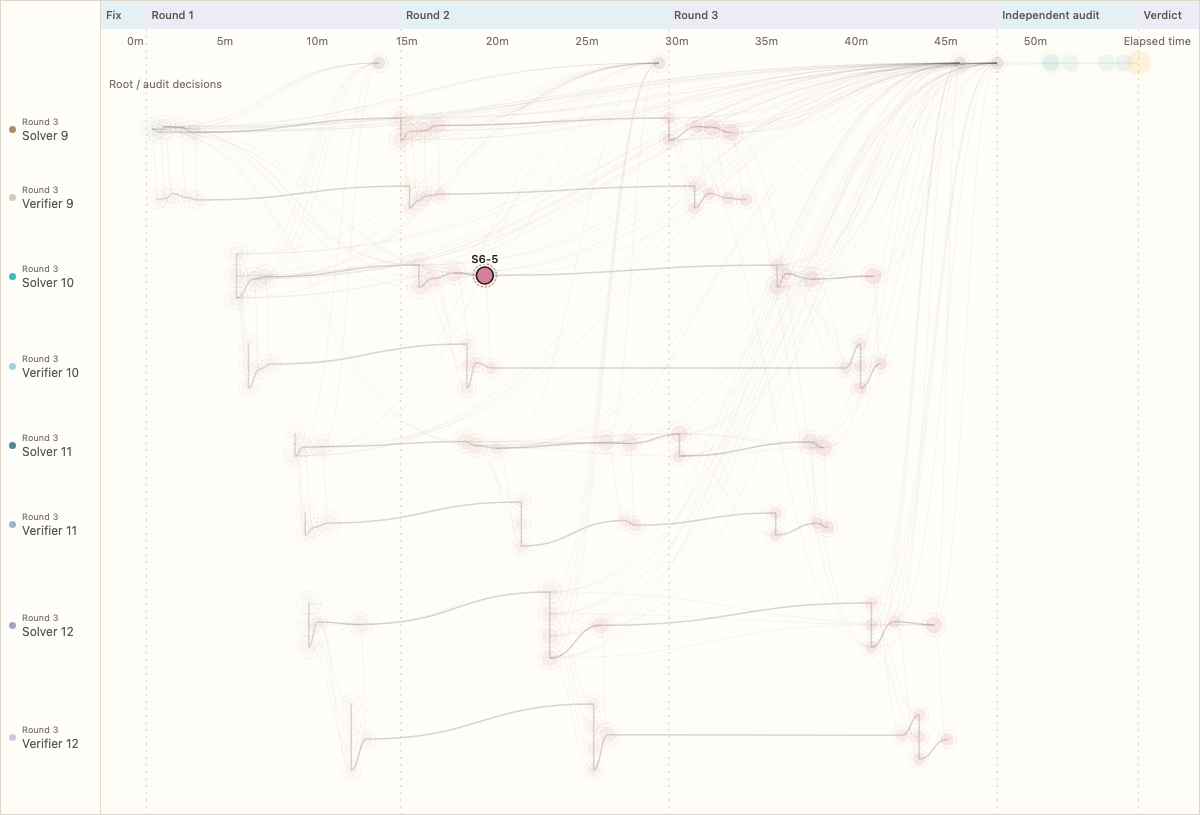
Figure 50. S6-5.