1 · The question
\(G=\mathrm{GL}_n\) acts on \(X=\mathbb A^n\): \(LX=F^n\), \(L^+X=\mathcal O^n\), \(L^+G=\mathrm{GL}_n(\mathcal O)\).
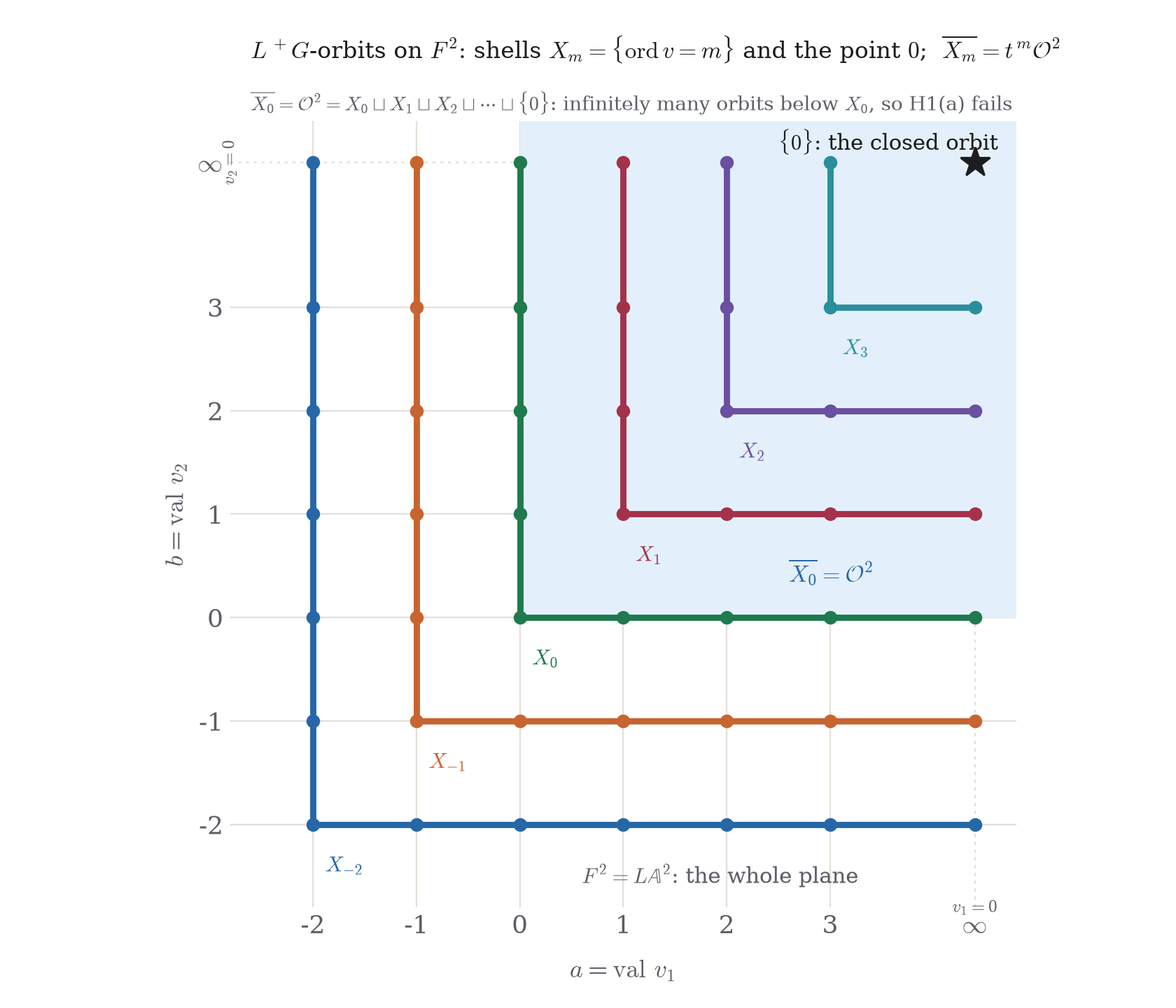
$$\mathcal C=\operatorname{Shv}_{\mathrm{cons}}(L^+G\backslash L\mathbb A^n),\qquad\mathrm{IC}_0=\underline k_{\mathcal O^n},\qquad\mathcal C^{\mathrm{Sat}}=\operatorname{Thick}_{\mathcal C}\{V_\lambda\ast\mathrm{IC}_0:\lambda\in\Lambda_T^+\},\qquad\boxed{\mathcal C^{\mathrm{Sat}}\overset?=\mathcal C.}$$H1(a) fails: every orbit closure contains infinitely many orbits. How much of Proposition I survives?
Verdict. Proposition I needs only finite posets of orbits; for \(\mathbb A^n\) finiteness holds one level at a time, and H5 is witnessed by central labels. Lost: the statement at the point \(0\), \(\mathrm{IC}_0=\Delta_0\), and the criterion of Proposition III.
2 · Definitions
The affine space and its loop space
Work over \(k=\mathbb C\) with \(F=k(\!(t)\!)\), \(\mathcal O=k[\![t]\!]\) and the \(t\)-adic valuation \(\operatorname{val}\), with \(\operatorname{val}0=\infty\). \(G=\mathrm{GL}_n\) acts on column vectors, \(T\) is the diagonal torus and \(B\) the upper triangular Borel subgroup.
$$LX=F^n,\qquad L^+X=\mathcal O^n,\qquad L^+G=\mathrm{GL}_n(\mathcal O),\qquad x_0=e_n.$$\(X\) is smooth, affine and spherical: \(B\cdot e_n=\{v:v_n\ne0\}\) is the open \(B\)-orbit, with connected stabilizer (𝔸ⁿ, setup). The base point \(e_n\) generates the open \(L^+G\)-orbit of \(L^+X\); \(L^+X\) itself is not an orbit. The order of a vector is its smallest valuation:
$$\operatorname{ord}v=\min_i\operatorname{val}v_i\in\mathbb Z\cup\{\infty\},\qquad\operatorname{ord}v=\infty\iff v=0.$$Shells, lattices and the closure order
The shells are the level sets of the order. They and the point \(0\) are the \(L^+G\)-orbits on \(LX\) (step 1):
$$X_m=\{v\in F^n:\operatorname{ord}v=m\}=t^m(\mathcal O^n\setminus t\mathcal O^n)\quad(m\in\mathbb Z),\qquad LX=\bigsqcup_{m\in\mathbb Z}X_m\ \sqcup\ \{0\}.$$The closure of a shell is a lattice, and its boundary is the next lattice:
$$\overline{X_m}=t^m\mathcal O^n=\bigsqcup_{m'\ge m}X_{m'}\sqcup\{0\},\qquad\partial X_m=\overline{X_m}\setminus X_m=t^{m+1}\mathcal O^n.$$So the closure order on orbits is a chain with the point \(0\) at the bottom: \(X_{m'}\le X_m\) exactly when \(m'\ge m\), and \(\{0\}\lt X_m\) for every \(m\).
Hecke labels and the leading exponent
A cocharacter of \(T\) is an integer vector, dominant when its entries weakly decrease. The central labels are the constant vectors:
$$\Lambda_T=\mathbb Z^n,\qquad\Lambda_T^+=\{\lambda:\lambda_1\ge\cdots\ge\lambda_n\},\qquad m\cdot\mathbf 1=(m,\dots,m),\qquad t^{m\cdot\mathbf 1}=t^m\in Z(LG).$$In place of the leading-term map \(\lambda\mapsto\lambda-\theta(\lambda)\) of a symmetric space, the last entry of \(\lambda\) names the shell of the translated base point:
$$\varphi:\Lambda_T^+\longrightarrow\mathbb Z,\qquad\varphi(\lambda):=\lambda_n=\min_i\lambda_i,\qquad t^\lambda x_0=t^{\lambda_n}e_n\in X_{\varphi(\lambda)}.$$Already on the central labels \(\varphi\) is onto: \(\varphi(m\cdot\mathbf 1)=m\).
Category, basic object, standards
\(\mathcal C\) is the small, idempotent-complete, stable \(\infty\)-category of bounded \(L^+G\)-equivariant constructible complexes on \(L\mathbb A^n\) with coefficients in \(k\), and \(\mathcal C_W\) the same on an \(L^+G\)-stable locally closed \(W\). \(\mathrm{IC}_0\) is the constant sheaf on \(L^+X\), as in the draft; here \(L^+X=\overline{X_0}\) is smooth, so \(\mathrm{IC}_0\) is the intersection complex of the closure of the open shell and not a standard object:
$$\mathcal C=\operatorname{Shv}_{\mathrm{cons}}(L^+G\backslash L\mathbb A^n),\qquad\mathrm{IC}_0=\underline k_{\mathcal O^n}=\mathrm{IC}\big(\overline{X_0}\big),\qquad\widehat{\mathcal C}=\operatorname{Ind}(\mathcal C).$$The standard of a shell extends its constant sheaf by zero. The constant objects are unshifted; a fixed shift does not affect thick generation.
$$a_m:X_m\hookrightarrow LX,\qquad\Delta_m=a_{m!}\underline k_{X_m}\in\mathcal C,\qquad\mathcal C^{\mathrm{Sat}}=\operatorname{Thick}_{\mathcal C}\{V_\lambda\ast\mathrm{IC}_0:\lambda\in\Lambda_T^+\}.$$\(V_\lambda\) is the Satake sheaf of \(\mathrm{GL}_n\), the intersection complex of \(\operatorname{Gr}_G^{\le\lambda}\), and \(\ast\) is the action of the definitions of Proposition I: \(\mathcal A\ast\mathcal F=m_!(\mathcal A\mathbin{\widetilde\boxtimes}\mathcal F)\) along \(m:LG\times^{L^+G}LX\to LX\).
Levels, pieces and finite-level categories
A level is a lattice modulo a smaller lattice, a finite-dimensional vector space on which the arc group acts through a jet group:
$$Y_N=t^{-N}\mathcal O^n=\overline{X_{-N}},\qquad Y_{N,M}=t^{-N}\mathcal O^n/t^M\mathcal O^n\cong\mathbb A^{(N+M)n},\qquad\pi_{N,M}:Y_N\twoheadrightarrow Y_{N,M},$$ $$G_{N,M}=1+t^{N+M}M_n(\mathcal O)=\ker\big(L^+G\to J_{N+M}G\big),\qquad J_{N+M}G=\mathrm{GL}_n\big(\mathcal O/t^{N+M}\big).$$\(G_{N,M}\) acts trivially on \(Y_{N,M}\), since \((1+t^{N+M}A)v=v+t^{N+M}Av\in v+t^M\mathcal O^n\) for \(v\in t^{-N}\mathcal O^n\). So the connected algebraic group \(J_{N+M}G\) acts on \(Y_{N,M}\), and \(\pi_{N,M}\) is equivariant.
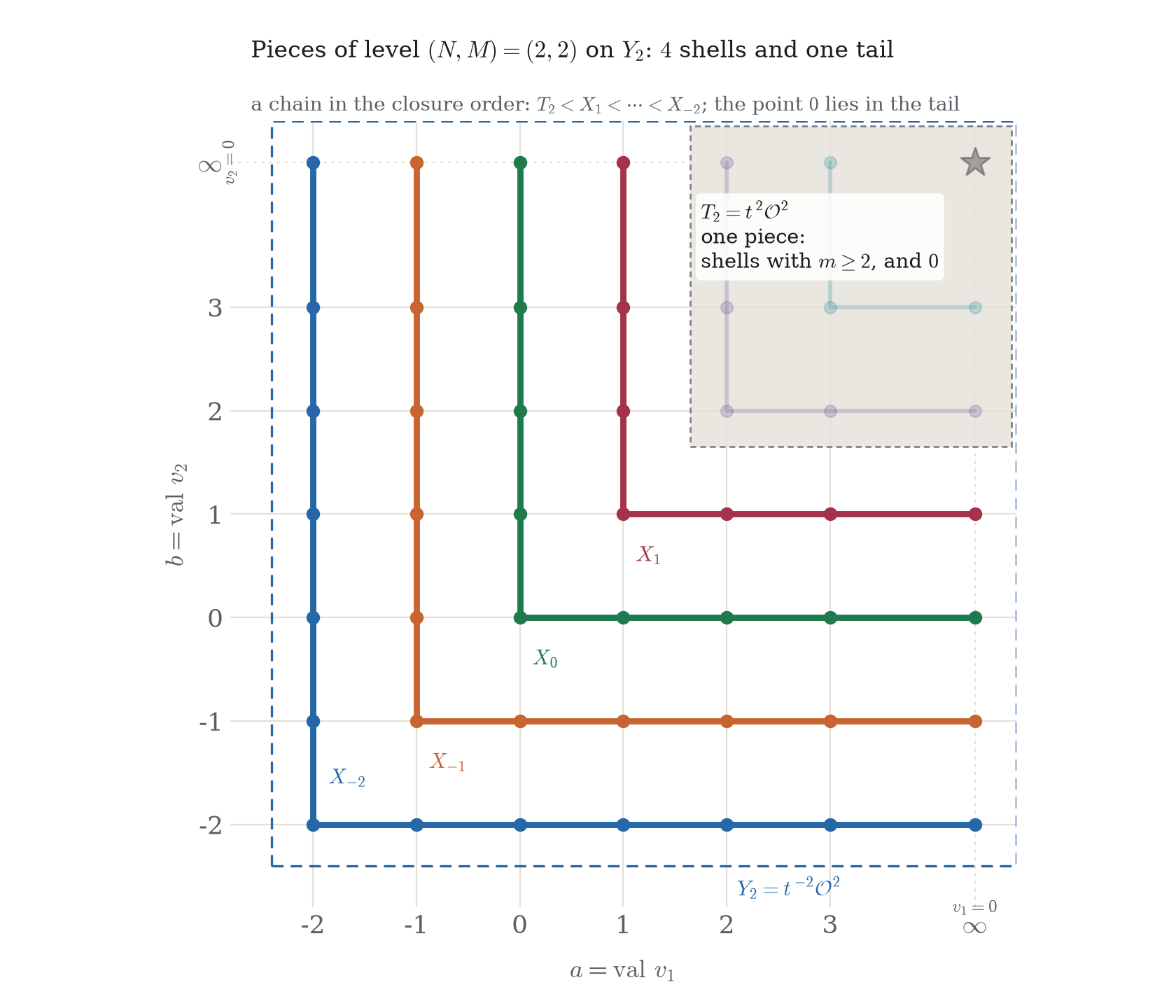
Pieces. A piece of level \((N,M)\) is the preimage under \(\pi_{N,M}\) of a \(J_{N+M}G\)-orbit on \(Y_{N,M}\). The tail of the level is the preimage of \(0\):
$$\mathcal P_{N,M}=\{\pi_{N,M}^{-1}(o):o\subseteq Y_{N,M}\ \text{an orbit}\},\qquad T_M=t^M\mathcal O^n=\pi_{N,M}^{-1}(0),\qquad P'\le P\iff P'\subseteq\overline P.$$Pieces are \(L^+G\)-stable, locally closed, and unions of orbits; the standard of a piece \(P\), with inclusion \(a_P\), is \(\Delta_P=a_{P!}\underline k_P\). For a shell it is \(\Delta_m\); for the tail, which is closed, it is \(\underline k_{T_M}\) extended by zero.
Finite-level categories. The objects pulled back from one level form a full subcategory, increasing in \(N\) and \(M\); \(r_N\) is the closed inclusion of \(Y_N\):
$$\mathcal C^{(N,M)}=\big\{r_{N*}\pi_{N,M}^*\bar M:\ \bar M\in\operatorname{Shv}_{\mathrm{cons}}(J_{N+M}G\backslash Y_{N,M})\big\}\subseteq\mathcal C,\qquad\mathcal C^{(N,M)}_W=\mathcal C^{(N,M)}\cap\mathcal C_W.$$Thick span
\(\operatorname{Thick}_{\mathcal D}(\mathcal S)\) is the smallest full subcategory of a stable \(\infty\)-category \(\mathcal D\) that contains \(0\) and \(\mathcal S\) and is closed under isomorphisms, shifts, cofibers and retracts, with the two properties used by Proposition I:
$$\text{(T1)}\quad A\to B\to C\xrightarrow{+1}\ \text{exact},\ \ A,C\in\operatorname{Thick}_{\mathcal D}(\mathcal S)\ \Longrightarrow\ B\in\operatorname{Thick}_{\mathcal D}(\mathcal S),$$ $$\text{(T2)}\quad F:\mathcal D\to\mathcal D'\ \text{exact}\ \Longrightarrow\ F\big(\operatorname{Thick}_{\mathcal D}(\mathcal S)\big)\subseteq\operatorname{Thick}_{\mathcal D'}\big(F(\mathcal S)\big).$$
3 · What breaks in Proposition I
| Hypothesis | For \(\mathbb A^n\) | Why | Used in Proposition I |
|---|---|---|---|
| H1(a) finite closures | fails | \(\overline{X_m}=t^m\mathcal O^n\) contains \(X_{m'}\) for all \(m'\ge m\), and \(0\) | step 1, induction on the number of orbits; step 7, induction on \(h(\mu)\) |
| H1(b) finite support | holds | every object lives on some \(t^{-N}\mathcal O^n=\overline{X_{-N}}\) | step 1 |
| H2 recollement | fails | the only closed finite unions of orbits are \(\varnothing\) and \(\{0\}\), and \(\{0\}\) has infinite codimension: \(\delta_0\notin\mathcal C\)[T] | steps 3–4 |
| H3 constant coefficients | holds | every stabilizer is connected (step 3) | step 1 |
| H4 constructible action | holds | central \(\lambda\) by computation (step 4); all \(\lambda\) as in Proposition III | step 2 |
| H5 top splitting | at shells only | \(\lambda=m\cdot\mathbf 1\) works at \(X_m\); nothing is supported on \(\{0\}\) | steps 2, 5, 6 |
Also: \(\delta_0\notin\mathcal C\) (remark 1), and \(\mathrm{IC}_0=\underline k_{\mathcal O^n}\) is not a standard (remark 2). What survives: every object lives on a finite level \(Y_{N,M}\), where the infinitely many small orbits collapse into one tail.
| In Proposition I, for a symmetric space | For \(\mathbb A^n\) under \(\mathrm{GL}_n\) |
|---|---|
| orbit \(\mathcal O_\mu\), \(\mu\in\Lambda_S^+\) | piece of a level: a shell \(X_m\), \(-N\le m\lt M\), or the tail \(T_M\) |
| closed finite union of orbits \(Z\) | closed union of pieces of one level: \(t^m\mathcal O^n\), \(-N\le m\le M\) |
| H1(a): finitely many orbits below \(\mu\) | L1(a): \(N+M+1\) pieces per level, a chain |
| H1(b): support in finitely many closures | L1(b): pulled back from one level |
| standard \(\Delta_\mu\); \(\mathrm{IC}_0=\Delta_0\) | \(\Delta_m\) and \(\underline k_{T_M}\); \(\mathrm{IC}_0=\underline k_{\mathcal O^n}=\mathrm{IC}(\overline{X_0})\) |
| leading-term map \(\varphi(\lambda)=\lambda-\theta(\lambda)\) | leading exponent \(\varphi(\lambda)=\lambda_n\) |
| H5 witness: a dominant lift \(\lambda\in\varphi^{-1}(\mu)\) | the central label \(m\cdot\mathbf 1\) |
| induction on \(h(\mu)=\#\{\nu\le\mu\}\) | one triangle per shell, then the union over levels |
| function shadow: \(\mathcal H_K\cdot\varphi_0=C_K\) | \(\mathbf 1_{X_m}=\mathbf 1_{t^m\mathcal O^n}-\mathbf 1_{t^{m+1}\mathcal O^n}=(\mathbf 1_{t^mK}-\mathbf 1_{t^{m+1}K})\ast\varphi_0\) (𝔸ⁿ, generation at both levels) |
4 · The level form of H1–H5
L1–L5 are H1–H5 with "orbit" read as "piece of a level".
L1 · Finite levels.
- For every level \((N,M)\) the set of pieces is finite, each piece is \(L^+G\)-stable and locally closed in \(Y_N\), and the closure of a piece in \(Y_N\) is the union of the pieces below it: $$\#\mathcal P_{N,M}\lt\infty,\qquad\overline P\cap Y_N=\bigsqcup_{P'\le P}P'.$$
- Every object of \(\mathcal C\) is pulled back from some level: $$\mathcal C=\bigcup_{N,M}\mathcal C^{(N,M)}.$$
L2 · Recollement at a level.
Let \(D\subseteq Z\) be closed unions of pieces of one level \((N,M)\) and \(P\subseteq Z\) a piece, with embeddings \(i:D\hookrightarrow Z\), \(r_Z:Z\hookrightarrow LX\) and \(a_{P,Z}:P\hookrightarrow Z\).- Restriction \(f^*\) and extension by zero \(f_!\) along these embeddings and their composites are defined and exact, and preserve the finite-level categories \(\mathcal C^{(N,M)}_{(-)}\). For a closed embedding \(f\), the extension \(f_!=f_*\) is right adjoint to \(f^*\).
- If \(P\) is open in \(Z\) with complement \(D\), then \(j=a_{P,Z}\) and \(i\) give every \(M\in\mathcal C_Z\) a localization triangle \(j_!j^*M\to M\to i_*i^*M\xrightarrow{+1}\).
- Restriction and extension by zero respect composition.
L3 · Constant coefficients on pieces.
For every piece \(P\) of a level \((N,M)\), the finite-level category of \(P\) has a bounded t-structure whose heart consists of the finite direct sums of the constant sheaf: $$\big(\mathcal C^{(N,M)}_P\big)^\heartsuit\simeq\operatorname{Vect}_k^{\mathrm{fd}},\qquad V\longmapsto\underline k_P\otimes_kV.$$ For the ordinary t-structure the heart is \(\operatorname{Rep}^{\mathrm{fd}}_k\big(\pi_0\operatorname{Stab}_{J_{N+M}G}(o)\big)\) for the orbit \(o=\pi_{N,M}(P)\), so connected stabilizers give L3.L4 · Constructible Hecke action.
The action is defined and takes values in \(\mathcal C\): $$\ast:\mathcal H\times\mathcal C\longrightarrow\mathcal C,\qquad V_\lambda\ast\mathrm{IC}_0\in\mathcal C\quad(\lambda\in\Lambda_T^+).$$L5 · Nonzero top splitting on pieces.
For every level \((N,M)\) and every piece \(P\in\mathcal P_{N,M}\), with inclusion \(a_P:P\hookrightarrow LX\), there is \(\lambda\in\Lambda_T^+\) whose Satake object lies in \(\mathcal C^{(N,M)}\) and has two properties:- It lives on the closure of \(P\): \(\operatorname{supp}(V_\lambda\ast\mathrm{IC}_0)\subseteq\overline P\).
- Its restriction to \(P\) is a finite, nonzero sum of shifted constant sheaves: $$a_P^*(V_\lambda\ast\mathrm{IC}_0)\simeq\bigoplus_{s=1}^{N_P}\underline k_P[d_s]\ \text{ in }\mathcal C^{(N,M)}_P,\qquad0\lt N_P\lt\infty.$$
Proposition I′ · Level formProved: the proof of Proposition I, read at one level
Assume L1–L5. Then the Satake subcategory is everything, and the Satake objects detect zero in \(\widehat{\mathcal C}\):
$$\boxed{\mathcal C^{\mathrm{Sat}}=\mathcal C},\qquad\Map_{\widehat{\mathcal C}}(V_\lambda\ast\mathrm{IC}_0,F)=0\ \ \forall\lambda\ \Longrightarrow\ F=0.$$Proof
Proof · three steps at a fixed level, then the union
- Standard generation at level \((N,M)\). For every closed union \(Z\) of pieces of the level, the piece standards generate: \(\mathcal C^{(N,M)}_Z=\operatorname{Thick}\{\Delta_{P,Z}:P\subseteq Z\}\). This is step 1 of Proposition I with L1(a), L2 and L3 in place of H1(a), H2 and H3: on one piece, truncation in the t-structure of L3 builds every object from \(\underline k_P\) by (T1); in \(Z\), a piece maximal for \(\le\) is open by L1(a), the triangle of L2(b) leaves an object on one piece fewer, and (T2) for \(j_!\) and \(i_*\) closes the induction on \(\#\{P\subseteq Z\}\).
- Induction over the pieces of the level. \(\Delta_P\in\mathcal C^{\mathrm{Sat}}\) for every piece \(P\), by induction on \(h(P)=\#\{P'\le P\}\). Take \(\lambda\) from L5. The boundary part \(i_{P*}i_P^*(V_\lambda\ast\mathrm{IC}_0)\) lies in \(\mathcal C^{(N,M)}_{\partial P}\) by L2(a), hence in \(\operatorname{Thick}\{\Delta_{P'}:P'\lt P\}\subseteq\mathcal C^{\mathrm{Sat}}\) by step 1, (T2) and induction. The top part \(a_{P!}a_P^*(V_\lambda\ast\mathrm{IC}_0)\) lies in \(\mathcal C^{\mathrm{Sat}}\) by L5(a), the triangle of L2(b) and (T1). By L5(b) it is \(\bigoplus_s\Delta_P[d_s]\) with \(N_P\ge1\) summands, so \(\Delta_P\) is a retract of an object of \(\mathcal C^{\mathrm{Sat}}\). These are steps 2–6 of Proposition I.
- Union over levels. Steps 1 and 2 give \(\mathcal C^{(N,M)}\subseteq\mathcal C^{\mathrm{Sat}}\) for every level; L1(b) gives \(\mathcal C=\bigcup\mathcal C^{(N,M)}\subseteq\mathcal C^{\mathrm{Sat}}\). Detection in \(\widehat{\mathcal C}\) is step 7 of Proposition I, unchanged.
5 · Proposition IV
Proposition IV · \(\mathbb A^n\) under \(\mathrm{GL}_n\)Proved, given the level presentation L1(b)
Setting. \(X=\mathbb A^n\) under \(G=\mathrm{GL}_n\), any \(n\ge1\); \(\mathcal C\), \(\mathrm{IC}_0\), the shells \(X_m\), the levels \(Y_{N,M}\) and the pieces are as in the definitions.
Claim.
- H1(a) fails: \(\overline{X_m}=\bigsqcup_{m'\ge m}X_{m'}\sqcup\{0\}\) for every \(m\). The orbit \(\{0\}\) is closed, of infinite codimension, and has no standard object in \(\mathcal C\). Proposition I does not apply as stated.
- Given L1(b), the level hypotheses L1–L5 hold, and L5 is witnessed on every piece by a central label: \(\lambda=m\cdot\mathbf 1\) at the shell \(X_m\) and \(\lambda=M\cdot\mathbf 1\) at the tail \(T_M\).
- Hence the central Satake objects, which are the constant sheaves on the lattices, already generate, and the Satake objects detect zero in \(\widehat{\mathcal C}\): $$\boxed{\mathcal C=\operatorname{Thick}_{\mathcal C}\{V_{m\cdot\mathbf 1}\ast\mathrm{IC}_0=\underline k_{t^m\mathcal O^n}:m\in\mathbb Z\}=\mathcal C^{\mathrm{Sat}}.}$$
Classical reading. For \(F\) non-archimedean, \(\mathcal H_K\cdot\varphi_0=C_K\) with the elements \(\mathbf 1_{t^mK}\) alone (𝔸ⁿ, generation at both levels).
Proof
Step 1 finds the orbits and proves (a); steps 2–5 check L1–L5, which is (b); step 6 applies Proposition I′ and collapses its induction, which is (c).
- Result Orbits and closures: part (a).
The \(L^+G\)-orbits on \(F^n\) are the shells and the point \(0\), and the closure of a shell is a lattice:
$$L^+G\cdot v=X_{\operatorname{ord}v}\quad(v\ne0),\qquad\overline{X_m}=t^m\mathcal O^n=\bigsqcup_{m'\ge m}X_{m'}\sqcup\{0\}.$$Proof
- Primitive vectors. If \(\operatorname{ord}v=0\), some coordinate \(v_i\) is a unit, and the matrix with columns \(e_1,\dots,\widehat{e_i},\dots,e_n,v\) has determinant \(\pm v_i\in\mathcal O^\times\): it lies in \(L^+G\) and sends \(e_n\) to \(v\). So \(L^+G\cdot e_n=\mathcal O^n\setminus t\mathcal O^n=X_0\).
- Shells. A nonzero \(v\) is \(t^mv_0\) with \(m=\operatorname{ord}v\) and \(v_0\) primitive; \(L^+G\) preserves every \(t^m\mathcal O^n\), hence the order, so \(L^+G\cdot v=t^mX_0=X_m\). The point \(0\) is fixed.
- Closures. \(t^m\mathcal O^n=\varprojlim_Mt^m\mathcal O^n/t^M\mathcal O^n\), and for \(M\gt m\) the shell \(X_m\) is the preimage of the complement of the proper linear subspace \(t^{m+1}\mathcal O^n/t^M\mathcal O^n\), a dense open subset of the affine space \(t^m\mathcal O^n/t^M\mathcal O^n\). So \(X_m\) is open and dense in the closed subset \(t^m\mathcal O^n\) of \(LX\), whose other points are the shells with \(m'\gt m\) and \(0\).
- Part (a). The closure of \(X_m\) contains the infinitely many orbits \(X_{m'}\), \(m'\gt m\): H1(a) fails. The point \(0\) is the intersection of the lattices \(t^M\mathcal O^n\), of codimension \((M-m)n\to\infty\) in \(t^m\mathcal O^n\); its skyscraper is supported on a set that is not a union of pieces of any level, so under L1(b) it is not an object of \(\mathcal C\), and no standard \(\Delta_{\{0\}}\) exists in \(\mathcal C\).
- Result L1: the pieces of a level form a chain.
$$\mathcal P_{N,M}=\{X_m:-N\le m\lt M\}\sqcup\{T_M\},\qquad T_M\lt X_{M-1}\lt\cdots\lt X_{-N},\qquad\#\mathcal P_{N,M}=N+M+1.$$
Proof
- For \(-N\le m\lt M\), the shell \(X_m\subseteq Y_N\) is a union of cosets of \(t^{m+1}\mathcal O^n\supseteq t^M\mathcal O^n\), so \(X_m=\pi_{N,M}^{-1}(\pi_{N,M}(X_m))\); and \(\pi_{N,M}(X_m)\) is one \(J_{N+M}G\)-orbit, since \(L^+G\) is transitive on \(X_m\) and acts on \(Y_{N,M}\) through \(J_{N+M}G\).
- Every shell with \(m\ge M\), and the point \(0\), map to \(0\in Y_{N,M}\), which \(J_{N+M}G\) fixes; the preimage of \(0\) is \(T_M=t^M\mathcal O^n\). These preimages partition \(Y_N\), so they are all the pieces.
- By step 1, the closure of \(X_m\) in \(Y_N\) is \(t^m\mathcal O^n=\bigsqcup_{m\le m'\lt M}X_{m'}\sqcup T_M\), a union of pieces of the level, and \(T_M\) is closed. This is L1(a), with the chain as the closure order.
- L1(b), assumed. That every object of \(\mathcal C\) is pulled back from some \(Y_{N,M}\) is the reading of the draft's colimit description of sheaves on the placid ind-scheme \(LX=\varinjlim_NY_N\), \(Y_N=\varprojlim_MY_{N,M}\); it is the same assumption as in I1 of the Iwahori workspace, and the finite-level analogue of H1(b).
- Result L2 and L3: recollement and connected stabilizers at a level.
$$\operatorname{Stab}_{J_{N+M}G}(0)=J_{N+M}G,\qquad\operatorname{Stab}_{J_{N+M}G}\big(t^me_n\bmod t^M\big)=\{g:\ ge_n\equiv e_n\bmod t^{M-m}\},\qquad\text{both connected}.$$
Proof
- L2. Pieces of level \((N,M)\) are the preimages of the orbits of the connected algebraic group \(J_{N+M}G\) on the vector space \(Y_{N,M}\), and closed unions of pieces are preimages of closed unions of orbits. The equivariant derived category of \(Y_{N,M}\) has restriction and extension by zero along stable locally closed embeddings, exact, compatible with composition, with \(f_!=f_*\) right adjoint to \(f^*\) for closed \(f\) and the localization triangle for an open-closed pair (Bernstein–Lunts; BBD, §1.4). Pullback along the smooth equivariant surjection \(\pi_{N,M}\) commutes with these functors, so they preserve the finite-level categories \(\mathcal C^{(N,M)}_{(-)}\).
- L3 at the tail. \(\pi_{N,M}(T_M)=\{0\}\), whose stabilizer is all of \(J_{N+M}G\), connected; equivariant sheaves on a point under a connected group have constant heart.
- L3 at a shell. \(t^me_n\in X_m\) represents the orbit \(\pi_{N,M}(X_m)\). Its stabilizer is the set of \(g\in\mathrm{GL}_n(\mathcal O/t^{N+M})\) with \(ge_n\equiv e_n\bmod t^{M-m}\), \(M-m\ge1\): the preimage under reduction modulo \(t\) of \(\{\bar g\in\mathrm{GL}_n(k):\bar ge_n=e_n\}\cong\mathrm{GL}_{n-1}\ltimes k^{n-1}\), which is connected, by the connected unipotent kernel of reduction, intersected with an affine-linear condition on the last column. So it is connected, and the heart \(\operatorname{Rep}^{\mathrm{fd}}_k(\pi_0\operatorname{Stab})\) is \(\operatorname{Vect}_k^{\mathrm{fd}}\).
- Result The central Satake objects are the constant sheaves on the lattices.
$$V_{m\cdot\mathbf 1}\ast\mathrm{IC}_0\simeq\underline k_{t^m\mathcal O^n}\qquad(m\in\mathbb Z),\qquad\underline k_{t^m\mathcal O^n}\in\mathcal C^{(N,M)}\ \text{ for }-N\le m\le M.$$
Proof
- \(t^{m\cdot\mathbf 1}=t^m\) is central in \(LG\), so \(L^+G\,t^mL^+G=t^mL^+G\) and \(\operatorname{Gr}_G^{\le m\cdot\mathbf 1}=\operatorname{Gr}_G^{m\cdot\mathbf 1}=\{t^mL^+G\}\) is a point; \(V_{m\cdot\mathbf 1}\) is the constant sheaf on it, unshifted.
- The convolution space is \(t^mL^+G\times^{L^+G}\mathcal O^n\), and the action map \([t^mg,v]\mapsto t^mgv\) is an isomorphism onto the lattice \(t^m\mathcal O^n\), with inverse \(w\mapsto[t^m,t^{-m}w]\). So \(m_!\) of the constant sheaf is \(\underline k_{t^m\mathcal O^n}\), extended by zero to \(LX\).
- For \(-N\le m\le M\), \(t^m\mathcal O^n/t^M\mathcal O^n\) is a \(J_{N+M}G\)-stable linear subspace of \(Y_{N,M}\), and \(\underline k_{t^m\mathcal O^n}\) is the pullback of its constant sheaf: it lies in \(\mathcal C^{(N,M)}\). This is L4 for the central labels; for all \(\lambda\) the support is bounded by the leading exponent (remark 3), and the action is assumed to land in \(\mathcal C\) with the same status as H4 in Proposition III.
- Result L5 holds, with central labels.
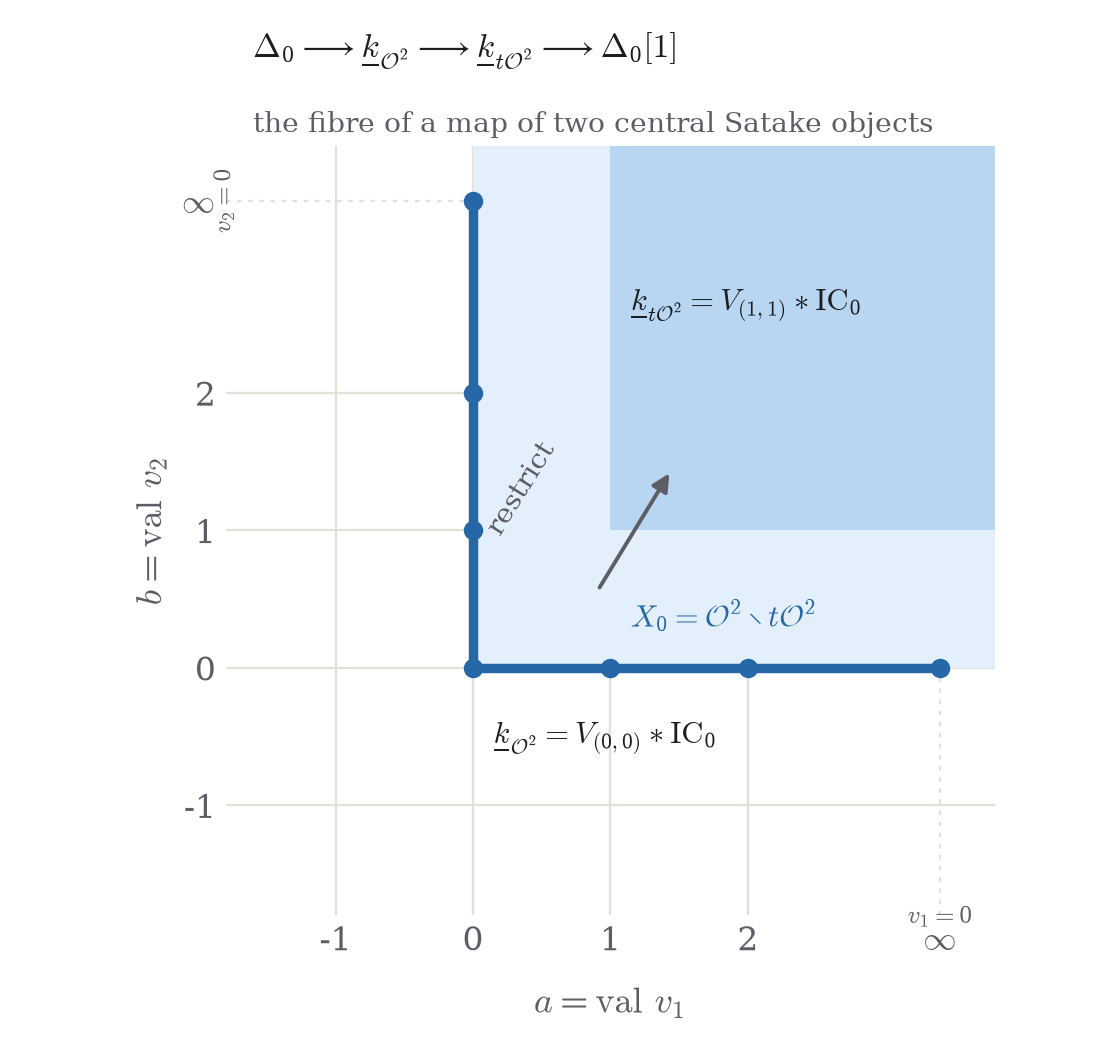
At the shell \(X_0\): the Satake object \(\underline k_{\mathcal O^2}\) lives on \(\overline{X_0}\), and its boundary part is the next central Satake object. $$P=X_m:\ \ \lambda=m\cdot\mathbf 1,\quad\operatorname{supp}=t^m\mathcal O^n=\overline{X_m},\quad a_m^*\big(V_\lambda\ast\mathrm{IC}_0\big)=\underline k_{X_m};\qquad P=T_M:\ \ \lambda=M\cdot\mathbf 1,\quad V_\lambda\ast\mathrm{IC}_0=\underline k_{T_M}.$$
Proof
- At a shell piece \(X_m\), \(-N\le m\lt M\): by step 4 the Satake object of \(m\cdot\mathbf 1\) is \(\underline k_{t^m\mathcal O^n}\), in \(\mathcal C^{(N,M)}\), supported on \(\overline{X_m}\) (L5(a)); its restriction to the open subset \(X_m\) is the constant sheaf, one summand, no shift (L5(b) with \(N_P=1\)).
- At the tail \(T_M\): \(\underline k_{T_M}=V_{M\cdot\mathbf 1}\ast\mathrm{IC}_0\), in \(\mathcal C^{(N,M)}\), supported on \(T_M=\overline{T_M}\), with restriction \(\underline k_{T_M}\).
- The witnesses are the central labels, on which the leading exponent \(\varphi(m\cdot\mathbf 1)=m\) is already onto \(\mathbb Z\): the coverage condition \(\varphi(\Lambda_T^+)=\Lambda_S^+\) of Proposition III has a trivial analogue here. With steps 2–4 this proves (b).
- Conclusion Proposition I′ applies, and its induction collapses to one triangle per shell.
$$\Delta_m\longrightarrow\underline k_{t^m\mathcal O^n}\longrightarrow\underline k_{t^{m+1}\mathcal O^n}\xrightarrow{+1},\qquad\Delta_m\in\operatorname{Thick}\{V_{m\cdot\mathbf 1}\ast\mathrm{IC}_0,\ V_{(m+1)\cdot\mathbf 1}\ast\mathrm{IC}_0\}.$$
Proof
- Steps 2–5 give L1–L5, so Proposition I′ gives \(\mathcal C^{\mathrm{Sat}}=\mathcal C\) and detection in \(\widehat{\mathcal C}\).
- Explicitly: \(X_m\) is open in \(t^m\mathcal O^n\) with closed complement \(t^{m+1}\mathcal O^n\), and the localization triangle of L2(b) for \(\underline k_{t^m\mathcal O^n}\) reads \(\Delta_m\to\underline k_{t^m\mathcal O^n}\to\underline k_{t^{m+1}\mathcal O^n}\). Both outer terms are central Satake objects, so \(\Delta_m\) is in their thick span by (T1), as a fibre. The tail standard \(\underline k_{T_M}\) is itself a central Satake object. The retract of step 2 of Proposition I′ is not needed: the top part is exactly one copy of \(\Delta_m\).
- So every piece standard of every level lies in \(\operatorname{Thick}\{\underline k_{t^m\mathcal O^n}:m\in\mathbb Z\}\); by standard generation at each level and L1(b), this thick span is all of \(\mathcal C\). This is (c), and its function shadow is \(\mathbf 1_{X_m}=\mathbf 1_{t^m\mathcal O^n}-\mathbf 1_{t^{m+1}\mathcal O^n}\).
6 · Remarks
- The point \(0\). The unique closed orbit, of infinite codimension in every \(Y_N\). At level \((N,M)\) it lies in the tail \(T_M\), whose standard is the central Satake object \(\underline k_{T_M}\). Its skyscraper \(\delta_0\) is not pulled back from any level, so it is not an object of \(\mathcal C\): the orbit-by-orbit conclusion "\(\Delta_\mu\in\mathcal C^{\mathrm{Sat}}\) for every orbit" has no content at \(0\), and the level form replaces it. For functions, local constancy at \(0\) plays the same role (𝔸ⁿ, generation at both levels).
- \(\mathrm{IC}_0\) is not a standard. \(L^+X=\mathcal O^n=\overline{X_0}\) is the closure of the open shell, not an orbit, and \(\mathrm{IC}_0=\underline k_{\mathcal O^n}=\mathrm{IC}(\overline{X_0})\). The standard of the open shell needs two Satake objects: $$\Delta_0=\operatorname{fib}\big(\mathrm{IC}_0\longrightarrow V_{\mathbf 1}\ast\mathrm{IC}_0\big).$$ For a symmetric space \(L^+X=\mathcal O_0\) is a closed orbit and \(\mathrm{IC}_0=\Delta_0\).
- Non-central labels. Every lattice \(L=g\mathcal O^n\) with \(g\in L^+G\,t^{\lambda'}L^+G\), \(\lambda'\le\lambda\), satisfies \(t^{\lambda_1}\mathcal O^n\subseteq L\subseteq t^{\lambda_n}\mathcal O^n\), since \(\lambda'_1\le\lambda_1\) and \(\lambda'_n\ge\lambda_n\) in the dominance order. Proper base change along the action map gives the stalks and the support bound:
$$(V_\lambda\ast\mathrm{IC}_0)_v\simeq R\Gamma\big(\{L\in\operatorname{Gr}_G^{\le\lambda}:v\in L\},\ V_\lambda\big),\qquad\operatorname{supp}(V_\lambda\ast\mathrm{IC}_0)\subseteq t^{\lambda_n}\mathcal O^n=\overline{X_{\varphi(\lambda)}},$$
with stalk \(IH^*(\operatorname{Gr}_G^{\le\lambda})\) at every \(v\in t^{\lambda_1}\mathcal O^n\), so the object is constant on the tail \(t^{\lambda_1}\mathcal O^n\). On \(X_{\varphi(\lambda)}\) the fibre is nonempty, and the argument of Proposition III, step 6, applies verbatim to show the stalk is nonzero; this is not needed for Proposition IV and is not re-checked here. Two examples for \(n=2\), with \(V_\lambda=\underline k_{\mathbb P^1}[1]\):
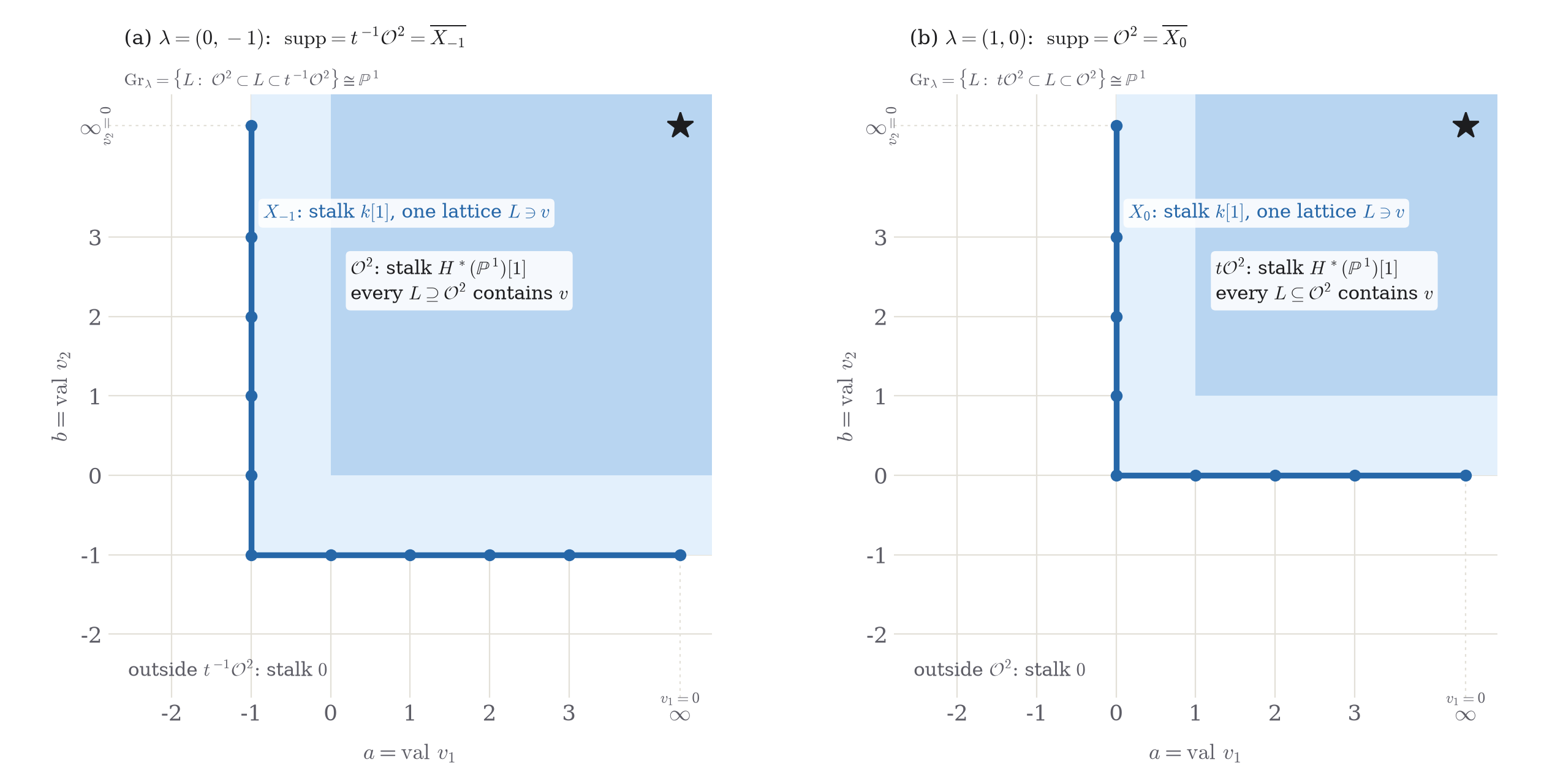
Figure 3. Two non-central Satake objects for \(n=2\): each lives on \(\overline{X_{\varphi(\lambda)}}\), is one shifted constant sheaf on \(X_{\varphi(\lambda)}\), and is constant on the tail \(t^{\lambda_1}\mathcal O^2\). Table 3. · Stalks of three Satake objects for \(n=2\). \(\lambda\) \(\operatorname{supp}\) on \(X_{\varphi(\lambda)}\) on the tail \(t^{\lambda_1}\mathcal O^2\) \((m,m)\) \(t^m\mathcal O^2\) \(k\) \(k\) \((0,-1)\) \(t^{-1}\mathcal O^2\) \(k[1]\) on \(X_{-1}\) \(H^*(\mathbb P^1)[1]\) on \(\mathcal O^2\) \((1,0)\) \(\mathcal O^2\) \(k[1]\) on \(X_0\) \(H^*(\mathbb P^1)[1]\) on \(t\mathcal O^2\) - No involution. Orbits are indexed by \(\mathbb Z\sqcup\{\infty\}\), not \(\Lambda_S^+\). The two conditions of Proposition III become connected stabilizers (step 3) and \(\varphi(m\cdot\mathbf 1)=m\) (step 5).
- Iwahori level and functions. At Iwahori level the same levels have \((N+M)n+1\) pieces, the rays \(O_{m,j}\), and the translates needed are all the \(I\)-stable lattices \(\Lambda_{m,j}\) (Proposition IIa). At spherical level the \(n\) steps of a shell collapse to one, and only the lattices \(t^m\mathcal O^n\) occur. For functions, both statements are 𝔸ⁿ, generation at both levels.
- Scope of the modification. Replaced: orbits by pieces, H1 by L1. Gained: generation by the centre \(t^m\), \(m\in\mathbb Z\), alone.