Proposition I and proof
Definitions
Symmetric space
Work over \(k=\mathbb C\) with complex coefficients. Fix a connected reductive group \(G\) and an involution \(\theta\) of \(G\) whose fixed subgroup \(G^\theta\) is connected.
$$X=G/G^\theta,\qquad x_0=eG^\theta.$$Two tori, two jobs. \(T\) belongs to the group: its dominant cocharacters label the Satake sheaves. \(S\subseteq T\) belongs to the space: its dominant cocharacters label the orbits on \(LX\) (see the index sets).
The θ-split torus \(S\). A torus is θ-split when \(\theta\) inverts it, and \(S\) is a maximal one. All such are \(G^\theta\)-conjugate, and their dimension is the rank of \(X\). \(S\) is the torus that \(X\) sees: the Cartan embedding \(\tau\) lands in the elements that \(\theta\) inverts, and each orbit has a representative with \(\tau(x_\mu)=t^\mu\in S(F)\).
$$\theta(s)=s^{-1}\quad(s\in S),\qquad\dim S=\operatorname{rank}X.$$The maximal torus \(T\). \(T\) is a maximal torus of \(G\) that contains \(S\) and is θ-stable. \(\theta\) splits it into a fixed part and the split part, which is \(S\):
$$S=\{t\in T:\theta(t)=t^{-1}\}^\circ,\qquad T=(T^\theta)^\circ\cdot S.$$Positive roots. A Borel \(B\supseteq T\) inside a minimal θ-split parabolic \(P\) fixes the positive roots \(\Phi^+\). The Levi \(L\) centralizes \(S\).
$$P\cap\theta(P)=L=Z_G(S).$$Loops and arcs. Loop spaces use Laurent series \(F=k(\!(t)\!)\) and arc spaces power series. The arc group \(L^+G\) acts on the loop space \(LX\).
$$LX(k)=X(F),\qquad L^+X(k)=X(k[\![t]\!]).$$Examples. In the group case \(G=H\times H\), \(\theta(g_1,g_2)=(g_2,g_1)\), and \(T_H\) is a maximal torus of \(H\). In \(\mathrm{GL}_2/\mathrm{Sp}_2\), \(\theta(g)=g/\det g\) (worked out here).
Table 1. \(X\) and \(T\) and \(S\) \(X\) \(T\) \(S\) \(\operatorname{rank}X\) \((H\times H)/H\) \(T_H\times T_H\) \(\{(s,s^{-1}):s\in T_H\}\) \(\operatorname{rank}H\) \(\mathrm{GL}_2/\mathrm{Sp}_2\) \(\{\operatorname{diag}(t_1,t_2)\}\) \(\{\operatorname{diag}(a,a)\}\) \(1\) Two index sets, two roles
Hecke labels. Cocharacters of \(T\) label the Satake sheaves \(V_\lambda\). A dominant \(\lambda\) is a highest weight of the dual group.
$$\Lambda_T=X_*(T),\qquad\Lambda_T^+=\{\lambda\in\Lambda_T:\langle\alpha,\lambda\rangle\ge0\text{ for all }\alpha\in\Phi^+\}.$$Orbit labels. Dominant cocharacters of \(S\) label the arc-group orbits on \(LX\). The Cartan embedding \(\tau\) picks a representative \(x_\mu\) of each orbit (Chen–Yi, Proposition 17).
$$\Lambda_S=X_*(S)\subseteq\Lambda_T,\qquad\Lambda_S^+=\Lambda_S\cap\Lambda_T^+,$$ $$\tau:X\hookrightarrow G,\quad gG^\theta\longmapsto g\theta(g)^{-1},\qquad\tau(x_\mu)=t^\mu,$$ $$LX=\bigsqcup_{\mu\in\Lambda_S^+}\mathcal O_\mu,\qquad\mathcal O_\mu=L^+G\cdot x_\mu.$$The leading-term map. Translating the base point by a Hecke label lands in one orbit, and \(\varphi\) names it.
$$\varphi:\Lambda_T^+\longrightarrow\Lambda_S^+,\qquad\lambda\longmapsto\lambda-\theta(\lambda),$$ $$\tau(t^\lambda x_0)=t^\lambda\theta(t^\lambda)^{-1}=t^{\varphi(\lambda)},\qquad t^\lambda x_0\in\mathcal O_{\varphi(\lambda)}.$$Why the leading-term map is well defined
- For \(t\in T\), \(\theta\) inverts \(t\theta(t)^{-1}\), and the image of \(T\) is connected; so the image lies in \((T^{-\theta})^\circ\), which is \(S\) by maximality of \(S\). On cocharacters the map is \(\lambda\mapsto\lambda-\theta(\lambda)\): $$T\longrightarrow S,\quad t\longmapsto t\theta(t)^{-1},\qquad\lambda-\theta(\lambda)\in\Lambda_S.$$
- Roots of \(L\) vanish on \(S\), and \(T=(T^\theta)^\circ\cdot S\), so \(\theta\) fixes them. Since \(B\subseteq P\) and \(P\cap\theta(P)=L\), the parabolic \(\theta(P)\) is opposite to \(P\), so \(\theta\) sends the roots \(\Phi^+\setminus\Phi_L\) of the unipotent radical of \(P\) to negative roots: $$\theta\alpha=\alpha\quad(\alpha\in\Phi_L),\qquad-\theta\alpha\in\Phi^+\quad(\alpha\in\Phi^+\setminus\Phi_L).$$
- Since \(\langle\alpha,\theta\lambda\rangle=\langle\theta\alpha,\lambda\rangle\), a dominant input gives an output that pairs nonnegatively with every positive root: $$\langle\alpha,\lambda-\theta\lambda\rangle=\begin{cases}0,&\alpha\in\Phi_L^+,\\\langle\alpha,\lambda\rangle+\langle-\theta\alpha,\lambda\rangle\ge0,&\alpha\in\Phi^+\setminus\Phi_L.\end{cases}$$ Therefore the map has the stated domain and codomain: $$\boxed{\varphi:\Lambda_T^+\longrightarrow\Lambda_S^+,\quad\lambda\longmapsto\lambda-\theta(\lambda).}$$
- The Cartan embedding is injective, and \(\tau(t^\lambda x_0)=t^{\varphi(\lambda)}=\tau(x_{\varphi(\lambda)})\). So the translate is the orbit representative: $$t^\lambda x_0=x_{\varphi(\lambda)}\in\mathcal O_{\varphi(\lambda)}.$$
For a symmetric space, H5 forces \(\varphi\) to be onto, and under H3 Proposition III proves the converse. The example page computes \(\varphi\) for the group case of \(\mathrm{SL}_2\), where it is onto, and for \(\mathrm{SL}_2/\mathrm{SO}_2\), where it doubles.
Categories
For an \(L^+G\)-stable locally closed \(W\subseteq LX\), let \(\mathcal C_W\) be the small, idempotent-complete, stable \(\infty\)-category of bounded \(L^+G\)-equivariant constructible complexes on \(W\) with coefficients in \(k\). Proposition I concerns the one on all of \(LX\):
$$\mathcal C=\mathcal C_{LX}=\operatorname{Shv}_{\mathrm{cons}}(L^+G\backslash LX),\qquad\mathcal C_Z=\operatorname{Shv}_{\mathrm{cons}}(L^+G\backslash Z),$$ $$\mathcal C_\mu=\operatorname{Shv}_{\mathrm{cons}}(L^+G\backslash\mathcal O_\mu),\qquad\widehat{\mathcal C}=\operatorname{Ind}(\mathcal C).$$Orbit order and supports
Order \(\Lambda_S^+\) by the dominance order of \(\Lambda_T\):
$$\nu\le\mu\iff\mu-\nu\in\textstyle\sum_{\check\alpha\in\check\Phi^+}\mathbb Z_{\ge0}\,\check\alpha.$$A closed finite union of orbits is a closed \(L^+G\)-stable \(Z\subseteq LX\) that is the union of finitely many orbits. \(I(Z)\) lists its orbits, and \(r_Z\) is its inclusion:
$$I(Z)=\{\mu:\mathcal O_\mu\subseteq Z\},\qquad r_Z:Z\hookrightarrow LX.$$An object \(M\in\mathcal C\) is supported on \(Z\) when the unit of \(r_Z^*\dashv r_{Z*}\) is an isomorphism on \(M\):
$$\operatorname{supp}(M)\subseteq Z\quad:\Longleftrightarrow\quad M\xrightarrow{\ \sim\ }r_{Z*}r_Z^*M.$$Boundary, orbit inclusions and standards
Boundary. The boundary of the orbit \(\mathcal O_\mu\) is its closure minus the orbit. By H1(a) it is the union of the orbits below \(\mu\), a closed finite union of orbits:
$$\overline{\mathcal O_\mu}\setminus\mathcal O_\mu=\bigsqcup_{\nu\lt\mu}\mathcal O_\nu.$$Inclusions. The orbit inclusion \(a_\mu\) is locally closed and the boundary inclusion \(i_\mu\) is closed. Inside a closed finite union \(Z\), the orbit includes by \(a_{\mu,Z}\).
$$a_\mu:\mathcal O_\mu\hookrightarrow LX,\qquad i_\mu:\overline{\mathcal O_\mu}\setminus\mathcal O_\mu\hookrightarrow LX,\qquad a_{\mu,Z}:\mathcal O_\mu\hookrightarrow Z.$$Top and boundary parts. The top part of \(M\in\mathcal C\) restricts it to the orbit and extends by zero. The boundary part restricts it to the boundary and pushes forward:
$$a_{\mu!}a_\mu^*M\ \ \text{(top part)},\qquad i_{\mu*}i_\mu^*M\ \ \text{(boundary part)}.$$Standards. A standard object extends the constant sheaf of an orbit by zero. \(\mathrm{IC}_0\) is the standard of \(\mathcal O_0=L^+X\), the orbit of the base point, which is closed.
$$\Delta_\mu=a_{\mu!}\underline k_{\mathcal O_\mu}\in\mathcal C,\qquad\Delta_{\mu,Z}=a_{\mu,Z!}\underline k_{\mathcal O_\mu}\in\mathcal C_Z,\qquad\mathrm{IC}_0=\Delta_0.$$The constant objects are unshifted; a fixed normalization shift does not affect thick generation.
Thick span
For a set \(\mathcal S\) of objects of a stable \(\infty\)-category \(\mathcal D\), \(\operatorname{Thick}_{\mathcal D}(\mathcal S)\) is the smallest full subcategory that contains \(0\) and \(\mathcal S\) and is closed under isomorphisms, shifts, cofibers and retracts. Two of its properties are used:
$$\text{(T1)}\quad A\to B\to C\xrightarrow{+1}\ \text{exact},\ \ A,C\in\operatorname{Thick}_{\mathcal D}(\mathcal S)\ \Longrightarrow\ B\in\operatorname{Thick}_{\mathcal D}(\mathcal S),$$ $$\text{(T2)}\quad F:\mathcal D\to\mathcal D'\ \text{exact}\ \Longrightarrow\ F\big(\operatorname{Thick}_{\mathcal D}(\mathcal S)\big)\subseteq\operatorname{Thick}_{\mathcal D'}\big(F(\mathcal S)\big).$$Proofs of (T1) and (T2) → · Thick versus the draft's two spans →
Spherical Hecke action
The action uses the contracted product, where the arc group acts on the right on the first factor and on the left on the second.
$$\operatorname{Gr}_G=LG/L^+G,\qquad\mathcal H=\operatorname{Shv}_{\mathrm{cons}}(L^+G\backslash LG/L^+G),$$ $$m:LG\mathbin{\times^{L^+G}}LX\longrightarrow LX,\qquad[g,x]\longmapsto gx,$$ $$\boxed{\ast:\mathcal H\times\mathcal C\longrightarrow\mathcal C,\qquad\mathcal A\ast\mathcal F=m_!(\mathcal A\mathbin{\widetilde\boxtimes}\mathcal F).}$$The twisted external product descends the equivariant external product to the contracted product. Hypothesis H4 requires the result to stay in the constructible category.
Satake objects
Geometric Satake identifies representations of the dual group with spherical perverse sheaves. \(V_\lambda\) is the sheaf of the irreducible representation with highest weight \(\lambda\).
$$\operatorname{Sat}:\operatorname{Rep}_k(\check G)\xrightarrow{\sim}\operatorname{Perv}(L^+G\backslash\operatorname{Gr}_G)\subseteq\mathcal H,\qquad V_\lambda=\operatorname{Sat}(V_\lambda^{\mathrm{rep}}).$$The Satake objects are the convolutions \(V_\lambda\ast\mathrm{IC}_0\), \(\lambda\in\Lambda_T^+\). Chen–Yi (2025), §10.2 defines the spherical action in its sheaf theory; we assume its realization in the category specified here.
Mapping convention
Every Map denotes the full derived mapping complex, with its category as a subscript.
$$\Map_{\mathcal D}:\mathcal D^{\mathrm{op}}\times\mathcal D\longrightarrow D(k),$$ $$\Map_{\mathcal D}(A,B)=0\quad\Longleftrightarrow\quad\operatorname{Hom}_{h\mathcal D}(A,B[n])=0\ \text{ for every }n\in\mathbb Z.$$
Hypotheses
H1 · Finite orbit filtration.
- Each orbit closure is the disjoint union of the finitely many orbits below it: $$\overline{\mathcal O_\mu}=\bigsqcup_{\nu\le\mu}\mathcal O_\nu,\qquad\#\{\nu\in\Lambda_S^+:\nu\le\mu\}\lt\infty.$$
- Every object of \(\mathcal C\) is supported on a finite union of orbit closures: $$\forall M\in\mathcal C\ \ \exists J\subseteq\Lambda_S^+\ \text{finite}:\qquad\operatorname{supp}(M)\subseteq\bigcup_{\mu\in J}\overline{\mathcal O_\mu}.$$
H2 · Equivariant recollement.
Let \(D\subseteq Z\) be closed finite unions of orbits and \(\mathcal O_\mu\subseteq Z\) an orbit, with embeddings $$i:D\hookrightarrow Z,\qquad r_Z:Z\hookrightarrow LX,\qquad a_{\mu,Z}:\mathcal O_\mu\hookrightarrow Z.$$- Restriction \(f^*\) and extension by zero \(f_!\) along these embeddings and their composites are defined and exact. For a closed embedding \(f\), the extension \(f_!=f_*\) is right adjoint to \(f^*\).
- If \(\mathcal O_\mu\) is open in \(Z\) with complement \(D\), then \(j=a_{\mu,Z}\) and \(i\) give every \(M\in\mathcal C_Z\) a localization triangle: $$j_!j^*M\longrightarrow M\longrightarrow i_*i^*M\xrightarrow{+1}.$$
- Restriction and extension by zero respect composition: \((fg)^*\simeq g^*f^*\) and \((fg)_!\simeq f_!g_!\).
H3 · Constant coefficients.
Each orbit category has a bounded t-structure whose heart consists of the finite direct sums of the constant sheaf: $$\mathcal C_\mu^\heartsuit\simeq\operatorname{Vect}_k^{\mathrm{fd}},\qquad V\longmapsto\underline k_{\mathcal O_\mu}\otimes_kV.$$ For the ordinary t-structure the heart is \(\operatorname{Rep}^{\mathrm{fd}}_k\big(\pi_0(\operatorname{Stab}_{L^+G}(x_\mu))\big)\) (draft Construction 3.34), so connected stabilizers give H3.H4 · Constructible Hecke action.
The action is defined and takes values in \(\mathcal C\): $$\ast:\mathcal H\times\mathcal C\longrightarrow\mathcal C,\qquad V_\lambda\ast\mathrm{IC}_0\in\mathcal C\quad(\lambda\in\Lambda_T^+).$$H5 · Nonzero top splitting.
Let \(a_\mu:\mathcal O_\mu\hookrightarrow LX\) be the orbit inclusion. For every \(\mu\in\Lambda_S^+\) there is \(\lambda\in\Lambda_T^+\) whose Satake object \(V_\lambda\ast\mathrm{IC}_0\) has two properties:- It lives on the closure of \(\mathcal O_\mu\): $$\operatorname{supp}(V_\lambda\ast\mathrm{IC}_0)\subseteq\overline{\mathcal O_\mu}.$$
- Its restriction to \(\mathcal O_\mu\) is a finite, nonzero sum of shifted constant sheaves: $$a_\mu^*(V_\lambda\ast\mathrm{IC}_0)\simeq\bigoplus_{s=1}^{N_\mu}\underline k_{\mathcal O_\mu}[d_s]\ \text{ in }\mathcal C_\mu,$$ $$0\lt N_\mu\lt\infty,\qquad d_s\in\mathbb Z.$$
Discussion · H5 forces φ(λ) = μ
Proposition I does not use \(\varphi\): any \(\lambda\in\Lambda_T^+\) satisfying H5 at \(\mu\) completes the induction step at \(\mu\). For a symmetric space such a \(\lambda\) must lie over \(\mu\):
$$\lambda\ \text{satisfies H5 at }\mu\implies\varphi(\lambda)=\mu,\qquad\mathrm{H5}\implies\varphi(\Lambda_T^+)=\Lambda_S^+.$$Why. The Satake object lives on \(\overline{\mathcal O_{\varphi(\lambda)}}\) and is nonzero at \(t^\lambda x_0\in\mathcal O_{\varphi(\lambda)}\) (Proposition III, steps 2 and 6). H5(a) therefore puts \(\mathcal O_{\varphi(\lambda)}\) inside \(\overline{\mathcal O_\mu}\), and H5(b) puts \(\mathcal O_\mu\) inside \(\overline{\mathcal O_{\varphi(\lambda)}}\); H1(a) turns the two inclusions into \(\varphi(\lambda)\le\mu\le\varphi(\lambda)\).
Under H3 the converse holds, and Proposition III combines both directions. For \(\mathrm{SL}_2/\mathrm{SO}_2\), \(\varphi\) doubles, so H5 fails at odd labels (examples).
Proposition I
Setting. \(G\) is a connected reductive group over \(k=\mathbb C\) with an involution \(\theta\), and the arc group \(L^+G\) acts on the loop space of \(X=G/G^\theta\). \(\mathcal C\) is the small, idempotent-complete, stable \(\infty\)-category of bounded \(L^+G\)-equivariant constructible complexes on \(LX\) with coefficients in \(k\):
$$\mathcal C=\operatorname{Shv}_{\mathrm{cons}}(L^+G\backslash LX).$$Satake objects. For \(\lambda\in\Lambda_T^+\), convolve the Satake sheaf \(V_\lambda\) with \(\mathrm{IC}_0\), the constant sheaf on \(L^+X\) extended by zero; H4 puts the result in \(\mathcal C\). The Satake subcategory is the thick span of these convolutions:
$$\mathcal C^{\mathrm{Sat}}:=\operatorname{Thick}_{\mathcal C}\{V_\lambda\ast\mathrm{IC}_0:\lambda\in\Lambda_T^+\}.$$Claim. Assume H1–H5. Then the Satake subcategory is everything, and the Satake objects detect zero in \(\widehat{\mathcal C}\):
$$\boxed{\mathcal C^{\mathrm{Sat}}=\mathcal C},\qquad\Map_{\widehat{\mathcal C}}(V_\lambda\ast\mathrm{IC}_0,F)=0\ \ \forall\lambda\ \Longrightarrow\ F=0.$$Proof
Step 1 reduces the claim to one object per orbit: every standard \(\Delta_\mu\) lies in \(\mathcal C^{\mathrm{Sat}}\). Steps 2–6 prove this by induction on \(\mu\), assuming \(\Delta_\nu\in\mathcal C^{\mathrm{Sat}}\) for all \(\nu\lt\mu\); step 7 concludes.
Dots: orbits. Edges: closure relations. Green: standard generated. Orange ring: current orbit.
-
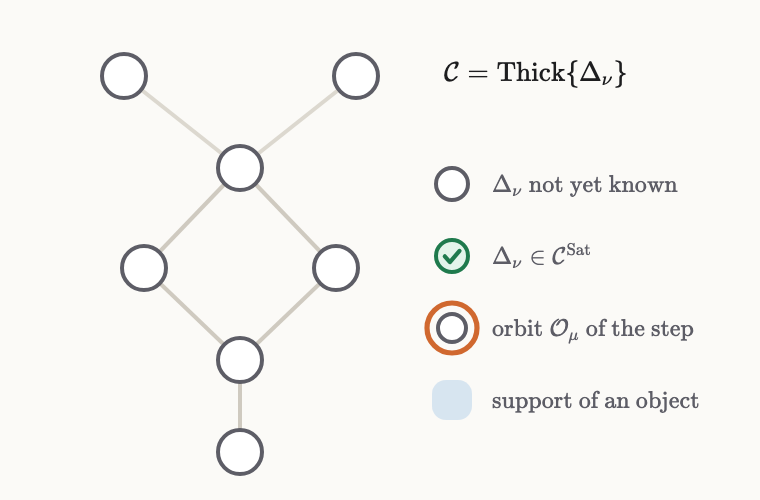
Each dot carries its standard \(\Delta_\nu\). The claim holds once every dot is green. Under H1–H3, the claim is equivalent to placing one object per orbit in the Satake subcategory:
$$\mathcal C^{\mathrm{Sat}}=\mathcal C\quad\Longleftrightarrow\quad\Delta_\mu\in\mathcal C^{\mathrm{Sat}}\ \text{ for every }\mu\in\Lambda_S^+.$$Proof
- Standard generation. The standards generate every closed finite union of orbits, and all of \(\mathcal C\): $$\text{(a)}\quad\mathcal C_Z=\operatorname{Thick}_{\mathcal C_Z}\{\Delta_{\nu,Z}:\nu\in I(Z)\},$$ $$\text{(b)}\quad\mathcal C=\operatorname{Thick}_{\mathcal C}\{\Delta_\mu:\mu\in\Lambda_S^+\}.$$ On one orbit, truncation in the t-structure of H3 builds every object from the constant sheaf. In \(Z\), an orbit maximal for \(\le\) is open, and the H2(b) triangle leaves an object on one orbit fewer; H1(b) passes to \(\mathcal C\). Full proof →
- Reduction. \(\mathcal C^{\mathrm{Sat}}\) is thick, so if it contains every standard, (b) gives $$\mathcal C=\operatorname{Thick}_{\mathcal C}\{\Delta_\mu:\mu\in\Lambda_S^+\}\subseteq\mathcal C^{\mathrm{Sat}}\subseteq\mathcal C.$$ Conversely, if \(\mathcal C^{\mathrm{Sat}}=\mathcal C\), it contains every standard.
-
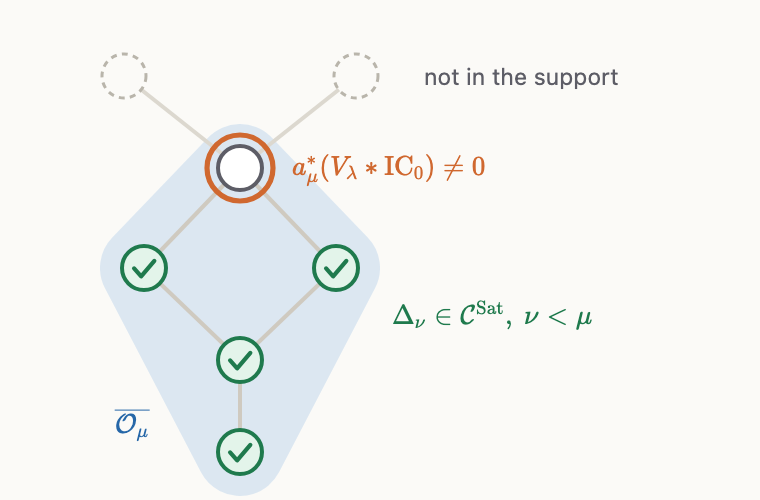
The dots below \(\mu\) are green by induction. The chosen object (blue) lives on \(\overline{\mathcal O_\mu}\) and is nonzero at \(\mu\). Fix \(\mu\) and assume \(\Delta_\nu\in\mathcal C^{\mathrm{Sat}}\) for every \(\nu\lt\mu\). The induction step starts from one Satake object that lives on the closure of \(\mathcal O_\mu\) and does not vanish on \(\mathcal O_\mu\):
$$V_\lambda\ast\mathrm{IC}_0\in\mathcal C^{\mathrm{Sat}},\qquad\operatorname{supp}(V_\lambda\ast\mathrm{IC}_0)\subseteq\overline{\mathcal O_\mu},\qquad a_\mu^*(V_\lambda\ast\mathrm{IC}_0)\ne0.$$By H5(a), the object is the middle term of the localization triangle of step 4, whose outer terms are its top part and the boundary part of step 3. By H5(b), a shift of \(\Delta_\mu\) is a direct summand of the top part (steps 5–6).
Proof
- H5 gives \(\lambda\in\Lambda_T^+\) whose Satake object lives on \(\overline{\mathcal O_\mu}\) by H5(a). By H5(b) its restriction to \(\mathcal O_\mu\) has \(N_\mu\gt0\) summands, so \(a_\mu^*(V_\lambda\ast\mathrm{IC}_0)\ne0\).
- H4 puts \(V_\lambda\ast\mathrm{IC}_0\) in \(\mathcal C\); as a Satake object it lies in \(\mathcal C^{\mathrm{Sat}}\).
-
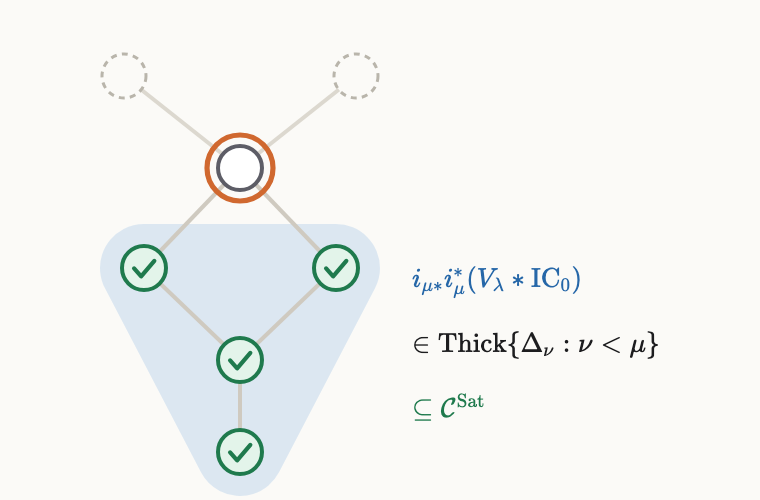
The boundary part (blue) lives on the green dots below \(\mu\). The boundary part lies in \(\mathcal C^{\mathrm{Sat}}\), by the induction hypothesis:
$$i_{\mu*}i_\mu^*(V_\lambda\ast\mathrm{IC}_0)\in\mathcal C^{\mathrm{Sat}}.$$Proof
- By H1, the boundary \(Z=\overline{\mathcal O_\mu}\setminus\mathcal O_\mu\) is a closed finite union of orbits whose orbits are exactly the smaller ones (filtration proof). Part (a) of step 1 gives $$i_\mu^*(V_\lambda\ast\mathrm{IC}_0)\in\operatorname{Thick}_{\mathcal C_Z}\{\Delta_{\nu,Z}:\nu\lt\mu\}.$$
- The exact functor \(i_{\mu*}\) sends \(\Delta_{\nu,Z}\) to \(\Delta_\nu\) by H2(c). By (T2) and the induction hypothesis: $$i_{\mu*}i_\mu^*(V_\lambda\ast\mathrm{IC}_0)\in\operatorname{Thick}_{\mathcal C}\{\Delta_\nu:\nu\lt\mu\}\subseteq\mathcal C^{\mathrm{Sat}}.$$
-
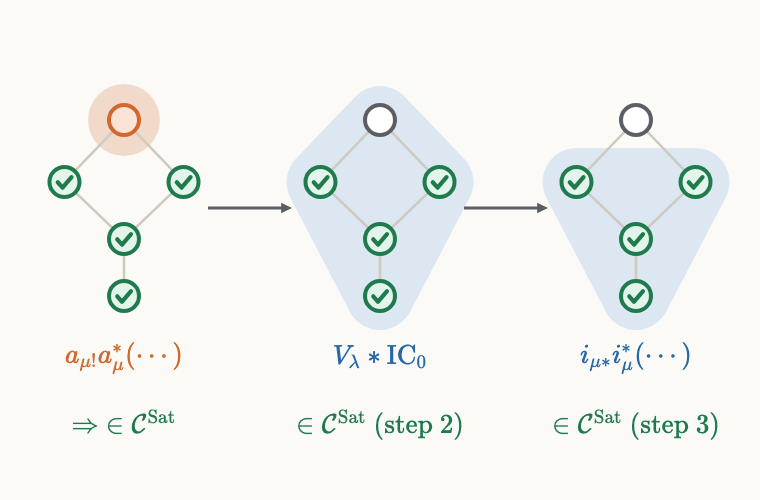
Top part \(\to V_\lambda\ast\mathrm{IC}_0\to\) boundary part. The right two lie in \(\mathcal C^{\mathrm{Sat}}\), so the top part does too. Removing the boundary part leaves the top part, which therefore lies in \(\mathcal C^{\mathrm{Sat}}\) too:
$$a_{\mu!}a_\mu^*(V_\lambda\ast\mathrm{IC}_0)\in\mathcal C^{\mathrm{Sat}}.$$Proof
- By H5(a), \(V_\lambda\ast\mathrm{IC}_0\) lives on \(\overline{\mathcal O_\mu}\), in which \(\mathcal O_\mu\) is open. H2(b) there, pushed to \(LX\) by H2(c), gives a triangle: $$a_{\mu!}a_\mu^*(V_\lambda\ast\mathrm{IC}_0)\longrightarrow V_\lambda\ast\mathrm{IC}_0\longrightarrow i_{\mu*}i_\mu^*(V_\lambda\ast\mathrm{IC}_0)\xrightarrow{+1}.$$
- The middle term lies in \(\mathcal C^{\mathrm{Sat}}\) by step 2 and the right term by step 3. The left term is the fiber of the right-hand map, a cofiber shifted by \([-1]\), so it lies in \(\mathcal C^{\mathrm{Sat}}\) as well.
-
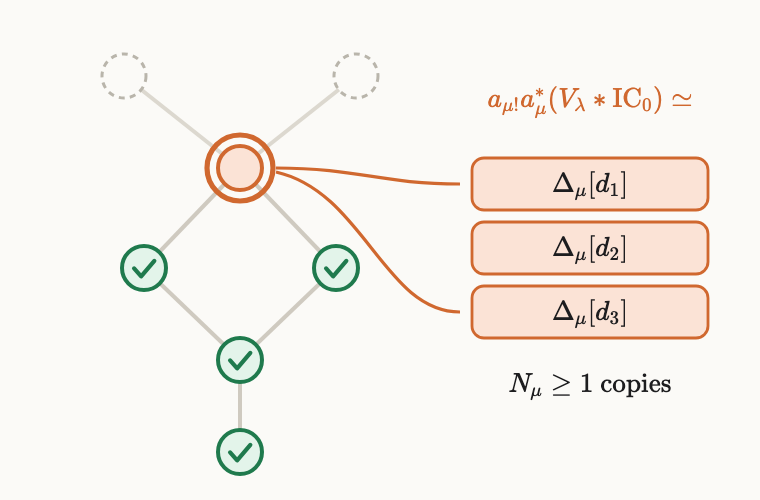
On \(\mathcal O_\mu\) the top part is \(N_\mu\ge1\) shifted copies of \(\Delta_\mu\). The top part is a finite, nonzero sum of shifted copies of \(\Delta_\mu\):
$$a_{\mu!}a_\mu^*(V_\lambda\ast\mathrm{IC}_0)\simeq\bigoplus_{s=1}^{N_\mu}\Delta_\mu[d_s],\qquad0\lt N_\mu\lt\infty.$$Proof
- H5(b) splits the restriction to the orbit: $$a_\mu^*(V_\lambda\ast\mathrm{IC}_0)\simeq\bigoplus_{s=1}^{N_\mu}\underline k_{\mathcal O_\mu}[d_s]\quad\text{in }\mathcal C_\mu.$$
- The exact functor \(a_{\mu!}\) preserves finite sums and shifts, and \(a_{\mu!}\underline k_{\mathcal O_\mu}=\Delta_\mu\). How H5 is verified →
-
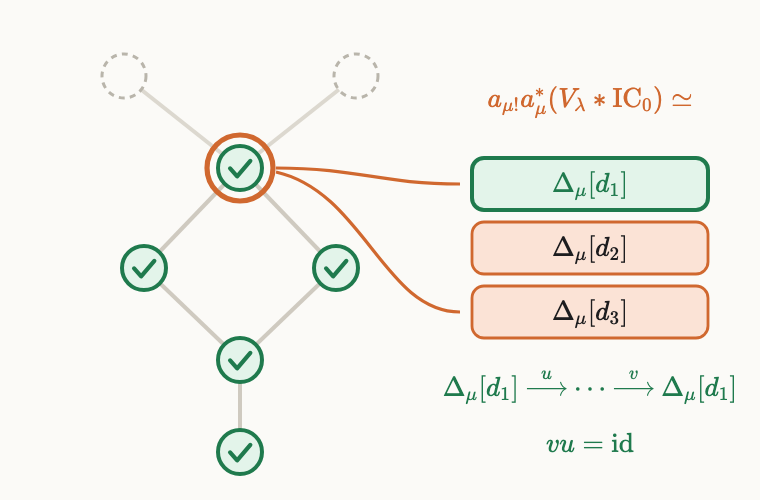
One copy is a retract, so \(\Delta_\mu\) lies in \(\mathcal C^{\mathrm{Sat}}\): the orange dot turns green. This completes the induction step: the standard of \(\mathcal O_\mu\) lies in \(\mathcal C^{\mathrm{Sat}}\).
$$\Delta_\mu\in\mathcal C^{\mathrm{Sat}}.$$Proof
- Since \(N_\mu\gt0\), \(\Delta_\mu[d_1]\) is a direct summand of the top part (step 5), which lies in \(\mathcal C^{\mathrm{Sat}}\) (step 4): $$\Delta_\mu[d_1]\xrightarrow{u}a_{\mu!}a_\mu^*(V_\lambda\ast\mathrm{IC}_0)\xrightarrow{v}\Delta_\mu[d_1],\qquad vu=\mathrm{id}.$$
- A thick subcategory contains retracts and shifts, so it contains \(\Delta_\mu[d_1]\) and then \(\Delta_\mu\).
-
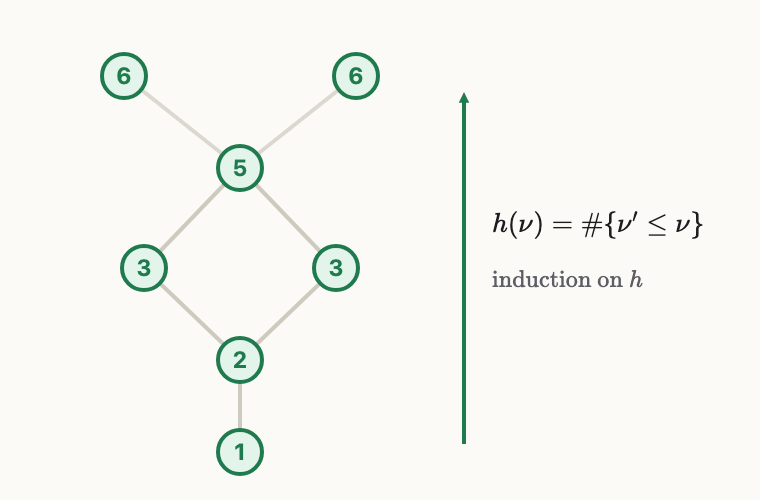
Induction on \(h(\nu)=\#\{\nu'\le\nu\}\), the number in each dot, turns every dot green. The induction reaches every orbit, so step 1 gives the claim and its consequence:
$$\mathcal C^{\mathrm{Sat}}=\mathcal C,\qquad\Map_{\widehat{\mathcal C}}(V_\lambda\ast\mathrm{IC}_0,F)=0\ \ \forall\lambda\ \Longrightarrow\ F=0.$$Proof
- By H1(a), each \(\mu\) has finitely many \(\nu\le\mu\), so induction on \(h(\mu)=\#\{\nu:\nu\le\mu\}\) reaches every orbit. A minimal orbit has empty boundary, and step 3 is then vacuous.
- If \(F\in\widehat{\mathcal C}\) is orthogonal to every \(V_\lambda\ast\mathrm{IC}_0\), exactness of \(\Map_{\widehat{\mathcal C}}(-,F)\) extends this to shifts, cofibers and retracts, hence to \(\mathcal C^{\mathrm{Sat}}=\mathcal C\). Objects of \(\mathcal C\) are compact generators of \(\widehat{\mathcal C}\), so \(F=0\).