1 · The space
For \(2\times2\) matrices the symplectic condition is a determinant condition:
$$J_2=\begin{pmatrix}0&1\\-1&0\end{pmatrix},\qquad gJ_2g^T=\det(g)\,J_2\quad(g\in\mathrm{GL}_2).$$So the involution divides by the determinant, and its fixed group is \(\mathrm{SL}_2\):
$$\theta(g)=J_2\,(g^T)^{-1}J_2^{-1}=\frac{g}{\det g},\qquad G^\theta=\{g:gJ_2g^T=J_2\}=\mathrm{SL}_2=\mathrm{Sp}_2.$$The determinant identifies \(X\) with the punctured line, and \(G\) acts through it:
$$X=\mathrm{GL}_2/\mathrm{SL}_2\xrightarrow{\ \sim\ }\mathbb G_m,\qquad g\,\mathrm{SL}_2\longmapsto\det g,\qquad c\longmapsto\operatorname{diag}(c,1)\,\mathrm{SL}_2,$$ $$h\cdot c=\det(h)\,c,\qquad x_0=1.$$The Cartan embedding turns a point of \(X\) into a matrix that \(\theta\) inverts, so orbits can be named by matrices. Here it records exactly \(c=\det g\):
$$\tau(g)=g\,\theta(g)^{-1}=\det(g)\,I_2,\qquad\tau(X)=\{c\,I_2:c\ne0\}.$$2 · Tori and labels
What the two tori are for. \(T\) is a θ-stable maximal torus of \(G\); its dominant cocharacters label the Satake sheaves. \(S\) is the part of \(T\) that \(\theta\) inverts; its dominant cocharacters label the orbits. The leading-term map passes from one to the other.
$$S=\{t\in T:\theta(t)=t^{-1}\}^\circ,\qquad\underbrace{\lambda\in\Lambda_T^+}_{\text{Satake sheaf }V_\lambda}\ \xrightarrow{\ \varphi=1-\theta\ }\ \underbrace{\mu\in\Lambda_S^+}_{\text{orbit }\mathcal O_\mu}.$$Here \(\dim X=1\), so \(S\) is a line inside the plane \(T\). \(T\) is the diagonal torus, and \(\theta\) swaps and inverts its two entries:
$$\theta\bigl(\operatorname{diag}(t_1,t_2)\bigr)=\operatorname{diag}(t_2^{-1},t_1^{-1}),\qquad\theta(a,b)=(-b,-a)\ \text{ on }\Lambda_T=\mathbb Z^2,\quad(a,b)\leftrightarrow\bigl(t\mapsto\operatorname{diag}(t^a,t^b)\bigr).$$| Object | Here | Why |
|---|---|---|
| \(S\) | \(\{\operatorname{diag}(a,a)\}=Z(\mathrm{GL}_2)\) | \(\theta(t)=t^{-1}\iff t_1=t_2\) |
| \(T^\theta\) | \(\{\operatorname{diag}(b,b^{-1})\}\) | the torus of \(\mathrm{SL}_2\) |
| \(L=Z_G(S)\) | \(\mathrm{GL}_2\) | \(S\) is central |
| \(Z_{G^\theta}(S)\) | \(\mathrm{SL}_2\) | \(Z_G(S)\cap G^\theta=\mathrm{GL}_2\cap\mathrm{SL}_2\) |
| \(\Lambda_T^+\) | \(\{(a,b)\in\mathbb Z^2:a\ge b\}\) | \(\langle\varepsilon_1-\varepsilon_2,(a,b)\rangle=a-b\ge0\) |
| \(\Lambda_S^+\) | \(\{(a,a):a\in\mathbb Z\}\cong\mathbb Z\) | \(\theta(a,b)=-(a,b)\iff a=b\) |
A label is one integer \(a\), negative ones included: dominance puts no condition on the central torus \(S\).
The centralizer \(Z_{G^\theta}(S)\). It is the set of elements of \(G^\theta\) that commute with \(S\); \(S\) need not lie in \(G^\theta\), and it never does, since \(s\in S\cap G^\theta\) gives \(s=\theta(s)=s^{-1}\):
$$Z_{G^\theta}(S)=\{h\in G^\theta:hs=sh\ \ \forall s\in S\}=Z_G(S)\cap G^\theta,\qquad S\cap G^\theta=S[2]=\{\pm I_2\}.$$Here \(S\) is central, so every \(h\in\mathrm{SL}_2\) qualifies. Its role: it is the component group of the orbit stabilizers, so it decides H3 (Proposition III, step 4).
3 · Orbits
The loop space is \(F^\times\), and the arc group acts through \(\det\), which is onto \(\mathcal O^\times\):
$$LX(k)=X(F)=F^\times,\qquad L^+G=\mathrm{GL}_2(\mathcal O),\qquad\det\mathrm{GL}_2(\mathcal O)=\mathcal O^\times.$$Proof
Proof that \(\det\mathrm{GL}_2(\mathcal O)=\mathcal O^\times\)
- \(\subseteq\). \(g\) and \(g^{-1}\) have entries in \(\mathcal O\), so \(\det g\) and \(\det g^{-1}=(\det g)^{-1}\) both lie in \(\mathcal O\): \(\det g\in\mathcal O^\times\).
- \(\supseteq\). For \(u\in\mathcal O^\times\), \(g=\operatorname{diag}(u,1)\) has inverse \(\operatorname{diag}(u^{-1},1)\), also with entries in \(\mathcal O\); so \(g\in\mathrm{GL}_2(\mathcal O)\) and \(\det g=u\).
So the orbits are the cosets of \(\mathcal O^\times\), one per valuation:
$$\boxed{LX=\bigsqcup_{a\in\mathbb Z}\mathcal O_{(a,a)},\qquad\mathcal O_{(a,a)}=t^a\mathcal O^\times=\{c\in F^\times:\operatorname{val}c=a\}.}$$The representative of Chen–Yi's parametrization is \(c=t^a\):
$$x_{(a,a)}=\operatorname{diag}(t^a,1)\,x_0\ \leftrightarrow\ c=t^a,\qquad\tau(x_{(a,a)})=t^aI_2=t^{(a,a)}.$$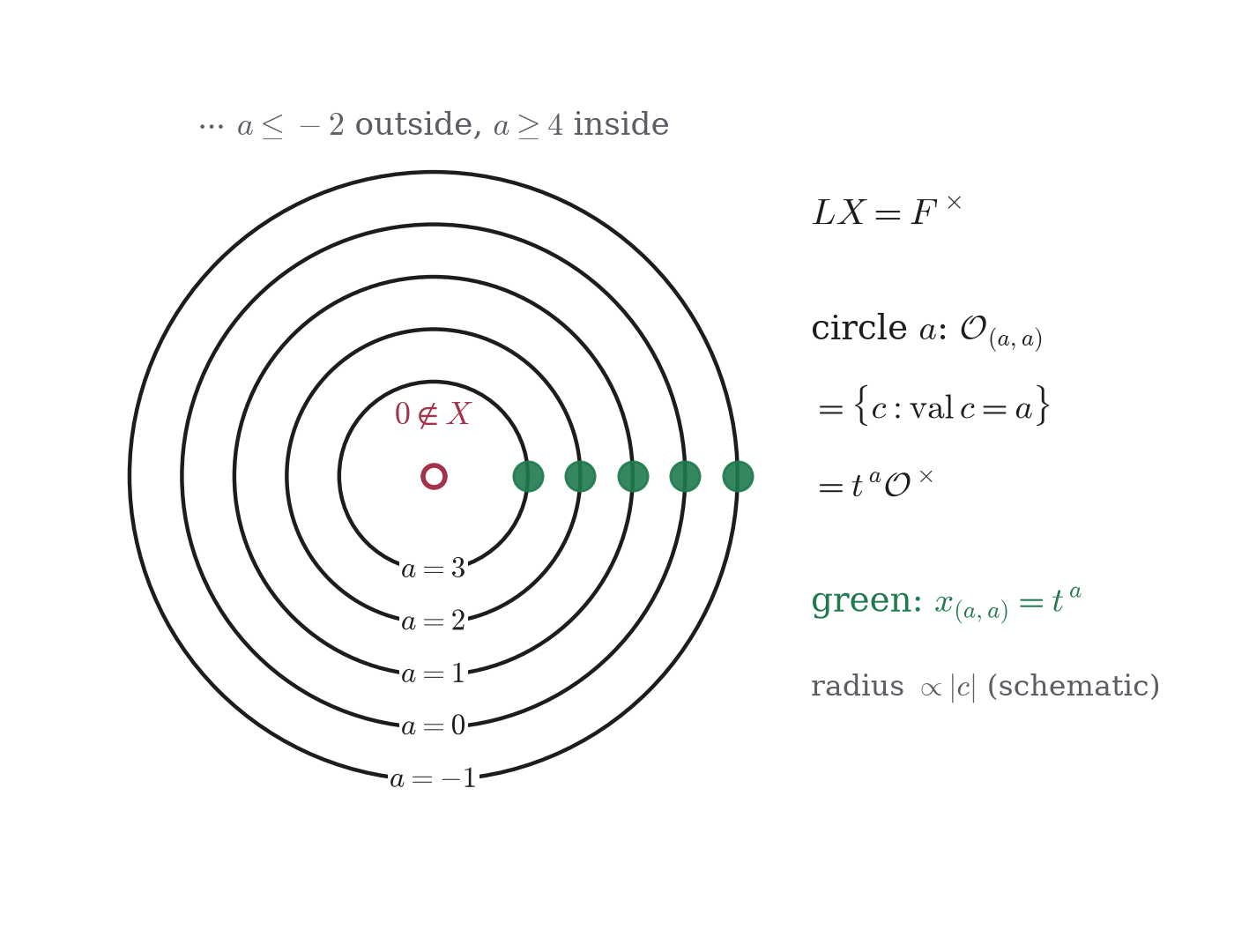
4 · H1 explicitly
Recall H1 (Proposition I). Order the labels by dominance, \(\nu\le\mu\iff\mu-\nu\) is a sum of positive coroots.
- Each orbit closure is the union of the finitely many orbits below it: $$\overline{\mathcal O_\mu}=\bigsqcup_{\nu\le\mu}\mathcal O_\nu,\qquad\#\{\nu\in\Lambda_S^+:\nu\le\mu\}\lt\infty.$$
- Every object of \(\mathcal C\) is supported on finitely many orbit closures: $$\operatorname{supp}(M)\subseteq\bigcup_{\mu\in J}\overline{\mathcal O_\mu},\qquad J\subseteq\Lambda_S^+\ \text{finite}.$$
So the orbits form a stratification of \(LX\) indexed by a poset with finite lower sets, and each object lives on finitely many strata.
Order. The labels \(\mu,\nu\in\Lambda_S^+\subseteq\Lambda_T\) are compared inside \(\Lambda_T\), with the positive coroots of \(G\) relative to \((T,B)\). \(\mathrm{GL}_2\) has one positive root, \(\varepsilon_1-\varepsilon_2\) (the upper-right entry of \(B\)), and its coroot is the cocharacter of \(\mathrm{SL}_2\subseteq\mathrm{GL}_2\):
$$(\varepsilon_1-\varepsilon_2)^\vee=(1,-1)\ \leftrightarrow\ t\mapsto\operatorname{diag}(t,t^{-1}),\qquad\langle\varepsilon_1-\varepsilon_2,(1,-1)\rangle=2.$$The difference of two labels lies on the line \(a=b\), the coroots on the line \(a+b=0\), and the two lines meet only in \(0\):
$$(b,b)\le(a,a)\iff(a-b,a-b)\in\mathbb Z_{\ge0}\,(1,-1)\iff a=b.$$Why this order: \(\nu\le\mu\) exactly when \(L^+Gt^\nu L^+G\subseteq\overline{L^+Gt^\mu L^+G}\) in \(LG\), and the Cartan embedding sends \(\mathcal O_\mu\) into \(L^+Gt^\mu L^+G\). Here \(\operatorname{val}\det\) is constant on each double coset (\(\operatorname{val}\det t^{(a,b)}=a+b\)), and a coroot has \(a+b=0\), so the order cannot change \(\operatorname{val}c\).
Closures. \(\operatorname{val}\) is locally constant on \(F^\times\) (\(\operatorname{val}(c'-c)\gt\operatorname{val}c\Rightarrow\operatorname{val}c'=\operatorname{val}c\)), so each circle is open and closed in \(LX\):
$$\overline{\mathcal O_{(a,a)}}=\mathcal O_{(a,a)}=\bigsqcup_{\nu\le(a,a)}\mathcal O_\nu,\qquad\#\{\nu\le(a,a)\}=1.$$Supports. An object of \(\mathcal C\) is supported on finitely many orbits by definition; here, finitely many circles:
$$\operatorname{supp}M\subseteq\bigsqcup_{a\in J}\mathcal O_{(a,a)},\qquad J\subseteq\mathbb Z\ \text{finite}.$$| Part of H1 | Here |
|---|---|
| (a) closure | \(\overline{\mathcal O_{(a,a)}}=\mathcal O_{(a,a)}\) |
| (a) finiteness | \(\#\{\nu\le(a,a)\}=1\) |
| (b) supports | finitely many circles |
The constant sheaf \(\underline k_{\mathcal O_{(a,a)}}=\Delta_{(a,a)}\) on one circle lies in \(\mathcal C\); the constant sheaf on all of \(LX\) does not, since it meets every circle.
Rank two. From \(\mathrm{GL}_4/\mathrm{Sp}_4\) on, the order has relations and H1(a) is Chen–Yi's Theorem 18, not an observation (family page, section 3):
$$(2,2,-1,-1)-(1,1,0,0)=(\varepsilon_1^\vee-\varepsilon_3^\vee)+(\varepsilon_2^\vee-\varepsilon_4^\vee),\qquad\mathcal O_{(1,1,0,0)}\subseteq\overline{\mathcal O_{(2,2,-1,-1)}}.$$5 · The other hypotheses
Lifts. Translating the base point by \(t^\lambda\) multiplies \(c\) by \(t^{\lambda_1+\lambda_2}\), so each label has the balanced dominant lift \(\lambda_a\):
$$t^\lambda x_0\ \leftrightarrow\ c=t^{\lambda_1+\lambda_2},\qquad\varphi(\lambda)=(\lambda_1+\lambda_2)(1,1),\qquad\lambda_a=\bigl(\lceil a/2\rceil,\lfloor a/2\rfloor\bigr).$$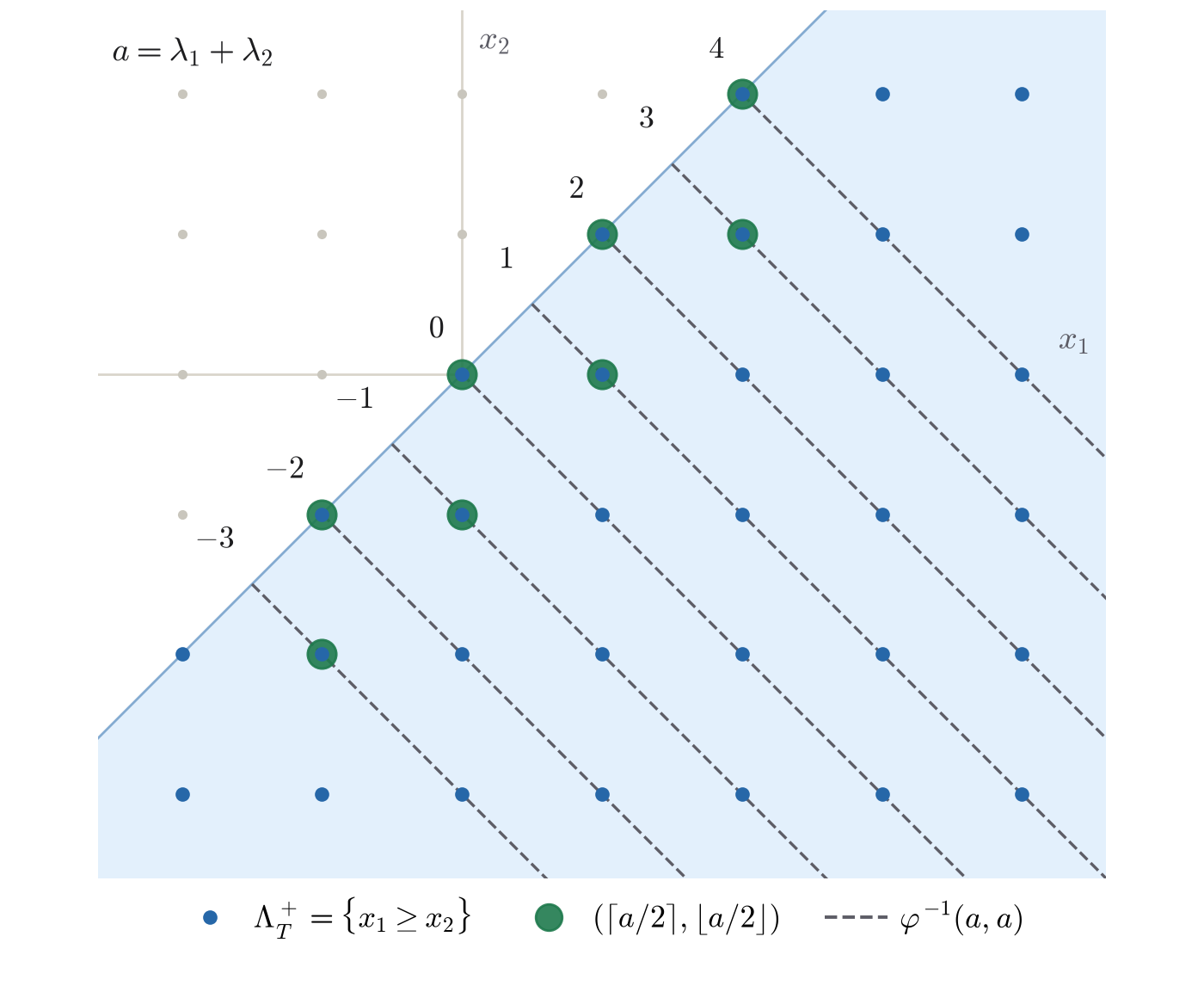
Top restriction. Every \(g\in\operatorname{Gr}_{\le\lambda_a}\) has \(\operatorname{val}\det g=a\), so the fibre of \(m\) over each point of \(\mathcal O_{(a,a)}\) is all of \(\operatorname{Gr}_{\le\lambda_a}\), and the stalk is \(IH^*(\operatorname{Gr}_{\le\lambda_a})\cong V_{\lambda_a}\):
$$\operatorname{Gr}_{\le\lambda_a}=\begin{cases}\mathrm{pt},&a\text{ even},\\\mathbb P^1,&a\text{ odd},\end{cases}\qquad a_{(a,a)}^*(V_{\lambda_a}\ast\mathrm{IC}_0)\simeq\begin{cases}\underline k,&a\text{ even},\\\underline k[1]\oplus\underline k[-1],&a\text{ odd}.\end{cases}$$| Hypothesis | Why it holds here |
|---|---|
| H1 | orbits are the circles \(\operatorname{val}c=a\), each closed (section 4) |
| H2, H4 | hold for every symmetric space (Proposition III, step 3) |
| H3 | \(Z_{G^\theta}(S)=\mathrm{SL}_2\) is connected (step 4) |
| H5 | \(\lambda_a\) lifts \((a,a)\), with \(N_{(a,a)}=1\) or \(2\) (above) |
So \(\mathcal C^{\mathrm{Sat}}=\mathcal C\) for \(\mathrm{GL}_2/\mathrm{Sp}_2\) by Proposition I.