What does the basic function generate?
The function-level form of the question: does the spherical Hecke algebra, acting on \(\phiz=\one_{X(\cO)}\), produce every \(K\)-invariant Schwartz function on \(X(F)\)? The categorical form is on the spherical and Iwahori workspaces. Statements and proofs as a paper (.pdf + .tex).
Setting
\(F\) is a non-archimedean local field with integers \(\cO\), uniformizer \(\vpi\) and residue field \(\Fq\); \(G\supseteq B\supseteq T\) is split connected reductive over \(\cO\); \(X\) is a \(G\)-variety with a model over \(\cO\).
\[K:=G(\cO),\qquad\CK:=C_c^\infty(X(F))^K,\qquad\phiz:=\one_{X(\cO)}\in\CK,\qquad\HK:=C_c(K\backslash G(F)/K).\]With Haar measure \(\vol K=1\), \(f\in\HK\) acts on \(\varphi\in\CK\) by convolution; for \(\lambda\in\LTp\) put \(t^\lambda:=\lambda(\vpi)\).
\[(f\ast\varphi)(x)=\int_{G(F)}f(g)\,\varphi(g^{-1}x)\,dg=\sum_{g\in G(F)/K}f(g)\,\varphi(g^{-1}x),\qquad T_\lambda:=\one_{Kt^\lambda K},\qquad G(F)=\bigsqcup_{\lambda\in\LTp}Kt^\lambda K.\]The question:
At almost every place a period of automorphic forms is read off \(\phiz\) as a ratio of L-values; (SG) says \(\phiz\) controls all of \(\CK\) (periods and L-functions, Oberwolfach 2013).
Well defined; the Satake transform; conventions
- The summand depends only on \(gK\), and finitely many cosets contribute. \(f\ast\varphi\) is \(K\)-invariant, \(\supp(f\ast\varphi)\subseteq\supp f\cdot\supp\varphi\), \(\HK\) is an associative algebra with unit \(\one_K\), and \(\CK\) is a unital left \(\HK\)-module [Cartier, §1.3–1.4].
- \(\{T_\lambda\}_{\lambda\in\LTp}\) is a basis of \(\HK\), and the Satake transform is an algebra isomorphism onto the \(W\)-invariant functions on the dual torus \(\As:=\Hom(\LT,\C^\times)\) [Cartier, §4; Macdonald 1971]: \[\Sat f(\chi)=\int_{T(F)}\delta_B^{1/2}(t)\,\chi(t)\int_{U(F)}f(tu)\,du\,dt,\qquad\Sat:\HK\xrightarrow{\ \sim\ }\C[\As]^W,\qquad\Sat T_\lambda=q^{\langle\rho,\lambda\rangle}x^\lambda+(\text{lower in the dominance order}).\]
- \(\varphi\mapsto f\ast\varphi\) is \(\pi(f)=\int f(g)\pi(g)\,dg\) for \((\pi(g)\varphi)(x)=\varphi(g^{-1}x)\), so every \(G(F)\)-map \(C_c^\infty(X(F))\to V\) restricts to an \(\HK\)-map \(\CK\to V^K\).
- Conventions: \(X=G/H\) with left actions and left modules. Sakellaridis writes \(H\backslash G\) and right modules; \(x\mapsto x^{-1}\) exchanges the two.
(orbits and translates) Proved here
- Every \(K\)-orbit in \(X(F)\) is compact, and \(\one_{Kx}\in\CK\) when \(Kx\) is open. If \(X=G/H\) is homogeneous and \(\operatorname{char}F=0\), every \(K\)-orbit is compact open and \(\CK\) has the basis \(\{\one_{Kx}\}_{Kx\in K\backslash X(F)}\).
- For \(\lambda\in\LTp\) and \(x_0\in X(\cO)\), \[(T_\lambda\ast\phiz)(x)=\#\{gK\subseteq Kt^\lambda K:\ x\in g\,X(\cO)\},\qquad\supp(T_\lambda\ast\phiz)=K\,t^\lambda X(\cO),\qquad(T_\lambda\ast\phiz)(t^\lambda x_0)\ge1.\]
Proof
- (1) \(Kx\) is the image of the compact group \(K\). For homogeneous \(X\), \(X(F)\) is the disjoint union of the \(G(F)\)-orbits indexed by \(\ker\big(H^1(F,H)\to H^1(F,G)\big)\), a finite set since \(\operatorname{char}F=0\) (Borel–Serre 1964; [Serre]). Each \(G(F)x\simeq G(F)/H_x(F)\) is open, the orbit map being smooth, and \(Kx\) is the image of the open set \(K\) under the open map \(G(F)\to G(F)x\). A \(K\)-invariant Schwartz function is constant on each orbit, and its compact support meets finitely many of them.
- (2) With \(\vol K=1\), \((T_\lambda\ast\phiz)(x)=\sum_{gK\subseteq Kt^\lambda K}\one_{X(\cO)}(g^{-1}x)\), and the term for \(gK\) is \(1\) iff \(x\in gX(\cO)\). So the support is \(Kt^\lambda K\cdot X(\cO)=Kt^\lambda X(\cO)\), as \(X(\cO)\) is \(K\)-stable. At \(x=t^\lambda x_0\) the coset \(t^\lambda K\) contributes \(1\).
A triangular criterion
For homogeneous \(X\), by Lemma A(1):
\[\text{(SG)}\iff\text{every orbit indicator }\one_{Kx}\text{ is a Hecke translate }f\ast\phiz .\](triangular generation) Proved here
Let \(\Omega\) be a set of compact open \(K\)-orbits \(O_\mu\) whose indicators span \(\CK\), with a partial order \(\le\) whose lower sets \(\{\nu\le\mu\}\) are finite. If every \(\mu\in\Omega\) has \(f_\mu\in\HK\) with
\[\supp(f_\mu\ast\phiz)\subseteq\bigcup_{\nu\le\mu}O_\nu\qquad\text{and}\qquad f_\mu\ast\phiz\ne0\ \text{on }O_\mu,\]then (SG) holds. Conversely, under (SG) such \(f_\mu\) exist for every order, with \(f_\mu\ast\phiz=\one_{O_\mu}\).
Proof
Induction on \(n(\mu):=\#\{\nu\le\mu\}\). \(f_\mu\ast\phiz\) is constant on orbits and supported in the finite union, so
\[f_\mu\ast\phiz=c_\mu\one_{O_\mu}+\sum_{\nu<\mu}c_\nu\one_{O_\nu},\quad c_\mu\ne0,\qquad\one_{O_\mu}=c_\mu^{-1}\Big(f_\mu\ast\phiz-\sum_{\nu<\mu}c_\nu\one_{O_\nu}\Big),\]and each \(\one_{O_\nu}\), \(n(\nu)<n(\mu)\), lies in \(\HK\ast\phiz\) by induction. The \(\one_{O_\mu}\) span \(\CK\).
(dominant lifts) Proved here
Let \(X\) be homogeneous, \(\operatorname{char}F=0\), and \(\mu\mapsto O_\mu\) a bijection \(\LXp\to K\backslash X(F)\), with a partial order on \(\LXp\) with finite lower sets. If every \(\mu\) has \(\lambda\in\LTp\) with
\[t^\lambda x_0\in O_\mu\qquad\text{and}\qquad K\,t^\lambda X(\cO)\subseteq\bigcup_{\nu\le\mu}O_\nu,\]then (SG) holds, with \(f_\mu=T_\lambda\).
Proof
Proof; the sheaf-level reading
- Lemma A(2) gives the support and \((T_\lambda\ast\phiz)(t^\lambda x_0)\ge1\); apply Proposition B.
- Finite lower sets are H1(a) of the spherical workspace's Proposition I; a \(\lambda\) with \(t^\lambda x_0\in O_\mu\) is a dominant lift under the leading-term map (\(\varphi(\LTp)=\Lambda_S^+\) in Proposition III); the support bound is the function-level reading of H5. No implication between the two levels is proved.
The group
(group case) Proved here
\(X=H\) under \(G=H\times H\), \((h_1,h_2)\cdot x=h_1xh_2^{-1}\), \(K=K_H\times K_H\). Then \(\CK=\mathcal H_{K_H}\), \(\phiz=\one_{K_H}\) is its unit, \(\HK\simeq\mathcal H_{K_H}\otimes\mathcal H_{K_H}^{\mathrm{op}}\) acts by \((a\otimes b)\cdot\varphi=a\ast\varphi\ast b\), and
\[\HK\ast\phiz=\mathcal H_{K_H}\ast\one_{K_H}\ast\mathcal H_{K_H}=\mathcal H_{K_H}=\CK .\]Proof
\(C_c^\infty(H(F))^{K_H\times K_H}=C_c(K_H\backslash H(F)/K_H)\), and \(a\ast\one_{K_H}\ast\one_{K_H}=a\). In the language of Corollary C the orbits are the \(K_Ht^\lambda K_H\), the lift of \(\lambda\) is \((\lambda,0)\), and \(Kt^{(\lambda,0)}X(\cO)=K_Ht^\lambda K_H\) is one orbit: the triangular system is diagonal.
Sakellaridis's theorem
Sakellaridis decides (SG) for affine homogeneous \(X\) under five standing hypotheses, each stated exactly on the hypotheses page and none verified here for any family: (A1) \(F\) \(p\)-adic, \(G\) split with simply connected derived group; (A2) the integral model; (A3) his Axioms 2.2.1, 2.4.1, 2.4.2; (A4) spherical roots and colours; (A5) \(X=H\backslash G\) homogeneous affine with one open \(B(F)\)-orbit.
[Sak, Thm. 8.0.2, Cor. 8.0.4(1), Ex. 8.0.1] Proved (cited), under (A1)–(A5)
- There is an isomorphism of \(\HK\)-modules, with \(\HK\simeq\C[\As]^W\) acting through the restriction map \(\Res\): \[\CK\ \simeq\ \C\big[\dXh\AXs\big]^{\WX},\qquad\phiz\longmapsto1,\qquad\Res:\C[\As]^W\longrightarrow\C\big[\dXh\AXs\big]^{\WX}.\]
- (SG) holds if and only if \(\Res\) is surjective.
- For \(X=\SL_2^3\backslash\Sp_4^2\) (two factors as \(\Sp_2\) in the two copies of \(\Sp_4\), the third diagonally), \(\Res\) is not surjective and (SG) fails.
\(\AX\), \(\LXp\), \(\AXs\subseteq\As\), \(\dX\) and \(\WX\) are the invariants of [SV, §2]: see \(\AX\) and the cone, \(\dX\), \(\WX\), and the Theorem item by item. For symmetric \(X=G/G^\theta\): \(\AX\simeq S\), \(\LXp=\Lambda_S^+\), and \(\WX\) is the restricted Weyl group.
Proof
Proof of (2) from (1); (A5) and connected stabilizers
- Under (1), \(\HK\ast\phiz\) corresponds to \(\Res(\C[\As]^W)\cdot1=\im\Res\), so (SG) is the surjectivity of \(\Res\). In (3), \(\WX\)-inequivalent points of \(\AXs\) become \(W\)-conjugate.
- If the stabilizer \(B_x\) of a point of the open \(B\)-orbit is connected, then \(H^1(F,B_x)=1\) (a connected solvable subgroup of the split \(B\): Hilbert 90 and \(H^1(F,\mathbb G_a)=0\)), so \(\Xo(F)\) is one \(B(F)\)-orbit and (A5) holds. For \(\SL_2/T\) the generic stabilizer is \(\{\pm1\}\), \(\Xo(F)/B(F)\simeq F^\times/F^{\times2}\), and (A5) fails: Proposition J(2).
(the two \(\GL\) families) Proved here
\(\Res\) is surjective for the following \(X\); so (SG) holds for them under (A1)–(A5), by Theorem E(2). Write \(p_{\pm k}:=\sum_ix_i^{\pm k}\).
- \(X=\GL_{2n}/\Sp_{2n}\): \(\AXs=\{(y_1,y_1,\dots,y_n,y_n)\}\), \(\dXh\) moves each pair to \((q^{1/2}y_i,q^{-1/2}y_i)\), \(\WX=S_n\) permutes the pairs, and \[\Res(p_{\pm k})=\big(q^{k/2}+q^{-k/2}\big)\,p_{\pm k}(y).\]
- \(X=\GL_n/(\GL_p\times\GL_q)\), \(p\le q\): \(\AXs=\{(y_1,\dots,y_p,1,\dots,1,y_p^{-1},\dots,y_1^{-1})\}\), \(\dXh\) moves only the middle block, \(\WX=W(C_p)\) acts by signed permutations, and \[\Res(p_k)=\sum_{i=1}^p\big(y_i^k+y_i^{-k}\big)+c_k,\qquad c_k\in\C .\]
(SG) for \(\SL_{2n}/\Sp_{2n}\) follows from (SG) for \(\GL_{2n}/\Sp_{2n}\), with no further hypothesis.
Proof
- Generators. \(\C[\As]^W=\C[x^{\pm1}]^{S_N}=\C[x]^{S_N}[e_N^{-1}]\) is generated by the \(p_{\pm k}\), since \(e_N^{-1}=e_N(x^{-1})\) is a polynomial in the \(p_{-k}\).
- (1) \(\theta\) pairs the coordinates, \(\LevX=\GL_2^n\), and \(\dX\) is \(|a/b|\) on each block \(\diag(a,b)\): the shift \((q^{1/2},q^{-1/2})\). Then \(p_{\pm k}\mapsto\sum_i\big((q^{1/2}y_i)^{\pm k}+(q^{-1/2}y_i)^{\pm k}\big)=(q^{k/2}+q^{-k/2})\,p_{\pm k}(y)\). The target \(\C[y^{\pm1}]^{S_n}\) is generated by the \(p_{\pm k}(y)\), and \(q^{k/2}+q^{-k/2}\ne0\).
- (2) The pulled-back characters are those with \(\chi\circ\theta=\chi^{-1}\); \(\LevX=\Gm^{2p}\times\GL_{q-p}\), so \(\dX\) fixes the \(y_i\) and moves the middle \(1\)'s to constants \(c^{(j)}\), and \(c_k=\sum_j(c^{(j)})^k\). The target \(\C[y^{\pm1}]^{W(C_p)}=\C[z_1,\dots,z_p]^{S_p}\), \(z_i:=y_i+y_i^{-1}\), is generated by \(P_k:=\sum_iz_i^k\). Since \(y^k+y^{-k}=z^k+(\text{lower powers of }z)\), \[\Res(p_k)-c_k=P_k+(\text{linear combination of }P_{k-2},P_{k-4},\dots\text{ and }1),\] so every \(P_k\) lies in \(\im\Res\) by induction on \(k\).
- \(\SL_{2n}\) from \(\GL_{2n}\). \(X_{\GL}(F)\) is the set of nondegenerate alternating forms on \(F^{2n}\), and \(X_{\SL}(F)=\{J:\operatorname{Pf}J=1\}\) is one \(\SL_{2n}(F)\)-orbit, since \(\operatorname{Pf}(gJg^{\mathsf T})=\det g\cdot\operatorname{Pf}J\) and \(H^1(F,\Sp_{2n})=1\) (Kneser). The \(K\)-orbits on \(X_{\GL}(F)\) are the classes \((a_1,a_1,\dots,a_n,a_n)\), \(a_1\ge\dots\ge a_n\), with \(\val\operatorname{Pf}=\sum_ia_i\); two forms of Pfaffian \(1\) in one class are conjugate by a \(g\in\GL_{2n}(\cO)\) with \(\det g=1\). So \(\CK(X_{\SL})\simeq\CK(X_{\GL})_0\), the classes with \(\sum_ia_i=0\), with \(\phiz\mapsto\phiz\). Grade \(\HK(\GL_{2n})=\bigoplus_m\mathcal H_m\) by \(\val\det\): \(\mathcal H_m\ast\CK(X_{\GL})_{m'}\subseteq\CK(X_{\GL})_{m+m'}\), and \(\mathcal H_0\simeq\HK(\SL_{2n})\) compatibly with the actions, as \(Kt^\lambda K\cap\SL_{2n}(F)=K_{\SL}t^\lambda K_{\SL}\) for \(\sum_i\lambda_i=0\). The degree-\(0\) part of \(\HK\ast\phiz=\CK(X_{\GL})\) is \(\mathcal H_0\ast\phiz=\CK(X_{\GL})_0\).
Both families, and \(\Spin_{2n}/\Spin_{2n-1}\), satisfy (SG) over every \(F\), without (A1)–(A5) [satake-two-levels, Props. IV–V]. For \(E_6/F_4\), \(\Res\) is not surjective and (SG) fails (computing \(\Res\)).
Not homogeneous: \(\Aff^n\) and \(\Mat_n\)
(affine space) Proved here
\(X=\Aff^n\) under \(G=\GL_n\). The \(K\)-orbits on \(F^n\) are the point \(0\) and the shells \(X_m:=\{v:\ord v=m\}\), \(m\in\Z\), with \(\ord v:=\min_i\val v_i\), and
\[\one_{\vpi^mK}\ast\phiz=\one_{\vpi^m\cO^n},\qquad\one_{X_m}=\one_{\vpi^m\cO^n}-\one_{\vpi^{m+1}\cO^n}.\]So (SG) holds over every \(F\), with the central elements \(\one_{\vpi^mK}=T_{m\cdot\mathbf 1}\) alone.
Proof
- \(K\) is transitive on vectors of a given order (extend \(\vpi^{-m}v\) to a basis of \(\cO^n\)). \(\vpi^mK=K\vpi^mK\) is one coset, so \((\one_{\vpi^mK}\ast\phiz)(v)=\phiz(\vpi^{-m}v)=\one_{\vpi^m\cO^n}(v)\).
- A \(K\)-invariant Schwartz \(\varphi\) is supported in some \(\vpi^{-N}\cO^n\) and constant on \(\vpi^N\cO^n\), so \(\varphi=\varphi(0)\,\one_{\vpi^N\cO^n}+\sum_{-N\le m<N}\varphi(X_m)\,\one_{X_m}\).
- Here \(\{0\}\) is not open, \(\CK\) is not spanned by orbit indicators, and the lower sets are infinite, so Proposition B does not apply; lattice indicators replace orbit indicators. Iwahori level: 𝔸ⁿ: Iwahori; the twist by \(|\det|^{1/2}\): 𝔸ⁿ: the Theorem's form.
(matrices) Proved here
\(X=\Mat_n\) under \(G=\GL_n\times\GL_n\), \((g_1,g_2)\cdot x=g_1xg_2^{-1}\), \(K=K_n\times K_n\), \(\phiz=\one_{\Mat_n(\cO)}\). The \(K\)-orbits are the elementary-divisor classes \(a=(a_1\le\dots\le a_n)\), \(a_i\in\Z\cup\{\infty\}\); the nonsingular ones \(K_nt^aK_n\) are compact open.
- Every nonsingular \(\one_{K_nt^aK_n}\) lies in \(\HK\ast\phiz\): on \(\GL_n(F)\), \[\Sat\big(\phiz|_{\GL_n(F)}\big)=\prod_{i=1}^n\big(1-q^{(n-1)/2}x_i\big)^{-1},\] whose inverse is a polynomial.
- For \(n=2\), (SG) holds.
- For \(n\ge3\), (SG) is open.
Proof
Proof of (1) and (2)
- (1) On \(\GL_n(F)\), \((a\otimes b)\cdot\varphi=a\ast\varphi\ast b=(a\ast b)\ast\varphi\) for bi-\(K_n\)-invariant \(\varphi\), as \(\mathcal H_{K_n}\) is commutative. For \(t=\diag(\vpi^{a_1},\dots,\vpi^{a_n})\): \(tu\in\Mat_n(\cO)\) iff \(a_i\ge0\) and \(u_{ij}\in\vpi^{-a_i}\cO\) (\(i<j\)), of volume \(\prod_{i<j}q^{a_i}\), and \(\delta_B^{1/2}(t)=q^{-\sum_{i<j}(a_i-a_j)/2}\). Since \(\sum_{i<j}(a_i+a_j)=(n-1)\sum_ia_i\), \[\Sat\big(\phiz|_{\GL_n(F)}\big)=\sum_{a\in\Z_{\ge0}^n}q^{\sum_{i<j}(a_i+a_j)/2}\,x^a=\prod_{i=1}^n\big(1-q^{(n-1)/2}x_i\big)^{-1}\] [Godement–Jacquet]. \(\Sat\) extends, multiplicative and injective, to bi-\(K_n\)-invariant functions supported in some \(\vpi^{-N}\Mat_n(\cO)\). Put \(f:=\Sat^{-1}\big(\Sat(\one_{K_nt^aK_n})\prod_i(1-q^{(n-1)/2}x_i)\big)\in\mathcal H_{K_n}\). Then \(f\ast\phiz=\one_{K_nt^aK_n}\) on the dense open \(\GL_n(F)\); both sides are locally constant, so they agree on \(\Mat_n(F)\).
- (2) A \(K\)-invariant Schwartz \(\varphi\) on \(\Mat_2(F)\) is supported in \(\vpi^{-N}\Mat_2(\cO)\) and constant on cosets of \(\vpi^N\Mat_2(\cO)\). Subtracting nonsingular orbit indicators, assume \(\varphi=0\) on classes with \(a_2<N\). Each matrix with \(a_1=s<N\le a_2\) is congruent mod \(\vpi^N\) to \(\diag(\vpi^s,0)\) up to \(K\), so \[\varphi=\sum_{s<N}c_s\,\one_{\{a_1=s,\ a_2\ge N\}}+c\,\one_{\vpi^N\Mat_2(\cO)},\qquad\one_{\{a_1=s,\ a_2\ge N\}}=\one_{\vpi^s\Mat_2(\cO)}-\one_{\vpi^{s+1}\Mat_2(\cO)}-\one_{\{a_1=s,\ a_2<N\}},\] with \(\one_{\vpi^s\Mat_2(\cO)}=\one_{\vpi^sK_2\times K_2}\ast\phiz\) and the last term a finite sum of nonsingular orbit indicators.
Rank one on the tree
(rank one) Proved here
\(T\subseteq\GL_2\) is the diagonal torus.
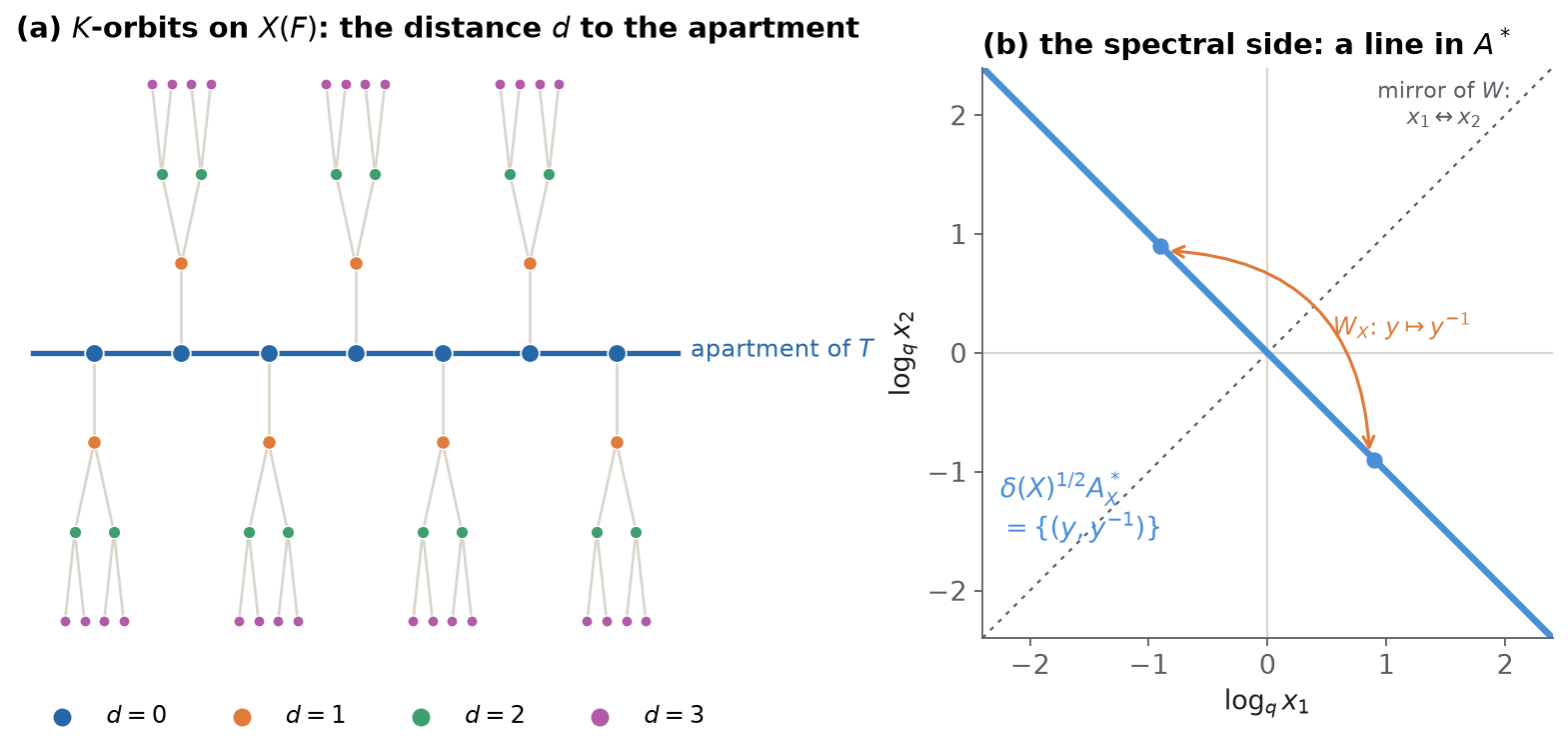
- \(X=\GL_2/T\): \(K\backslash X(F)=\{d\ge0\}\), \(d\) the distance of a vertex of the tree of \(\PGL_2(F)\) to the apartment of \(T\), and (SG) holds.
- \(X=\SL_2/T\), \(q\) odd: (SG) fails.
- \(X=\GL_2/\SL_2\simeq\Gm\), through \(\det\): \(K\backslash X(F)=F^\times/\cO^\times\simeq\Z\), and (SG) holds.
Proof
- (1) \(X(F)=\GL_2(F)/T(F)\) by Hilbert 90, and \(K\)-orbits on it are \(T(F)\)-orbits on lattices up to scaling, i.e. on vertices of the tree [Serre, II.1]. \(T(F)\) translates the apartment, and \(T(\cO)\) is transitive on the vertices at distance \(d\) above a vertex of it, so \(K\backslash X(F)=\{d\ge0\}\) and \(\phiz=\one_{\{d=0\}}\). \(T_1:=\one_{K\diag(\vpi,1)K}\) is the adjacency operator. A vertex on the apartment has \(2\) neighbours on it and \(q-1\) at distance \(1\); a vertex at distance \(d\ge1\) has \(1\) at distance \(d-1\) and \(q\) at distance \(d+1\). So \[T_1\one_{\{0\}}=2\,\one_{\{0\}}+\one_{\{1\}},\qquad T_1\one_{\{1\}}=(q-1)\,\one_{\{0\}}+\one_{\{2\}},\qquad T_1\one_{\{d\}}=q\,\one_{\{d-1\}}+\one_{\{d+1\}}\ \ (d\ge2),\] and by induction every \(\one_{\{d\}}\) lies in \(\C[T_1]\ast\phiz\): Proposition B with \(f_d=T_1^d\).
- (2) Let \(u\in\cO^\times\) be a non-square, \(s:=\diag(u,1)\), and \(\sigma:gT\mapsto sgs^{-1}T\). \(s\) normalizes \(K\), \(T\) and every \(Kt^\lambda K\), and fixes \(x_0=eT\), so \(\sigma\) fixes \(\phiz\) and commutes with \(\HK\): every element of \(\HK\ast\phiz\) is \(\sigma\)-invariant. For \(\val x=-1\), the points \[y=\begin{pmatrix}1&x\\0&1\end{pmatrix}T,\qquad\sigma(y)=\begin{pmatrix}1&ux\\0&1\end{pmatrix}T\] lie in different \(K\)-orbits: the only candidates are \(k=\begin{pmatrix}a^{-1}&xa^{-1}(ua^2-1)\\0&a\end{pmatrix}\), in \(K\) only if \(a\in\cO^\times\) and \(ua^2\equiv1\bmod\vpi\), i.e. \(u\) a square mod \(\vpi\). So \(\one_{Ky}\notin\HK\ast\phiz\). (A5) fails here (Theorem E).
- (3) \(\det K=\cO^\times\), and \(\det\) is constant mod \(\cO^\times\) on \(Kt^\lambda K\), so \(T_\lambda\ast\phiz=\#(Kt^\lambda K/K)\cdot\one_{\vpi^{\lambda_1+\lambda_2}\cO^\times}\). These span \(\CK=C_c(\Z)\).
Status
| \(X\) | (SG) | reason |
|---|---|---|
| \(H\) under \(H\times H\) | holds | \(\phiz\) is the unit (D) |
| \(\GL_2/T\) | holds | adjacency on the tree (J) |
| \(\GL_2/\SL_2\simeq\Gm\) | holds | \(K\backslash X(F)=\Z\) (J) |
| \(\GL_n/(\GL_p\times\GL_q)\), \(\Spin_{2n}/\Spin_{2n-1}\) | holds over every \(F\) | \(\Res\) onto (F); [stl, Prop. V] |
| \(\GL_{2n}/\Sp_{2n}\), \(\SL_{2n}/\Sp_{2n}\) | holds over every \(F\) | \(\Res\) onto (F); [stl, Prop. IV] |
| \(\Aff^n\) under \(\GL_n\) | holds over every \(F\) | lattices (G) |
| \(\Mat_n\) under \(\GL_n^2\) | \(n=2\) holds; \(n\ge3\) open | L-factor (H) |
| \(\SL_2/T\), \(q\) odd | fails | square classes (J) |
| \(\GL_n/\Orth_n\), \(\PGL_2/\mathrm{PO}_2\) | fails | \(X(F)\) has \(G(F)\)-orbits missing \(X(\cO)\) |
| \(\SL_2^3\backslash\Sp_4^2\) | fails | \(\Res\) not onto (E) |
| \(E_6/F_4\), \(p\) odd | fails | \(\Res\) not onto (r) |
Wherever (SG) fails, the orbit set is too large for Hecke translates (square classes, extra \(G(F)\)-orbits) or \(\Res\) glues points.
Literature
- [Sak] Sakellaridis, Spherical functions on spherical varieties, Amer. J. Math. 135 (2013): §1.7, §7, §8, Thm. 8.0.2, Cor. 8.0.4, Ex. 8.0.1, table p. 76.
- [SV] Sakellaridis–Venkatesh, Astérisque 396 (2017), §2: the invariants of \(X\).
- Hecke algebras and Satake: [Cartier], [Macdonald 1971]; the tree: [Serre]; \(\Mat_n\): [Godement–Jacquet]; finiteness of \(X(F)/G(F)\): Borel–Serre (1964); \(H^1(F,\Sp_{2n})=1\): Kneser.
What these pages cost to make
| session | main agent | helper agents | US $ |
|---|