Why ask what \(\phiz\) generates?
The Theorem is a local statement about one \(p\)-adic group, but it was proved for a global reason: of automorphic forms are often , a period factors into local pieces, and at almost every place the local piece is computed from the \(\phiz\).
Periods and L-valuesWhere does a spherical variety meet an L-function?
Let \(k\) be a number field with adeles \(\mathbb A\), \(G\) a reductive group over \(k\), \(H\subseteq G\) a subgroup, and \(\pi\subset C^\infty(G(k)\backslash G(\mathbb A))\) a cuspidal automorphic representation. The period of \(\phi\in\pi\) along \(H\) is the linear map
\[\Per_H:\pi\to\C,\qquad \Per_H(\phi)=\int_{H(k)\backslash H(\mathbb A)}\phi(h)\,dh .\]“In most cases where [the period] is related to an L-function, \(H\) acts with an open orbit on the full flag variety of \(G\)” [SV, §1, p. 1], i.e. \(X=G/H\) is . Relative Langlands duality makes the L-function part of the data: \(X\) has a dual \(\Gv\)-variety \(\check X\), and the period along \(X\) computes an L-value read off \(\check X\) [OWR25, Introduction, diagram (1); BZSV, §1.5]:
\[\begin{array}{rcccl}&\pi&\longleftrightarrow&\phi_\pi&\\[2pt]\Per_X&\Big\downarrow&&\Big\downarrow&L(\,\cdot\,,\check X)\\[2pt]&\C&=&\C&\end{array}\]Here \(\phi_\pi\) is the Langlands parameter of \(\pi\), a homomorphism from the Galois (or Langlands) group of \(k\) to \(\Gv\).
| period | \(X\) under \(G\) | \(\check X\) under \(\Gv\) | L-value |
|---|---|---|---|
| Tate | \(\Aff^1\) under \(\Gm\) | \(\Aff^1\) under \(\Gm\) | \(L(s,\chi)\), every \(s\) |
| Hecke | \(\PGL_2/A\) | \(\Aff^2\) under \(\SL_2\) | \(L(s,\pi)\), every \(s\) |
| group | \(\GL_n\) under \(\GL_n\times\GL_n\) | \(\GL_n\) under \(\GL_n\times\GL_n\) | \(\|\phi\|^2\doteq L(1,\pi,\Ad)\), \(\phi\) Whittaker-normalized |
| Godement–Jacquet | \(\Mat_n\) under \(\GL_n\times\GL_n\) | \(\Gv\times^{\GL_n}\Aff^n\) | \(L(s,\pi)\), every \(s\) |
| Gross–Prasad | \((\SO_{n+1}\times\SO_n)/\SO_n\) | \(\mathrm{std}\otimes\mathrm{std}\) (a vector space) | \(|\Per|^2\doteq\dfrac{L(\frac12,\pi_{n+1}\times\pi_n)}{L(1,\pi,\Ad)}\) |
Rows and duals: [BZSV, Table 1.5.1]. L-values: Tate [OWR25, Kaletha, Cor. 2; Lai, §3], Hecke and Godement–Jacquet [Sak12, (1.2), (1.1)], group [OWR25, Lin, Ex. 3], Gross–Prasad [OWR25, Kaletha, Prop. 7, Conj. 9; II].
Twisting \(\phi\) by a character of \(\det\) moves \(s\), so the first, second and fourth periods see the whole L-function; the Gross–Prasad period sees only the central value [OWR25, Lai, Rem. 3.1(1)]. Tate's and Godement–Jacquet's \(X\) are not homogeneous; that is the last section.
From one global period to local piecesHow does a global period become a product over places?
Write \(\pi=\bigotimes'_v\pi_v\). When every \(\Hom_{H(k_v)}(\pi_v,\C)\) has dimension at most \(1\), the period is a product of local functionals:
\[\Per_H=\bigotimes_v{}'\,\ell_v,\qquad \ell_v\in\Hom_{H(k_v)}(\pi_v,\C).\]At almost every place \(\pi_v\) is unramified: with \(K_v=G(\cO_v)\), the \(K_v\)-fixed vectors form a line, spanned by the \(u_v^0\),
\[\pi_v^{K_v}=\C\,u_v^0,\qquad \|u_v^0\|=1,\]and \(\bigotimes'\) is formed with respect to these vectors. So at almost every place two local questions arise:
- Nonvanishing. Is \(\ell_v(u_v^0)\ne0\)? If not, the product is not even defined with this normalization.
- Size. What is \(|\ell_v(u_v^0)|^2\)?
Since \(\ell_v\) is unique up to a scalar, a size is fixed by choosing one \(H(k_v)\)-invariant hermitian form on \(\pi_v\). When the integral converges, Ichino–Ikeda take the matrix-coefficient integral [OWR25, Kaletha, §3.3]:
\[P_v:\pi_v\times\pi_v\to\C,\qquad P_v(u,u')=\int_{H(k_v)}\langle\pi_v(h)u,u'\rangle\,dh,\qquad P_v(u,u)=|\ell_v(u)|^2 .\]Sakellaridis–Venkatesh's \(P_v^{\mathrm{Planch}}:\pi_v\times\pi_v\to\C\) is the same kind of form, defined for every spherical \(X\) by the Plancherel formula of \(L^2(X(k_v))\), as “the correct generalization of the forms \(\theta_{\pi_v}\) of Ichino and Ikeda” [SV, §1.4, §17.3].
(the period conjecture) [SV, Conj. 17.4.1] Open
For \(\pi\) with an \(X\)-distinguished global Arthur parameter and \(\phi=\otimes_v\phi_v\in\pi\), there is \(q\in\Q^\times\) with
\[|\Per_H(\phi)|^2\;=\;q\cdot\prod_v{}'\,P_v^{\mathrm{Planch}}(\phi_v,\phi_v).\]The product diverges; \(\prod'\) means that outside a finite set \(T\) of places the factors \(P_v^{\mathrm{Planch}}(u_v^0,u_v^0)\) are replaced by the value of a quotient of partial L-functions [SV, (17.13)]. For \(\SO_{n+1}\times\SO_n\) it is the Ichino–Ikeda conjecture.
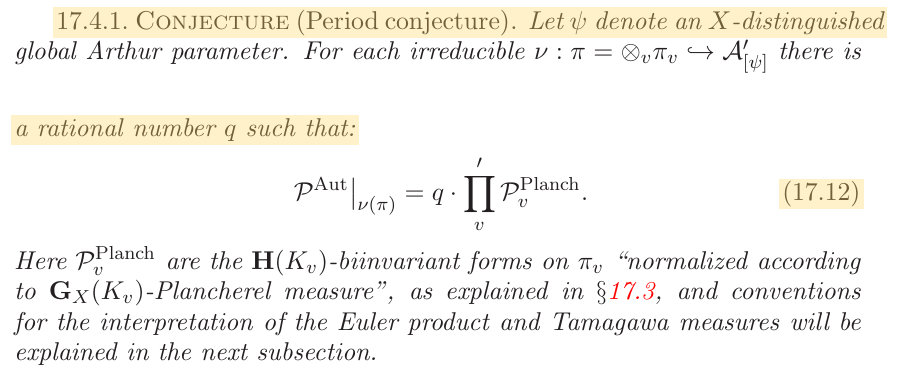

For \(\prod'\) to make sense, the unramified value \(P_v^{\mathrm{Planch}}(u_v^0,u_v^0)\) has to be an L-value. That is computed from the basic function (next section).
From the functional to the basic functionWhy is a question about functionals a question about functions on \(X\)?
Fix one place and drop the index \(v\):
- \(F\) a \(p\)-adic field with ring of integers \(\cO\), \(K=G(\cO)\);
- \(X=G/H\) with base point \(x_0\), a \(G(F)\)-invariant measure \(dx\) on \(X(F)\), and \(X(\cO)=Kx_0\) (the orbit labelled \(0\), K-orbits);
- \(\phiz=\one_{X(\cO)}:X(F)\to\C\), the ;
- the of a compactly supported function with a smooth one,
(functionals as functions on \(X\)) Proved here
Let \(\pi\) be a smooth irreducible representation of \(G(F)\) and \(\ell\in\Hom_H(\pi,\C)\), \(\ell\ne0\).
(a) The map
\[M_\ell:\pi\to C^\infty(X(F)),\qquad M_\ell(u)(gx_0)=\ell\big(\pi(g)^{-1}u\big),\]is well defined, \(G(F)\)-equivariant and injective.
(b) If \(\pi\) is unramified with \(u^0\), then \(M_\ell(u^0)\) is \(K\)-invariant and
\[M_\ell(u^0)(x_0)=\ell(u^0),\qquad \langle\phiz,M_\ell(u^0)\rangle=\vol(X(\cO))\;\ell(u^0).\]Proof
- Well defined: for \(h\in H\), \(\ell(\pi(gh)^{-1}u)=\ell(\pi(h)^{-1}\pi(g)^{-1}u)=\ell(\pi(g)^{-1}u)\), since \(\ell\) is \(H\)-invariant.
- Equivariant: \(M_\ell(\pi(g')u)(gx_0)=\ell(\pi(g'^{-1}g)^{-1}u)=M_\ell(u)(g'^{-1}gx_0)\).
- Injective: \(\ker M_\ell\) is a subrepresentation, not all of \(\pi\) (\(\ell\ne0\) and \(M_\ell(u)(x_0)=\ell(u)\)), so it is \(0\) by irreducibility.
- For \(u^0\in\pi^K\), \(M_\ell(u^0)(kx)=M_\ell(\pi(k)^{-1}u^0)(x)=M_\ell(u^0)(x)\), so \(M_\ell(u^0)\) is constant on \(X(\cO)=Kx_0\), with value \(\ell(u^0)\).
- Hence \(\langle\phiz,M_\ell(u^0)\rangle=\int_{X(\cO)}M_\ell(u^0)\,dx=\vol(X(\cO))\,\ell(u^0)\).
So the number \(\ell(u^0)\) of the previous section is the value at \(x_0\) of the function \(M_\ell(u^0)\), and pairing with \(\phiz\) reads it off. These functions are eigenfunctions of the \(\HK\), which acts on \(K\)-invariant functions by
\[(h\ast M)(x)=\int_{G(F)}h(g)\,M(g^{-1}x)\,dg,\qquad h\in\HK,\quad M\in C^\infty(X(F))^K.\](\(M_\ell(u^0)\) is a Hecke eigenfunction) Proved here
In (b), let \(\eta_\pi:\HK\to\C\) be the character with \(\pi(h)u^0=\eta_\pi(h)\,u^0\). Then
\[h\ast M_\ell(u^0)=\eta_\pi(h)\,M_\ell(u^0)\qquad\text{for all }h\in\HK .\]Proof
- \(\pi(h)u^0\) is \(K\)-fixed, so it lies in the line \(\pi^K=\C u^0\); this defines \(\eta_\pi\).
- By equivariance, \(M_\ell(\pi(g)u)(x)=M_\ell(u)(g^{-1}x)\); integrating against \(h(g)\,dg\) gives \(M_\ell(\pi(h)u)=h\ast M_\ell(u)\).
- With \(u=u^0\): \(h\ast M_\ell(u^0)=M_\ell(\eta_\pi(h)u^0)=\eta_\pi(h)M_\ell(u^0)\).
Sakellaridis writes down one such eigenfunction for each point of a complex torus:
(spherical functions) [Sak, §3.2, Prop. 4.2.1, Thm. 4.2.2] Definition
Let \(\chi\in\AXs\), a point of the \(\AXs=\Hom(\LX,\C^\times)\). Let \(\pi_\chi\) be the unramified principal series whose spherical vector has Hecke eigencharacter \(\eta_{\pi_\chi}(h)=\Sat(h)(\dXh\chi)\), and \(\ell_\chi\in\Hom_H(\pi_\chi,\C)\) Sakellaridis's functional (integration over the open \(B\)-orbit, continued rationally in \(\chi\)). The spherical function is
\[\Om_\chi:=M_{\ell_\chi}(u^0)\ \in\ C^\infty(X(F))^K .\]Sakellaridis writes \(\Om_{\dXh\chi}\), and uses a specific \(K\)-fixed vector \(\Phi_K\) in place of \(u^0\).
So \(\Om_\chi\) is a \(K\)-invariant, not compactly supported function on \(X(F)\); by it is an \(\HK\)-eigenfunction with eigencharacter \(h\mapsto\Sat(h)(\dXh\chi)\), and by its value at \(x_0\) is \(\ell_\chi(u^0)\). That value is a ratio of L-values:
(the value at \(x_0\)) [Sak, Thm. 7.2.1, (1.3)–(1.5)] Proved (cited), \(X\) affine, under (A1)–(A5)
\[\Om_\chi(x_0)=c\,\beta(\chi),\qquad \beta=\frac{\prod_{\check\gamma\in\check\Phi_X^+}\big(1-e^{\check\gamma}\big)}{\prod_{\check\theta\in\Theta^+}\big(1-\sigma_{\check\theta}\,q^{-r_{\check\theta}}e^{\check\theta}\big)},\qquad c=\beta\big(\delta_{P(X)}^{1/2}\big)^{-1},\]where \(\check\Phi_X^+\) are the positive roots of the dual group \(\GX\), and the triples \((\check\theta,\sigma_{\check\theta},r_{\check\theta})\) (a weight of \(\AXs\), a sign, a positive half-integer) come from the colours of \(X\) [Sak, §7.1]. The function
\[\LXf:\AXs\to\C,\qquad \LXf(\chi):=c^2\,\beta(\chi)\,\beta(\chi^{-1}),\]is a quotient of local L-values.
This answers question 2. The form \(P^{\mathrm{Planch}}\) lives on \(\pi_\chi\times\pi_\chi\); for unitary \(\chi\) its value on the spherical vector is \(\LXf\) divided by the Plancherel density of the split group \(G_X\) whose dual is \(\GX\) [SV, (17.8)]:
\[P^{\mathrm{Planch}}(u^0,u^0)=\frac{\LXf(\chi)}{Q\cdot\mu_{G_X}(\chi)},\qquad \mu_{G_X}=\prod_{\check\gamma\in\check\Phi_X}\frac{1-e^{\check\gamma}}{1-q^{-1}e^{\check\gamma}},\]with \(Q\) a constant depending on \(q\) and the parabolic \(P(X)\) [SV, (17.9)].
(Hecke, \(X=\PGL_2/A\); our \(\GL_2/T\) without the centre) [SV, Ex. 17.5.1]
- \(\AXs=\C^\times\ni y\), embedded in \(\As\) as \((y,y^{-1})\) (A* and A_X*); \(\pi\) is unramified with Satake parameter \(\diag(y,y^{-1})\in\SL_2(\C)=\Gv=\GX\).
- Period: \(\int_{k^\times\backslash\mathbb A^\times}\phi\big(\diag(a,1)\big)|a|^s\,d^\times a=L(s+\tfrac12,\pi)\) [Sak12, (1.2)].
- Unramified value, with \(L(s,\pi)\) and \(L(s,\pi,\Ad)\) the : \[P^{\mathrm{Planch}}(u^0,u^0)=\frac{1-q^{-1}}{1-q^{-2}}\cdot\frac{L(\tfrac12,\pi)^2}{L(1,\pi,\Ad)} .\]
- Check against the dual: \(\check X=\Aff^2\), so the numerator is \(L(\tfrac12,\pi)^2\), one factor per copy of \(\mathrm{std}\) in \(T^*\Aff^2=\mathrm{std}\oplus\mathrm{std}\) [OWR25, Shan, Ex. 2.4(4)]; the denominator is the Plancherel density of \(G_X=\PGL_2\).
How item 3 is computed
[SV, Ex. 17.5.1] gives \(\frac{(1-q^{-1})^2}{1-q^{-2}}\prod_{\check\alpha=\pm\check\alpha_0}\frac{1-q^{-1}e^{\check\alpha}}{(1-q^{-1/2}e^{\check\alpha/2})^2}\) at \(\chi\), with \(e^{\check\alpha_0/2}(\chi)=y\). With
\[L(s,\pi)=\frac1{(1-q^{-s}y)(1-q^{-s}y^{-1})},\qquad L(s,\pi,\Ad)=\frac1{(1-q^{-s}y^2)(1-q^{-s})(1-q^{-s}y^{-2})},\]the product equals \(L(\tfrac12,\pi)^2\big/\big((1-q^{-1})L(1,\pi,\Ad)\big)\), and the prefactor turns \((1-q^{-1})^2\) into \(1-q^{-1}\).
(the group, \(X=\GL_n\) under \(\GL_n\times\GL_n\))
- \(H=\Delta\GL_n\), so \(\Per_H(\phi\otimes\bar\phi)=\int_{[\GL_n]}|\phi|^2=\|\phi\|^2\), the Petersson norm.
- \(\AXs=\As_{\GL_n}\) and \(\GX=\GL_n(\C)\) (A* and A_X*); \(\Om_\chi\) is Macdonald's zonal spherical function [Sak, §5.4], and \(\LXf\) is Macdonald's Plancherel density [OWR25, Fintzen, example (3)].
- So \(\LXf\) is a constant multiple of \(\mu_{G_X}\) with \(G_X=\GL_n\): the unramified factor \(P^{\mathrm{Planch}}(u^0,u^0)\) is a constant, independent of \(\pi\).
- The L-value appears only once \(\phi\) is normalized by its Whittaker coefficient: then \(\|\phi\|^2\doteq L(1,\pi,\Ad)\), which is equivalent to the conjecture of Lapid–Mao [OWR25, Lin, Ex. 3].
What (SG) addsThe value \(\Om_\chi(x_0)\) uses only \(\phiz\). Why ask that \(\phiz\) generate \(\CK\)?
Computing \(\LXf\) does not need . Question 1 (nonvanishing) does, and so does the passage from \(\phiz\) to the rest of \(\CK\).
[Sak, Cor. 8.0.4 and the remark after it] Proved (cited), under (A1)–(A5)
Assume (SG), i.e. \(\Res\) is onto (). Then for every irreducible unramified \(\pi\):
- test vectors: every nonzero \(\ell\in\Hom_H(\pi,\C)\) satisfies \(\ell|_{\pi^K}\ne0\);
- multiplicity one: \(\dim\Hom_G(\pi,C^\infty(X))\le1\);
- local to global: if \(G,H\) are defined over \(k\) and satisfy the hypotheses at almost every place, then \(\Hom_{H(k_v)}(\pi_v,\C)\ne0\) for all \(v\) implies \(\Hom_{H(\mathbb A)}(\pi,\C)\ne0\).
Proof
Proof of 1 from (SG)
Sakellaridis omits the proof as straightforward. Let \(u^0\in\pi^K\) be the spherical vector and \(M=M_\ell(u^0)\) ().
- By , \(h^\vee\ast M=\eta_\pi(h^\vee)M\) for \(h\in\HK\), with \(h^\vee(g)=h(g^{-1})\).
- Invariance of the measure gives \(\langle h\ast f,M\rangle=\langle f,h^\vee\ast M\rangle\) for \(f\in\CK\).
- If \(\langle\phiz,M\rangle=0\), then \(\langle h\ast\phiz,M\rangle=\eta_\pi(h^\vee)\langle\phiz,M\rangle=0\) for all \(h\), so by (SG) \(\langle f,M\rangle=0\) for all \(f\in\CK\).
- But \(M\ne0\) is \(K\)-invariant: if \(M(x)\ne0\), then \(f=\one_{Kx}\) gives \(\langle f,M\rangle=\vol(Kx)M(x)\ne0\). So \(\langle\phiz,M\rangle\ne0\), and \(\ell(u^0)=\langle\phiz,M\rangle/\vol(X(\cO))\ne0\) by .
Item 3 follows: the global functional \(\bigotimes'_v\ell_v\) needs \(\ell_v(u_v^0)\ne0\) at almost every \(v\), which is item 1.
The same Hecke equivariance carries the Plancherel formula from \(\phiz\) to everything it generates.
(the unramified spectrum is weighted by \(\LXf\)) Proved here from [Sak, Thm. 9.0.1]
Under (A1)–(A5), with the measure normalized by \(\vol(x_0I)=1\) and \(\langle\Phi,M\rangle=\int_{X(F)}\Phi\,\overline M\), for every \(h\in\HK\)
\[\|h\ast\phiz\|^2=\frac{\vol(X(\cO))^2}{Q\,|\WX|}\int_{\AXs{}^{,1}}\big|\Sat(h)\big(\dXh\chi\big)\big|^2\,\LXf(\chi)\,d\chi,\]where \(\AXs{}^{,1}\) is the compact torus of unitary characters with probability Haar measure \(d\chi\), and \(Q\) is the constant of [Sak, Thm. 9.0.1]. If (SG) holds, every \(\Phi\in\CK\) is of the form \(h\ast\phiz\).
Proof
- [Sak, Thm. 9.0.1]: \(\|\Phi\|^2=\frac1{Q|\WX|}\int_{\AXs{}^{,1}}|\langle\Phi,\Om_{\chi}\rangle|^2d\chi\) for \(\Phi\in\CK\).
- \(\langle\phiz,\Om_\chi\rangle=\vol(X(\cO))\,\Om_\chi(x_0)\), by (b).
- As in step 2 of the previous proof, \(\langle h\ast\phiz,\Om_\chi\rangle=\langle\phiz,h^*\ast\Om_\chi\rangle\) with \(h^*(g)=\overline{h(g^{-1})}\). For unitary \(\chi\) the eigencharacter \(\eta(h)=\Sat(h)(\dXh\chi)\) is that of a unitary representation, so \(\eta(h^*)=\overline{\eta(h)}\) and \(|\langle h\ast\phiz,\Om_\chi\rangle|=|\eta(h)|\,|\langle\phiz,\Om_\chi\rangle|\).
- \(|\Om_\chi(x_0)|^2=c^2\beta(\chi)\overline{\beta(\chi)}=c^2\beta(\chi)\beta(\chi^{-1})=\LXf(\chi)\) for unitary \(\chi\), since \(\beta\) has real coefficients and \(c\) is real ().
So the density of the unramified Plancherel measure of \(X\) is the ratio of L-values \(\LXf\). With (SG), this one density, read off \(\phiz\), governs all of \(\CK\). Without (SG), as for \(E_6/F_4\) (computing r), the formula covers only the submodule \(\HK\ast\phiz\), and Sakellaridis's Example 8.0.1 shows that multiplicity one can fail at special \(\pi\) even when it holds generically [Sak, §8].
Ben-Zvi–Sakellaridis–Venkatesh conjecture this picture for every \(X\) whose cotangent bundle is hyperspherical, with the L-values read off the dual:
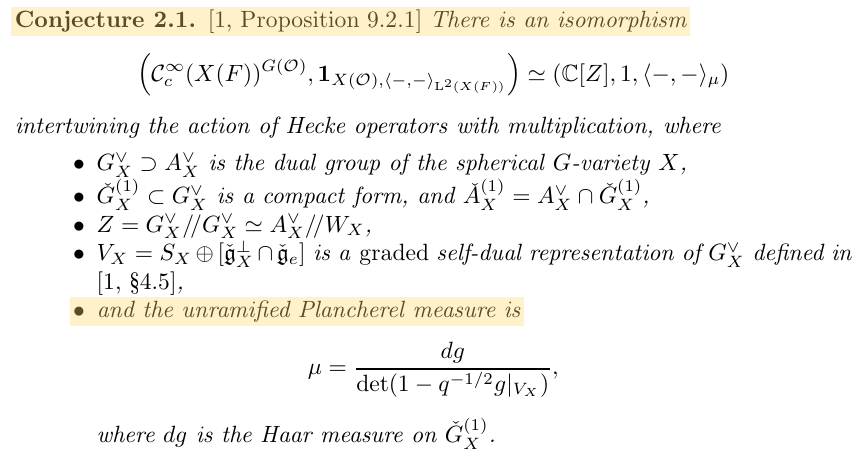
(numerical unramified Plancherel conjecture) [BZSV, §9; stated as OWR25, Shan, Conj. 2.1] Open in general
With the Hecke action normalized to be unitary, there is an isomorphism intertwining \(\HK\) with multiplication by Satake transforms,
\[\big(\CK,\ \phiz,\ \langle\,,\rangle_{L^2}\big)\;\simeq\;\big(\C[\GX/\!/\GX],\ 1,\ \langle\,,\rangle_\mu\big),\qquad \mu=\frac{dg}{\det\big(1-q^{-1/2}g\,\big|\,V_X\big)},\]where \(dg\) is Haar measure on a compact form of \(\GX\) and \(V_X\) is the graded representation of \(\GX\) attached to \(\check X\) (\(\mathrm{std}\oplus\mathrm{std}\) for Hecke). Since \(\C[\GX/\!/\GX]=\C[\AXs]^{\WX}\), under (A1)–(A5) this is 's \(\Phi\) together with the Proposition above; it is known in many cases by [Sak] and [SW] [OWR25, Fintzen].
Non-homogeneous \(X\): the basic function is the L-factorWhy look beyond homogeneous \(X\) at all?
For a homogeneous \(X\) the L-values appear only after a computation. For Tate's \(X=\Aff^1\) they appear at once:
(Tate, \(X=\Aff^1\) under \(\Gm\)) [Tate 1950]
- \(G=\Gm\) acts on \(X(F)=F\) by scaling; \(K=\cO^\times\). The \(K\)-orbits are the shells \(\vpi^m\cO^\times\), \(m\in\Z\), and the point \(\{0\}\).
- \(\phiz=\one_{\cO}:F\to\C\), since \(X(\cO)=\cO\). On the open orbit \(F^\times\) it is a sum over shells: \[\one_{\cO}\big|_{F^\times}=\sum_{m\ge0}\one_{\vpi^m\cO^\times}.\]
- \(\chi:F^\times\to\C^\times\) unramified, \(\vol(\cO^\times)=1\), and \(y=\chi(\vpi)q^{-s}\). The shell \(m\) contributes \(y^m\): \[\int_{F^\times}\one_{\cO}(x)\,\chi(x)|x|^s\,d^\times x=\sum_{m\ge0}y^m=\frac1{1-y}=L(s,\chi).\]
- Compare \(X=\Gm\), where \(X(\cO)=\cO^\times\) is a single shell: the basic function is \(\one_{\cO^\times}\) and the same integral is \(1\).
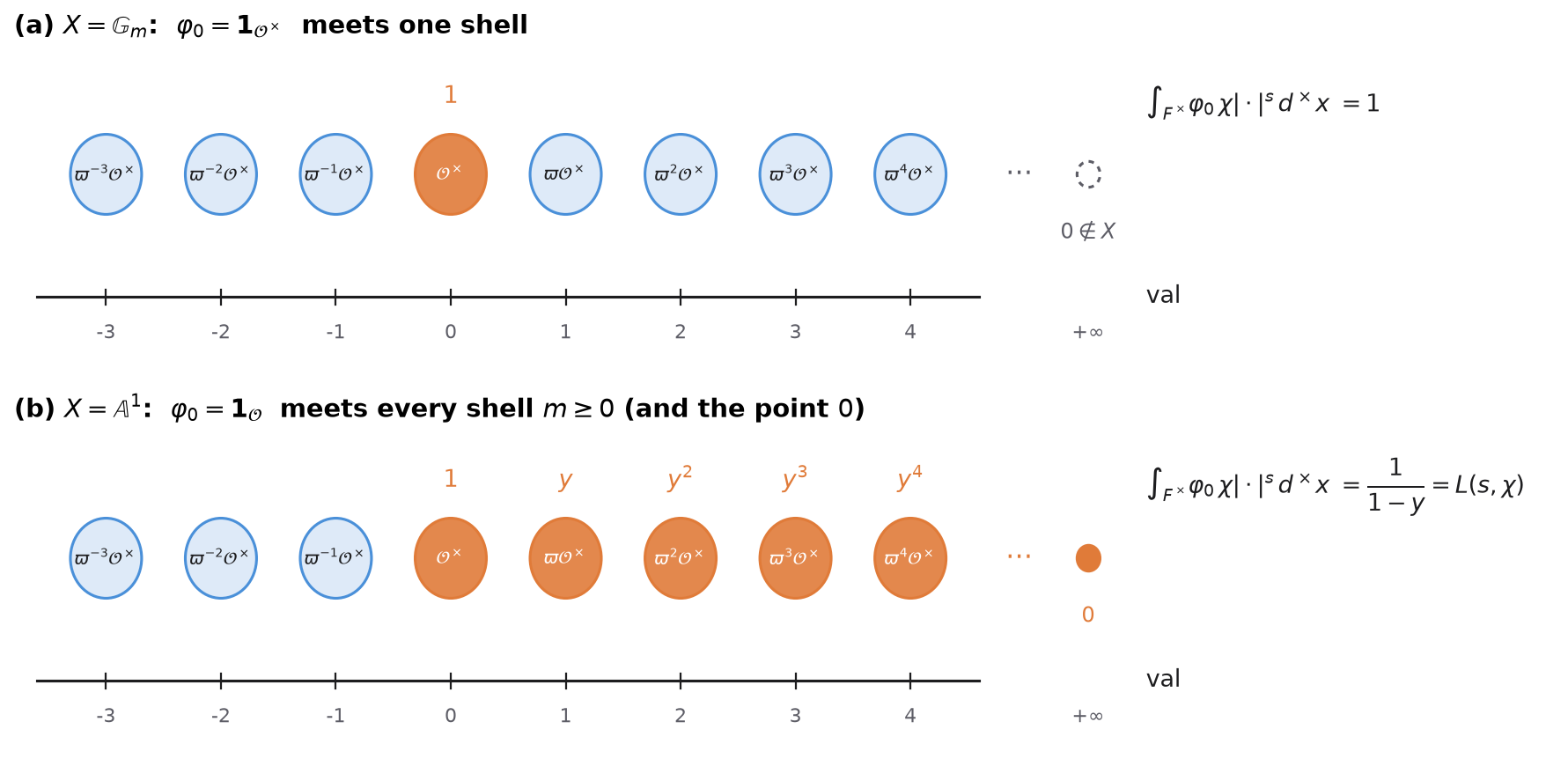
So the L-factor comes from the closed orbit \(\{0\}\): \(X(\cO)\) contains a neighbourhood of it, which meets infinitely many \(K\)-orbits of the open orbit. The same happens for \(\Aff^n\), where in the open-orbit model \(\phiz\) becomes \(1/(1-y)\) (𝔸ⁿ), and for \(\Mat_n\), where \(\one_{\Mat_n(\cO)}\) gives the Godement–Jacquet L-factor [Godement–Jacquet; Sak12, §1.2].
Sakellaridis turned this into a program [Sak12, §1.3]: to every affine spherical \(X\) attach a Schwartz space on \(X(\mathbb A)\), restricted with respect to a basic function at almost every place, and form theta series \(\theta(\Phi,g)=\sum_{x\in X^+(k)}\Phi(xg)\) and \(X\)-Eisenstein series. When \(X\) is singular the basic function is not \(\one_{X(\cO)}\) but the function of an intersection complex; over \(\Fqt\) it is computed in [SW], whose hypothesis (1.1) excludes \(\Aff^n\) for \(n\ge2\) (beyond SV).
(\(X\)-Eisenstein series) [Sak12, Conj. 3.2.2, 3.2.4] Open
For affine spherical \(X\) with trivial arithmetic multiplicity there is a Schwartz space \(\Sw(X(\mathbb A))\) whose basic functions are given by the Gaitsgory–Nadler sheaf, such that for every cusp form \(\phi\) and \(\Phi\in\Sw(X(\mathbb A))\)
\[\int_{G(k)\backslash G(\mathbb A)}\phi(g)\,\omega(g)\,\theta(\Phi,g)\,dg\]continues meromorphically in the idele class character \(\omega\) (the weak form, Conj. 3.2.4). Sakellaridis proves it for wavefront pre-flag bundles [Sak12, Thm. 4.1.3]; it recovers Tate, Godement–Jacquet, Rankin–Selberg and the period integrals.
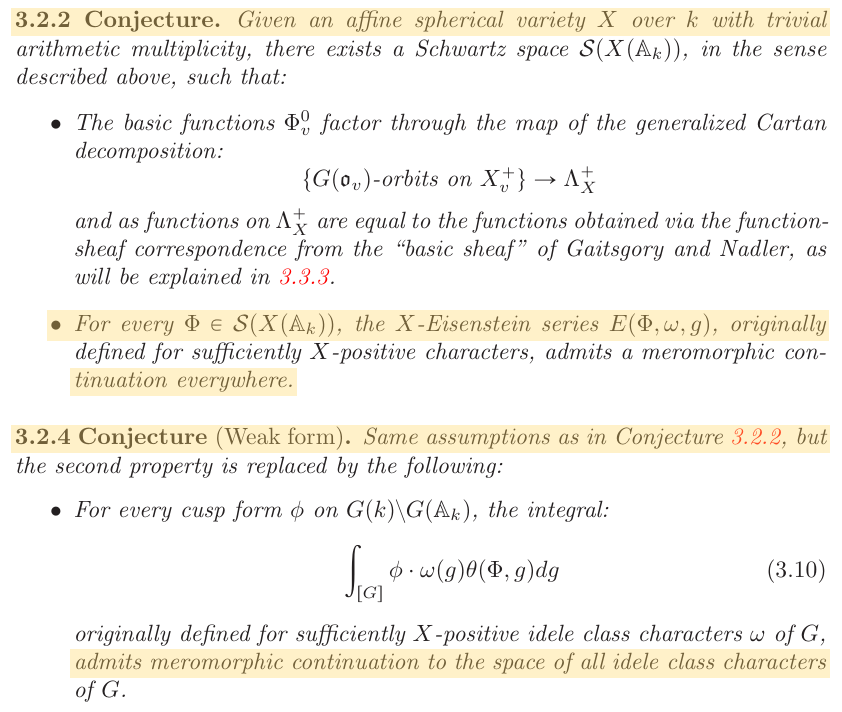
The question “what does the basic function generate?” has the same meaning for non-homogeneous \(X\). On these pages it is answered for \(\Aff^n\) (𝔸ⁿ); for \(\Mat_n\), \(n\ge3\), it is open.
Where this goes
- The question as Sakellaridis posed it in 2013, with the four complications he listed: Oberwolfach 2013.
- The Theorem item by item, including the Corollary above: the Theorem; when \(\Res\) is not onto: computing r.
- The running example \(\GL_2/T\) is Hecke's \(\PGL_2/A\) with the centre added; its geometry is the tree.