\(\Aff^n\): the Theorem's formulation
The Theorem does not apply to \(\Aff^n\), and no paper states its analogue. It can be proved directly: \(\CK\simeq\C[y^{\pm1}]\) with \(\phiz\mapsto1\) and \(\HK\) acting by evaluation along an explicit curve in \(\As\). That curve is the Theorem's \(\dXh\AXs\) for the open orbit, shifted by the central character \(|\det|^{1/2}\).
The questionWhat should “the Theorem for \(\Aff^n\)” assert?
For homogeneous affine \(X\) the Theorem has three parts: a basis of \(\CK\) indexed by \(\LXp\); an isomorphism \(\CK\simeq\C[\dXh\AXs]^{\WX}\) with \(\phiz\mapsto1\); and \(\HK\) acting through restriction \(\Res\). For \(\Aff^n\) each part needs adjusting:
- the orbit indicators do not span \(\CK\) (orbits), so use the lattice basis \(\one_{\vpi^m\cO^n}\);
- \(\Xb\) has no \(G\)-invariant measure: \(d(gv)=|\det g|\,dv\). So functions and the measures Sakellaridis works with ([Sak, §1.7]: \(C_c^\infty\) denotes smooth measures) differ by a character, and the curve where \(\HK\) acts moves by a central twist;
- the answer to (SG) is the surjectivity of a restriction map, as before.
The Hecke module \(\CK(\Aff^n)\)What is \(\CK\) as an \(\HK\)-module?
(the Theorem's analogue for \(\Aff^n\)) Proved here, over every non-archimedean \(F\)
Let \(G=\GL_n\), \(X=\Aff^n\), \(\phiz=\one_{\cO^n}\), and for \(y\in\C^\times\)
\[\chi_y:=\big(q^{\frac{n-1}2}y,\ q^{\frac{n-3}2},\ q^{\frac{n-5}2},\ \dots,\ q^{-\frac{n-1}2}\big)\in\As .\]Then the linear map \(\Phi(\one_{\vpi^m\cO^n}):=y^m\) is an isomorphism
The map \(\Res:\C[\As]^W\to\C[y^{\pm1}]\), \(\Res(P)(y)=P(\chi_y)\), is onto. Hence \(\HK\ast\phiz=\CK\).
Proof
- Basis. \(\{\one_{\vpi^m\cO^n}\}_{m\in\Z}\) is a basis of \(\CK\) (orbits), so \(\Phi\) is a linear isomorphism and \(\Phi(\phiz)=\Phi(\one_{\cO^n})=1\).
- The centre. \(Z=\one_{\vpi K}\) acts by \((Z\ast\varphi)(v)=\varphi(\vpi^{-1}v)\), so \(Z\ast\one_{\vpi^m\cO^n}=\one_{\vpi^{m+1}\cO^n}\): \(Z\) acts as multiplication by \(y\). Every \(T_\lambda\) commutes with \(Z\), so it suffices to compute \(T_\lambda\ast\phiz\).
- Lattice counts. For \(\omega_k=(1^k,0^{n-k})\), \(T_{\omega_k}\ast\phiz(v)\) counts the lattices \(\vpi\cO^n\subseteq L\subseteq\cO^n\) with \(\cO^n/L\simeq\Fq^k\) and \(v\in L\), i.e. the codimension-\(k\) subspaces of \(\Fq^n\) containing \(\bar v\) (Hecke translates). This is \(\binom{n}{k}_q\) if \(v\in\vpi\cO^n\), \(\binom{n-1}{k}_q\) if \(\ord v=0\), and \(0\) if \(\ord v\lt0\). In the lattice basis, by \(q\)-Pascal \(\binom nk_q=\binom{n-1}k_q+q^{n-k}\binom{n-1}{k-1}_q\): \[T_{\omega_k}\ast\phiz=\tbinom{n-1}{k}_q\,\one_{\cO^n}+q^{n-k}\tbinom{n-1}{k-1}_q\,\one_{\vpi\cO^n},\qquad\Phi\big(T_{\omega_k}\ast\phiz\big)=\tbinom{n-1}{k}_q+q^{n-k}\tbinom{n-1}{k-1}_q\,y .\]
- Satake side. \(\Sat(T_{\omega_k})=q^{k(n-k)/2}e_k\) (Satake). Write \(\chi_y=(q^{\frac{n-1}2}y,\,z)\) with \(z=q^{-\frac{n-1}2}(1,q,\dots,q^{n-2})\). Using \(e_k(1,q,\dots,q^{m-1})=q^{k(k-1)/2}\binom mk_q\), \[q^{\frac{k(n-k)}2}e_k(\chi_y)=q^{\frac{k(n-k)}2}\Big(e_k(z)+q^{\frac{n-1}2}y\,e_{k-1}(z)\Big)=\tbinom{n-1}{k}_q+q^{n-k}\tbinom{n-1}{k-1}_q\,y,\] the exponents of \(q\) cancelling to \(0\) and \(n-k\) respectively.
- Conclusion. \(\HK=\C[T_{\omega_1},\dots,T_{\omega_n},T_{\omega_n}^{-1}]\) and \(T_{\omega_n}=Z\), with \(\Sat Z=e_n\) and \(e_n(\chi_y)=y\). Steps 2–4 give \(\Phi(f\ast\varphi)=\Sat f(\chi_y)\,\Phi(\varphi)\) for generators, hence for all \(f\). Finally \(\Res(e_n)=y\) and \(\Res(e_n^{-1})=y^{-1}\), so \(\Res\) is onto.
numerical check The lattice counts of step 3 (brute force over \(\Fq^n\), \(q=2,3\), \(n=2,3\)) and the identity of step 4 (\(q\le7\), \(n\le6\), random \(y\)) are rechecked by assets/figures/check_affine.py. The Hecke lab on functions runs the same module for \(n\le4\).
Reading the curve: \(\dXh\AXs\) and \(|\det|^{1/2}\)Is \(\chi_y\) the Theorem's \(\dXh\AXs\)?
(the curve is a twisted translate) Proved here
With \(\nu^{1/2}:=|\det|^{1/2}=(q^{-1/2},\dots,q^{-1/2})\in\As\) and the translate \(\dXh\AXs\) of \(\Xb\) (invariants), up to \(W\):
\[\{\chi_y\}=\nu^{1/2}\cdot\dXh\AXs,\qquad\chi_y=\nu^{1/2}\cdot\big(q^{\frac{n-2}2},\dots,q^{-\frac{n-2}2},\ q^{n/2}y\big).\]Proof
Multiply each coordinate of \((q^{\frac{n-2}2-j})_{0\le j\le n-2}\) by \(q^{-1/2}\) to get \((q^{\frac{n-3}2-j})_j\), the last \(n-1\) coordinates of \(\chi_y\); and \(q^{-1/2}\cdot q^{n/2}y=q^{\frac{n-1}2}y\).
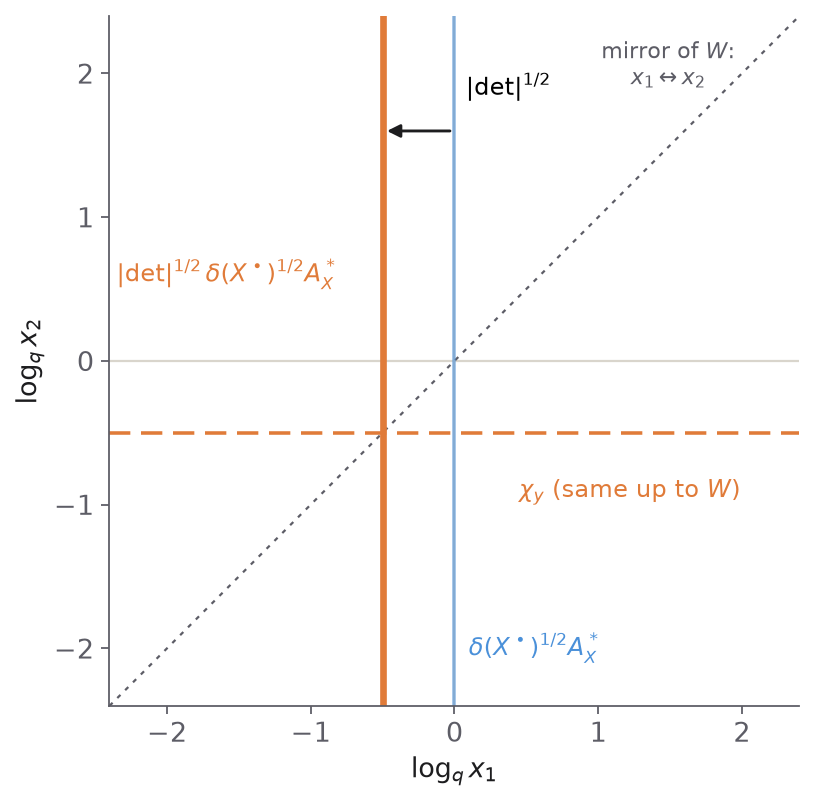
Heuristic Lebesgue measure on \(F^n\) is a \(G\)-eigenmeasure with eigencharacter \(\nu=|\det|\), and normalizing by its square root (half-densities, the unitary normalization) is what moves the translate by \(\nu^{1/2}\). For homogeneous affine \(X\), \(H\) is reductive, the invariant measure exists, \(\nu=1\), and no twist appears. So the Proposition has the Theorem's shape:
\[\CK(\Aff^n)\simeq\C\big[\nu^{1/2}\dXh\AXs\big]^{\WX},\qquad\WX=1,\qquad\phiz\mapsto1 .\]The open-orbit model: \(\phiz\) as an L-factorWhat does \(\phiz\) look like seen from \(\Xb\)?
Restricting to the open orbit is injective on \(\CK(\Aff^n)\) (\(\{0\}\) has measure zero and functions are locally constant). On \(\Xb\) the orbit indicators do form a basis, \(\Sw(\Xb)^K\simeq\C[y^{\pm1}]\) via \(\one_{X_m}\mapsto y^m\), with the same \(\HK\)-action. Then
\[\one_{\vpi^m\cO^n}\big|_{\Xb}=\sum_{m'\ge m}\one_{X_{m'}}\longmapsto\frac{y^m}{1-y},\qquad\phiz\longmapsto\frac1{1-y}=\sum_{m\ge0}y^m,\qquad\CK(\Aff^n)\simeq\tfrac1{1-y}\,\C[y^{\pm1}]\subseteq\C(\!(y)\!).\]So in this model the basic function is not \(1\) but the factor \(1/(1-y)\), and the two models differ by multiplication by it. For \(n=1\) this is Tate's thesis [Tate 1950]: the Mellin transform of \(\one_{\cO}\) is \(L(s,\chi)=(1-\chi(\vpi)q^{-s})^{-1}\). In the coordinate \(y'=q^{n/2}y\) of the Lemma, \(1/(1-y)=1/(1-q^{-n/2}y')\), an L-factor of \(\GX=\Gm\) at \(s=n/2\). This is the picture in Sakellaridis's L-functions paper, where basic functions of non-homogeneous affine \(X\) are described through their transforms on the open orbit [Sak12, §1.3, §3.1], and in its geometric refinement [SW].
The Plancherel formula: L-values as the spectral densityWhat does the Motivation page's Plancherel proposition become for \(\Aff^n\)?
(unramified Plancherel formula for \(\Aff^n\)) Proved here
Take Lebesgue measure on \(F^n\) with \(\vol(\cO^n)=1\), \(dz\) the probability Haar measure on \(|z|=1\), \(L(s,z):=(1-q^{-s}z)^{-1}\) and \(\zeta(s):=(1-q^{-s})^{-1}\). For every \(h\in\HK\),
and by the Proposition every \(f\in\CK\) is some \(h\ast\phiz\).
Proof
- In the open-orbit model, \(f\mapsto F_f(y)=\sum_mf(X_m)\,y^m\), and \(F_{h\ast\phiz}(y)=\Sat(h)(\chi_y)/(1-y)\) ( and the previous section). The series converges for \(|y|\lt1\): \(f(X_m)=0\) for \(m\ll0\) and is constant for \(m\gg0\).
- \(\vol(X_m)=q^{-mn}(1-q^{-n})\), so by Parseval on \(|y|=q^{-n/2}\), \[\|f\|^2=(1-q^{-n})\sum_m|f(X_m)|^2q^{-mn}=(1-q^{-n})\int_{|z|=1}\big|F_f(q^{-n/2}z)\big|^2dz .\]
- Substitute step 1: \(|1-q^{-n/2}z|^{-2}=L(\tfrac n2,z)L(\tfrac n2,z^{-1})\) because \(\bar z=z^{-1}\), and \(1-q^{-n}=\zeta(n)^{-1}\).
numerical check Both sides for random \(f\), \(q=2,3,5\), \(n\le4\): assets/figures/check_affine.py, check 3.
This is the \(\Aff^n\) case of the Plancherel proposition (Proposition 4.2 there, proved for homogeneous \(X\) from [Sak, Thm. 9.0.1]). The density is \(\LXf(z)=L(\tfrac n2,z)L(\tfrac n2,z^{-1})/\zeta(n)\), values of the L-factor of \(\GX=\Gm\) at the special point \(s=\tfrac n2\). In the coordinate \(y'=q^{n/2}y\) of the circle is \(|y'|=1\), the unitary characters. For \(n=1\) this is Tate's local computation: \(\one_\cO\) has Mellin transform \(L(s,\chi)\), and its \(L^2\)-norm is \(\int L(\tfrac12,z)L(\tfrac12,z^{-1})/\zeta(1)\,dz=1\).
Status of the formulationWho has stated this, and in what form?
| source | covers \(\Aff^n\)? | what it says |
|---|---|---|
| [Sak], Thm. 8.0.2 | no | needs \(X\) homogeneous (§1.1) and affine (§8) |
| [SV] | only \(\Xb\) | invariants of homogeneous quasi-affine \(X\); no Hecke-module theorem |
| [Sak12], ANT 2012 | globally | \(\Aff^N\) is a pre-flag bundle (Ex. 4.1.2); basic functions and Euler products, conjectural in general (Conj. 3.2.2, 3.2.4) |
| [SW], JAMS 2022 | no | over \(\Fqt\), hypothesis (1.1) \(\GX=\Gv\), which fails for \(\Aff^n\), \(n\ge2\) (\(\GX=\Gm\)) |
| [BZSV], 2024 | dual data | \(\GX=\Gm\), \(P_{1,n-1}\) (Ex. 4.3.12); local conjecture 7.5.1 is geometric; not among its known cases (§7.6.5) |
| these pages | yes | the Proposition above, over every \(F\), with (SG) |
Open A general statement for non-homogeneous affine \(X\): which space (\(\Sw(X)^K\) or \(\Sw(\Xb)^K\)), which normalization (functions or half-densities), and which hypotheses replace (A5). [BZSV, §9.4] expects \(C_c^\infty(X_F/G_{\cO})\simeq\C[\GX]^{\GX}\) “in the situations to which [Sak13] is applicable”. For \(\Aff^n\) the Proposition shows that, in the lattice basis and with the twist, the expected shape holds.
Contrast: \(\Mat_n\) under \(\GL_n\times\GL_n\)Does the same argument work for matrices?
For \(X=\Mat_n\), \(\phiz=\one_{\Mat_n(\cO)}\), the open orbit is the group \(\GL_n\), and restricted to it \(\phiz\) has Satake transform the standard L-factor \(\prod_i(1-q^{(n-1)/2}x_i)^{-1}\) [Godement–Jacquet, LNM 260]. Its inverse is a polynomial, so every nonsingular orbit indicator lies in \(\HK\ast\phiz\). Near the singular matrices the lattice argument has no analogue for \(n\ge3\): (SG) holds for \(n=2\) and is open for \(n\ge3\) on these pages (Proposition H).