\(\Aff^n\): geometry and orbits
\(\Aff^n\) under \(\GL_n\) is the simplest spherical variety that is affine but not homogeneous, so it sits just outside the Theorem. This page computes its invariants, says what the extra point \(0\) adds, draws \(F^n\) in valuation coordinates, and finds its \(K\)-orbits, its \(I\)-orbits and its \(I\)-stable lattices.
SetupWhy is \(\Aff^n\) neither in the Theorem nor far from it?
\(G=\GL_n\) acts on column vectors \(X=\Aff^n\), \(B\) upper triangular. Then
\[\Xo=B\cdot e_n=\{v_n\ne0\},\qquad\Stab_B(e_n)=\{b:\ b_{in}=0\ (i\lt n),\ b_{nn}=1\}\ \text{(connected)},\] \[\Xb:=\Aff^n\smallsetminus\{0\}=G/H,\qquad H=\Stab_G(e_n)\supseteq N^-\ \text{(lower unitriangular)}.\]So \(X\) is affine, smooth and spherical with connected generic \(B\)-stabilizers, but not homogeneous. Its open \(G\)-orbit \(\Xb\) is homogeneous and but only quasi-affine. The Theorem needs both properties at once [Sak, §1.1, §8], so it applies to neither.
Over \(F\): \(X(F)=F^n\), \(X(\cO)=\cO^n\), \(\phiz=\one_{\cO^n}\), \(K=\GL_n(\cO)\), \(I=\{k\in K:\ k\bmod\vpi\in B(\Fq)\}\) and \(K_1=1+\vpi\Mat_n(\cO)\subseteq I\). In the examples and pictures \(F=\Fqt\), \(\cO=\Fq[[t]]\) and \(\vpi=t\).
The invariantsWhat are \(\AX\), \(\LXp\), \(\WX\), \(\dX\) here?
All invariants are those of the open orbit \(\Xb\), computed with the recipes of the Geometry tab.
| object | value | how |
|---|---|---|
| \(\PX\), \(\LevX\) | \(P_{n-1,1}\), \(\GL_{n-1}\times\GL_1\) | last row \((0,\dots,0,*)\) |
| \(\Xc(X)\), \(\AX\) | \(\Z\epsilon_n\) (eigenfunction \(v_n\)), \(\Gm\) | \(\LevX/(\LevX\cap H)\), \(\LevX\cap H=\GL_{n-1}\) |
| \(\LT\to\LX\) | \(\lambda\mapsto\lambda_n\) | onto |
| \(\Vc\), \(\LXp\) | \(\Q\), \(\Z\) | horospherical |
| \(\WX\) | \(1\) | horospherical |
| \(\AXs\subseteq\As\) | \(\{(1,\dots,1,y)\}\) | dual of \(\lambda\mapsto\lambda_n\) |
| \(\dXh\AXs\) | \(\{(q^{\frac{n-2}2},\dots,q^{-\frac{n-2}2},\,y)\}\) | \(\rho\) of \(\GL_{n-1}\) |
This agrees with Ben-Zvi–Sakellaridis–Venkatesh, who treat \(\Aff^n\) with the right action of \(\GL_n\): “the only \(B\)-stable divisor is defined by \(x_1=0\) and its stabilizer is the parabolic \(P(X)=P_{1,n-1}\)”, with dual group \(\GX=\Gm\) and \(\SL_2\) “principal for the Levi of type \((1,n-1)\)” [BZSV, Ex. 4.3.12]. The principal \(\SL_2\) of \(\GL_{n-1}\) at \(\diag(q^{1/2},q^{-1/2})\) is the string \(q^{\frac{n-2}2},\dots,q^{-\frac{n-2}2}\) in the table.
The colour and the point \(0\)What does the embedding \(\Xb\subseteq\Aff^n\) add?
\(\Aff^n\) has one colour, \(D=\{v_n=0\}\) (colours), and one extra \(G\)-orbit, \(\{0\}\), of codimension \(n\). In Luna–Vust terms \(\Aff^n\) is the simple embedding of \(\Xb\) whose closed orbit is \(\{0\}\), with coloured cone spanned by the valuation of \(D\): \(v_D(v_n)=1\), the positive direction of \(\LX=\Z\). In the \(K\)-orbit picture this is the direction of the shells \(X_m\), \(m\to+\infty\), which accumulate at \(0\) ():
\[\overline{X_m}=\vpi^m\cO^n=\{0\}\sqcup\bigsqcup_{m'\ge m}X_{m'} .\]A function in \(\Sw(\Aff^n)\) may be nonzero along this direction, as long as it is eventually constant there. That is the difference between \(\Sw(\Xb)\) and \(\Sw(\Aff^n)\).
The valuation pictureHow do we draw \(F^n\)?
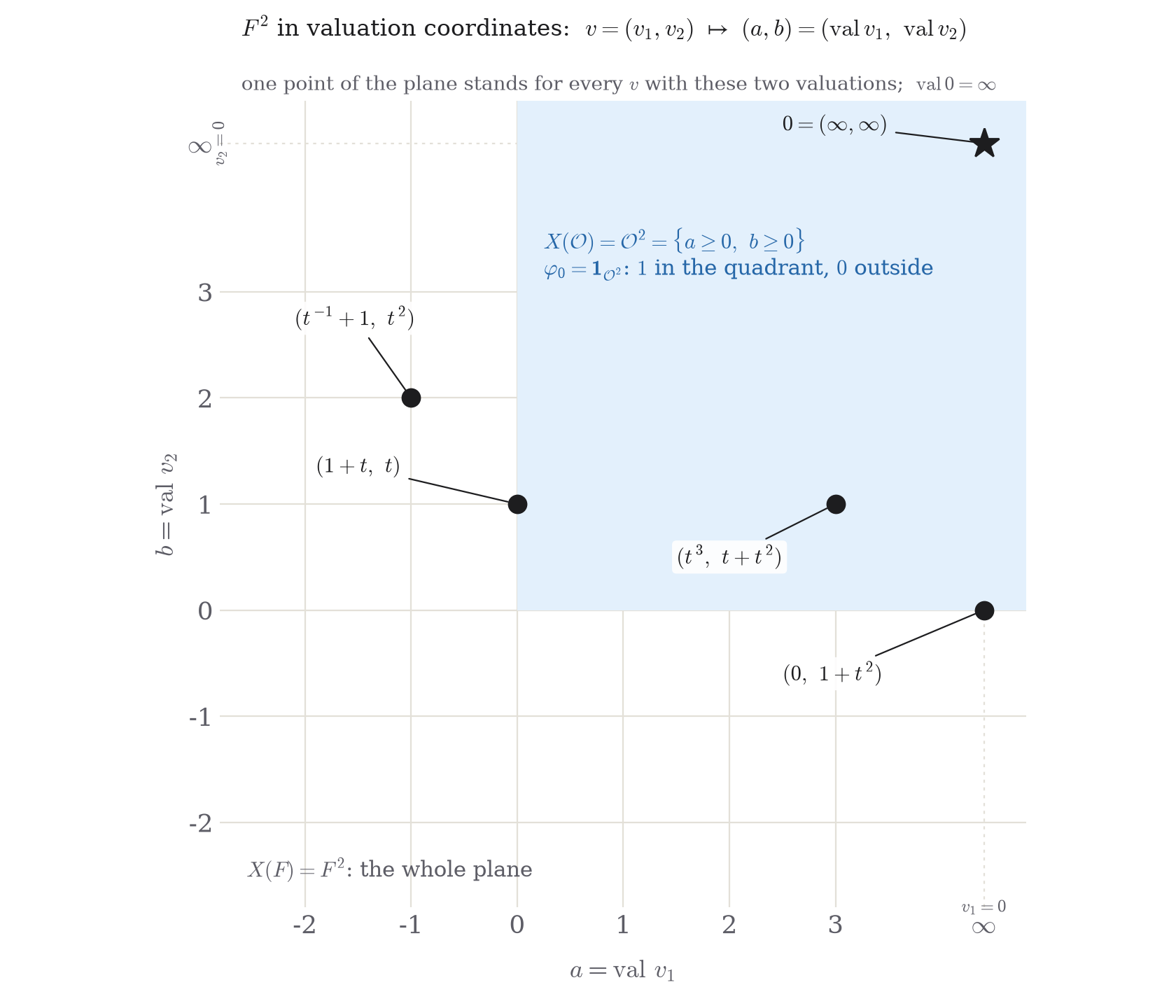
For \(n=2\), draw \(v=(v_1,v_2)\) at \((a,b)=(\val v_1,\val v_2)\), a zero coordinate at \(\infty\). One point of the plane stands for every vector with those two valuations; the orbits of \(K\) and \(I\) turn out to be unions of such points.
(order and last coordinate) Definition
For \(v\in F^n\smallsetminus0\),
\[\ord v:=\min_i\val v_i\in\Z,\qquad\operatorname{last}v:=\max\{i:\ \val v_i=\ord v\}\in\{1,\dots,n\}.\]Equivalently \(\ord v\) is the largest \(m\) with \(v\in\vpi^m\cO^n\), so \(v=\vpi^{\ord v}u\) with \(u\) primitive (below), and \(\operatorname{last}v\) is the last nonzero coordinate of \(u\bmod\vpi\in\Fq^n\). An upper triangular matrix cannot move that coordinate, which is why \(\operatorname{last}\) is an \(I\)-invariant.
(primitive vector) Definition
\(u\in\cO^n\) is primitive if the following equivalent conditions hold:
\[u\notin\vpi\cO^n\iff\ord u=0\iff u\bmod\vpi\ne0\iff\exists i:\ u_i\in\cO^\times .\]For \(n=2\): \((1+t,t)\), \((t,1+t)\), \((1,1)\) are primitive; \((t,t^2)\) and \((0,0)\) are not.
(\(n=2\))
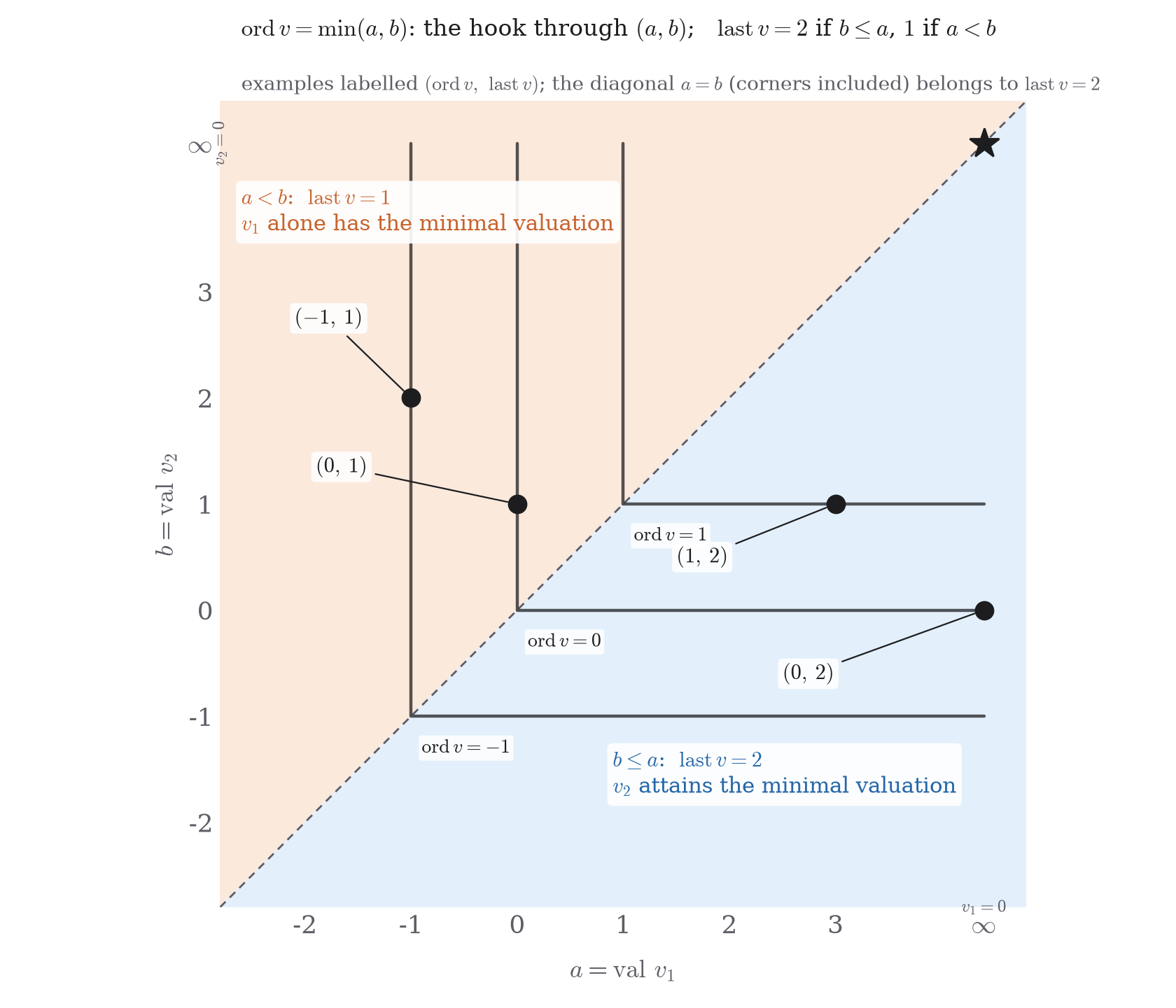
At \((a,b)\): \(\ord v=\min(a,b)\), so the vectors of order \(m\) fill the hook \(\{\min(a,b)=m\}\), the rays \(\{b=m\le a\}\) and \(\{a=m\le b\}\) with corner \((m,m)\); \(\operatorname{last}v=2\) if \(b\le a\), and \(1\) if \(a\lt b\).
| \(v\) | \((a,b)\) | \(v=t^{\ord v}u\) | \(u\bmod t\) | \((\ord v,\operatorname{last}v)\) |
|---|---|---|---|---|
| \((t^{-1}+1,\ t^2)\) | \((-1,2)\) | \(t^{-1}(1+t,\ t^3)\) | \((1,0)\) | \((-1,1)\) |
| \((1+t,\ t)\) | \((0,1)\) | \((1+t,\ t)\) | \((1,0)\) | \((0,1)\) |
| \((t,\ 1+t)\) | \((1,0)\) | \((t,\ 1+t)\) | \((0,1)\) | \((0,2)\) |
| \((0,\ 1+t^2)\) | \((\infty,0)\) | \((0,\ 1+t^2)\) | \((0,1)\) | \((0,2)\) |
| \((t^3,\ t+t^2)\) | \((3,1)\) | \(t\,(t^2,\ 1+t)\) | \((0,1)\) | \((1,2)\) |
| \((t^2,\ t^2+t^3)\) | \((2,2)\) | \(t^2(1,\ 1+t)\) | \((1,1)\) | \((2,2)\) |
\(K\)- and \(I\)-orbitsWhat are the cells of \(F^n\)?
(orbits) Proved here
The \(K\)-orbits on \(F^n\) are \(\{0\}\) and the shells \(X_m=\{\ord v=m\}=\vpi^m(\cO^n\smallsetminus\vpi\cO^n)\), \(m\in\Z\). The \(I\)-orbits are \(\{0\}\) and \(O_{m,j}=\{\ord v=m,\ \operatorname{last}v=j\}\), \(1\le j\le n\), so \(X_m=\bigsqcup_{j=1}^nO_{m,j}\). Every orbit other than \(\{0\}\) is open and compact.
Proof
- The \(K\)-orbits.
- \(\ord\) is \(K\)-invariant. For \(n=2\), write \(k=\begin{pmatrix}\alpha&\beta\\\gamma&\delta\end{pmatrix}\in K\), so \(\alpha,\beta,\gamma,\delta\in\cO\). Then \[kv=\begin{pmatrix}\alpha&\beta\\\gamma&\delta\end{pmatrix}\begin{pmatrix}v_1\\v_2\end{pmatrix}=\begin{pmatrix}\alpha v_1+\beta v_2\\\gamma v_1+\delta v_2\end{pmatrix},\] \[\val(\alpha v_1+\beta v_2)\ge\min(\val\alpha+\val v_1,\ \val\beta+\val v_2)\ge\min(\val v_1,\val v_2)=\ord v,\] and the same holds for \(\gamma v_1+\delta v_2\). So \(\ord(kv)\ge\ord v\). Applying this to \(k^{-1}\in K\) and \(kv\) gives \(\ord v\ge\ord(kv)\). For example, with \(k=\begin{pmatrix}1&1\\0&1\end{pmatrix}\) and \(v=(t^2,t)\), \[kv=\begin{pmatrix}t^2+t\\t\end{pmatrix}:\qquad(a,b)=(2,1)\ \mapsto\ (1,1),\qquad\ord=1\ \text{before and after}.\] For general \(n\) the argument is the same, with \((kv)_i=\sum_lk_{il}v_l\). So each \(X_m\) is \(K\)-stable, and so is \(\{0\}\).
- \(K\) is transitive on primitive vectors. Let \(u\) be primitive with \(u_i\in\cO^\times\), and let \(k=(e_1|\cdots|\widehat{e_i}|\cdots|e_n|u)\) have columns \(e_l\) (\(l\ne i\), in order) and then \(u\).
- \(ke_n\) is the last column of \(k\), so \(ke_n=u\).
- The entries of \(k\) lie in \(\cO\), so \(k\in K=\GL_n(\cO)\) if and only if \(\det k\in\cO^\times\).
- Row \(i\) of \(k\) is \((0,\dots,0,u_i)\): each \(e_l\) with \(l\ne i\) has a \(0\) in row \(i\).
- Expand \(\det k\) along row \(i\). The only nonzero entry is \(u_i\), in position \((i,n)\), so \[\det k=(-1)^{i+n}\,u_i\,\det k',\] where \(k'\) is \(k\) with row \(i\) and column \(n\) deleted. Deleting row \(i\) from the columns \(e_1,\dots,\widehat{e_i},\dots,e_n\) leaves \(e_1,\dots,e_{n-1}\in\cO^{n-1}\), so \(k'=1_{n-1}\) and \(\det k=\pm u_i\).
- \(u_i\in\cO^\times\), so \(\det k\in\cO^\times\) and \(k\in K\).
- The other shells. \(X_m=\vpi^mX_0=K\,\vpi^me_n\), because the scalar \(\vpi^m\) commutes with \(K\).
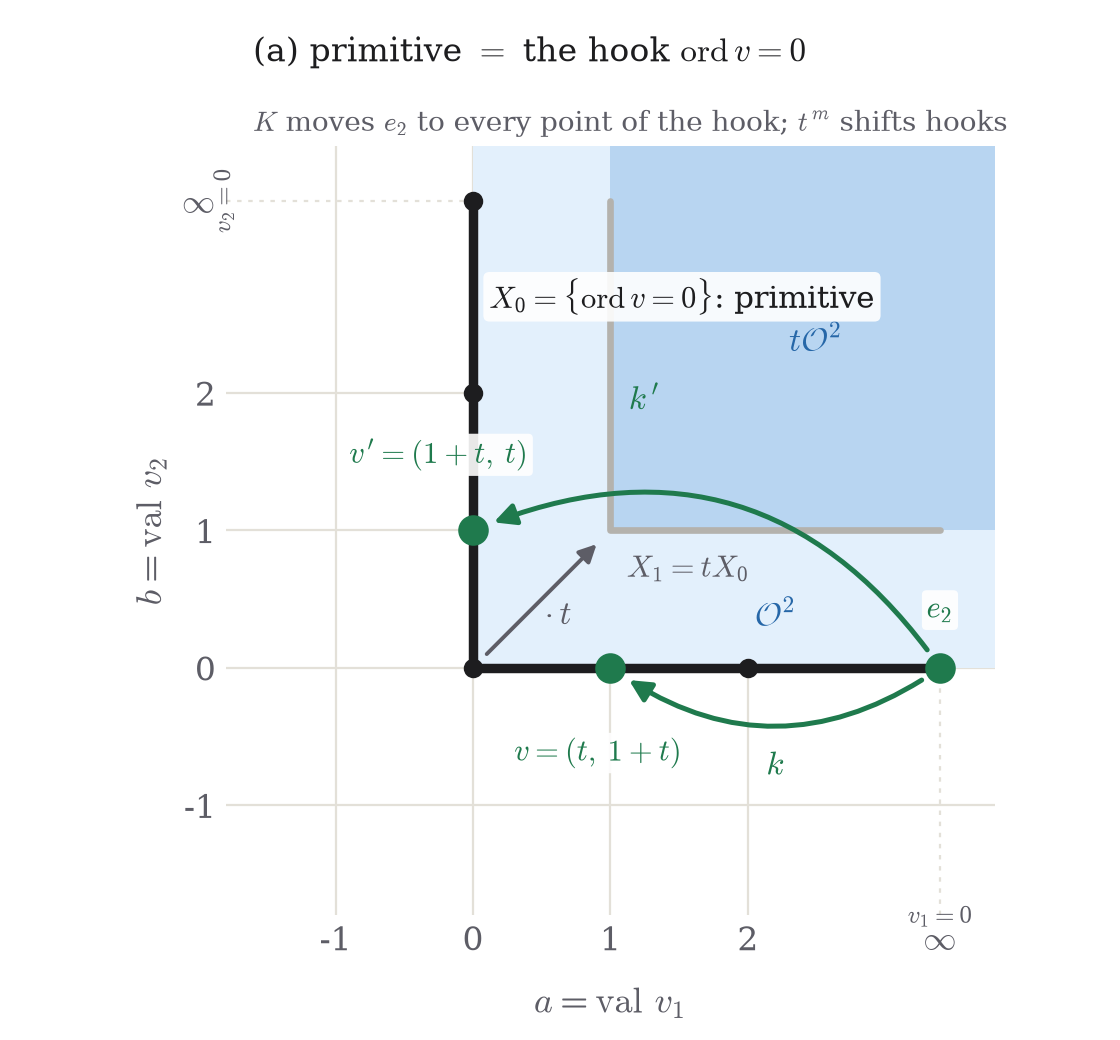
Step 1 for \(n=2\): \(k=\begin{pmatrix}1&t\\0&1+t\end{pmatrix}\) carries \(e_2\) to \((t,1+t)\), \(k'=\begin{pmatrix}0&1+t\\1&t\end{pmatrix}\) carries it to \((1+t,t)\), and \(t\cdot\) carries \(X_0\) to \(X_1\). - Reduction to \(\Fq^n\). Let \(r_m:X_m\to\Fq^n\smallsetminus0\), \(r_m(v)=\vpi^{-m}v\bmod\vpi\).
- \(r_m\) is \(I\)-equivariant: \(r_m(kv)=\bar k\,r_m(v)\) with \(\bar k=k\bmod\vpi\in B(\Fq)\). So each \(I\)-orbit lies over one \(B(\Fq)\)-orbit.
- The fibres of \(r_m\) are \(K_1\)-orbits: \(K_1v=v+\vpi^{m+1}\cO^n\). Given \(w\in\cO^n\) and \(v=\vpi^mu\), \(u_i\in\cO^\times\), let \(A\) have column \(i\) equal to \(wu_i^{-1}\) and all other columns zero; then \((1+\vpi A)v=v+\vpi^{m+1}w\).
- Conclusion. If \(r_m(w)=\bar b\,r_m(v)\) with \(\bar b\in B(\Fq)\), lift \(\bar b\) to \(b\in B(\cO)\subseteq I\); then \(w\in K_1bv\subseteq Iv\). So the \(I\)-orbits in \(X_m\) are the preimages of the \(B(\Fq)\)-orbits.
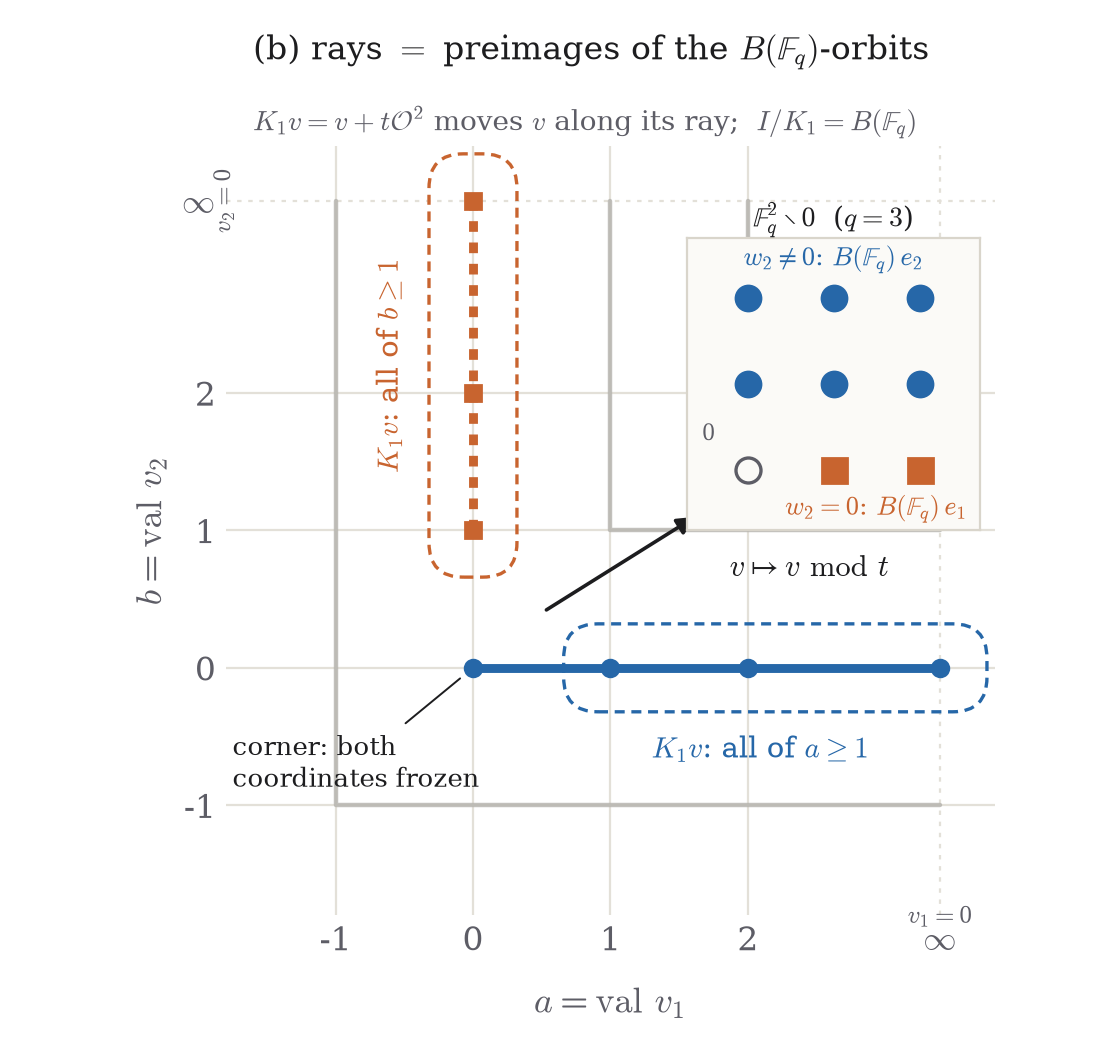
Step 2 for \(n=2\): \(K_1v=v+t\cO^2\) moves \(v\) along its ray and cannot leave it; \(B(\Fq)\) permutes the fibres over \(\{w_2\ne0\}\), and separately those over \(\{w_2=0\}\). - The \(B(\Fq)\)-orbits on \(\Fq^n\smallsetminus0\). For \(w\ne0\) with last nonzero coordinate \(j\), \((bw)_i=\sum_{l\ge i}b_{il}w_l\) is \(0\) for \(i\gt j\) and \(b_{jj}w_j\ne0\) for \(i=j\), so \(j\) is preserved. Conversely the matrix equal to the identity except for column \(j\), which is \(w\), is upper triangular, invertible, and sends \(e_j\) to \(w\). So the orbits are \(B(\Fq)e_j=\{w_j\ne0,\ w_i=0\ (i\gt j)\}\), and their preimages are the \(O_{m,j}\).
- Each \(O_{m,j}\) is a union of cosets of \(\vpi^{m+1}\cO^n\) inside the compact set \(\vpi^m\cO^n\), hence open and compact.
(a) \(K\)-orbits
One hook per order.
(b) \(I\)-orbits
Blue horizontal: last \(=2\). Orange vertical: last \(=1\).

The chain of \(I\)-stable latticesWhich lattices does \(I\) preserve, and what lies between them?
(the chain of lattices) Definition
For \(m\in\Z\) and \(0\le j\le n\),
\[\Lambda_{m,j}:=\{v:\ \val v_i\ge m\ (i\le j),\ \val v_i\ge m+1\ (i\gt j)\}=g_{m,j}\cO^n,\] \[g_{m,j}:=\vpi^m\begin{pmatrix}1_j&0\\0&\vpi\,1_{n-j}\end{pmatrix}=\vpi^m\begin{pmatrix}1&&&&&\\&\ddots&&&&\\&&1&&&\\&&&\vpi&&\\&&&&\ddots&\\&&&&&\vpi\end{pmatrix}\quad(j\text{ entries }1,\ n-j\text{ entries }\vpi,\ \text{zeros elsewhere}),\] \[n=2:\qquad g_{m,2}=\vpi^m\begin{pmatrix}1&0\\0&1\end{pmatrix},\qquad g_{m,1}=\vpi^m\begin{pmatrix}1&0\\0&\vpi\end{pmatrix},\qquad g_{m,0}=\vpi^m\begin{pmatrix}\vpi&0\\0&\vpi\end{pmatrix},\] \[n=3:\qquad g_{m,2}=\vpi^m\begin{pmatrix}1&0&0\\0&1&0\\0&0&\vpi\end{pmatrix},\qquad g_{m,1}=\vpi^m\begin{pmatrix}1&0&0\\0&\vpi&0\\0&0&\vpi\end{pmatrix},\qquad g_{0,1}\begin{pmatrix}x\\y\\z\end{pmatrix}=\begin{pmatrix}x\\\vpi y\\\vpi z\end{pmatrix},\] \[\cdots\supset\Lambda_{m,n}=\vpi^m\cO^n\supset\Lambda_{m,n-1}\supset\cdots\supset\Lambda_{m,0}=\vpi^{m+1}\cO^n=\Lambda_{m+1,n}\supset\cdots\]Modulo \(\vpi^{m+1}\cO^n\), \(\Lambda_{m,j}\) is \(\langle e_1,\dots,e_j\rangle\subseteq\Fq^n\): the chain inserts the standard flag between \(\vpi^{m+1}\cO^n\) and \(\vpi^m\cO^n\). \(K\) acts on this quotient through \(\GL_n(\Fq)\), which moves the flag; \(I\) acts through \(B(\Fq)\), its stabilizer. Each step \(\Lambda_{m,j}\supset\Lambda_{m,j-1}\) imposes \(\val v_j\ge m+1\) and removes the vectors with \((\ord v,\operatorname{last}v)=(m,j)\). In the plane, \(\Lambda_{m,j}\) is a quadrant with corner \((m,m)\) for \(j=2\) and \((m,m+1)\) for \(j=1\); going down the chain moves the corner alternately up and right along the diagonal, one ray at a time.
(\(n=2\), around \(\cO^2\))
\[\Lambda_{-1,1}=t^{-1}\cO\oplus\cO\ \supset\ \Lambda_{0,2}=\cO^2\ \supset\ \Lambda_{0,1}=\cO\oplus t\cO\ \supset\ \Lambda_{1,2}=t\cO^2\ \supset\ \Lambda_{1,1}=t\cO\oplus t^2\cO,\]with corners \((-1,0)\), \((0,0)\), \((0,1)\), \((1,1)\), \((1,2)\). The last lattice containing \(v\) is \(\Lambda_{\ord v,\operatorname{last}v}\):
| \(v\) at \((a,b)\) | \(\Lambda_{-1,1}\) | \(\cO^2\) | \(\Lambda_{0,1}\) | \(t\cO^2\) | \(\Lambda_{1,1}\) |
|---|---|---|---|---|---|
| \((t^{-1}+1,\ t^2)\) at \((-1,2)\) | in | – | – | – | – |
| \((1+t,\ t)\) at \((0,1)\) | in | in | in | – | – |
| \((t,\ 1+t)\) at \((1,0)\) | in | in | – | – | – |
| \((t^3,\ t+t^2)\) at \((3,1)\) | in | in | in | in | – |
The permutation matrix swapping \((1+t,t)\) and \((t,1+t)\) lies in \(K\) but not in \(I\), and \(\Lambda_{0,1}\) contains the first but not the second.
(\(I\)-stable lattices) Proved here
- For \(g\in G(F)\) and \(L=g\cO^n\): \(L\) is \(I\)-stable \(\iff I\subseteq gKg^{-1}\iff IgK=gK\).
- Every \(\Lambda_{m,j}\) is \(I\)-stable, and \(\Lambda_{m,j}\smallsetminus\Lambda_{m,j-1}=O_{m,j}\).
- The \(I\)-stable lattices are exactly the \(\Lambda_{m,j}\); the \(K\)-stable lattices are exactly the \(\vpi^m\cO^n\).
Proof
- \(kL=L\iff g^{-1}kg\,\cO^n=\cO^n\iff g^{-1}kg\in K\), since \(K\) is the stabilizer of \(\cO^n\). So \(L\) is \(I\)-stable iff \(g^{-1}Ig\subseteq K\), i.e. \(kg\in gK\) for all \(k\in I\), i.e. \(IgK=gK\).
- For \(k\in I\) and \(g=g_{m,j}\), the entries of \(g^{-1}kg\) are \(\vpi^{-e_a}k_{ab}\vpi^{e_b}\) with \(e_a=0\) for \(a\le j\) and \(1\) for \(a\gt j\). The only negative exponent occurs for \(a\gt j\ge b\), below the diagonal, where \(k_{ab}\in\vpi\cO\). So \(g^{-1}kg\in K\) and \(\Lambda_{m,j}\) is \(I\)-stable by (a). The difference is \(\{v\in\Lambda_{m,j}:\ \val v_j=m\}=O_{m,j}\).
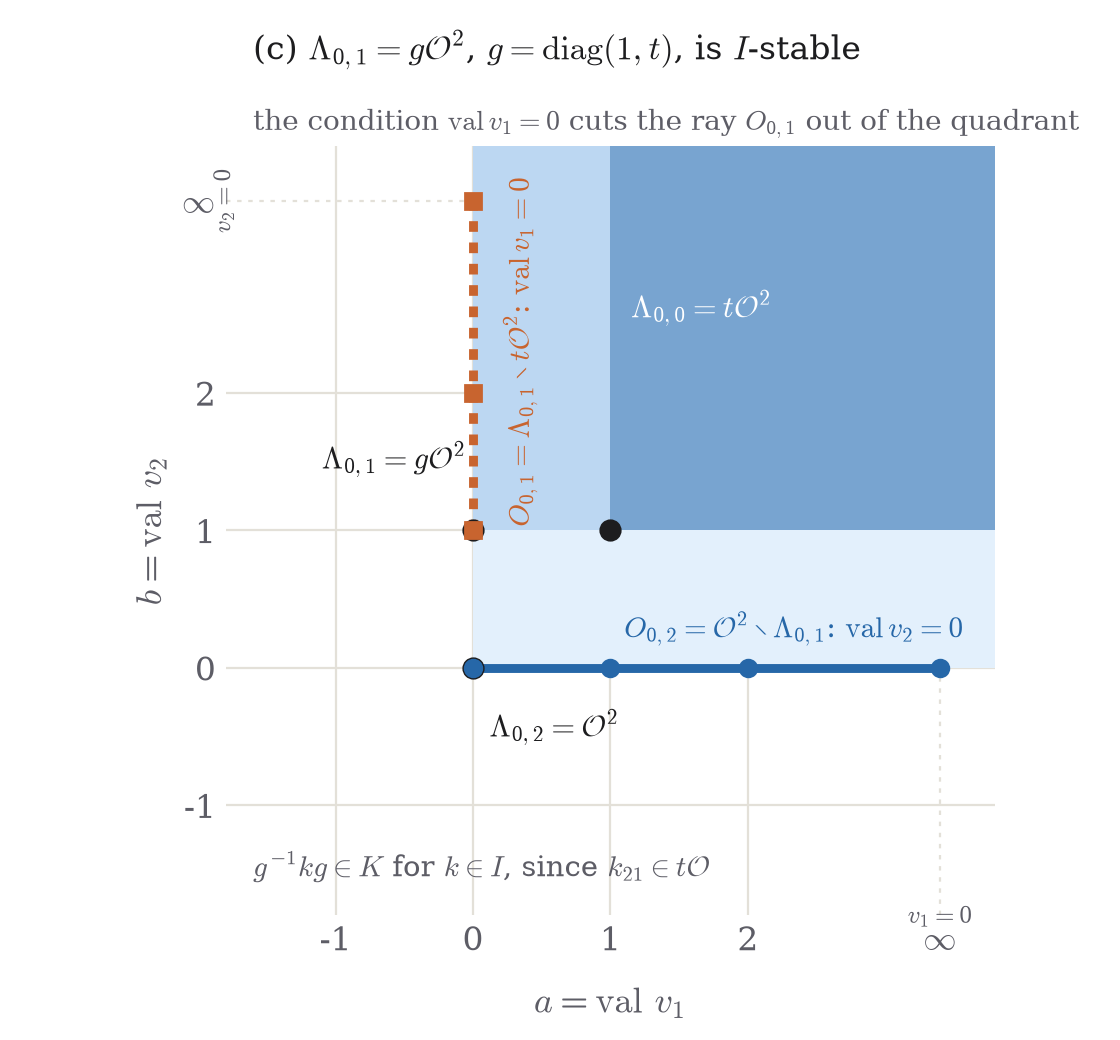
\(g=\begin{pmatrix}1&0\\0&t\end{pmatrix}\):\(g^{-1}kg=\begin{pmatrix}k_{11}&tk_{12}\\t^{-1}k_{21}&k_{22}\end{pmatrix}\in K\), because \(k_{21}\in t\cO\) for \(k\in I\); a quadrant minus the next one is one ray. - Let \(L\) be \(I\)-stable and \(m\) the largest integer with \(L\subseteq\vpi^m\cO^n\); some \(v\in L\) has \(\ord v=m\).
- \(K_1\subseteq I\) and \(K_1v=v+\vpi^{m+1}\cO^n\) (proof of , step 2b), so \(\vpi^{m+1}\cO^n\subseteq L\).
- So \(L\) is determined by its image \(W\subseteq\vpi^m\cO^n/\vpi^{m+1}\cO^n\cong\Fq^n\), a nonzero \(B(\Fq)\)-stable subspace.
- Let \(j\) be the largest last nonzero coordinate of a vector of \(W\), and \(w\in W\) one attaining it. Then \(W\subseteq\langle e_1,\dots,e_j\rangle\) and \(W\supseteq B(\Fq)w=B(\Fq)e_j\ni e_j,\ e_j+e_i\ (i\lt j)\), which span \(\langle e_1,\dots,e_j\rangle\). So \(W=\langle e_1,\dots,e_j\rangle\), the image of \(\Lambda_{m,j}\), and \(L=\Lambda_{m,j}\).
In the building of \(\GL_n\), the classes of \(\Lambda_{0,j}\), \(0\le j\le n-1\), up to homothety are the vertices of the alcove fixed by \(I\). The Iwahori page turns each \(\Lambda_{m,j}\) into a Hecke translate of \(\phiz\).