\(\Aff^n\): Iwahori level
The spherical proof used the lattices \(\vpi^m\cO^n\). At Iwahori level there are \(n\) times as many \(I\)-stable lattices \(\Lambda_{m,j}\), one between each pair of consecutive \(I\)-orbits (the chain), and each is a Hecke translate of \(\phiz\). So \(\Aff^n\) is the cleanest variety where both (SG) and (IG) hold.
Hecke translates of \(\phiz\) are lattice indicatorsWhat does \(\one_{gK}\ast\phiz\) look like?
(lattice translates) Proved here
Normalize \(\vol I=1\) on \(\HI\) (so \(\vol K=[K:I]\)) and \(\vol K=1\) on \(\HK\).
- (a) \(\one_{g_{m,j}K}\in\HI\) and \[\one_{\Lambda_{m,j}}=[K:I]^{-1}\,\one_{g_{m,j}K}\ast\phiz .\]
- (b) \(\one_{\vpi^mK}\in\HK\) and \[\one_{\vpi^m\cO^n}=\one_{\vpi^mK}\ast_K\phiz .\]
Proof
- (a) \(\Lambda_{m,j}=g_{m,j}\cO^n\) is \(I\)-stable (lattice lemma (b)), so \(Ig_{m,j}K=g_{m,j}K\) and \(\one_{g_{m,j}K}\) is bi-\(I\)-invariant. For \(h\in g_{m,j}K\), \(h\cO^n=\Lambda_{m,j}\), so \(\phiz(h^{-1}x)=\one_{\Lambda_{m,j}}(x)\) and \[(\one_{g_{m,j}K}\ast\phiz)(x)=\int_{g_{m,j}K}\phiz(h^{-1}x)\,dh=\vol(K)\,\one_{\Lambda_{m,j}}(x)=[K:I]\,\one_{\Lambda_{m,j}}(x).\]
- (b) \(\vpi^m\) is central, so \(\vpi^mK\) is bi-\(K\)-invariant; the same computation with \(\vol K=1\).
Generation at both levelsIs every \(I\)-orbit indicator a Hecke translate?
(\(\Aff^n\) at both levels) Proved here
For every \(n\ge1\) and every non-archimedean \(F\): \(\HK\ast_K\phiz=\CK\) and \(\HI\ast\phiz=\CI\). Explicitly, for all \(m,N\in\Z\) and \(1\le j\le n\),
\[\one_{O_{m,j}}=[K:I]^{-1}\big(\one_{g_{m,j}K}-\one_{g_{m,j-1}K}\big)\ast\phiz,\qquad\one_{\vpi^N\cO^n}=[K:I]^{-1}\,\one_{\vpi^NK}\ast\phiz .\]Proof
- Formulas. By the lattice lemma (b), \[\one_{O_{m,j}}=\one_{\Lambda_{m,j}}-\one_{\Lambda_{m,j-1}},\qquad\one_{\vpi^N\cO^n}=\one_{\Lambda_{N,n}};\] apply (a) to each \(\one_{\Lambda}\).
- Spanning. \(\varphi\in\CI\) is constant on each \(O_{m,j}\), and for \(M\gg0\) vanishes off \(\vpi^{-M}\cO^n\) and is constant on \(\vpi^M\cO^n\). So \[\varphi=\varphi(0)\,\one_{\vpi^M\cO^n}+\sum_{-M\le m\lt M}\ \sum_{j=1}^n\varphi(O_{m,j})\,\one_{O_{m,j}},\] and by step 1, \(\varphi\in\HI\ast\phiz\).
- Spherical level. The same with \(\one_{X_m}=\one_{\vpi^m\cO^n}-\one_{\vpi^{m+1}\cO^n}\) and (b).
Why the origin mattersWhy does \(\Aff^2\smallsetminus\{0\}\) fail while \(\Aff^2\) holds?
On \(F^2\smallsetminus0\) the same orbits \(O_{m,j}\) exist, but \(\one_\Lambda\) is no longer compactly supported. The Steinberg functional of the punctured plane, \(\Sw(F^2\smallsetminus0)^I\to\St^I\simeq\C\) (radial integration \(\Rad\), then \(C^\infty(\mathbb P^1)\to\St\)), is on \(I\)-orbits an alternating count of rays:
\[\lambda(\varphi)=\sum_{m\in\Z}\varphi(O_{m,1})-\sum_{m\in\Z}\varphi(O_{m,2}),\qquad\lambda(\phiz)=1-1=0,\qquad\lambda(\one_{\Lambda})=\infty-\infty .\]Derivation
- \((\Rad\varphi)([v])=\int_{F^\times}\varphi(sv)\,d^\times s\) sums \(\varphi\) along the diagonal \(\{(a+k,b+k)\}\) through \(\val v=(a,b)\). For \(b-a\ge1\) it meets only vertical rays \(O_{k,1}\), one per \(k\); for \(b-a\le0\) only horizontal rays \(O_{k,2}\). So \(\Rad\varphi\) is \(\sum_k\varphi(O_{k,1})\) on \(U_1=\{[1:y]:\val y\ge1\}\) and \(\sum_k\varphi(O_{k,2})\) on \(U_2=\{[x:1]:\val x\ge0\}\), the two \(I\)-orbits of \(\mathbb P^1(F)\), and \(C^\infty(\mathbb P^1)^I\to\St^I\) is \(f\mapsto f(U_1)-f(U_2)\).
- \(\phiz=\one_{X_0}=\one_{O_{0,1}}+\one_{O_{0,2}}\), one ray of each kind; a lattice contains infinitely many of each.
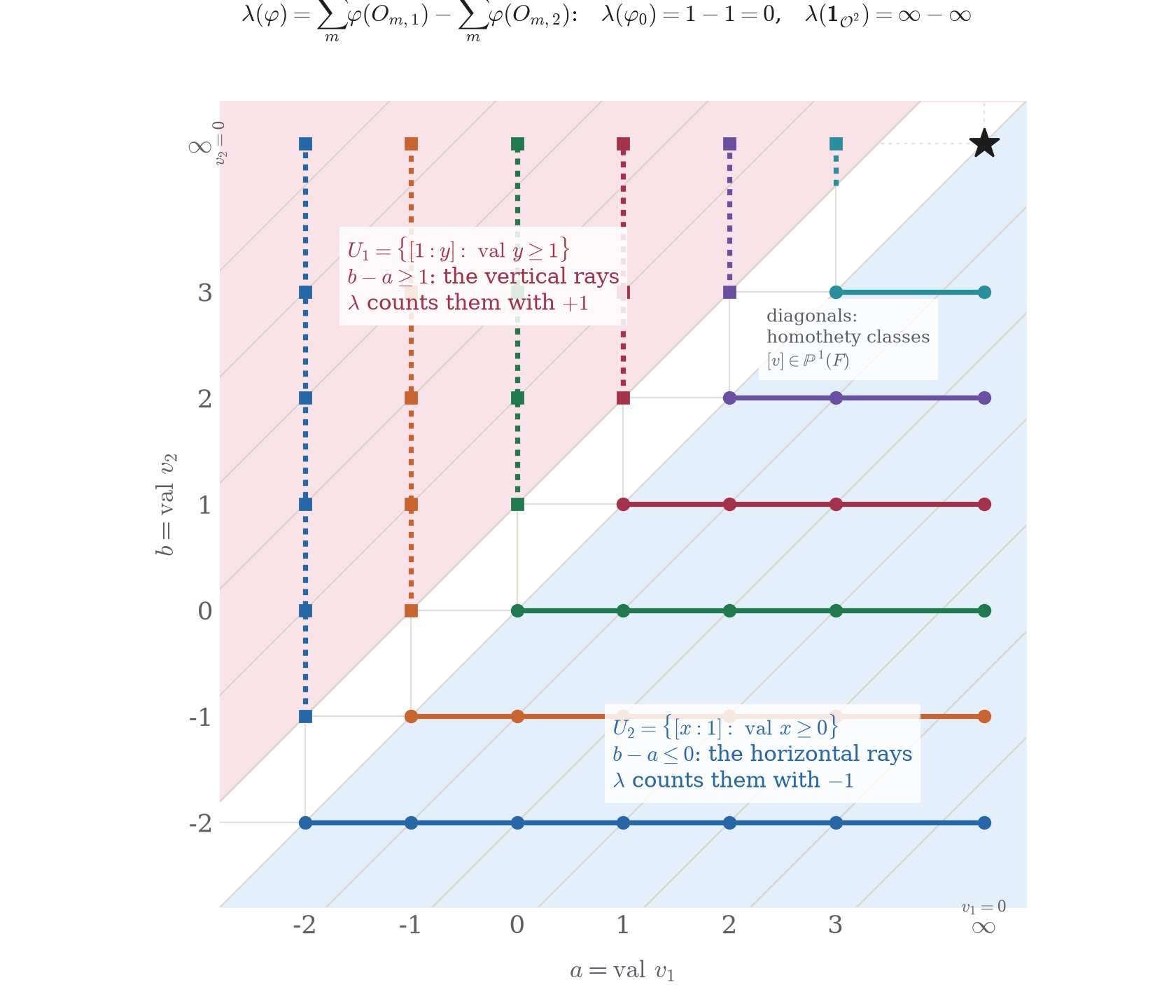
Adding the origin makes the lattice indicators Schwartz functions, and they are what the Steinberg functional cannot see. \(0\to\Sw(F^2\smallsetminus0)\to\Sw(F^2)\xrightarrow{\mathrm{ev}_0}\C\to0\) is exact; the Proposition with the obstruction principle gives \(\Hom_G(\Sw(F^2),\St)=0\), while \(\Rad\ne0\) in \(\Hom_G(\Sw(F^2\smallsetminus0),\St)\). So the connecting map sends \(\Rad\) to a nonzero class in \(\mathrm{Ext}^1_G(\C,\St)\): the origin absorbs the obstruction. Off the origin, \(\Aff^n\smallsetminus0=\GL_n/\mathrm{Mir}_n\) is horospherical (\(\mathrm{Mir}_n\supseteq N\)), which is where the Steinberg-type quotients come from.