\(\As\) and \(\AXs\): three examples
The Theorem compares \(\CK\) with functions on a subset of \(\As\). This page says what \(\As\) and \(\AXs\) are, as sets of unramified characters and as complex tori, and computes the inclusion \(\AXs\to\As\) in three examples.
\(\As\): unramified characters of \(T(F)\)What does the Hecke algebra \(\HK\) “see” of a representation?
An of \(T(F)\) is a homomorphism \(\chi:T(F)\to\C^\times\) trivial on \(T(\cO)\). Since \(T(F)/T(\cO)\simeq\LT\) via \(\lambda\mapsto\lambda(\vpi)\), such a \(\chi\) is the same as a homomorphism \(\LT\to\C^\times\):
[Sak, §1.7] Definition
\[\As:=\Hom(\LT,\C^\times),\qquad\chi\longmapsto\big(\lambda\mapsto\chi(\lambda(\vpi))\big).\]\(\As\) is a complex algebraic torus of dimension \(\operatorname{rk}T\) (the maximal torus of the dual group \(\Gv\)), with coordinate ring \(\C[\As]=\C[\LT]\), the Laurent polynomials \(\sum c_\lambda x^\lambda\). The Weyl group \(W\) acts on \(\LT\), hence on \(\As\).
(\(\GL_n\))
\(\LT=\Z^n\), and a point of \(\As\) is \(x=(x_1,\dots,x_n)\in(\C^\times)^n\) with \(x_i=\chi_i(\vpi)\) for \(\chi=\chi_1\otimes\dots\otimes\chi_n\); \(x^\lambda=x_1^{\lambda_1}\cdots x_n^{\lambda_n}\). \(W=S_n\) permutes coordinates, and \(\C[\As]^W=\C[e_1,\dots,e_n,e_n^{-1}]\) for the elementary symmetric functions \(e_k\).
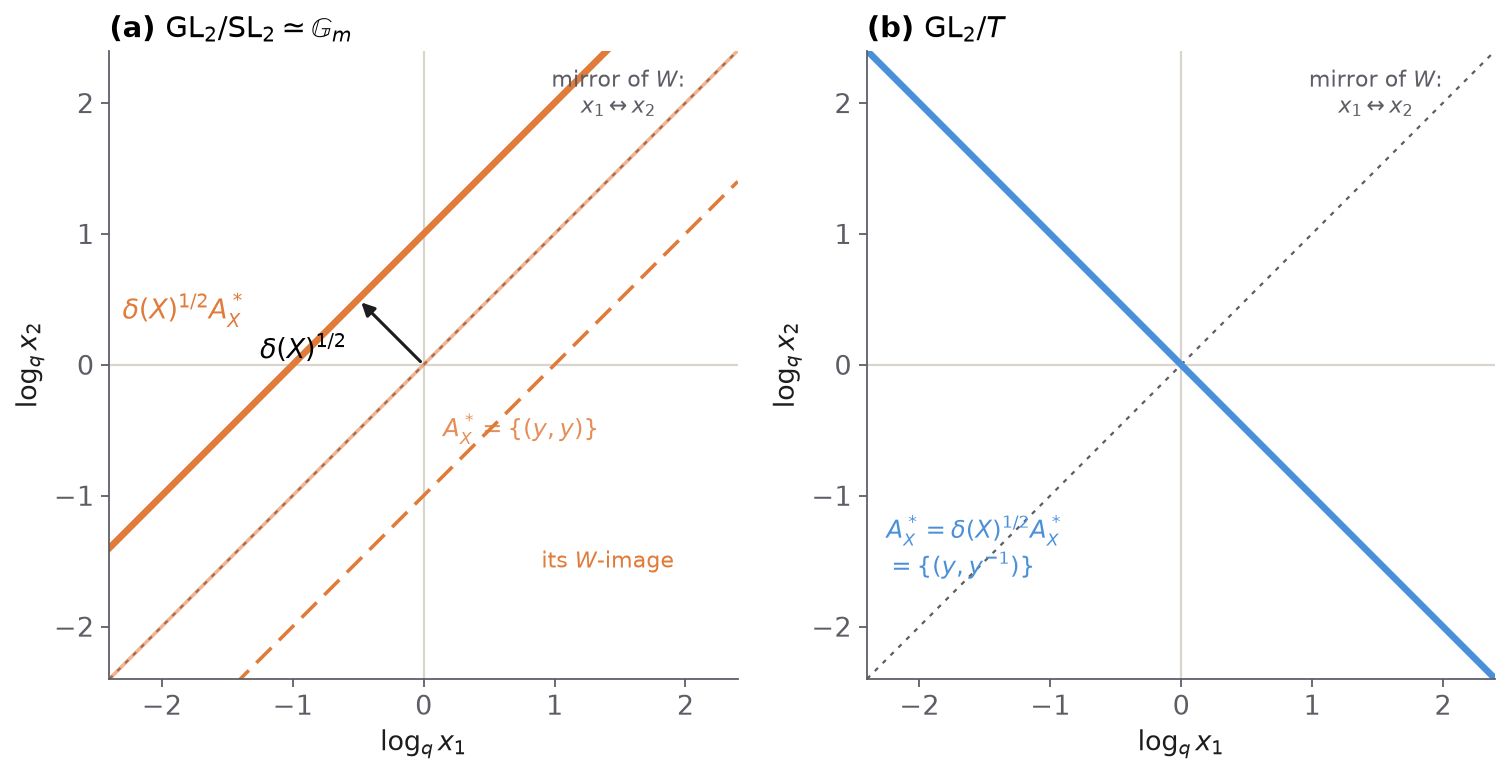
By the Satake isomorphism (Satake), \(\HK\simeq\C[\As]^W\), so a character of \(\HK\), i.e. the Hecke eigenvalues of an unramified representation, is a point of \(\As/W\). To draw real points, use \(u_i=\log_q|x_i|\); the figures on these pages are in these coordinates.
\(\AXs\) and its map to \(\As\)Which unramified characters of \(T\) come from \(X\)?
[Sak, §2.1, p. 8] Definition
\[\AXs:=\Hom(\LX,\C^\times),\qquad\AXs\longrightarrow\As,\quad y\longmapsto y\circ(\LT\to\LX).\]So \(y\in\AXs\) is an unramified character of \(\AX(F)\), and its image is the character \(t\mapsto y(\bar t)\) of \(T(F)\), \(\bar t\) the image of \(t\) in \(\AX(F)\). Sakellaridis writes \(\AXs\) also for the image.
(when \(\AXs\subseteq\As\)) Proved here
The map \(\AXs\to\As\) is injective if and only if \(\LT\to\LX\) is surjective. Under (A5), Sakellaridis states \(\AXs\subseteq\As\) [Sak, §8, p. 63].
Proof
\(T\twoheadrightarrow\AX\) is onto, so the cokernel \(C\) of \(\LT\to\LX\) is finite. \(\Hom(-,\C^\times)\) is exact because \(\C^\times\) is divisible, so \(\ker(\AXs\to\As)=\Hom(C,\C^\times)\), which is \(0\) iff \(C=0\).
A case where it fails: \(X=\{\pm1\}\backslash\Gm\) under \(\Gm\) acting by \(t\cdot x=t^2x\). Then \(\LT=\Z\to\LX=\Z\) is multiplication by \(2\), and \(y\mapsto y^2\) identifies \(y\) with \(-y\); this is the example of extra orbits.
First example: \(\GL_2/\SL_2\simeq\Gm\)What if \(X\) is itself a torus?
(\(G=\GL_2\), \(X=\Gm\), \(g\cdot x=\det(g)x\))
- \(\As=(\C^\times)^2\ni(x_1,x_2)\).
- \(\AX=\Gm\) via \(\det\), and \(\LT=\Z^2\to\LX=\Z\) is \((\lambda_1,\lambda_2)\mapsto\lambda_1+\lambda_2\) (torus page); onto.
- \(\AXs=\C^\times\ni y\), and \(y\mapsto(y,y)\): the character \(\diag(t_1,t_2)\mapsto y^{\val(t_1t_2)}\) is \(\chi\otimes\chi\) with \(\chi(\vpi)=y\). \[\AXs=\{(y,y)\}\subseteq\As,\qquad\dXh\AXs=\{(q^{-1/2}y,\,q^{1/2}y)\}\quad\text{(computed on the }\delta(X)\text{ page)}.\]
- Check: these are the Satake parameters of the characters \(\chi\circ\det\) of \(\GL_2(F)\), the representations with an \(\SL_2(F)\)-invariant functional (why δ(X)).
Second example: \(\GL_2/T\)What if \(H\) is a maximal torus?
(\(G=\GL_2\), \(X=\GL_2/T\), pairs of lines)
- \(\As=(\C^\times)^2\ni(x_1,x_2)\), the same as in the first example.
- \(\AX=T/Z\) via \(t_1/t_2\), and \(\LT\to\LX\) is \((\lambda_1,\lambda_2)\mapsto\lambda_1-\lambda_2\); onto.
- \(\AXs\ni y\mapsto(y,y^{-1})\): the character \(\diag(t_1,t_2)\mapsto y^{\val(t_1/t_2)}\). \[\AXs=\dXh\AXs=\{(y,y^{-1})\}\subseteq\As,\qquad\WX=\{1,w\},\ w(y)=y^{-1}.\]
- Check: by the Theorem \(\CK\simeq\C[y^{\pm1}]^{y\leftrightarrow y^{-1}}=\C[y+y^{-1}]\); the operator \(T_1\) is the adjacency operator of the tree and acts as \(q^{1/2}(y+y^{-1})\) (worked example on the Theorem page).
Third example: the group \(\GL_2\) under \(\GL_2\times\GL_2\)What does the Theorem say when it should say nothing new?
(\(G=\GL_2\times\GL_2\), \(X=\GL_2\))
- \(\As=(\C^\times)^2\times(\C^\times)^2\ni(x_1,x_2;\,x_1',x_2')\), \(W=S_2\times S_2\).
- \(\AX=(T\times T)/\Delta T\simeq T\), and \(\LT\times\LT\to\LX=\Z^2\) is \((\lambda,\lambda')\mapsto\lambda-\lambda'\); onto.
- \(\AXs=(\C^\times)^2\ni(y_1,y_2)\mapsto(y_1,y_2;\,y_1^{-1},y_2^{-1})\); \(\dX=1\) because \(\LevX=T\times T\) is a torus.
- \(\WX=S_2\), permuting \((y_1,y_2)\) and \((y_1^{-1},y_2^{-1})\) together. So \[\C[\dXh\AXs]^{\WX}=\C[y_1^{\pm1},y_2^{\pm1}]^{S_2}\simeq\mathcal H_{\GL_2(\cO)},\qquad\Res(f\otimes g)(y)=f(y)\,g(y^{-1}).\]
- Check: \(\CK=C_c(K_2\backslash\GL_2(F)/K_2)\) is the Hecke algebra of \(\GL_2\), and Satake identifies it with \(\C[y^{\pm1}]^{S_2}\); the right action of \(g\) is through \(g^\vee(h)=g(h^{-1})\), whose Satake transform is \(y\mapsto\Sat g(y^{-1})\).
Because the functions are \(W\)-invariant, it does not matter that the second factor uses the Borel \(B^-\) here, nor whether one writes \(y^{-1}\) or \(w_0y^{-1}\).
The three side by side
| \(X\) | \(\As\) | \(\dXh\AXs\) | \(\WX\) |
|---|---|---|---|
| \(\GL_2/\SL_2\) | \((\C^\times)^2\) | \(\{(q^{-1/2}y,q^{1/2}y)\}\) | \(1\) |
| \(\GL_2/T\) | \((\C^\times)^2\) | \(\{(y,y^{-1})\}\) | \(\Z/2\) |
| \(\GL_2\) under \(\GL_2^2\) | \((\C^\times)^4\) | \(\{(y_1,y_2;y_1^{-1},y_2^{-1})\}\) | \(S_2\) |
Predict
\(X=\GL_4/\Sp_4\), the nondegenerate alternating forms on \(F^4\). Its \(\LevX\) is \(\GL_2\times\GL_2\) and \(\LT\to\LX\) is \(\lambda\mapsto(\lambda_1+\lambda_2,\lambda_3+\lambda_4)\). What is \(\AXs\subseteq(\C^\times)^4\)?
\(\AXs=\{(y_1,y_1,y_2,y_2)\}\): dualize \(\lambda\mapsto(\lambda_1+\lambda_2,\lambda_3+\lambda_4)\). The translate by \(\dXh\) is \(\{(q^{-1/2}y_1,q^{1/2}y_1,q^{-1/2}y_2,q^{1/2}y_2)\}\), and \(\WX=S_2\) swaps the two pairs (δ(X), computing r).