Computing \(\dX\)
In the first example of the previous page, \(\AXs\) was the diagonal of \(\As\), yet the Theorem uses the shifted line \(\{(q^{-1/2}y,q^{1/2}y)\}\). This page says what the shift is (half the modular character of the Borel of \(\LevX\)), how to compute it in six steps, and why it must be there.
Modular characters as points of \(\As\)How can a character of a group be a point of a complex torus?
Definition
For a parabolic \(P=MU_P\) of \(G\), the is \(\delta_P(p)=|\det\mathrm{Ad}(p)|_{\mathrm{Lie}\,U_P}|\). For \(B\subseteq\GL_n\),
\[\delta_B(\diag(t_1,\dots,t_n))=\prod_{i\lt j}|t_i/t_j|,\qquad\delta_B\big(\lambda(\vpi)\big)=q^{-\langle2\rho,\lambda\rangle},\]with \(\rho\) the half-sum of positive roots. \(\delta_B\) is trivial on \(T(\cO)\), so \(\delta_B^{1/2}\) is a point of \(\As\):
\[\delta_B^{1/2}=q^{-\rho}:\quad\lambda\mapsto q^{-\langle\rho,\lambda\rangle};\qquad\GL_n:\ \delta_B^{1/2}=\big(q^{-\frac{n-1}2},q^{-\frac{n-3}2},\dots,q^{\frac{n-1}2}\big).\]The definitionWhich modular character, of which group?
[Sak, §1.7, p. 7] Definition
\(\dX\) is the absolute value of the modular character of \(\LevX\cap B\), a Borel subgroup of the Levi \(\LevX\) of the geometry page. As a point of \(\As\),
\[\dXh=q^{-\rho_L},\qquad\rho_L=\text{half the sum of the positive roots of }\LevX .\](the sign does not matter) Proved here
\[q^{\rho_L}\AXs=w_L\big(q^{-\rho_L}\AXs\big),\qquad w_L\ \text{the longest element of }W_{\LevX}.\]So \(\dXh\AXs\) and \(\dX^{-1/2}\AXs\) have the same image in \(\As/W\).
Proof
A point of \(\AXs\) is a character of \(\LevX\) (through \(\LevX\to\AX\)), so it is fixed by \(W_{\LevX}\). And \(w_L\rho_L=-\rho_L\). Hence \(w_L(q^{-\rho_L}y)=q^{\rho_L}y\).
Not to be confused with \(\delta_{\PX}\), the modular character of \(\PX\) itself, which appears in Sakellaridis's normalization of eigenfunctions, [Sak, (1.1)], and not in the Theorem.
The recipe, step by stepGiven \(X\), what do I actually compute?
- Find the open \(B\)-orbit \(\Xo\).
- Compute \(\PX=\{g:\ g\Xo=\Xo\}\).
- Take its Levi \(\LevX\supseteq T\) (for symmetric \(X\): \(\LevX=Z_G(S)\), \(S\) a maximal \(\theta\)-split torus).
- Write down \(\rho_L\), half the sum of the positive roots of \(\LevX\).
- \(\dXh=q^{-\rho_L}\in\As\).
- Translate: \(\dXh\AXs=\{q^{-\rho_L}y:\ y\in\AXs\}\).
For \(\GL_n\) the steps 3–5 are mechanical: if \(\LevX=\GL_{n_1}\times\dots\times\GL_{n_k}\), then \(q^{-\rho_L}\) is a string of exponents \(-\tfrac{n_j-1}2,\dots,\tfrac{n_j-1}2\) on each block.
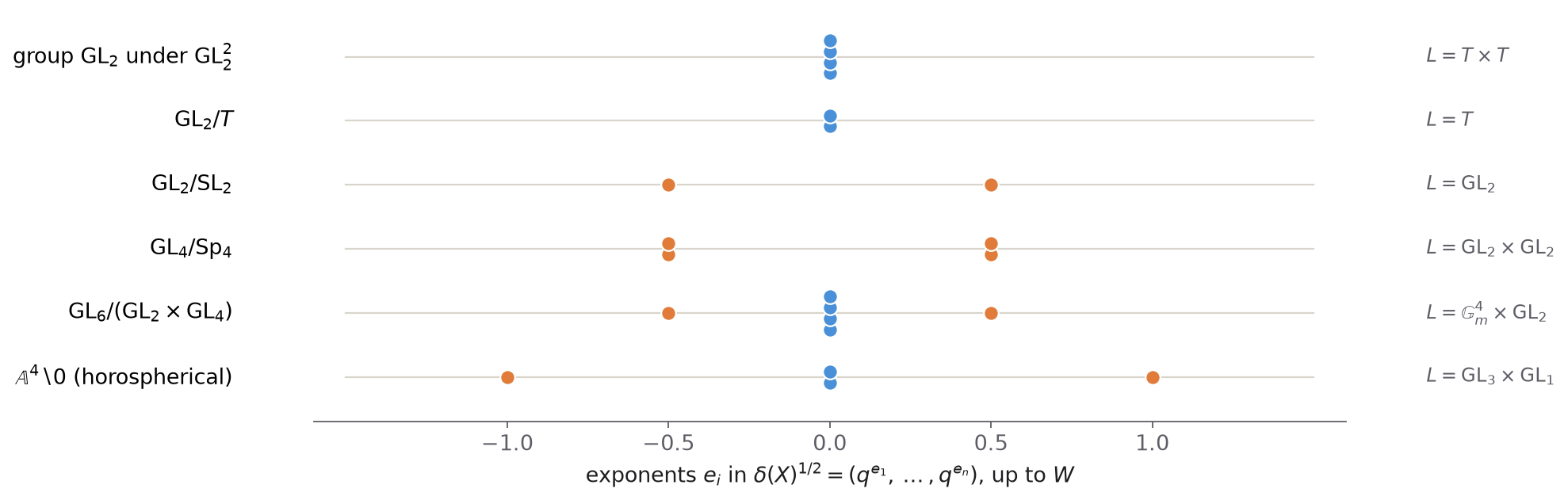
| \(X\) | \(\LevX\) | \(\dXh\AXs\), up to \(W\) |
|---|---|---|
| group \(\GL_2\) under \(\GL_2^2\) | \(T\times T\) | \((y_1,y_2;y_1^{-1},y_2^{-1})\), no shift |
| \(\GL_2/T\) | \(T\) | \((y,y^{-1})\), no shift |
| \(\GL_2/\SL_2\) | \(\GL_2\) | \((q^{1/2}y,q^{-1/2}y)\) |
| \(\GL_{2n}/\Sp_{2n}\) | \(\GL_2^n\) | \((q^{1/2}y_i,q^{-1/2}y_i)_{i\le n}\) |
| \(\GL_{p+q'}/(\GL_p\times\GL_{q'})\), \(p\le q'\) | \(\Gm^{2p}\times\GL_{q'-p}\) | \((y_1,\dots,y_p,\ q^{\frac{q'-p-1}2},\dots,q^{-\frac{q'-p-1}2},\ y_p^{-1},\dots,y_1^{-1})\) |
| \(E_6/F_4\) | \(\Spin_8\cdot S\) | \(q^{\rho_L}y\), \(\langle\rho_L,\alpha_j^\vee\rangle=(-3,1,1,1,1,-3)\) |
| \(\Aff^n\smallsetminus\{0\}\) | \(\GL_{n-1}\times\GL_1\) | \((q^{\frac{n-2}2},\dots,q^{-\frac{n-2}2},\ y)\) |
\(q'\) is the size of the second block (\(q\) is taken by the residue field). The \(\GL\) rows are from [Sak, Appendix A, rows 1–2] and the spherical-generation workspace's root data; the \(E_6/F_4\) row is from the satake-two-levels Proposition VII page.
Why the shift is thereWhich unramified representations have \(H\)-invariant functionals?
[Sak, Thm. 3.2.2], from [Sak08] Proved (cited)
If an irreducible unramified \(\pi\) is \(X\)-distinguished (\(\Hom_G(\pi,C^\infty(X(F)))\ne0\)), then \(\pi\) is the unramified subquotient of the normalized induction \(I_{\PX}(\chi)\) for some \(\chi\in\AXs\).
(Satake parameter of \(I_{\PX}(\chi)\)) Proved here
For \(\chi\in\AXs\), viewed as a character of \(\LevX\), the unramified subquotient of \(I_{\PX}(\chi)\) has Satake parameter \(\chi\cdot\dXh\) in \(\As/W\).
Proof
- The trivial representation of \(L=\LevX\) is the constants in \(C^\infty(B_L\backslash L)\), the unnormalized induction of \(1\), which is the normalized induction \(I_{B_L}(\delta_{B_L}^{-1/2})\). So its Satake parameter is \(\delta_{B_L}^{-1/2}=q^{\rho_L}\), which by the Lemma above is \(W\)-conjugate to \(q^{-\rho_L}=\dXh\).
- Twisting by the character \(\chi\) of \(L\) multiplies the parameter by \(\chi\).
- Induction in stages, \(I_{\PX}(\chi)\subseteq I_B(\chi\,\delta_{B_L}^{-1/2})\), and the unramified subquotient of a principal series \(I_B(\mu)\) has parameter \(\mu\).
Together: the Hecke eigenvalues that can occur on \(C^\infty(X(F))^K\) are the points of \(\dXh\AXs/\WX\) (mapped to \(\As/W\)).
(\(\GL_2/\SL_2\), by hand)
The \(\SL_2(F)\)-distinguished unramified representations of \(\GL_2(F)\) are the characters \(\chi\circ\det\). On \(\chi\circ\det\), \(T_{(1,0)}=\one_{K\diag(\vpi,1)K}\) acts by \(|K\diag(\vpi,1)K/K|\,\chi(\vpi)=(q+1)y\). The Satake transform of \(T_{(1,0)}\) is \(q^{1/2}(x_1+x_2)\) (Satake), and at the shifted point
\[q^{1/2}\big(q^{-1/2}y+q^{1/2}y\big)=(1+q)\,y .\]At the unshifted point \((y,y)\) one would get \(2q^{1/2}y\), which is wrong.
The dual-group readingIs the shift an accident of normalization?
No. In Sakellaridis–Venkatesh, a spherical variety comes with a dual group \(\GX\) and a morphism \(\GX\times\SL_2\to\Gv\) [SV, Thm. 2.2.3, under their axioms (GN2)–(GN5)]. The Satake parameters of \(X\)-distinguished unramified representations are expected to be the images of \((\,y,\ \diag(q^{1/2},q^{-1/2}))\), \(y\) in a maximal torus of \(\GX\) [SV, §16.3]; the \(\SL_2\) factor is what produces the shift.
- \(\GL_{2n}/\Sp_{2n}\): \(\GX=\GL_n\to\GL_{2n}\) by tensoring with the standard representation of \(\SL_2\) [SV, Ex. 1.3.2], giving exactly the pairs \((q^{1/2}y_i,q^{-1/2}y_i)\) of .
- \(\Aff^n\): \(\GX=\Gm\), and the \(\SL_2\) is principal in the Levi \(\GL_{n-1}\) [BZSV, Ex. 4.3.12], giving the string \(q^{\frac{n-2}2},\dots,q^{-\frac{n-2}2}\) of the last row.
In these examples the \(\SL_2\) is principal in the Levi dual to \(\LevX\), which is the recipe above. Read more on the Sakellaridis–Venkatesh page.