\(\AX\), \(\LX\) and the cone \(\Vc\)
On the previous page, only the torus \(\LevX/[\LevX,\LevX]\) moves the base point. Here that torus is cut down to \(\AX\), its cocharacters \(\LX\) are computed from \(B\)-eigenfunctions, and the cone \(\Vc\) of \(G\)-invariant valuations picks out the monoid \(\LXp\) that will label \(K\)-orbits.
\(B\)-eigenfunctionsWhich functions on \(X\) does \(B\) only rescale?
[Sak, §2.1; SV, §2.1] Definition
\(F(X)^{(B)}\) is the group of nonzero rational functions \(f\) on \(X\) with \(b\cdot f=\chi_f(b)f\) for a character \(\chi_f\) of \(B\) (hence of \(T\)); \(\Xc(X)\) is the group of these characters. Since \(B\) has a dense orbit, a \(B\)-eigenfunction is determined up to a constant by its character:
\[1\longrightarrow F^\times\longrightarrow F(X)^{(B)}\longrightarrow\Xc(X)\longrightarrow0 .\]The rank of \(X\) is the rank of the lattice \(\Xc(X)\).
| \(X\) | eigenfunctions | \(\Xc(X)\) | rank |
|---|---|---|---|
| \(\GL_2/\SL_2\) | the coordinate \(x\) | \(\Z(\epsilon_1+\epsilon_2)\) | 1 |
| \(\GL_2/T\) | \(x_1-x_2\) for \(\ell_i=[x_i:1]\) | \(\Z(\epsilon_1-\epsilon_2)\) | 1 |
| \(\GL_2\) under \(\GL_2^2\) | \(x_{22}\), \(\det x\) | \(\{(-\mu,\mu):\ \mu\in\Z^2\}\) | 2 |
| \(\Aff^n\) | \(v_n\) | \(\Z\epsilon_n\) | 1 |
How the second row is computed
\(b=\begin{pmatrix}a&c\\0&d\end{pmatrix}\) acts on \(x\) by \(x\mapsto(ax+c)/d\), so \(x_1-x_2\mapsto(a/d)(x_1-x_2)\): an eigenfunction with character \(\epsilon_1-\epsilon_2\) (or its inverse, for \(f\mapsto f(b^{-1}\,\cdot)\)). There is no eigenfunction with character \(\tfrac12(\epsilon_1-\epsilon_2)\), and the centre acts trivially on \(X\), so no character outside \(\Z(\epsilon_1-\epsilon_2)\) occurs.
The torus \(\AX\) and its lattice \(\LX\)What is the “torus of directions” along which \(x_0\) can be pushed to infinity?
[Sak, §2.1, p. 8; SV, §2.1, p. 20] Definition
\[\AX:=\LevX/(\LevX\cap H)=T/(T\cap H),\qquad\LX:=X_*(\AX)=\Hom(\Xc(X),\Z).\]\(\AX\) is a quotient of \(T\), and the projection \(T\twoheadrightarrow\AX\) induces a map of cocharacter lattices \(\LT\to\LX\), \(\lambda\mapsto(\chi\mapsto\langle\lambda,\chi\rangle)\).
\(\AX\) is identified with the orbit \(\LevX\cdot x_0\subseteq X\) [Sak, §2.1]. Cocharacters evaluated at \(\vpi\) give points of \(X(F)\):
\[\LX\simeq\AX(F)/\AX(\cO),\quad\lambda\mapsto\lambda(\vpi);\qquad x_\lambda:=\tilde\lambda(\vpi)\cdot x_0\quad(\tilde\lambda\in\LT\ \text{lifting}\ \lambda).\]Different lifts \(\tilde\lambda\) change \(x_\lambda\) by an element of \(T(\cO)\subseteq K\), so the \(K\)-orbit \(Kx_\lambda\) depends only on \(\lambda\).
| \(X\) | \(\AX\) | \(\LT\to\LX\) |
|---|---|---|
| \(\GL_2/\SL_2\) | \(\GL_2/\SL_2=\Gm\) via \(\det\) | \((\lambda_1,\lambda_2)\mapsto\lambda_1+\lambda_2\) |
| \(\GL_2/T\) | \(T/Z=\Gm\) via \(t_1/t_2\) | \((\lambda_1,\lambda_2)\mapsto\lambda_1-\lambda_2\) |
| \(\GL_2\) under \(\GL_2^2\) | \((T\times T)/\Delta T=T\) | \((\lambda,\lambda')\mapsto\lambda-\lambda'\) |
| \(\Aff^n\) | \((\GL_{n-1}\times\GL_1)/\GL_{n-1}=\Gm\) | \(\lambda\mapsto\lambda_n\) |
In all four rows \(\LT\to\LX\) is onto; that is the condition for \(\AXs\to\As\) to be injective (A* and A_X*).
Invariant valuations and the cone \(\Vc\)In which directions can \(x_\lambda\) go to infinity and stay in different \(K\)-orbits?
[Sak, §2.1; SV, §2.1, p. 19] Definition
A \(v\) of \(F(X)\) restricts to a homomorphism \(F(X)^{(B)}\to\Z\) that kills constants, i.e. to a point of \(\LX\). The cone \(\Vc\subseteq\LX\otimes\Q\) is spanned by these points, and
\[\LXp:=\LX\cap\Vc\]is the monoid of \(\Z\)-valued \(G\)-invariant valuations.
[Kn91, Cor. 5.3], quoted in [Sak, §2.1] and [SV, §2.1] Proved (cited)
\(\Vc\) contains the image of the negative Weyl chamber under \(\LT\otimes\Q\to\LX\otimes\Q\). It equals that image for symmetric varieties [Kn91, §5]; such \(X\) are called .
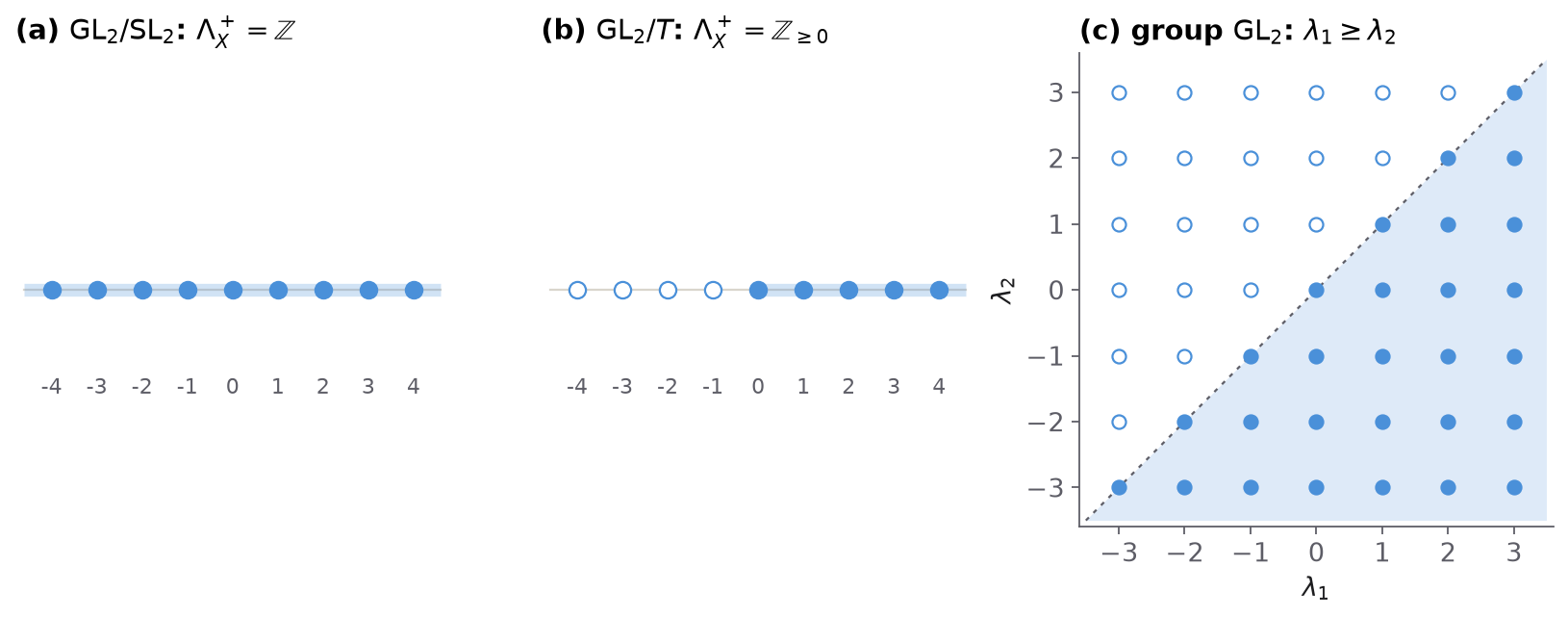
How the three cones are computed
(a) \(F(X)=F(x)\), and \(G\) rescales \(x\). The valuations of \(F(x)\) trivial on \(F\) are the orders of vanishing at points of \(\mathbb P^1\); only \(\operatorname{ord}_0\) and \(\operatorname{ord}_\infty\) are invariant under rescaling, with \(\operatorname{ord}_0(x)=1\), \(\operatorname{ord}_\infty(x)=-1\). Both directions occur: \(\LXp=\Z\).
(b) \(X\) is the complement of the diagonal \(\Delta\) in \(\mathbb P^1\times\mathbb P^1\), and \(\Delta\) is \(G\)-stable, so \(\operatorname{ord}_\Delta\) is \(G\)-invariant, with \(\operatorname{ord}_\Delta(x_1-x_2)=1\). The image of the negative chamber is a half-line, so by the Lemma \(\Vc\) is the half-line through \(\operatorname{ord}_\Delta\) (it is not the whole line, because \(X\) has a nontrivial little Weyl group, W_X). Orient \(\LX\simeq\Z\) by \(v\mapsto v(x_1-x_2)\): \(\LXp=\Z_{\ge0}\).
(c) For the group, \(\Vc\) is a Weyl chamber; with the Borel \(B\times B^-\) and the sign of the previous section it is \(\{\lambda_1\ge\lambda_2\}\), matching the Cartan decomposition \(G(F)=\bigsqcup Kt^\lambda K\) (K-orbits).
For \(\Xb=\Aff^n\smallsetminus\{0\}\) the stabilizer contains a maximal unipotent subgroup (), and then \(\Vc\) is the whole line, as in (a).
A word on signsWhy does Sakellaridis say “anti-dominant”?
With his right action on \(H\backslash G\), the cone \(\Vc\) contains the image of the negative chamber, and he calls the points \(x\in\AX(F)\) whose class lies in \(\LXp\) “\(X\)-anti-dominant”, writing \(\AX^+\) for them [Sak, §2.1, p. 8]. Passing to the left action \(x\mapsto x^{-1}\) and inverting the eigencharacters flips these signs. Nothing on these pages depends on the sign: every statement is either about the lattice \(\LX\), about \(W\)-invariant functions on \(\As\), or about a set of \(K\)-orbits, and each example fixes its orientation explicitly.