The tree and its apartments
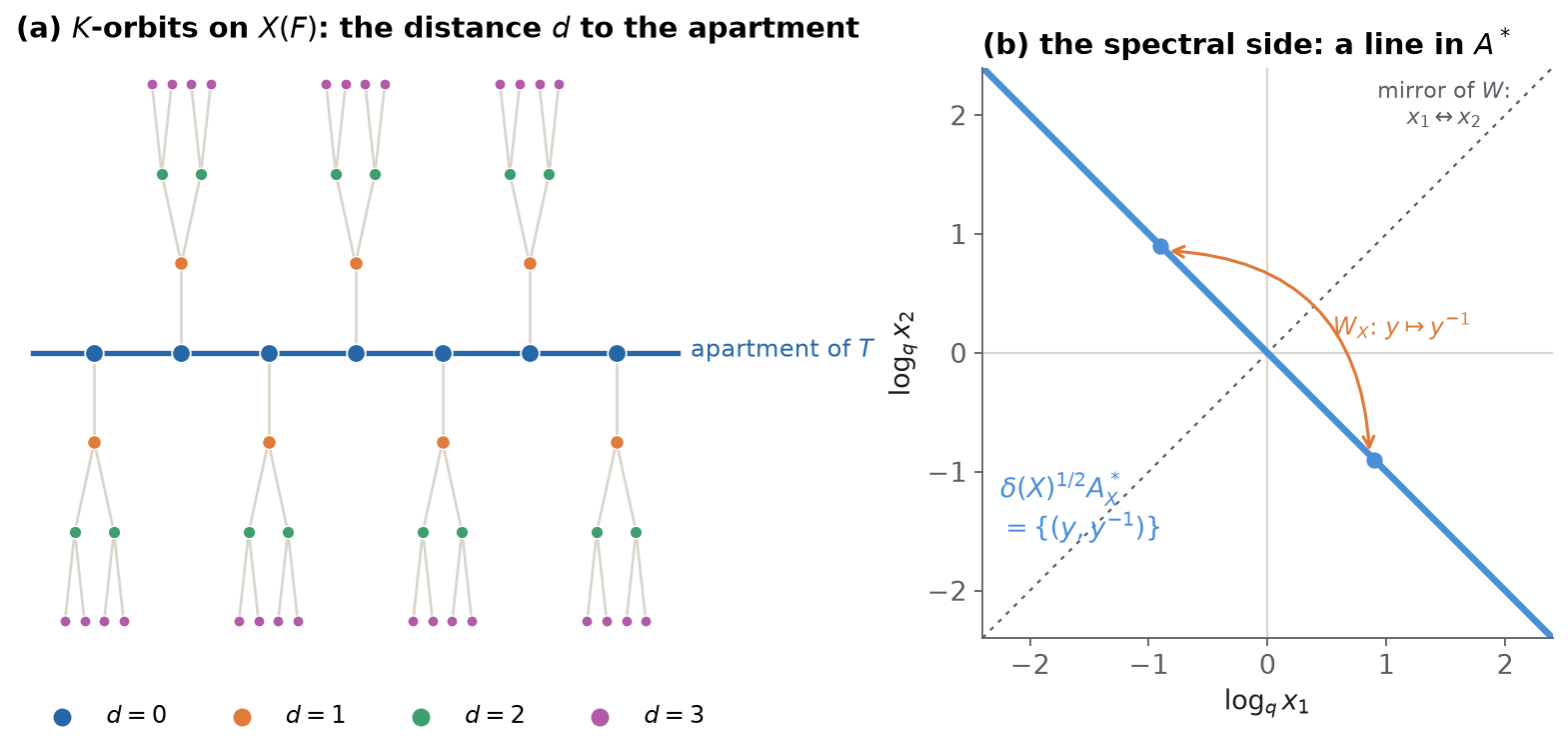
The hub draws \(X=\GL_2/T\) as a tree with a horizontal line through it (One picture). Vertices are lattices, points at infinity are lines, an is a pair of lines, and a \(K\)-orbit on \(X(F)\) is a distance. In the right half of the picture, a point of \(\AXs\) is an eigenfunction on the tree.
Lattices: the verticesWhat does \(\GL_2(F)\) act on, if not on a space of points?
(lattice, the tree) [Serre, Trees, II.1.1] Definition
A lattice \(\Lat\subset F^2\) is an \(\cO\)-submodule spanned by a basis of \(F^2\), for example \(\cO^2\) or \(\vpi\cO\oplus\cO\). Its class is \([\Lat]=\{c\Lat:c\in F^\times\}\). The graph \(\Tr\) has the classes as vertices, and \([\Lat]\), \([\Lat']\) are adjacent when representatives can be chosen with
\[\vpi\Lat\subsetneq\Lat'\subsetneq\Lat .\][Serre, Trees, II.1.1, Thm. 1] Proved (cited)
\(\Tr\) is a tree, and every vertex has exactly \(q+1\) neighbours.
Why \(q+1\) neighbours
A lattice \(\Lat'\) with \(\vpi\Lat\subsetneq\Lat'\subsetneq\Lat\) is the preimage of a line in \(\Lat/\vpi\Lat\simeq\Fq^2\), and \(\Fq^2\) has \(q+1\) lines. That \(\Tr\) has no cycles is the content of the cited theorem.
\(\GL_2(F)\) acts on lattices, hence on \(\Tr\), preserving adjacency. The base vertex is \(v_0=[\cO^2]\), and its stabilizer contains \(K=\GL_2(\cO)\). The vertices at distance \(d\ge1\) from \(v_0\) number \((q+1)q^{d-1}\): \(q+1\) first steps, then \(q\) new choices at each step, since a walk must not turn back.
The vertices are in bijection with \(\GL_2(F)/F^\times K\). The Hecke operator \(T_1\) will be a walk to a neighbour (section 5).
Ends: the points at infinityWhere do the lines of \(F^2\) appear?
A ray from \(v_0\) is an infinite path \(v_0,v_1,v_2,\dots\) that never turns back. Its end is the point at infinity it runs to. Two rays from \(v_0\) have the same end only if they are equal.
(ends are lines) [Serre, Trees, II.1.1] Proved (cited)
Write a line \(\ell\in\mathbb P^1(F)\) as \(\ell=Fu\) with \(u\in\cO^2\) primitive (one coordinate a unit). Then
\[v_k=\big[\cO u+\vpi^k\cO^2\big],\qquad k\ge0,\]is a ray from \(v_0\), and \(\ell\mapsto(v_k)_k\) is a bijection from \(\mathbb P^1(F)\) to the ends of \(\Tr\).
Two lines \(Fu\), \(Fu'\) give rays that agree for exactly \(k\) steps when \(u\equiv u'\) modulo \(\vpi^k\), up to a unit, but not modulo \(\vpi^{k+1}\).
Apartments: what a split torus seesWhich part of the tree does \(T\) act on by translations?
(apartment) Definition
For distinct lines \(\ell_1=Fu_1\), \(\ell_2=Fu_2\), the apartment \(\Apt(\ell_1,\ell_2)\) is the set of vertices
\[\big[\vpi^a\cO u_1\oplus\vpi^b\cO u_2\big],\qquad a,b\in\Z,\]which depends only on \(a-b\in\Z\). Consecutive values of \(a-b\) are adjacent, so \(\Apt(\ell_1,\ell_2)\) is a line in \(\Tr\), infinite in both directions, joining the ends \(\ell_1\) and \(\ell_2\).
(the torus translates its apartment) Proved here
Let \(T_{\ell_1,\ell_2}=\{g:g\ell_1=\ell_1,\ g\ell_2=\ell_2\}\), the split torus diagonal in the basis \(u_1,u_2\). Then \(t=\diag(t_1,t_2)\) maps the vertex labelled \(a-b\) to the vertex labelled \(a-b+\val t_1-\val t_2\). In particular \(T_{\ell_1,\ell_2}(\cO)\) fixes the apartment pointwise, and \(\diag(\vpi,1)\) shifts it by one step.
Proof
\(t(\vpi^a\cO u_1\oplus\vpi^b\cO u_2)=\vpi^{a+\val t_1}\cO u_1\oplus\vpi^{b+\val t_2}\cO u_2\), since \(t_i\in\vpi^{\val t_i}\cO^\times\).
Off the apartment the tree branches. An apartment vertex has \(2\) neighbours on the apartment and \(q-1\) off it. A vertex at distance \(d\ge1\) from the apartment has \(1\) neighbour closer and \(q\) farther. Per apartment vertex there are
\[n_0=1,\qquad n_d=(q-1)q^{d-1}\quad(d\ge1)\]vertices at distance \(d\).
Why “apartment”. For \(\GL_n\) the vertices are again lattice classes in \(F^n\), the tree becomes a simplicial complex (the Bruhat–Tits building), and the apartment of a split maximal torus \(T\) is a Euclidean space of dimension \(n-1\), on which \(T(F)\) acts by translations through \(\val\). For \(n=2\) it is a line. Any two vertices lie in a common apartment: this is the Cartan decomposition \(\GL_n(F)=\bigsqcup K t^\lambda K\) (orbits). A torus with no semisimple part, such as \(\Gm\), has a single apartment, the line \(\R\). That is the picture of Example 2.2 (𝔾ₘ as a line).
\(X=\GL_2/T\) is the set of apartmentsWhere is the variety \(X\) in this picture, and what are its \(K\)-orbits?
A point of \(X(F)=\GL_2(F)/T(F)\) is an ordered pair of distinct lines \((\ell_1,\ell_2)\), the torus \(T\) being their stabilizer (geometry). By the last two sections, that is an ordered pair of distinct ends, so
\[X(F)=\{\text{apartments of }\Tr\text{ with an orientation}\}.\]\(K\) fixes \(v_0\), so the distance from \(v_0\) to an apartment is a \(K\)-invariant. It is the only one:
\[K\backslash X(F)\xrightarrow{\ \sim\ }\Z_{\ge0},\qquad(\ell_1,\ell_2)\mapsto d=\operatorname{dist}\big(v_0,\Apt(\ell_1,\ell_2)\big)=\val\det(u_1\,|\,u_2),\]with \(u_i\in\cO^2\) primitive. The proof is on the orbits page. Since \(u_1,u_2\) are primitive, \(d=0\) means they reduce to a basis of \(\Fq^2\), that is, \(\ell_1,\ell_2\) are distinct modulo \(\vpi\). So \(X(\cO)=\{d=0\}\) and \(\phiz=\one_{\{d=0\}}\).
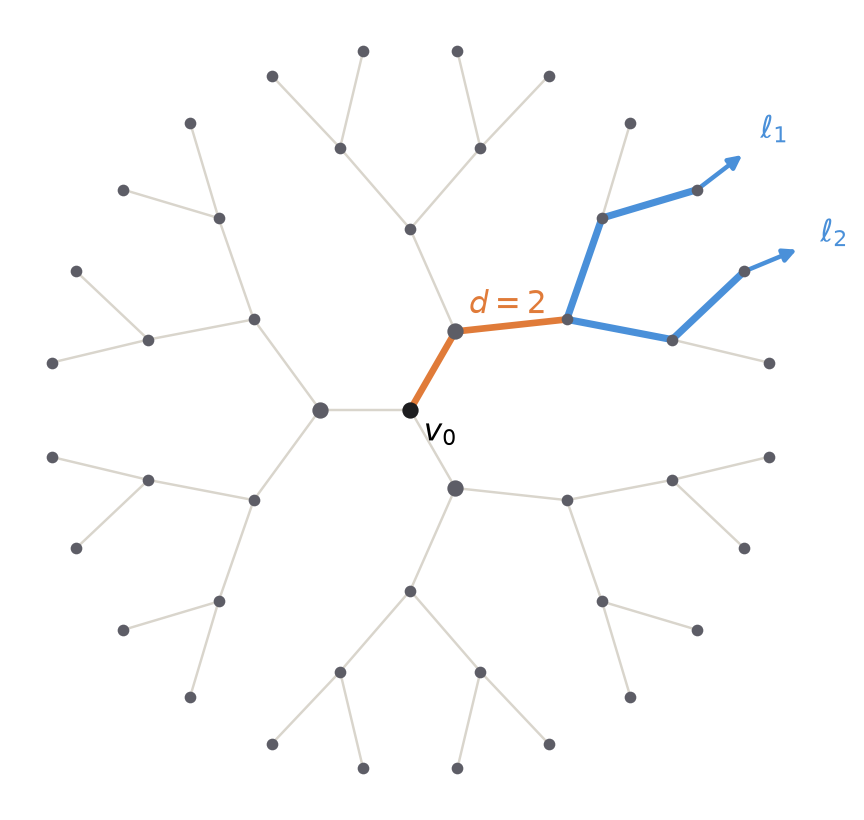
The hub figure uses the opposite viewpoint (ii): fix the apartment \(\Apt_0=\Apt(Fe_1,Fe_2)\) of the diagonal torus and move the vertex. Write \(o=(Fe_1,Fe_2)\in X(F)\), whose stabilizer is \(T\). (The base point \(x_0\) of the orbits page lies in the open \(B\)-orbit and is a different point.) Both viewpoints describe the same double cosets:
(two viewpoints) Proved here
The map \(f\mapsto F\), \(F(g^{-1}v_0)=f(g\,o)\), is a bijection from \(K\)-invariant functions on \(X(F)\) to \(T\)-invariant functions on the vertices of \(\Tr\). In both pictures the function depends only on \(d\), the distance between \(v_0\) and the apartment in (i), and between the vertex and \(\Apt_0\) in (ii).
Proof
- Well defined: if \(g^{-1}v_0=g'^{-1}v_0\), then \(g'=kg\) with \(k\) in the stabilizer of \(v_0\), which is \(F^\times K\). The centre acts trivially on \(X\), so \(f(g'o)=f(go)\). Conversely, a \(T\)-invariant \(F\) defines \(f(go)=F(g^{-1}v_0)\), which is \(K\)-invariant.
- \(T\)-invariance: \(F(tg^{-1}v_0)=f(gt^{-1}o)=f(go)\), since \(T\) fixes \(o\).
- Distances: \(\operatorname{dist}(v_0,g\Apt_0)=\operatorname{dist}(g^{-1}v_0,\Apt_0)\), and \(g\Apt_0\) is the apartment of the point \(go\).
\(T_1\) is adjacencyHow does a Hecke operator act in this picture?
\(T_1=\one_{K\diag(\vpi,1)K}\), and \(K\diag(\vpi,1)K/K\) is the set of \(q+1\) neighbours of \(v_0\). Acting on \(T\)-invariant vertex functions (viewpoint (ii)), \(T_1\) sums over neighbours [Serre, Trees, II.1; functions]:
\[(T_1F)(v)=\sum_{u\sim v}F(u),\qquad\text{so}\qquad (T_1F)(d)=\begin{cases}2F(0)+(q-1)F(1),&d=0,\\ F(d-1)+qF(d+1),&d\ge1.\end{cases}\]The two cases are the neighbour counts of section 3.
The right half: points of \(\AXs\) are eigenfunctionsWhat is the line in panel (b) doing next to the tree?
Panel (b) draws \(\As=(\C^\times)^2\) by \((\log_q|x_1|,\log_q|x_2|)\). \(\AXs=\{(y,y^{-1})\}\) is the anti-diagonal (A* and A_X*), and \(\WX\) swaps \(y\leftrightarrow y^{-1}\). By the Satake isomorphism, \(T_1\) acts at the point \((y,y^{-1})\) by
\[w=q^{1/2}\big(y+y^{-1}\big).\](one eigenfunction per point of \(\AXs/\WX\)) Proved here
For every \(w\in\C\) there is exactly one function \(f_w\) of \(d\) with \(T_1f_w=wf_w\) and \(f_w(0)=1\):
\[f_w(1)=\frac{w-2}{q-1},\qquad f_w(d+1)=\frac{w\,f_w(d)-f_w(d-1)}{q}\quad(d\ge1).\]With \(w=q^{1/2}(y+y^{-1})\), write \(f_y=f_w\); then \(f_y=f_{y^{-1}}\), and for \(d\ge1\)
\[f_y(d)=A\,(q^{-1/2}y)^d+B\,(q^{-1/2}y^{-1})^d\qquad(y^2\ne1),\]for constants \(A,B\) depending on \(y\). The Theorem's isomorphism pairs functions with these eigenfunctions:
\[\Phi(F)(y)=\sum_{d\ge0}n_d\,F(d)\,f_y(d),\qquad\text{equivalently}\qquad P_d=n_d\,f_y(d).\]Proof
- The two cases of \(T_1F=wF\) in section 5 solve uniquely for \(F(1)\), then \(F(d+1)\).
- The recursion's characteristic equation is \(qr^2-wr+1=0\), that is \((q^{1/2}r-y)(q^{1/2}r-y^{-1})=0\). Its roots \(q^{-1/2}y^{\pm1}\) give the closed form, and \(w\) is symmetric in \(y\leftrightarrow y^{-1}\).
- \(g_d:=n_df_y(d)\) satisfies \(g_0=1\), \(g_1=w-2\), \(g_2=wg_1-(q-1)g_0\), and \(g_{d+1}=wg_d-qg_{d-1}\) for \(d\ge2\), using \(n_{d+1}=qn_d\) for \(d\ge1\). These are the recursion and initial values of \(P_d\) (the Theorem, worked example), so \(g_d=P_d\).
Two families matter:
- Tempered, \(|y|=1\): \(w\) is real with \(|w|\le2\sqrt q\), and \(f_y(d)\) decays like \(q^{-d/2}\) while oscillating with frequency \(\arg y\). These \(y\) carry the unramified spectrum of \(L^2(X)\).
- Trivial, \(y=q^{1/2}\): \(w=q+1\) and \(f_y\equiv1\), the constant function, eigenvalue the number of neighbours.
Explore the treeCan you see the distance and the eigenfunctions on the picture?
The thick blue line is the apartment \(\Apt_0\) of the diagonal torus; in distance mode, vertices are coloured by \(d=0,1,2,3\) (blue, orange, green, purple) as in the hub figure. Colours in eigenfunction mode: blue for \(f_y(d)>0\), orange for \(f_y(d)<0\), paler for smaller \(|f_y(d)|\). The dashed curves are \(\pm2|A|q^{-d/2}\) from the closed form (\(\pm(|a|+|b|d)q^{-d/2}\) at \(y=\pm1\)). The readout checks \(T_1f=wf\) at the selected vertex numerically.
Where this goes
- The proof that \(d\) classifies \(K\)-orbits, and the same question for other \(X\): K- and I-orbits.
- \(T_1\) acting on functions of \(d\), by hand: the Hecke lab on functions.
- Why the line in panel (b) is \(\AXs\), and the other two running examples: A* and A_X*.
- \(\SL_2/T\) is also “a tree with an apartment”, but there the \(K\)-orbits are not determined by \(d\): (A5).