Random fixed-point storage
Attempt 1 · three-round report; finite unknowns retain their original status here
$$1\le \alpha_-\le2,\qquad p_n(n)\longrightarrow1.$$
History: Cover → Hillar · Storage-capacity results
The notation \(p_n(n)\) is intentional: it asks about storing \(n\) random patterns with \(n\) neurons, so the load is one. The theorem says this probability tends to one as both grow; it does not say every finite set is storable. What the notation means.
$$\text{nonstorage}\iff\exists\lambda\ge0:\ \sum\lambda=1,\quad\sum_\mu\lambda_i^\mu s_i^\mu=0,\quad\sum_\mu(\lambda_i^\mu+\lambda_j^\mu)s_i^\mu s_j^\mu=0.$$
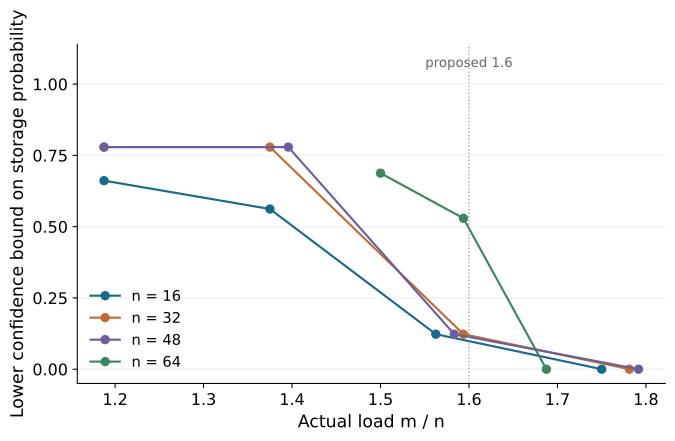
For each fixed load, we want to know how whole-set storage probability changes as network size grows:
$$\alpha>0\text{ fixed},\qquad m=\lfloor\alpha n\rfloor,\qquad\text{study }p_n(\lfloor\alpha n\rfloor)\text{ as }n\to\infty.$$
The current figure shows lower bounds across loads at three finite sizes. A low lower bound cannot show the true probability is low. The proposed primary plot holds load fixed and varies neuron count.
| Neurons | Patterns | Certified / trials | 95% lower bound |
|---|---|---|---|
| 16 | 25 | 4/12 | 0.123 |
| 32 | 51 | 4/12 | 0.123 |
| 48 | 76 | 4/12 | 0.123 |
| 64 | 102 | 7/8 | 0.529 |
How to read Table 1 and its confidence bounds
The 16-neuron row tested twelve random sets of 25 patterns each: four sets were exactly certified stored and eight remain unknown. The value 0.123 is a conservative one-sided 95% lower confidence bound on \(p_{16}(25)\); it is not the measured fraction stored or the true probability.
The 64-neuron row comes from the separate held-out block: seven certificates among eight sets of 102 patterns give lower bound 0.529; one set is unknown.
Across repeated studies with independent uniform draws, the confidence procedure produces a bound below the fixed true probability at least 95% of the time. Each displayed guarantee is pointwise. Beginner explanation and worked example.
No upper confidence bounds on storage or asymptotic estimate follow from the uncertified cases.
For every fixed \(0<\alpha\le2\), with high probability every nonstorage certificate involves more than \(\lfloor n/8\rfloor\) distinct patterns.
Experiment design
Four fresh solver–verifier pairs in each of three rounds.
| Round | Pair1 | Pair2 | Pair3 | Pair4 |
|---|---|---|---|---|
| Round 1 | S1 / V1 Convex feasibility and dual certificates | S2 / V2 Constructive lower bounds | S3 / V3 Counting and probabilistic upper bounds | S4 / V4 Background literature and normalization audit |
| Round 2 | S5 / V5 Bias-augmented projection and boundary load | S6 / V6 Symmetry-sensitive upper bounds | S7 / V7 Finite-size symmetric LP experiment | S8 / V8 Sharp-threshold quantifiers and concentration |
| Round 3 | S9 / V9 Linear pattern support of every dual witness | S10 / V10 Symmetrization as a construction beyond one | S11 / V11 Independent larger-size LP replication | S12 / V12 Concentration through maximum storable subsets |
Recorded search
Drag to pan · Ctrl/⌘ + wheel or pinch to zoom · the time bar's shaded curve is the tokens used · select a blossom to read the step · select an agent for its context per call.
Run parameters (Table 2)
| Parameter | Value | Basis |
|---|---|---|
| Solvers | 4 per round | given |
| Rounds | 3, fixed | given |
| Verification | one paired verifier per solver | given |
| Team | fresh each round | given |
| Model / effort | GPT-6.1 Sol / High (workers) | given |
| Worker identities | 29 | recorded |
| Budget | none specified | default |
| Harness | Codex interactive; at most3 workers active | recorded |
| Confirmation | off; execution requested | authorized |
Read the connected proof attempt and exact remaining gaps.
Evaluation and cost
Five fresh reviewers graded120 original steps:117 correct,3 minor notation findings,0 mathematical errors. All47 root-used author inputs held. The final notation clarification was separately rechecked; later audit summaries and post-audit synthesis are not added to the120-step denominator.
Search: 113097348 recorded input-plus-output tokens; cached input counted once. Page production is accounted separately.
History and next study
The two-neuron example keeps the shared-edge mechanism; it illustrates strict storage and does not model the large-dimensional transition.