A reflection on understanding —with AI

Milton Lin


Why?

Why do I care?

Because I want to participate in the production of knowledge.


Production of knowledge looks a little different.

A few examples, since 2023

2023 2024 2025 2026 builds on (stated)an earlier case Wang, Lai, GĂłmez-Serrano, Buckmaster, PRL 130 (2023) 244002: physics-informed neural networks find the Luo–Hou self-similar blow-up profile.Euler blow-up profile2023 · neural nets (PINNs) Romera-Paredes et al., Nature 625 (2024) 468–475: an LLM evolves programs; new large cap sets in dimension 8.FunSearch: cap setsDec 2023 · DeepMind The shared formal library every Lean node below builds on.Lean + Mathlibbefore 2023 · ~800 authors Hariharan and Viazovska start the formalization, with a blueprint.Sphere packing in LeanMar 2024 · humans begin Hubert et al., Nature 651 (2026): AlphaProof + AlphaGeometry 2, 28/42 points, problems hand-translated into Lean.IMO silver, in LeanJul 2024 · AlphaProof Imperial College FLT project: a multi-year community formalization.FLT in LeanOct 2024 · Buzzard’s project Novikov et al., arXiv:2506.13131: FunSearch extended from one function to whole programs.AlphaEvolveMay 2025 · DeepMind DeepMind, 21 Jul 2025: 35/42, natural language end to end; “a significant advance over last year’s”.IMO gold, in EnglishJul 2025 · Gemini Deep Think arXiv:2509.14185: improves the 2023 profiles and finds new unstable families; proofs “in preparation”.Unstable singularitiesSep 2025 · numerics, no proof Math Inc’s Gauss completes the remaining dimension-8 results in 5 days, then dimension 24.Sphere packing doneFeb 2026 · Gauss, 5 days arXiv:2605.00301: a proof first produced in a GPT-5.4 Pro run, rewritten by eight authors.ErdƑs #1196May 2026 · GPT-5.4 Pro hexagonmath.org: a repository without peer review; each deposit declares AI use and human understanding.HexagonSep 2026 · AI use declared Anthropic, 4 Sep 2026: 13M lines; “adapts pieces from the Imperial College London FLT project”.FLT, end to endSep 2026 · Claude, 11 days github.com/openai/math: ~4,000 problems posed; Lean for 162 of 722 papers, statements unchecked.OpenAI: 722 papersOct 2026 · unreleased model
Wang et al., PRL 130 (2023) 244002 · Romera-Paredes et al., Nature 625 (2024) 468 · Hubert et al., Nature 651 (2026) · Novikov et al., arXiv:2506.13131 · DeepMind (21 Jul 2025) · arXiv:2509.14185 · Math Inc (2026) · arXiv:2605.00301 · Anthropic (4 Sep 2026) · github.com/openai/math (Lean catalogue). Hexagon (hexagonmath.org) is different: not a result but a new venue for results, a repository without peer review where depositors declare their AI use and how much the human contributors understand. Hover a node for details.

A very large proof of a theorem we already believed

all of Mathlib~800 authors, since 2017 ~2.5M lines FLT formalizationagents, 11 days 13.4M lines
“Note that mathematically this work of anthropic tells us essentially nothing [
] What this work does tell us, however, is what is possible in the field of autoformalization.” K. Buzzard, “FLT: Anthropic has beaten me to it,” Xena blog, 4 Sep 2026
Lines: Buzzard (“over 13.4 million”; Anthropic’s post says 13 million). Mathlib: mathlib stats, 7 Oct 2026 (2.47M lines). Lines measure size, not content.


Has something similar happened in the past?

Has information management been a problem in the past?

Antiquity, 3rd c. BCE – 1st c. CE
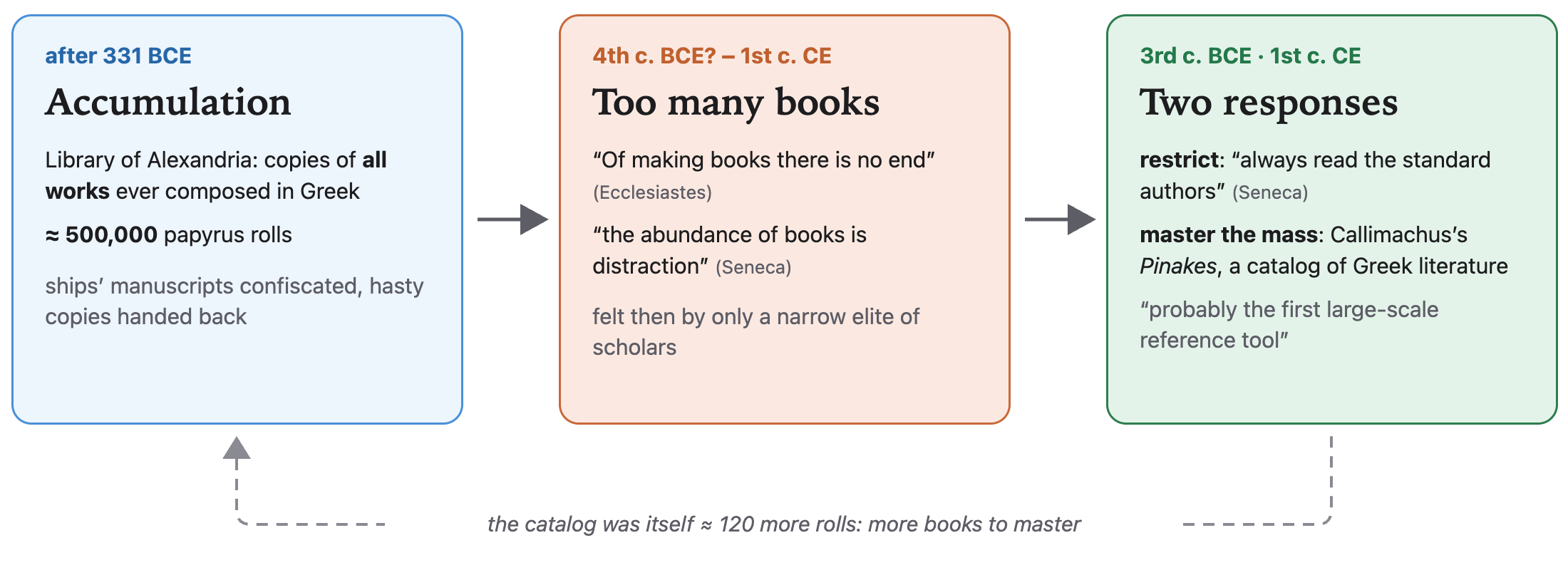
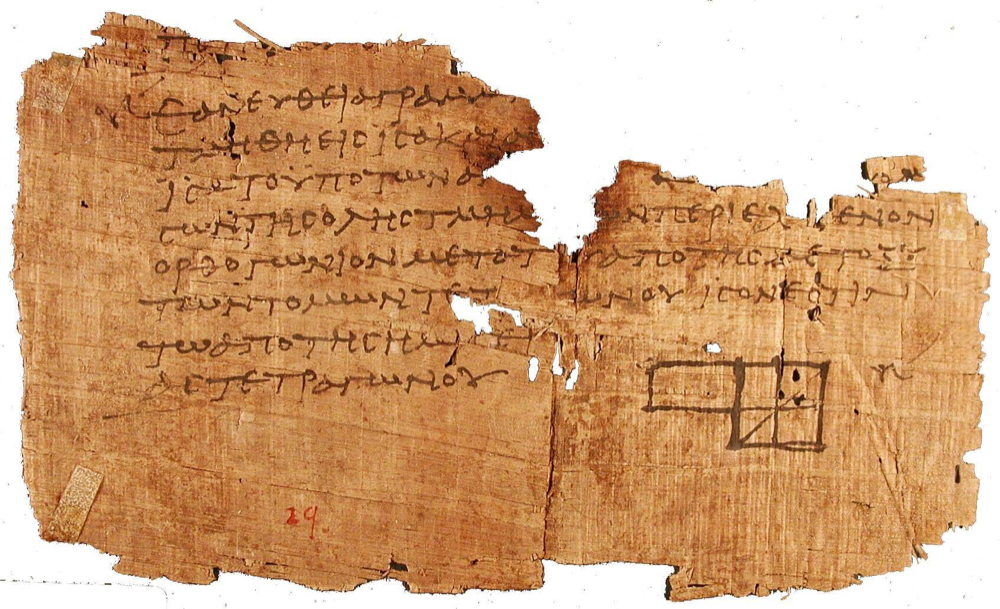
Flow diagram. After 331 BCE, accumulation: the Library of Alexandria sought copies of all works ever composed in Greek, about 500,000 papyrus rolls. 4th c. BCE? to 1st c. CE, too many books: Ecclesiastes, of making books there is no end; Seneca, the abundance of books is distraction; felt then by only a narrow elite. Two responses: restrict (Seneca, always read the standard authors) or master the mass (Callimachus's Pinakes, probably the first large-scale reference tool). A dashed arrow returns from the Pinakes to accumulation: the catalog was itself about 120 more rolls.
A torn, light-brown papyrus fragment with eight lines of Greek uncial script and a small square diagram divided into rectangles.

A papyrus roll, ca. 75–125 CE: Euclid, Elements II.5, statement and diagram, no proof.

Two responses to abundance, a canon or tools to master the mass, are already in place.

A. Blair, Too Much to Know: Managing Scholarly Information before the Modern Age (Yale UP, 2010), ch. 1, pp. 14–17; “narrow elite”: Blair, “A Multitude of Books” (2021). Papyrus: P.Oxy. I 29, Penn Museum E 2748, public domain.

Printing, 1450–1700 CE

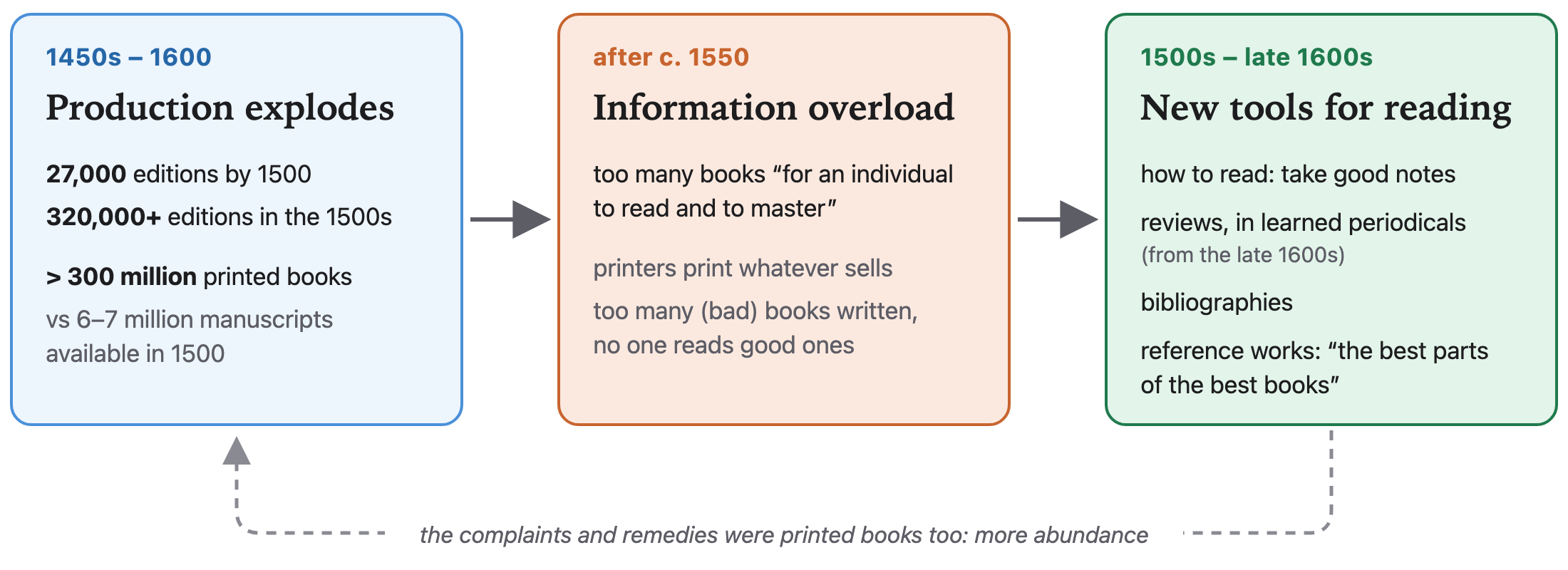
Flow diagram. 1450s–1600, production explodes: 27,000 editions by 1500, more than 320,000 in the 1500s, over 300 million books versus 6–7 million manuscripts available in 1500. After c. 1550, information overload: too many books for an individual to read and to master. 1500s–late 1600s, new tools for reading: note-taking advice, reviews in learned periodicals, bibliographies, reference works. A dashed arrow returns from the tools to production: the remedies were printed books too.
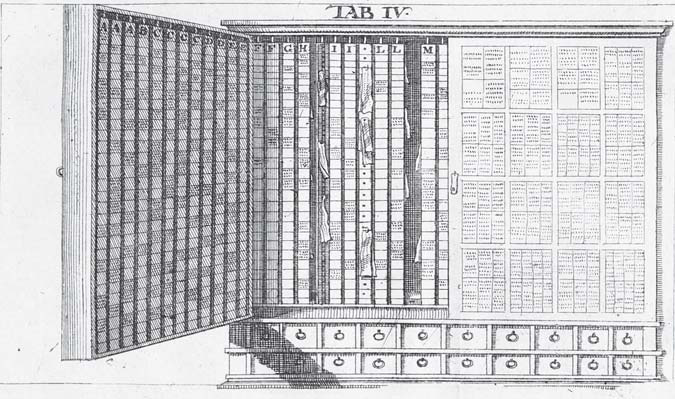
Engraving of a tall cabinet with its door open: rows of vertical bars with hooks holding paper slips, lettered headings along the top, drawers below.

A new tool: the note closet, slips on hooks under 3,000+ headings (Placcius, 1689).

6 Oct 2026: 722 AI papers in one release → open problems “harvested 
 in an unsustainable fashion” (Tao) → new tools for understanding?

A. Blair, “A Multitude of Books,” Lapham’s Quarterly, 27 Jan 2021 (laphamsquarterly.org); excerpted from Blair, Duguid, Goeing & Grafton (eds.), Information: A Historical Companion (Princeton UP, 2021). “after c. 1550” = Blair’s “after the first century of printing”. Closet: Blair, Too Much to Know (2010), fig. 2.1.

A reflection on understanding —in the modern society

understanding involves participating

A first form of participation: history

SKILL.md · § 2. history.html

“Required, read first after the hub: it explains why the target is shaped the way it is. A timeline with as many events as the story needs, in order. Each event: the obstacle, the advance, what stayed open, its key examples, the pictures people used, sources (linked to references.html), and links to the pages that develop it. Later pages link back to the event where their idea first arose [
]”

.agents/skills/explain-math-html/SKILL.md, lines 81–89 (this repository)
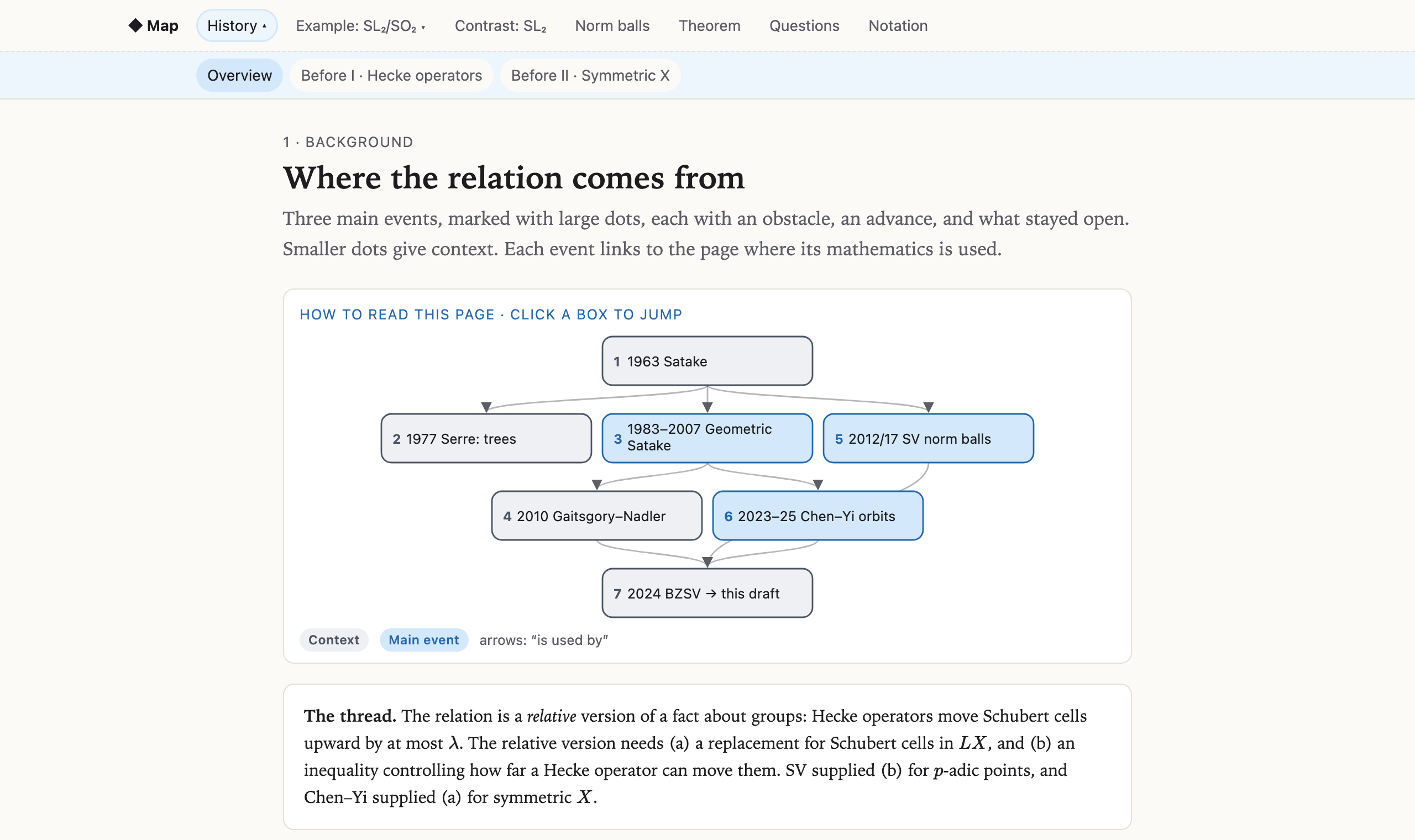
History page of the orbit-closures explainer: a timeline graph from Satake 1963 through Serre's trees, geometric Satake, Gaitsgory–Nadler, Sakellaridis–Venkatesh norm balls and Chen–Yi orbits to the current draft
“Understanding is to be thought of less as a subjective act than as participating in an event of tradition, a process of transmission in which past and present are constantly mediated.” H.-G. Gadamer, Truth and Method (1960), 2nd rev. ed., trans. J. Weinsheimer & D. G. Marshall (Sheed & Ward, 1989), p. 290
Screenshot: history page of the explainer Hecke translates of orbit closures (this site), built with the explain-math-html skill. German: “EinrĂŒcken in ein Überlieferungsgeschehen”, Wahrheit und Methode, Part II.

Microworlds: a place where mathematics answers back
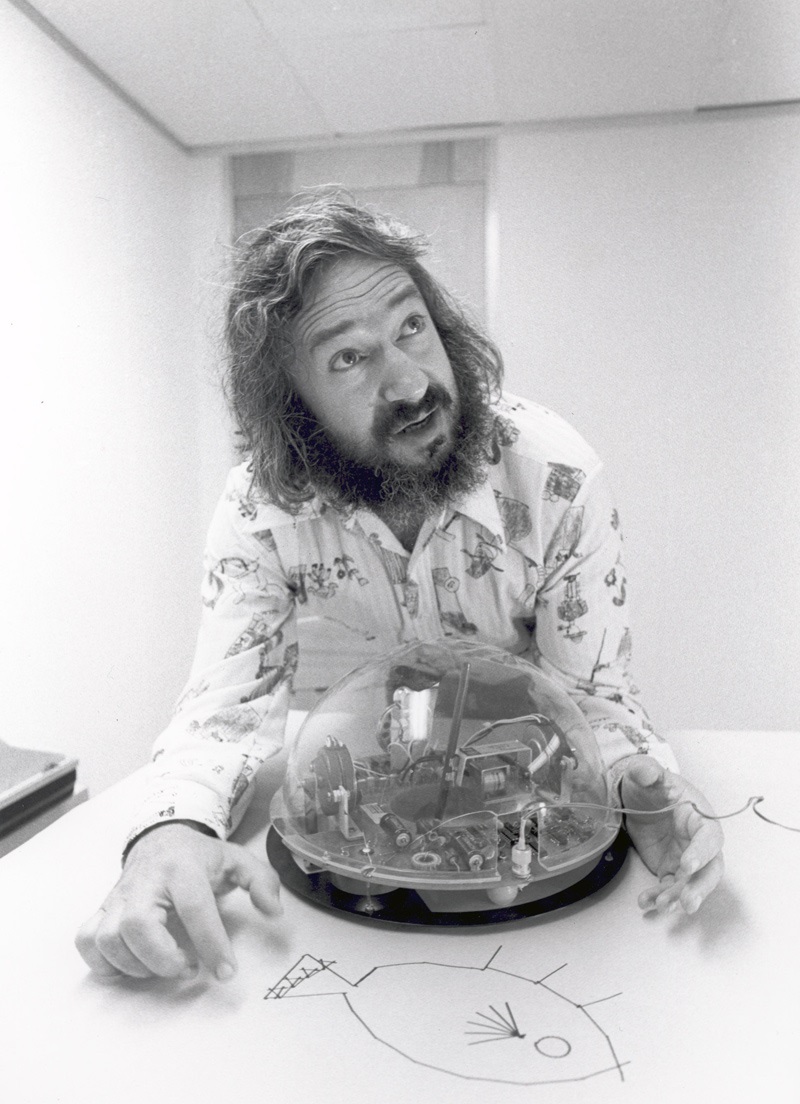
Portrait of Seymour Papert
Photo: Matematicamente.it, CC BY-SA 3.0, via Wikimedia Commons
Understanding mathematics in a “Mathland”: a world where mathematical actions have consequences you can explore. Adapted from S. Papert, Mindstorms (Basic Books, 1980), p. 6

Turtle: REPEAT 36 [FORWARD 10 RIGHT 10]  â†’  a circle you can debug by walking it.

Understanding through constructing a public object: the constructionist perspective — Papert & Harel, “Situating constructionism” (1991).

What is a \(K\)-orbit?

K=\mathrm{GL}_n(\mathcal O)\curvearrowright F^n,\qquad K\cdot v=\{kv:k\in K\}

Why do we want to know the orbits?

f(kv)=f(v)\quad\Longrightarrow\quad\text{one value of }f\text{ per orbit}

Here the nonzero orbits are shells

X_m=\varpi^m\mathcal O^n\setminus\varpi^{m+1}\mathcal O^n,\qquad a_m:=f(v)\ (v\in X_m)
\varphi_0=\mathbf1_{\mathcal O^n},\qquad \varphi_0|_{X_m}=\begin{cases}0&m<0,\\1&m\ge0.\end{cases}
\(F\): non-archimedean local field; \(\mathcal O\): its integers; \(\varpi\): a uniformizer; \(\mathbf1_A\): indicator of \(A\). We study \(C_K=C_c^\infty(F^n)^K\), the locally constant, compactly supported \(K\)-invariant functions.

What can we learn by moving a point?

(a) \(K\)-orbits

One hook per order.

(b) \(I\)-orbits

Blue horizontal: last \(=2\). Orange vertical: last \(=1\).

Click a grid point or change a valuation: the highlighted \(K\)-orbit and \(I\)-orbit update together.
\(F^2\), \(K=\mathrm{GL}_2(\mathcal O)\); \(I\subset K\): upper triangular modulo \(\varpi\); \(t=\varpi\). Widget from the basic-function geometry page. ★ denotes the zero vector.
Part I · Recording the shell values

\(y\) records a shift of one shell

Take \(y\) as a formal variable and store the values of \(f\) as coefficients:

f\longmapsto F_f(y):=\sum_{m\in\mathbb Z}a_m y^m

Where \(F_f\) lives

F_f(y)\in\frac1{1-y}\,\mathbb C[y^{\pm1}]\subset\mathbb C((y))

\(\mathbb C((y))\): formal Laurent series with only finitely many negative powers.

a_m=0\ (m\ll0),\qquad a_m=f(0)\ (m\gg0)

The basic function gives a geometric series

F_{\varphi_0}(y)=\sum_{m=0}^{\infty}y^m=\frac1{1-y}

As an analytic series, \(F_f(y)\) converges on \(0<|y|<1\).

(Tf)(v):=f(\varpi^{-1}v)\qquad\Longrightarrow\qquad F_{Tf}(y)=yF_f(y)
C_K=\operatorname{span}_{\mathbb C}\{T^m\varphi_0:m\in\mathbb Z\},\qquad T^m\varphi_0=\mathbf1_{\varpi^m\mathcal O^n}
Compact support gives the zero tail as \(m\to-\infty\), local constancy at \(0\) gives the constant tail as \(m\to+\infty\). Details: the shell model.

Where does this appear in the literature?

Tate’s thesis (1950; published 1967): the case \(n=1\)

\(\chi:F^\times\to\mathbb C^\times\) unramified, \(q=|\mathcal O/\varpi\mathcal O|\), \(\operatorname{vol}(\mathcal O^\times)=1\).

F^\times=\bigsqcup_{m\in\mathbb Z}\varpi^m\mathcal O^\times,\qquad y=\chi(\varpi)q^{-s}
\int_{F^\times}\mathbf1_{\mathcal O}(x)\chi(x)|x|^s\,d^\times x =\sum_{m\ge0}y^m=\frac1{1-y}=L(s,\chi)

The orbit decomposition turns the integral into the shell sum, initially for \(|y|<1\).

Sakellaridis (2012), §1.3 and §3.3.3: basic functions on spherical varieties

For smooth \(X\), the basic function is \(\mathbf1_{X(\mathcal O)}\); Tate’s \(X=\mathbb A^1\) is the simplest example.

The broader continuation conjecture is Conjecture 3.2.2.

J. Tate, “Fourier analysis in number fields and Hecke’s zeta-functions,” in Algebraic Number Theory (1967), pp. 305–347. Y. Sakellaridis, “Spherical varieties and integral representations of L-functions”, Algebra & Number Theory 6 (2012), 611–667, §1.3, §3.3.3.

A third participation: collaborative participation?

Level 3 · contribute: pose the next question; judge what is interesting. This takes other people.

Table 1 · Two forms of mathematical collaboration.
who took partwho checkedwhat machines did
Polymath1
2009 · Gowers’s blog
27 people, ≈ 800 comments in 37 daysparticipants, then referees (Annals 2012)blog and wiki only
Equational Theories Project
Sep 2024 – Apr 2025 · Tao et al.
over fifty contributors, “diverse academic and professional backgrounds”Lean: all 22 028 942 implicationsautomated provers: the bulk; LLMs: little; ≈ two dozen cases by hand
T. Gowers & M. Nielsen, “Massively collaborative mathematics,” Nature 461 (2009) 879–881, doi:10.1038/461879a; D. H. J. Polymath, Ann. of Math. 175 (2012) 1283–1327. M. Bolan et al., “The Equational Theories Project,” arXiv:2512.07087 (2025), pp. 2, 7, 12.

A question stays attached to its passage

Scroll, open a proof or source, or highlight a passage to comment. Open the full page ↗ · Comment dashboard ↗

What do the comments tell us about a reader?
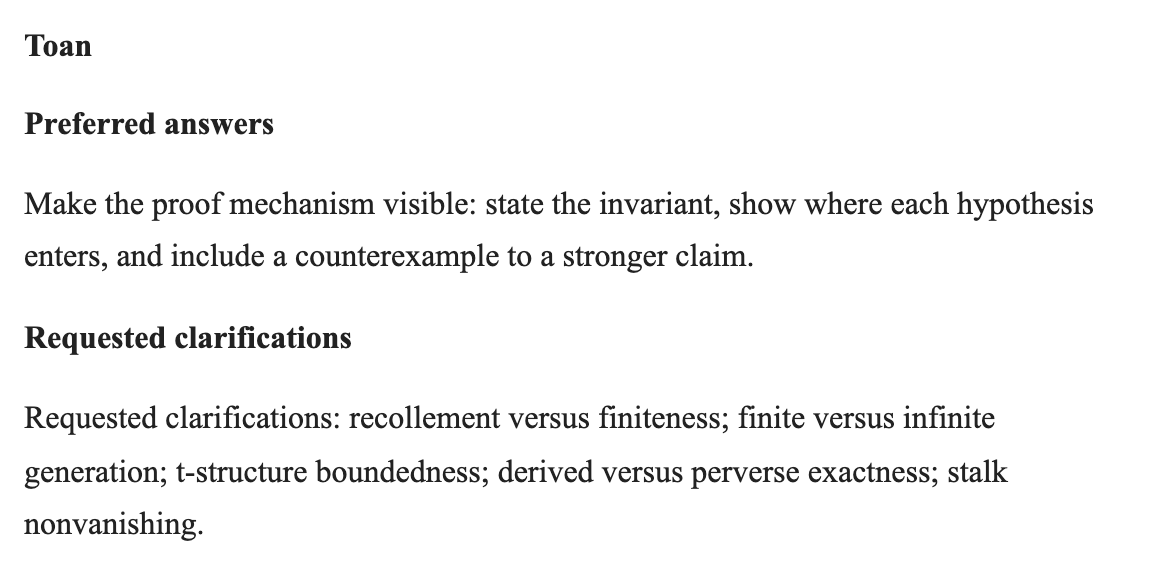
Relevant crop of Toan’s actual reader profile: preferred answers and requested mathematical clarifications.
The relevant part of Toan’s personalization profile.

Repeated questions reveal where the explanation needs more detail.

For Toan: show where each hypothesis enters, with examples and counterexamples.

An inferred preference, open to correction by the reader.

Screenshot: User preferences · Toan, 21 October 2026. Personalization plan: retain requests and their evidence across changing proposition statements.

The review returns to the reader

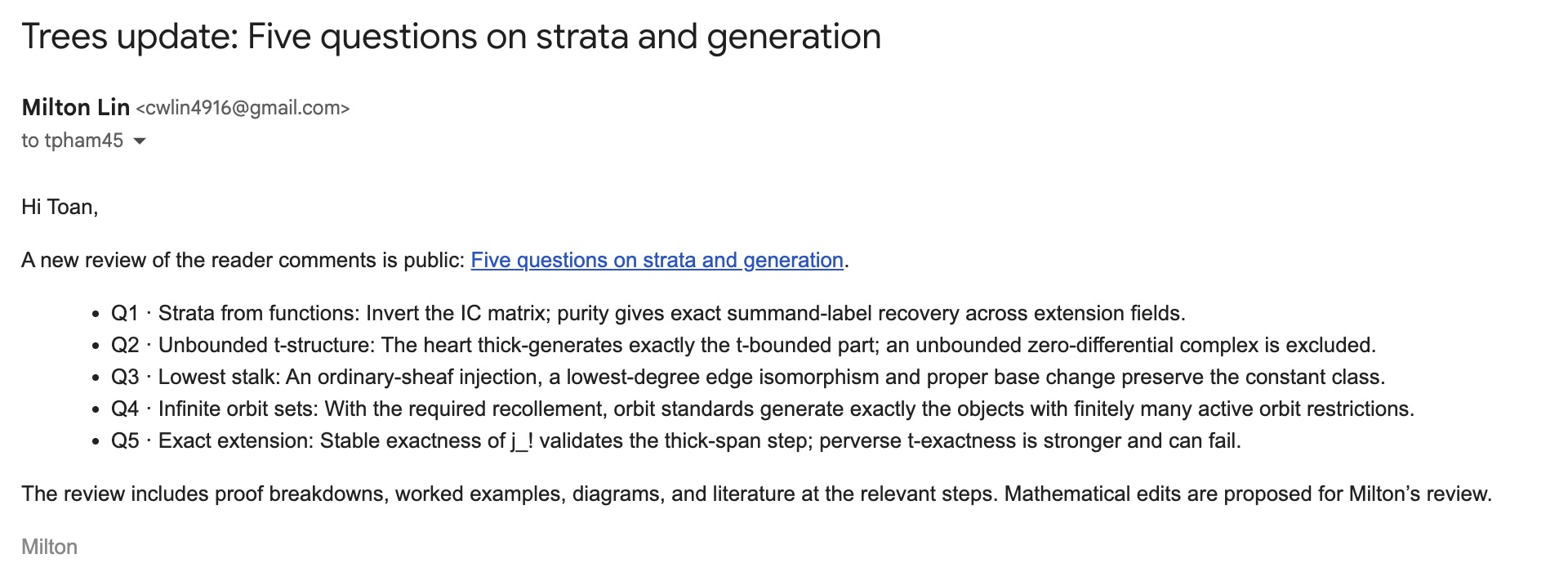
Sent to Toan, 21 October 2026 at 11:46 CDT: the review link and its five questions.

A reader’s question leads to a review, then a concrete invitation to continue the discussion.

Actual sent message, “Trees update: Five questions on strata and generation.” The linked review contains the proof breakdowns, examples and sources. Click the image for the full-resolution PNG.

A reflection on understanding —did all that help?

1.  I showed you the tools. Did they help me understand better?

2.  We benchmark AI all the time;
we should benchmark human–AI interaction.

3.  I should have shown you the process of how this all came to be.
How do I demonstrate this?

A reflection on understanding —how would you want to understand?

How would you want to participate?

← → to move · N notes · all slides