The length-zero subgroup
What does the result in Haines–Kottwitz–Prasad say, and why does it give translation?
1 · Reflections and alcove symmetries
· The extended group and Ω Definition
Fix a non-Archimedean local field \(\Loc\), its valuation ring \(\Ring\), and a uniformizer \(\unif\). For a split connected reductive group \(\Grp\) with split maximal torus \(T\), let \(W_0\) be its finite Weyl group and \(Q^\vee\) its coroot lattice. Choose a base alcove \(\alc\) in the apartment, and write
$$\Wext=X_*(T)\rtimes W_0,\qquad \Waff=Q^\vee\rtimes W_0.$$ $$\Om=\operatorname{Stab}_{\Wext}(\alc)=\{w\in\Wext:\len(w)=0\}.$$Length counts the affine walls separating the base alcove from its image; a central direction contributes no walls.
· The group-algebra part of the Hecke algebra Proved (cited)
With Haar volume of \(\Iw\) equal to one, set
$$\Hecke=C_c(\Iw\backslash\Grp(\Loc)/\Iw),\qquad T_w=\mathbf1_{\Iw w\Iw}.$$ $$\Wext=\Waff\rtimes\Om,\qquad T_\omega T_\eta=T_{\omega\eta}\quad(\omega,\eta\in\Om).$$ $$\mathbb C[\Om]\hookrightarrow\Hecke,\qquad [\omega]\longmapsto T_\omega.$$[HKP, §7.1, p. 19][HKP, §1.2, p. 2]Proof
- Choose a representative of \(\omega\in\Om\) normalizing \(\Iw\); this is the alcove stabilizer description for the split group: $$\Iw\omega\Iw=\omega\Iw.$$
- There is only one right coset, and it has volume one: $$T_\omega*T_\eta=\mathbf1_{\omega\eta\Iw}.$$
- Different double cosets are disjoint, so their indicators are independent: $$\sum_\omega c_\omega T_\omega=0\ \Longrightarrow\ c_\omega=0\quad\text{for every }\omega.$$
Writing \(\HeckeAff\) for the subalgebra indexed by \(\Waff\), HKP also gives the crossed-product structure:
$$\Hecke\cong\HeckeAff\rtimes\mathbb C[\Om].$$The twist is conjugation: an alcove symmetry permutes the simple reflection operators.
2 · Why Ω is infinite for GLₙ
· The determinant index Proved here
In the model of the lattice chain, define \(\degdet:\Wext\to\mathbb Z\) by determinant valuation:
$$\degdet(\unif^\lambda w)=\sum_{i=1}^{\nDim}\lambda_i.$$ $$\ker(\degdet)=\Waff,\qquad \degdet(\shift)=1,\qquad \Om=\langle\shift\rangle\cong\mathbb Z.$$ $$\mathbb C[\Om]\cong\mathbb C[z,z^{-1}],\qquad z=T_{\shift}.$$Proof
- The coroot lattice of GLₙ consists of integer vectors of total sum zero: $$Q^\vee=\{\lambda\in\mathbb Z^{\nDim}:\sum_i\lambda_i=0\}.$$
- The model proves that \(\shift\) preserves the alcove’s lattice chain, hence has length zero. For every \(w\in\Wext\), removing its determinant degree gives $$w\shift^{-\degdet(w)}\in\Waff.$$
- The affine reflection group acts simply transitively on alcoves; an element in it fixing the base alcove is the identity. Therefore $$\Om\cap\Waff=\{1\},\qquad \omega=\shift^{\degdet(\omega)}\quad(\omega\in\Om).$$
Although the affine Dynkin diagram has only \(\nDim\) nodes, \(\shift\) has infinite order: its \(\nDim\)-th power is the nontrivial central translation \(\unif1_{\nDim}\). For \(\nDim=1\), there are no affine walls and the whole extended group is \(\mathbb Z\).
3 · The same operator on any G-space
· Convolution without averaging Proved here
Let \(X(\Loc)\) be a locally compact left \(\Grp(\Loc)\)-space, and define the left Hecke action on \(\Module=C_c^\infty(X(\Loc))^{\Iw}\) by
$$h*f(x)=\int_{\Grp(\Loc)}h(g)f(g^{-1}x)\,dg.$$For every \(\omega\in\Om\) represented in the normalizer,
$$\boxed{(T_\omega*f)(x)=f(\omega^{-1}x).}$$Proof
- Use the single coset and left invariance of \(f\): $$\int_{\omega\Iw}f(g^{-1}x)\,dg=\int_{\Iw}f(i^{-1}\omega^{-1}x)\,di.$$
- The integrand is independent of \(i\), and the volume is one: $$\int_{\Iw}f(i^{-1}\omega^{-1}x)\,di=f(\omega^{-1}x).$$
HKP uses a right action on a different module. Its inverse in Lemma 7.2.1(iii) reflects that convention; the integral above fixes ours.
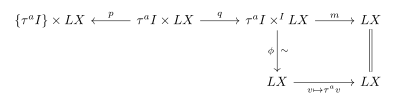
For this geometric GLₙ diagram, take \(k=\overline{\mathbb F}_q\) and define the loop functor by \(LX(R)=R((t))^n\) for each k-algebra R. The diagram uses a representative \(\shift^{\idx}\), the quotient maps \(p(g,v)=(gI,v)\), \(q(g,v)=[g,v]\), and action map \(m([g,v])=gv\); the vertical map is \(\phi([\shift^{\idx}i,v])=iv\). The introduction gives the sheaf formula and TikZ source.