Storage capacity › Q2 · Nonstorage endpoint
Q1. Why can the random storage load not exceed two?
Attempt 4 lowers this bound: R3 proves \(p_n(\lfloor(2-10^{-6})n\rfloor)\to0\), hence \(\alpha_-\le\alpha_+\le1.999999\).
Definitions
Definition 1. Spin network
For \(n\ge2\), \(J=J^\top\in\mathbb R^{n\times n}\), \(J_{ii}=0\), and \(h\in\mathbb R^n\). $$H_i(s)=\sum_{j\ne i}J_{ij}s_j+h_i,\qquad f_{J,h}(s)_i=\sigma(H_i(s)),\qquad\sigma(t)=\begin{cases}+1,&t>0,\\-1,&t\le0.\end{cases}$$ Strict storage requires \(s_iH_i(s)>0\) for every prescribed spin and neuron.
Definition 2. Storage probability
\(D\) is uniform among the \(m\)-element subsets of \(\{-1,1\}^n\). $$p_n(m)=\Pr\{D\text{ is storable}\}.$$
Definition 3. Capacity
$$\alpha_-=\sup\{a>0:p_n(\lfloor an\rfloor)\longrightarrow1\}.$$ This supremum does not assert a sharp threshold.
Definition 4. Two limiting endpoints
$$\alpha_-=\sup\{u>0:p_n(\lfloor un\rfloor)\to1\},\qquad \alpha_+=\inf\{a>0:p_n(\lfloor an\rfloor)\to0\}.$$ A sharp proportional threshold is equivalent to equality of these endpoints.
Definition 5. Spin patterns
\(s^\mu\in\{-1,1\}^n\), and \(S=[s^1\ \cdots\ s^m]\in\{-1,1\}^{n\times m}\).
Definition 6. Spin couplings
\(J=J^\top\in\mathbb R^{n\times n}\), \(J_{ii}=0\), and \(h\in\mathbb R^n\). Strict stability means \(s_i^\mu((Js^\mu)_i+h_i)>0\).
Definition 7. Augmented projection
$$U=\begin{bmatrix}S\\\mathbf1_m^\top\end{bmatrix},\qquad P=U(U^\top U)^{-1}U^\top$$ when \(U\) has column rank \(m\). Its last coordinate represents a free field.
Definition 8. Nonstorage certificate
The multipliers \(\lambda_i^\mu\ge0\) have total mass one and satisfy $$\sum_\mu\lambda_i^\mu s_i^\mu=0,\qquad \sum_\mu(\lambda_i^\mu+\lambda_j^\mu)s_i^\mu s_j^\mu=0\quad(i<j).$$ Their existence is equivalent to nonstorage.
Definition 9. First failure time
Uniformly order the entire spin cube and let \(\tau_n\) be the first prefix length that is not storable. $$p_n(m)=\Pr\{\tau_n>m\}.$$
Definition 10. Maximum storable subset
For a finite sample \(D\), $$L(D)=\max\{|E|:E\subseteq D\text{ is storable}\}.$$ Full storage is the event \(L(D)=|D|\).
Statement
Attempt 1 · supporting result in its stated scope
One-neuron obstruction. Let \(n\ge2\) and \(1\le m\le2^n\) be integers, and let \(D\) be uniform among the \(m\)-element subsets of \(\{-1,1\}^n\). For symmetric zero-diagonal threshold networks with unrestricted fields,
$$p_n(m)\le 2^{1-m}\sum_{k=0}^{n-1}\binom{m-1}{k}+\binom m2\,2^{-n},$$
where \(\binom{m-1}{k}=0\) for \(k>m-1\). Hence
$$\forall\alpha>2:\quad p_n(\lfloor\alpha n\rfloor)\longrightarrow0,\qquad \alpha_-\le2,\qquad\limsup_{n\to\infty}p_n(2n)\le\tfrac12.$$
The bound uses the necessary separability of a single neuron's labels, without assuming general position for spin inputs.
Proof and supporting results
Step 1. Distinct sampling and monotonicity
Established in Attempt 1 · stated scope
Let \(q_n(m)\) be the probability that \(m\) iid uniform cube patterns, with repetitions allowed, are simultaneously storable. For \(1\le m\le 2^n\), $$|p_n(m)-q_n(m)|\le \binom m2 2^{-n}.$$ Also \(p_n(m+1)\le p_n(m)\).
Proof
- Let \(E\) be the event that the iid patterns are distinct. A union bound over pairs gives \(r:=\Pr(E^c)\le\binom m2 2^{-n}\).
- Conditional on \(E\), every ordered tuple of distinct cube points is equally likely. Its unordered set is therefore a uniform \(m\)-element subset, so the conditional storage probability equals \(p_n(m)\).
- Writing \(a=\Pr(\text{storage}\mid E^c)\) when \(r>0\), one has \(q_n(m)=(1-r)p_n(m)+ra\), hence \(|q_n(m)-p_n(m)|=r|a-p_n(m)|\le r\). If \(r=0\), equality of probabilities is immediate.
- Couple uniform subsets of all sizes by taking successive initial segments of a uniform random permutation of the cube. Every subset of a storable set is storable, using exactly the same symmetric zero-diagonal weights and biases. Thus the indicator for size \(m+1\) is at most that for size \(m\), proving monotonicity.
Sources
The derivation is self-contained; no external theorem is required.
In the attempt tree
Figure 35. S3-1. Step 2. One-neuron bound without general position
Established in Attempt 1 · stated scope
For \(m\ge1\) iid uniform cube patterns, $$q_n(m)\le 2^{1-m}\sum_{k=0}^{n-1}\binom{m-1}{k}=\Pr\{B_{m-1}\le n-1\},\qquad B_{m-1}\sim\operatorname{Bin}(m-1,1/2),$$ where binomial coefficients beyond \(m-1\) are zero.
Proof
- Fix neuron 1. Conditional on all predictor vectors \(z^\mu=(s_2^\mu,\ldots,s_n^\mu)\in\mathbb R^{n-1}\), its labels \(s_1^1,\ldots,s_1^m\) are iid uniform signs, independent of those predictors. Storage requires their strict affine separation by \(w\cdot z^\mu+h_1\); relaxing symmetry and every other neuron's constraints only enlarges this event.
- Put \(v^\mu=(z^\mu,1)\in\mathbb R^n\). Strict affine labelings are exactly the sign vectors of \((\theta\cdot v^\mu)_{\mu=1}^m\) with all entries nonzero, namely chambers of the central hyperplanes \(\{\theta:\theta\cdot v^\mu=0\}\). Each feasible strict sign cell is open and convex, hence a single chamber.
- For any \(m\ge1\) proper central hyperplanes in \(\mathbb R^d\), their chamber count is at most \(R(m,d)=2\sum_{k=0}^{d-1}\binom{m-1}{k}\). Here is a proof that does not require general position. For \(d=1\) the count is two; for \(m=1\) it is two. If a newly added hyperplane duplicates an earlier one it creates no chambers. Otherwise each old chamber it splits intersects the new hyperplane in a distinct chamber of the arrangement restricted to that hyperplane. The restricted arrangement has at most \(m-1\) proper central hyperplanes in dimension \(d-1\), so induction bounds the new count by \(R(m-1,d)+R(m-1,d-1)=R(m,d)\). Hyperplanes absent from a restriction can only decrease its count. This proves the upper bound in every degenerate case as well.
- Taking \(d=n\), at most \(2\sum_{k=0}^{n-1}\binom{m-1}{k}\) of the \(2^m\) equiprobable labelings pass the test, conditionally on any predictors. Averaging gives the bound. The last expression is the binomial cumulative distribution by its defining mass formula. No probabilities for different neurons have been multiplied, and the free scalar field is included in dimension \(n\).
Sources
In the attempt tree
Figure 36. S3-2. Step 3. Rigorous upper capacity bound is two
Established in Attempt 1 · stated scope
For \(m=\lfloor\alpha n\rfloor\) and every fixed \(\alpha>2\), $$p_n(m)\le \exp\{-n[\alpha D(1/\alpha\Vert 1/2)+o(1)]\}+\binom m2 2^{-n}\longrightarrow0,$$ where \(D(u\Vert1/2)=u\log(2u)+(1-u)\log(2(1-u))\). In particular, \(\alpha_-\le2\). At the boundary, \(p_n(2n)\le\tfrac12+\binom{2n}{2}2^{-n}\), so \(\limsup_n p_n(2n)\le\tfrac12\).
Proof
$$p_n(m)\le\Pr\{B_{m-1}\le n-1\}+\binom m2 2^{-n}.$$ These checked parents have no open issues. This single-neuron upper bound is used once; there is no independence assertion concerning neurons.
- Put \(N=m-1\) and \(r=(n-1)/N\). When \(r<1/2\), exponential Markov inequality applied to \(e^{-tB_N}\) gives, for \(t>0\),
$$\Pr\{B_N\le Nr\}\le\exp(tNr)\left(\frac{1+e^{-t}}2\right)^N.$$ Choosing \(e^{-t}=r/(1-r)\) yields \(\Pr\{B_N\le Nr\}\le e^{-ND(r\Vert1/2)}\). For \(m=\lfloor\alpha n\rfloor\) with fixed \(\alpha>2\), eventually \(0<r<1/2\), \(N/n\to\alpha\) and \(r\to1/\alpha\). Continuity gives \(ND(r\Vert1/2)=n[\alpha D(1/\alpha\Vert1/2)+o(1)]\). The limiting rate is positive, since direct differentiation shows \(D\) has its unique minimum zero at \(1/2\).
- The collision term is \(O(n^2 2^{-n})\), so both terms tend to zero and the claimed limit follows. No \(\alpha>2\) can therefore belong to the set of loads with success limit one in the definition of \(\alpha_-\); its supremum is at most two. For \(m=2n\), symmetry of \(B_{2n-1}\) pairs each value at most \(n-1\) with one at least \(n\), giving exactly \(\Pr\{B_{2n-1}\le n-1\}=1/2\) and the boundary bound.
- The exact dual S3-3 preserves every symmetry constraint rather than dropping it. Thus a possible improvement below two would follow by proving that its displayed nonnegative certificate equations have a nonzero solution with probability tending to one at some fixed \(\alpha<2\). This stochastic assertion has not been proved here, and no conclusion below two uses it.
- This is partial progress on the shared target: the all-neuron storage probability tends to zero above two because every stored network must pass the necessary single-neuron test. These arguments give no positive linear-load success range, no zero-probability limit at a load below two, and no existence proof of a sharp constant \(\alpha_c\). The estimate \(1.6\) is neither proved nor disproved by the bound.
Sources
In the attempt tree
Figure 37. S3-4. Step 4. Capacity has the rigorous upper bound two
Established in Attempt 1 · stated scope
For m with (m−1)/2>n−1, p_n(m)≤exp{−2[((m−1)/2−(n−1))²/(m−1)]}+m(m−1)/2^{n+1}. Hence p_n(floor(αn))→0 for α>2, and every α in the set defining α_sym is at most 2.
Proof
- Sample m independent uniform spin vectors, temporarily allowing repeats. At neuron 1 the inputs \((s_2^\mu,\ldots,s_n^\mu)\) are independent of the iid fair labels \(s_1^\mu\). Strict storage requires affine separability of these labels.
- For arbitrary fixed features in R^d, the number of strictly affinely separable sign labelings is at most the supplied C_d(m)=2∑_{k=0}^d binom(m−1,k). To see why degeneracies cannot increase this number, select one strict classifier for each realizable labeling. There are finitely many such labelings, and a sufficiently small common perturbation of the features preserves all of these finitely many strict classifications. Choose that perturbation in affine general position and apply the supplied count there. This argument also handles repeated features.
- With d=n−1, conditioning on features therefore gives probability at most C_{n−1}(m)/2^m=P{B≤n−1}, where B is Binomial(m−1,1/2). For completeness, its lower-tail bound is P{B≤N/2−t}≤exp(−2t²/N): for independent centered Bernoulli variables, E exp(u(B−N/2))=cosh(u/2)^N≤exp(Nu²/8); apply Markov with u=−4t/N. This proves the exponential term. Only a necessary condition at neuron 1 was used; no row independence was asserted.
- The iid sample has a repeated pair with probability at most binom(m,2)2^{−n}. Its law conditioned on no repeats is a uniform ordered sample without replacement. The total variation distance from the iid law to that conditioned law equals the collision probability. Applying this to the symmetric storability event proves the displayed bound for uniform m-element subsets.
- At m=floor(αn), α>2, the tail exponent has order −n and the collision term tends to zero. Thus the probability tends to zero. This is an upper bound only and supplies neither a matching lower bound nor a sharp threshold.
Sources
In the attempt tree
Figure 38. S1-3. Step 5. Cover gives an upper bound on cube inputs
Established in Attempt 1 · stated scope
For m iid uniform spin patterns, the probability of strict feasibility at a fixed neuron is at most $$B_{n,m}=2^{1-m}\sum_{k=0}^{n-1}\binom{m-1}{k}=\Pr\{\operatorname{Bin}(m-1,1/2)\le n-1\}.$$ For uniformly sampled distinct patterns, $$p_n(m)\le B_{n,m}+\varepsilon_{n,m},\qquad \varepsilon_{n,m}=\binom m2 2^{-n}.$$ Consequently for every fixed \(\alpha>2\), \(p_n(\lfloor\alpha n\rfloor)\to0\), and \(\alpha_-\le2\).
Proof
- Cover (1965), Theorem 1, printed p. 326, states the homogeneous count \(2\sum_{k=0}^{d-1}\binom{m-1}{k}\) under the hypothesis: every subset of \(d\) or fewer vectors is linearly independent. The supplied affine count is its lift by \(z\mapsto(z,1)\). Here the covariates for neuron i are in \(\mathbb R^{n-1}\), so the homogeneous lifted parameter dimension is n, not n+1.
- For any fixed finite covariate list \(z^1,\ldots,z^m\in\mathbb R^{n-1}\), choose a strict affine witness for each realizable label vector. There are finitely many such vectors and finitely many strict margins. Hence sufficiently small simultaneous perturbations of all covariates preserve every witness. Perturb into affine general position, which is dense since the finitely many relevant determinant polynomials have zero sets with empty interior. The original number of realizable label vectors is therefore no greater than the general-position count. This proves an upper bound without assuming general position for cube inputs, even when covariates repeat.
- In the iid model, conditional on the entire list of covariates \(x_{-i}^\mu\), the labels \(s_i^\mu\) are independent uniform signs. Divide the preceding count by \(2^m\). Global symmetric feasibility implies feasibility at this single neuron, so its probability is at most \(B_{n,m}\). No product of neuron probabilities is used.
- The chance of any repeated full pattern in an iid list is at most \(\varepsilon_{n,m}\), by the union bound. Conditional on no repetition, the unordered list is the desired uniform m-subset. For any event A and event E, \(|\Pr(A\mid E)-\Pr(A)|\le\Pr(E^c)\); this follows by writing \(\Pr(A)=\Pr(E)\Pr(A\mid E)+\Pr(E^c)\Pr(A\mid E^c)\). Thus the asserted distinct-sampling bound holds.
- For \(m=\lfloor\alpha n\rfloor\), \(\alpha>2\), the binomial threshold fraction \((n-1)/(m-1)\to1/\alpha<1/2\), so the binomial lower tail tends to zero (e.g. by Chebyshev). Also \(\varepsilon_{n,m}\to0\). This yields the upper probability limit. Since no \(\alpha>2\) belongs to the defining set of \(\alpha_-\), its supremum is at most 2.
Sources
In the attempt tree
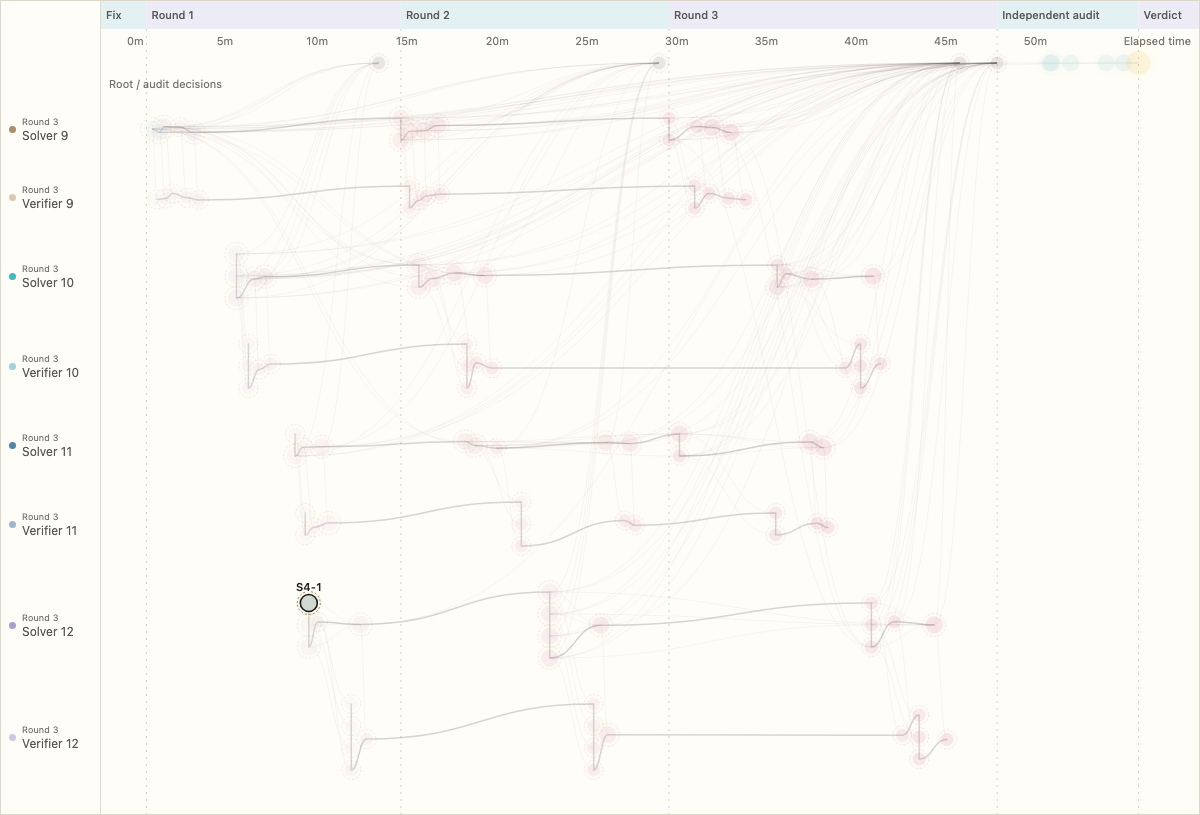
Figure 39. S4-1.