1 · What friction is
The friction of a block is how often its readers get stuck there. Classroom practice measures it by asking for the “muddiest point” [1] and revising before the next class [2]. The first design made it a rate, split by the reader's background:
$$g(u,a)=\min_{t\in\tau(a)}\ell_u(t),\qquad F_g(a)=\frac{\#\{u:\ g(u,a)=g,\ u\text{ commented on }a\}}{\#\{u:\ g(u,a)=g,\ u\text{ read }a\}},$$for a block \(a\), a reader \(u\), the topics \(\tau(a)\) the block uses, and the reader's level \(\ell_u(t)\in\{0,1,2\}\) (new, working, expert) in topic \(t\).
| \(F_0\) (new readers) | \(F_2\) (experts) | reading |
|---|---|---|
| high | low | missing background: add an example |
| low | high | a gap in the argument: re-check it |
| high | high | the block is badly organised |
2 · Why it does not work here
| problem | consequence |
|---|---|
| The denominator is never observed. A static page does not record who read a block, and recording it means tracking readers. | \(F_g\) cannot be computed. Only comment counts exist, and they mix difficulty with popularity. |
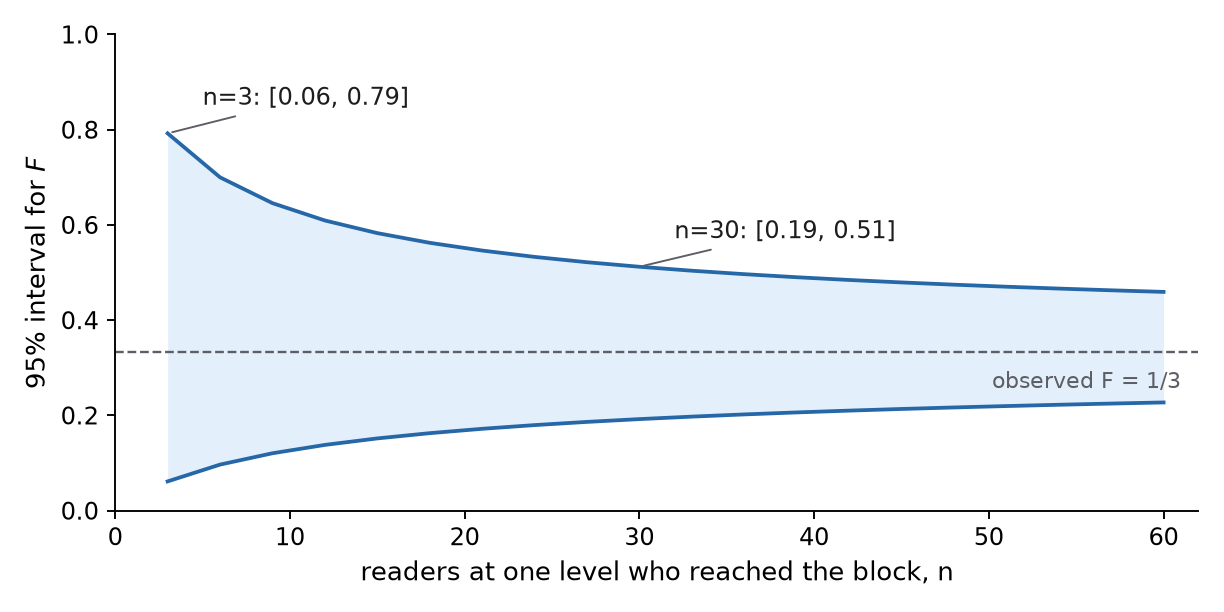
| Too few readers. A handful of collaborators per level. | An observed \(1/3\) is consistent with anything from 6% to 79% (figure). |
| It needs levels. \(\tau(a)\) and \(\ell_u(t)\) are the classification the design dropped, and self-assessed levels are noisy [3]. | A topic map and level scale to maintain, for a noisy input. |
| Silence is ambiguous. No comment can mean understood, skipped, or gave up. | A low \(F\) does not mean the block is clear. |
| Small counts identify people [4]. | It could never be shown publicly anyway. |
3 · What to keep
| part | keep | instead |
|---|---|---|
| Rate \(F_g(a)\) | no | Number of open comments per block, as a badge. |
| Topics \(\tau(a)\), levels \(\ell_u(t)\) | no | The reader summary written by the LLM (Prototype · G3). |
| New-reader vs expert reading | yes | For each thread, the bot uses the reader's summary to label it missing-background or possible-gap. A possible-gap goes to you. |
This matches classroom practice: the instructor reads the muddiest-point cards one by one rather than computing a rate [1]. Reconsider a rate only with about 30 or more readers per level and an opt-in “I read this” button.
References
- F. Mosteller. The “muddiest point in the lecture” as a feedback device. On Teaching and Learning (Harvard–Danforth Center) 3 (1989) 10–21.
- G. Novak, E. Patterson, A. Gavrin, W. Christian. Just-in-Time Teaching. Prentice Hall, 1999.
- J. Kruger, D. Dunning. Unskilled and unaware of it. J. Personality and Social Psychology 77(6) (1999) 1121–1134. doi:10.1037/0022-3514.77.6.1121
- L. Sweeney. k-anonymity: a model for protecting privacy. Int. J. Uncertainty, Fuzziness and Knowledge-Based Systems 10(5) (2002) 557–570.
- E. B. Wilson. Probable inference, the law of succession, and statistical inference. J. Amer. Statist. Assoc. 22 (1927) 209–212.