Octonions over \(\C\)
The groups \(\Esix\) and \(\Ffour\) on these pages are complex algebraic groups, so the octonions in the Albert algebra have complex coefficients. That changes one thing that matters: the norm acquires zeros, and the octonions stop being a division algebra.
Complex coefficientsWhat does “octonions over \(\C\)” mean?
(complexified octonions) Definition
\(\Oc_\C=\Oc\otimes_\R\C\) is the set of \(x=\sum_{k=0}^7x_ke_k\) with \(x_k\in\C\), multiplied by the same table as \(\Oc\) (the Fano plane), extended \(\C\)-bilinearly. Conjugation and norm are
\[\bar x=x_0e_0-\textstyle\sum_{k\ge1}x_ke_k,\qquad \Nm:\Oc_\C\to\C,\quad \Nm(x)=x\bar x=\textstyle\sum_{k=0}^7x_k^2 .\]Two different square roots of \(-1\) now live side by side: the octonion units \(e_1,\dots,e_7\), which anticommute with each other, and the complex scalar \(\mathrm i\), which commutes with everything. And \(\Nm(x)=\sum x_k^2\), not \(\sum|x_k|^2\): it is a complex quadratic form, not a length.
(identities survive) Proved here
For \(x,y\in\Oc_\C\): \(\Nm(xy)=\Nm(x)\Nm(y)\), \(x\bar x=\bar xx=\Nm(x)\), and \(x(xy)=(xx)y\), \((yx)x=y(xx)\).
Proof
Each identity holds for \(x,y\in\Oc\) [Baez, §1.1]. In the coordinates \(x_k,y_k\), both sides of each are polynomials with real coefficients that agree on \(\R^8\times\R^8\). A polynomial vanishing on \(\R^{16}\) vanishes on \(\C^{16}\), so they agree on \(\Oc_\C\times\Oc_\C\).
The norm has zerosWhat breaks?
(a zero divisor)
Let \(u=1+\mathrm i\,e_1\). Then \(\Nm(u)=1^2+\mathrm i^2=0\), and
\[(1+\mathrm i\,e_1)(1-\mathrm i\,e_1)=1-\mathrm i^2e_1^2=1-(-1)(-1)=0 .\](zero divisors are the null vectors) Proved here
For \(x\ne0\) in \(\Oc_\C\): there is \(y\ne0\) with \(xy=0\) if and only if \(\Nm(x)=0\).
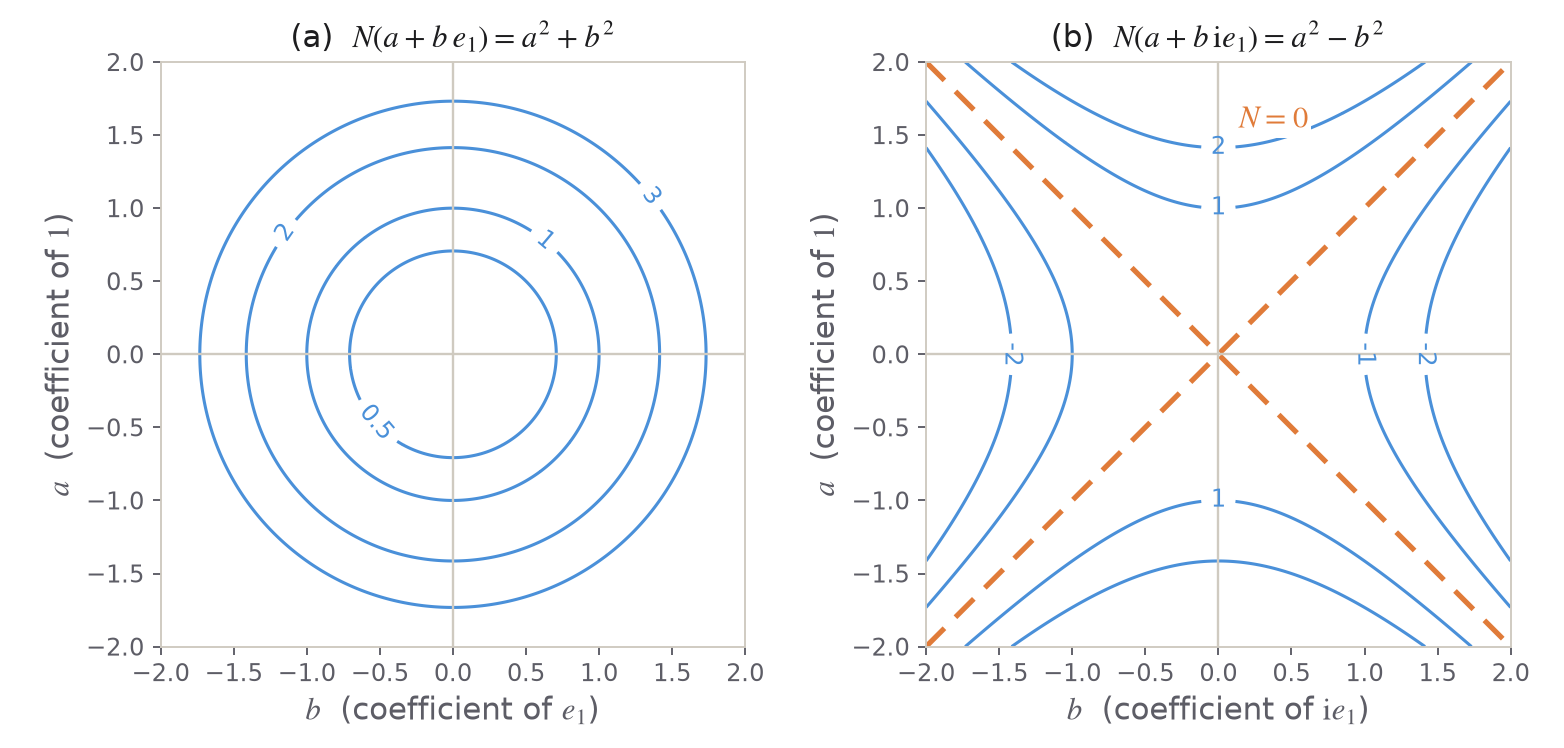
So over \(\C\) the octonions are no longer a division algebra, and the null vectors \(\{\Nm=0\}\) form a cone of complex dimension 7. This is the same thing that happens to the norm \(t^2-x^2-y^2\) on the hyperboloid page: over \(\C\), every nondegenerate quadratic form in two or more variables has null vectors.
The four algebras after complexifyingWhy does the \(A_2\) row over \(\C\) read \(\SL_3\), \(\SL_3\times\SL_3\), \(\SL_6\), \(\Esix\)?
(complexified \(\C\) and \(\Ha\)) Proved here
\(\C\otimes_\R\C\cong\C\times\C\) and \(\Ha\otimes_\R\C\cong M_2(\C)\) as complex algebras.
Proof
- In \(\C\otimes\C\), write \(j\) for the imaginary unit of the first factor and \(\mathrm i\) for the scalar. Then \((\mathrm ij)^2=\mathrm i^2j^2=1\), so \(p_\pm=\tfrac12(1\pm\mathrm ij)\) satisfy \(p_\pm^2=p_\pm\), \(p_+p_-=0\), \(p_++p_-=1\), and \(z\mapsto(zp_+,zp_-)\) splits the algebra into two copies of \(\C\).
- Send \(1,i,j,k\in\Ha\) to \(I,-\mathrm i\sigma_1,-\mathrm i\sigma_2,-\mathrm i\sigma_3\), with the Pauli matrices \(\sigma_1=\begin{pmatrix}0&1\\1&0\end{pmatrix}\), \(\sigma_2=\begin{pmatrix}0&-\mathrm i\\ \mathrm i&0\end{pmatrix}\), \(\sigma_3=\begin{pmatrix}1&0\\0&-1\end{pmatrix}\). From \(\sigma_a^2=I\) and \(\sigma_1\sigma_2=\mathrm i\sigma_3\) (and cyclically), \((-\mathrm i\sigma_a)^2=-I\) and \((-\mathrm i\sigma_1)(-\mathrm i\sigma_2)=-\mathrm i\sigma_3\): the relations of \(i,j,k\) hold. The four images are a basis of \(M_2(\C)\), so the \(\C\)-linear extension is an isomorphism.
| \(\K\) | \(\K\otimes\C\) | Hermitian \(3\times3\) over it | dim | \(G/K\) |
|---|---|---|---|---|
| \(\R\) | \(\C\) | \(\mathrm{Sym}_3(\C)\) | 6 | \(\SL_3/\SO_3\) |
| \(\C\) | \(\C\times\C\) | pairs \((A,A^T)\), i.e. \(M_3(\C)\) | 9 | \((\SL_3\times\SL_3)/\SL_3\) |
| \(\Ha\) | \(M_2(\C)\) | \(\cong\bigwedge^2\C^6\) (the \(A_2\) row) | 15 | \(\SL_6/\Sp_6\) |
| \(\Oc\) | \(\Oc_\C\), not associative | \(\Jalg\) | 27 | \(\Esix/\Ffour\) |
In the second row, conjugation of \(\C\otimes\C\) swaps \(p_+\) and \(p_-\); a Hermitian matrix with entries in \(\C\times\C\) is therefore a pair \((A,B)\) with \(B=A^T\), that is, an arbitrary \(A\in M_3(\C)\), with \(\det\) the usual determinant. Its symmetries \(A\mapsto gAh^T\) give \(\SL_3\times\SL_3\), and those fixing \(I\) are the pairs \((g,(g^T)^{-1})\), a copy of \(\SL_3\): this is where the “group case” of the row comes from. The last row has no such matrix description, because \(\Oc_\C\) is not associative; by it is not a division algebra either. Over \(\C\) there is only one octonion algebra up to isomorphism [SV, Thm 1.8.1] (location from a secondary citation, unverified).
Why the pages work over \(\C\), and what the real picture keepsWould it not be simpler to stay real?
- Square roots. Transitivity needs them: the last step on the \(\SL_3/\SO_3\) page is \(d^{-1/2}\), and a real \(g\) can never turn \(\diag(-1,-1,1)\) into \(I\).
- Borel subgroups. Sphericity asks for an open orbit of a Borel subgroup, a statement about algebraic groups over an algebraically closed field (spherical page).
- Roots. The eigenvalue computations of the Proposition diagonalize over \(\C\).
What the real picture keeps is shape. For \(\SL_3/\SO_3\) the real positive part is the space \(\Pd{3}\) of ellipsoids. For \(\Esix/\Ffour\) the analogue is the real form: the group \(E_{6(-26)}\) of \(\det\)-preserving maps of the real Albert algebra \(\mathfrak h_3(\Oc)\) has \(\Ffour\) as a maximal compact subgroup [Baez, §4.4, p. 46], and its orbit of matrices with three positive eigenvalues is \(E_{6(-26)}/\Ffour\), the hypersurface \(\{\det=1\}\) in that cone [FG, §4, pp. 9–10]. It is a 26-dimensional Riemannian symmetric space, the octonionic version of “ellipsoids of volume one”, and it is where the physics uses it.