The Proposition: what \(\Esix/\Ffour\) is
Everything the labs suggested, stated once and proved, with the cited inputs marked. The proofs follow the classical model step by step; each step links back to where the reader saw it happen.
StatementWhat exactly is being claimed?
Notation: \(\Jalg\), \(\det\), \(\one\), \(\Jo\) from the Albert algebra page; \(\Esix\), \(\Ffour\) from its group definitions; all symbols in the Notation tab.
Proved here from cited inputs
- Model. \(\Esix\) acts transitively on \(\Xe=\{X\in\Jalg:\det X=1\}\) with stabilizer \(\Ffour\) at \(\one\):
\[\Esix/\Ffour\ \xrightarrow{\ \sim\ }\ \Xe,\qquad g\Ffour\mapsto g\one,\qquad \dim\Xe=26 .\]
- Symmetric. \(\esix=\Der(\Jalg)\oplus\{\Lop{T}:T\in\Jo\}\), and \(\theta(\delta+\Lop{T})=\delta-\Lop{T}\) is an involution of \(\esix\) with fixed algebra \(\ffour\); it integrates to \(\theta:\Esix\to\Esix\) with \((\Esix^\theta)^\circ=\Ffour\). So \(\Esix/\Ffour\) is a .
- Roots. With \(\iot:\Jo\to\pf\), \(\iot(T)=2\Lop{T}\), the space \(\af=\iot\{\diag(h_1,h_2,h_3):\sum h_i=0\}\) is a , so \(\rk\Esix/\Ffour=2\). The are \(\pm\alpha_{ij}\), \(\alpha_{ij}(\iot H)=h_i-h_j\): a root system of type \(A_2\), every root of multiplicity \(\mult=8\).
Here \(\Lop{T}:\Jalg\to\Jalg\), \(\Lop{T}(X)=T\jo X\). Sphericity is the subject of the next page.
Proof
Proof of (a)The \(\SL_3/\SO_3\) transitivity and stabilizer lemmas, for \(\Jalg\).
- Transitivity [Krutelevich, Prop. 12(i)]: for the split octonions \(C\) over a field of characteristic \(\ne2,3\), the norm-preserving group of \(\mathfrak h_3(C)\) acts transitively on elements of a given nonzero norm. Over \(\C\) every octonion algebra is split, so \(\Oc_\C\) is the split one and the norm is \(\det\). In the classical model this was the elimination algorithm.
- Stabilizer [Yokota, §2.13, p. 65]: \(\{g\in\Esix:g\one=\one\}=\Ffour\). Classically: \(gg^T=I\).
- Isomorphism. The orbit map \(\Esix\to\Xe\), \(g\mapsto g\one\), is surjective by 1 and has fibres the cosets of \(\Ffour\) by 2. \(\Xe\) is smooth: by Euler's identity, \(d\det_X(X)=3\det X=3\ne0\). A bijective orbit map onto a smooth (hence normal) variety in characteristic 0 is an isomorphism.
- Dimension. \(\dim\Xe=27-1=26=78-52\); the tangent space at \(\one\) is \(\Jo\) (computed here).
Proof
Proof of (b)Where is the involution?
- Decomposition [CS; Yokota, Thm 3.2.1]: \(\esix=\Der(\Jalg)\oplus\{\Lop{T}:\tr T=0\}\), \(\dim=52+26=78\); \(\Der(\Jalg)=\ffour\) [Baez, §4.2].
- Brackets. For \(\delta,\delta'\in\Der\) and \(S,T\in\Jo\): \[[\delta,\delta']\in\Der,\qquad [\delta,\Lop{T}]=\Lop{\delta T},\qquad [\Lop{S},\Lop{T}]\in\Der .\] The first is clear; the second is the Leibniz rule \(\delta(T\jo X)=\delta T\jo X+T\jo\delta X\); the third is the standard fact that \([\Lop{S},\Lop{T}]\) is a derivation of a Jordan algebra (an inner derivation), checked numerically in .
- Involution. By 2, \(\theta(\delta+\Lop{T})=\delta-\Lop{T}\) respects brackets, \(\theta^2=\Id\), and its \(+1\) eigenspace is \(\kf=\Der(\Jalg)=\ffour\), its \(-1\) eigenspace \(\pf=\{\Lop{T}:T\in\Jo\}\). Classically: \(\slf_3=\so_3\oplus\{\text{symmetric}\}\).
- Group. \(\Esix\) is simply connected [Krutelevich, Remark 10(iv)], so \(\theta\) integrates to an automorphism of \(\Esix\). \(\Ffour\) is connected with Lie algebra \(\ffour=\kf\), hence \(\Ffour=(\Esix^\theta)^\circ\).
Proof
Proof of (c)Why is every multiplicity 8?
(the walls carry octonions) Proved here
Let \(H=\diag(h_1,h_2,h_3)\in\Jo\) and let \(T\in\Jo\) have a single off-diagonal octonion \(w\) in positions \((i,j)\), \((j,i)\) (as \(w,\bar w\)). Then
\[\big[\iot H,[\iot H,\iot T]\big]=(h_i-h_j)^2\,\iot T .\]Proof
For a derivation \(D\), \([D,\Lop{C}]=\Lop{DC}\). Apply this to \(D=[\Lop{H},\Lop{T}]\) (a derivation by step 2 of (b)) and \(C=H\):
\[[\Lop{H},[\Lop{H},\Lop{T}]]=-[[\Lop{H},\Lop{T}],\Lop{H}]=-\Lop{\,H\jo(T\jo H)-T\jo(H\jo H)} .\]Diagonal real matrices are scalars in each entry, so \(H\jo T=\tfrac{h_i+h_j}2T\) and \(H^2\jo T=\tfrac{h_i^2+h_j^2}2T\). Hence \(H\jo(T\jo H)-T\jo H^2=\big(\tfrac{(h_i+h_j)^2}4-\tfrac{h_i^2+h_j^2}2\big)T=-\tfrac{(h_i-h_j)^2}4T\), and multiplying by \(2^3\) for \(\iot=2L\) gives \((h_i-h_j)^2\iot T\).
- \(\Jo=\{\text{traceless diagonal}\}\oplus\bigoplus_{i<j}\{\text{octonion at }(i,j)\}\), of dimensions \(2+8+8+8\). Diagonal elements operator-commute, so \(\af\) is abelian and \(\iot H\) acts semisimply (by , \(\mathrm{ad}(\iot H)^2\) is diagonal on \(\pf\)).
- For \(H\) with \(h_1,h_2,h_3\) distinct, the eigenvalue of \(\mathrm{ad}(\iot H)^2\) on \(\pf\) is 0 only on \(\af\); so \(\af\) is maximal abelian, a Cartan subspace, and \(\rk=2\).
- As on the roots page, \(\gf_\alpha\oplus\gf_{-\alpha}=\kf_\alpha\oplus\pf_\alpha\) with \(\dim\gf_\alpha=\dim\pf_\alpha\). By the Lemma, \(\pf_{\alpha_{ij}}=\iot\{\text{octonion at }(i,j)\}\), so \(\mult_{\alpha_{ij}}=\dim_\C\Oc_\C=8\), and there are no other roots.
- Consequently \(\dim\gf_0=78-6\cdot8=30\) and \(\mf=Z_\kf(\af)\) has \(\dim\mf=30-2=28\).
[Klein, §4.1] states the same root data for the compact form: type \(A_2\), all multiplicities 8.
The Satake diagramHow does the literature draw this?
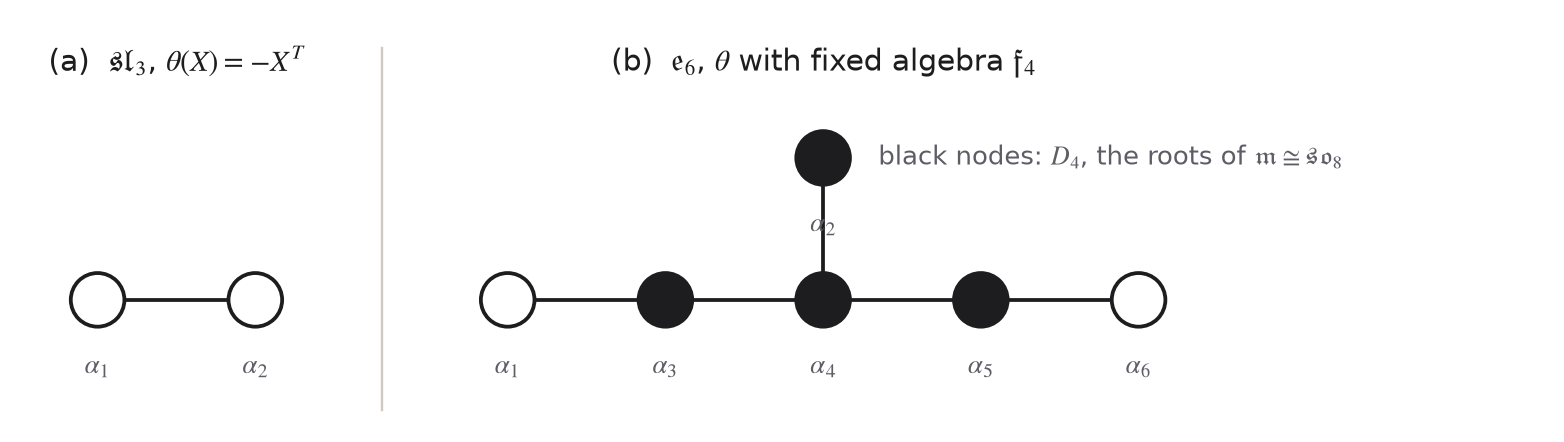
This is type EIV in Cartan's list; the diagram is tabulated in [Helgason, Ch. X, Table VI] (table and page not opened in the book). Folding the diagram of \(E_6\) by its symmetry gives \(F_4\), the fixed group; that is a different operation from reading off the restricted roots, which come from the white nodes.
Numerical checkDo the numbers come out on a computer?
The script assets/figures/check_albert.py builds \(\Lop{X}\) as \(27\times27\) matrices on the real form \(\mathfrak h_3(\Oc)\) and computes:
| quantity | computed |
|---|---|
| \(\dim\mathrm{span}\{[\Lop{S},\Lop{T}]\}\) | 52 |
| \(\dim(\mathrm{span}\{[\Lop{S},\Lop{T}]\}+\{\Lop{T}:T\in\Jo\})\) | 78 |
| eigenvalues of \(\mathrm{ad}(\iot H)\), \(h=(0.3,-1.1,0.8)\) | \(\pm0.5,\pm1.4,\pm1.9\) (each \(\times8\)), \(0\ (\times30)\) |
| \(\lVert[\Lop{S},\Lop{T}](U\jo V)-\ldots\rVert\), derivation defect | \(1\times10^{-14}\) |
A check on one random instance, not a proof; the proofs are above.