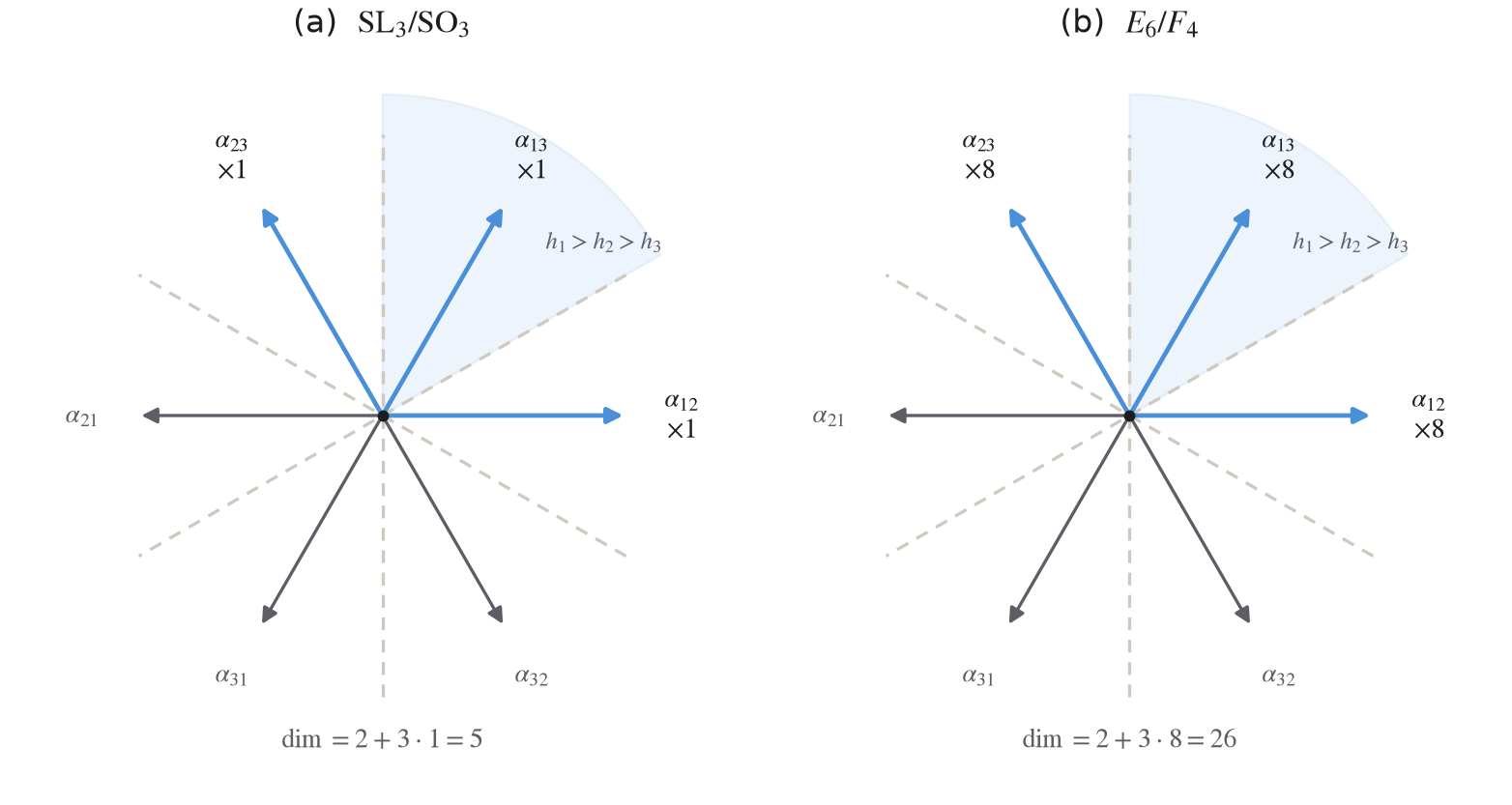
Roots of \(\SL_3/\SO_3\): the \(A_2\) walls
On the \(\SL_3/\SO_3\) page an ellipsoid could be turned in 3, 2 or 0 independent directions, depending on how many of its semi-axes are equal. This page explains that count with three lines in a plane, the walls of the roots. The same picture with 8 in place of 1 gives the 26 dimensions of \(\Esix/\Ffour\).
What this page is forWhat will we be able to compute at the end?
Two counts, for every diagonal shape \(H\) (defined in the next section):
\[\dim\{kSk^T:\ k\in\SO_3\}=\mult\cdot\#\{\text{walls not containing }H\},\qquad S=e^{2H},\] \[\dim\Pd{3}=\underbrace{2}_{\text{size}}+\underbrace{3\,\mult}_{\text{turning}}=5\qquad(\mult=1).\]The first explains the numbers 3, 2, 0 of the ellipsoid widget. The second is the formula that later gives \(2+3\cdot8=26\) for \(\Esix/\Ffour\). Both rest on one idea from the warm-up, where the size \(h\) and the rotation \(Z_{12}\) were linked by the number \(2h\), the one root.
The size directions \(H\)What is \(H\)?
Every point of \(\Pd{3}\) is a rotated diagonal matrix, \(S=k\,e^{2H}k^T\) with \(k\in\SO_3\) (ellipsoid lemma), where
\[H=\begin{pmatrix}h_1&0&0\\0&h_2&0\\0&0&h_3\end{pmatrix},\qquad h_1+h_2+h_3=0,\qquad e^{2H}=\begin{pmatrix}e^{2h_1}&0&0\\0&e^{2h_2}&0\\0&0&e^{2h_3}\end{pmatrix}.\]So \(H\) records the shape of the ellipsoid: its semi-axes are \(e^{h_1},e^{h_2},e^{h_3}\), and \(h_1+h_2+h_3=0\) says that the volume is \(\tfrac43\pi\). All such \(H\) form a plane,
\[\af=\{\diag(h_1,h_2,h_3):\ h_1+h_2+h_3=0\},\qquad \dim\af=2 .\]In the warm-up the same object was the line \(\{\diag(h,-h)\}\).
How the plane is drawn. The widget below uses the coordinates
\[u=\frac{h_1-h_2}{\sqrt2},\qquad v=\frac{h_1+h_2-2h_3}{\sqrt6},\]in which \(u^2+v^2=h_1^2+h_2^2+h_3^2\), so swapping two of the \(h_i\) is a reflection of the picture and the three walls meet at \(60^\circ\).
The Lie-algebra name. The tangent directions to \(\Xs{\R}\) at \(I\) are \(\pf=\{Y\in\slf_3(\C):Y^T=Y\}\) (involution section), and \(\af\subset\pf\) is its diagonal part. Two diagonal matrices commute, which is what the general definition asks for:
(Cartan subspace, rank) Definition
For a symmetric variety \(G/K\) with \(\gf=\kf\oplus\pf\), a Cartan subspace is a maximal abelian subspace \(\af\subset\pf\) consisting of semisimple elements. All Cartan subspaces are \(K\)-conjugate; their common dimension is the rank \(\rk(G/K)\).
What a root isHow does \(H\) act on the off-diagonal directions?
Commute \(H\) with any \(3\times3\) matrix \(Y=(y_{ij})\). Since \((HY)_{ij}=h_iy_{ij}\) and \((YH)_{ij}=y_{ij}h_j\),
\[[H,Y]=HY-YH=\begin{pmatrix}0&(h_1-h_2)\,y_{12}&(h_1-h_3)\,y_{13}\\(h_2-h_1)\,y_{21}&0&(h_2-h_3)\,y_{23}\\(h_3-h_1)\,y_{31}&(h_3-h_2)\,y_{32}&0\end{pmatrix}.\]The diagonal is killed, and the entry in position \((i,j)\) is multiplied by \(h_i-h_j\). These multipliers, as functions of \(H\), are the roots:
For the symmetric and antisymmetric matrices in the \((i,j)\) position, \(Y_{ij}=E_{ij}+E_{ji}\in\pf\) and \(Z_{ij}=E_{ij}-E_{ji}\in\kf\), this reads as in the warm-up:
\[[H,Y_{ij}]=\alpha_{ij}(H)\,Z_{ij},\qquad [H,Z_{ij}]=\alpha_{ij}(H)\,Y_{ij}.\](what a root measures) Proved here
Let \(k_t=\exp(tZ_{ij})\), the rotation by angle \(t\) in the \((i,j)\)-plane. Then
\[\frac{d}{dt}\Big|_{t=0}\,k_t\,e^{2H}k_t^T=\bigl(e^{2h_j}-e^{2h_i}\bigr)\,Y_{ij},\]which is zero if and only if \(\alpha_{ij}(H)=0\). So the rotation in the \((i,j)\)-plane moves the ellipsoid exactly when the root \(\alpha_{ij}\) is nonzero on its shape.
Proof
- \(k_t^T=\exp(tZ_{ij}^T)=\exp(-tZ_{ij})\), so the derivative is \(Z_{ij}D-DZ_{ij}\) with \(D=e^{2H}=\diag(d_1,d_2,d_3)\).
- By the matrix formula above (with \(D\) in place of \(H\)), \([Z_{ij},D]=-[D,Z_{ij}]\) has entry \(-(d_i-d_j)\) at \((i,j)\) and \(-(d_j-d_i)\cdot(-1)=-(d_i-d_j)\) at \((j,i)\), i.e. it is \((d_j-d_i)Y_{ij}\).
- \(d_j-d_i=e^{2h_j}-e^{2h_i}=0\iff h_i=h_j\iff\alpha_{ij}(H)=0\), since \(x\mapsto e^{2x}\) is injective on \(\R\).
The general definition, used for \(\Esix/\Ffour\):
(restricted roots, multiplicity) Definition
For \(\alpha\in\af^*\) put \(\gf_\alpha=\{Y\in\gf:[H,Y]=\alpha(H)Y\ \text{for all}\ H\in\af\}\). The restricted roots are the \(\alpha\neq0\) with \(\gf_\alpha\neq0\); the multiplicity of \(\alpha\) is \(\mult_\alpha=\dim\gf_\alpha\).
“Restricted” because \(H\) runs only over \(\af\subset\pf\), not over a Cartan subalgebra of all of \(\gf\). For \(\SL_3/\SO_3\) nothing is lost, since the diagonal matrices are already a Cartan subalgebra of \(\slf_3\); for \(\Esix/\Ffour\) the plane \(\af\) is smaller than a Cartan subalgebra of \(\esix\) (dimension 2 against 6), and that is where the multiplicity 8 comes from.
(restricted roots of \(\SL_3/\SO_3\)) Proved here
The restricted roots of \(\Xs{\R}\) are \(\pm\alpha_{12},\pm\alpha_{23},\pm\alpha_{13}\), each of multiplicity 1. They form the root system \(A_2\).
Proof
\(\slf_3=\af\oplus\bigoplus_{i\neq j}\C E_{ij}\) and \([H,E_{ij}]=(h_i-h_j)E_{ij}\) by the matrix formula. Distinct pairs \((i,j)\) give distinct functionals on \(\af\), so \(\gf_{\alpha_{ij}}=\C E_{ij}\), of dimension 1, and \(\gf_0=\af\). The six vectors \(\pm(e_i-e_j)\) in the plane \(\{\sum h_i=0\}\) all have the same length and make angles that are multiples of \(60^\circ\): the root system \(A_2\).
Walls, for a first meetingWhat is a wall, and why does landing on one matter?
The wall of the root \(\alpha_{ij}\) is the line where it vanishes:
\[\{H\in\af:\ \alpha_{ij}(H)=0\}=\{H:\ h_i=h_j\}.\]By , \(H\) lies on the wall of \(\alpha_{ij}\) exactly when semi-axes \(i\) and \(j\) of the ellipsoid are equal, and then turning in the \((i,j)\)-plane does nothing. Each wall \(H\) avoids leaves one direction of turning (\(\mult\) directions in general):
| \(H\) lies on | example \(H\) | ellipsoid | turning dimensions |
|---|---|---|---|
| no wall | \(\diag(1,0,-1)\) | three different axes | \(3\) |
| one wall, \(h_1=h_2\) | \(\diag(\tfrac12,\tfrac12,-1)\) | a spheroid | \(2\) |
| all three walls | \(0\) | the ball | \(0\) |
\(H\) cannot lie on exactly two walls: \(h_1=h_2\) and \(h_2=h_3\) force \(h_1=h_3\). In the warm-up there was a single wall, the point \(h=0\) of the line, where the orange circle shrank to a point.
The three walls are three lines through \(0\) that cut the plane into six sectors, the chambers, one for each ordering of \(h_1,h_2,h_3\) (six chambers).
Microworld: walls and chambersWhat changes when \(H\) lands on a wall?
The multiplicity buttons anticipate the next part of the story: \(\mult=8\) is \(\Esix/\Ffour\), proved on the Proposition page; the other values are the A₂ row.
Six chambersWhy do the two reflection buttons reach every chamber?
The reflection in the wall \(\alpha_{ij}=0\) swaps \(h_i\) and \(h_j\). The Weyl group \(\Wey\) generated by these reflections is the symmetric group \(S_3\).
(chambers) Proved here
The complement of the three walls in \(\af\cap\R^3\) has six components, one for each strict ordering \(h_{\sigma(1)}>h_{\sigma(2)}>h_{\sigma(3)}\), and \(\Wey=S_3\) permutes them simply transitively.
Proof
A point lies on no wall iff \(h_1,h_2,h_3\) are distinct, i.e. strictly ordered by a unique \(\sigma\in S_3\); each ordering is a convex cone. Permuting coordinates by \(\tau\) sends the cone of \(\sigma\) to the cone of \(\tau\sigma\), and \(\tau\sigma=\sigma\) only for \(\tau=\Id\).
Counting dimensionsWhere do the 5 dimensions of \(\pf\) and the 3 of \(\kf\) come from?
\(\theta\) acts by \(-1\) on \(\af\), so it swaps \(\gf_\alpha\) and \(\gf_{-\alpha}\). Hence \(\gf_\alpha\oplus\gf_{-\alpha}=\kf_\alpha\oplus\pf_\alpha\) with \(\kf_\alpha\), \(\pf_\alpha\) both of dimension \(\mult_\alpha\) (here \(\pf_{\alpha_{ij}}=\C Y_{ij}\)). Writing \(\mf=Z_\kf(\af)\):
\[\dim\pf=\dim\af+\sum_{\alpha>0}\mult_\alpha=2+3\cdot1=5,\qquad \dim\kf=\dim\mf+\sum_{\alpha>0}\mult_\alpha=0+3=3 .\]The same two lines, with \(\mult=8\) and \(\dim\mf=28\), will give \(26\) and \(52\) for \(\Esix/\Ffour\).
Where the octonions enterWhat in this picture can change, if the walls cannot?
The root vectors \(Y_{ij}\) sit in the off-diagonal positions of a symmetric matrix, one real (later complex) number per position. If each off-diagonal position held an element of a larger algebra \(\K\), each wall would carry \(\dim_\R\K\) directions instead of one, and the plane of walls would be the same. That is the exceptional lift, with \(\K=\Oc\) and \(\dim_\R\Oc=8\).