Multiagent with verifier
Multiagent with verifier: two architectures
A verifier checks another agent's mathematics and never writes any. It sits either after a round or beside each solver.
Architecture
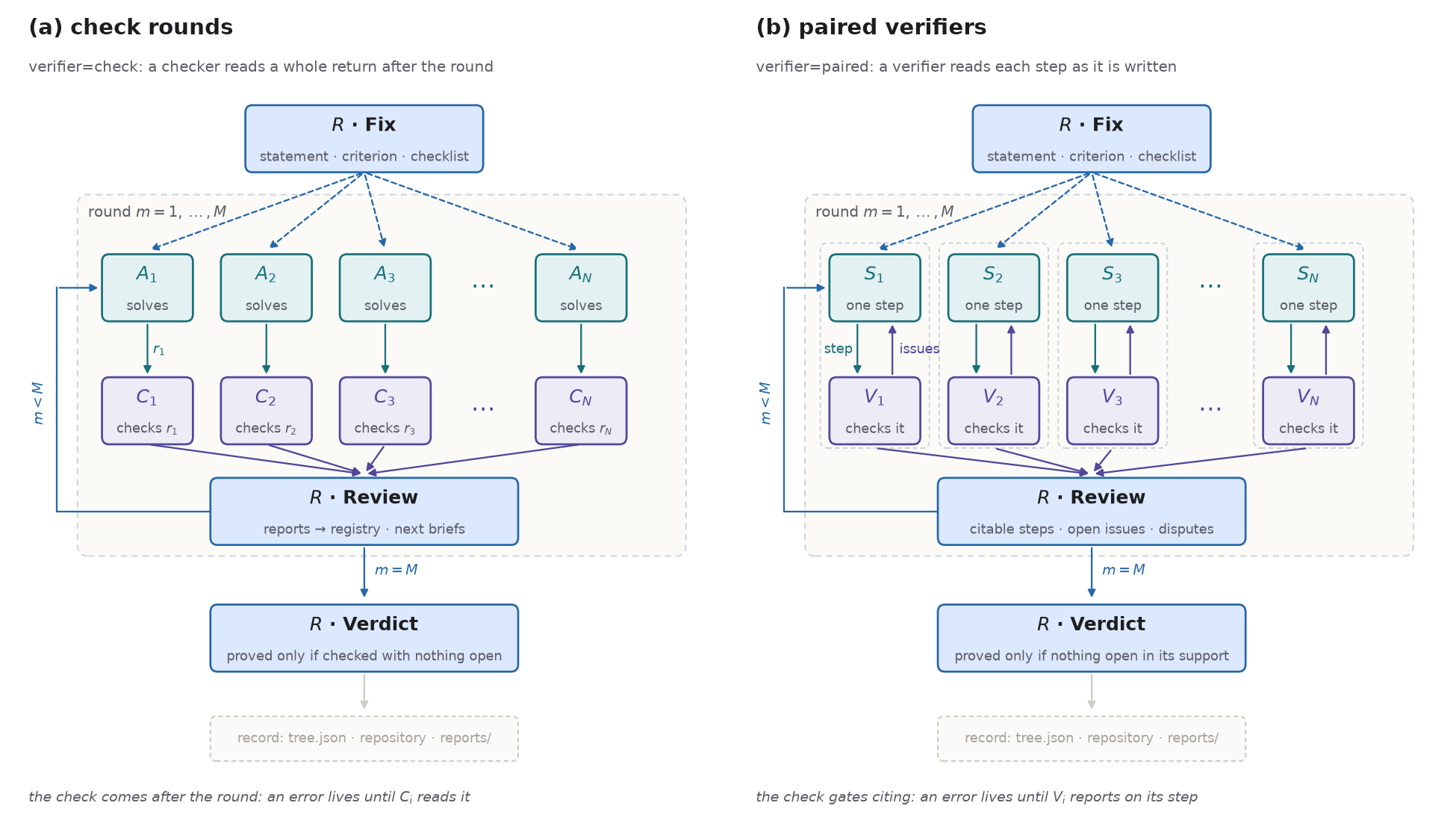
| (a) check rounds | (b) paired verifiers | |
|---|---|---|
| checks | a whole return, after the round | each step, as it is written |
| checker | \(C_i\), assigned by \(R\) to a return | \(V_i\), fixed beside \(S_i\) |
| an error lives until | the round ends | \(V_i\) reports on its step |
| citing an unchecked step | allowed inside the round | blocked |
| agents per round | \(N\) solvers + \(N\) checkers | \(N\) pairs |
| option | verifier=check | verifier=paired |
| design | Skill changes | Paired verifiers |
Both: an independent check
(independent check)
A verifier \(X\) of a proof or step \(P\) (\(X=C_i\) or \(V_i\)) satisfies
$$X\ne\lane(P),\qquad \text{brief}(X)=\big(P\ \text{verbatim},\ \text{checklist}\big);$$it sees neither \(R\)'s opinion of \(P\) nor another check of \(P\).
(a) is cheaper and reads a proof whole; (b) catches an error before later steps cite it: in the worked example 10 of 15 errors were found only after the run (latency). What one verifier should check: Verifying agent.