Multiagent with verifier · verifier=paired
Every solver with a weak verifier
The verifier=paired option of /solve-maths (made): root \(R\) plus \(N\le 4\) pairs \((S_i,V_i)\). The verifier \(V_i\) does not certify a step: it runs named checks and reports issues anyone can check. Only issues block; an approval certifies nothing.
Why: errors stayed in the record for hours
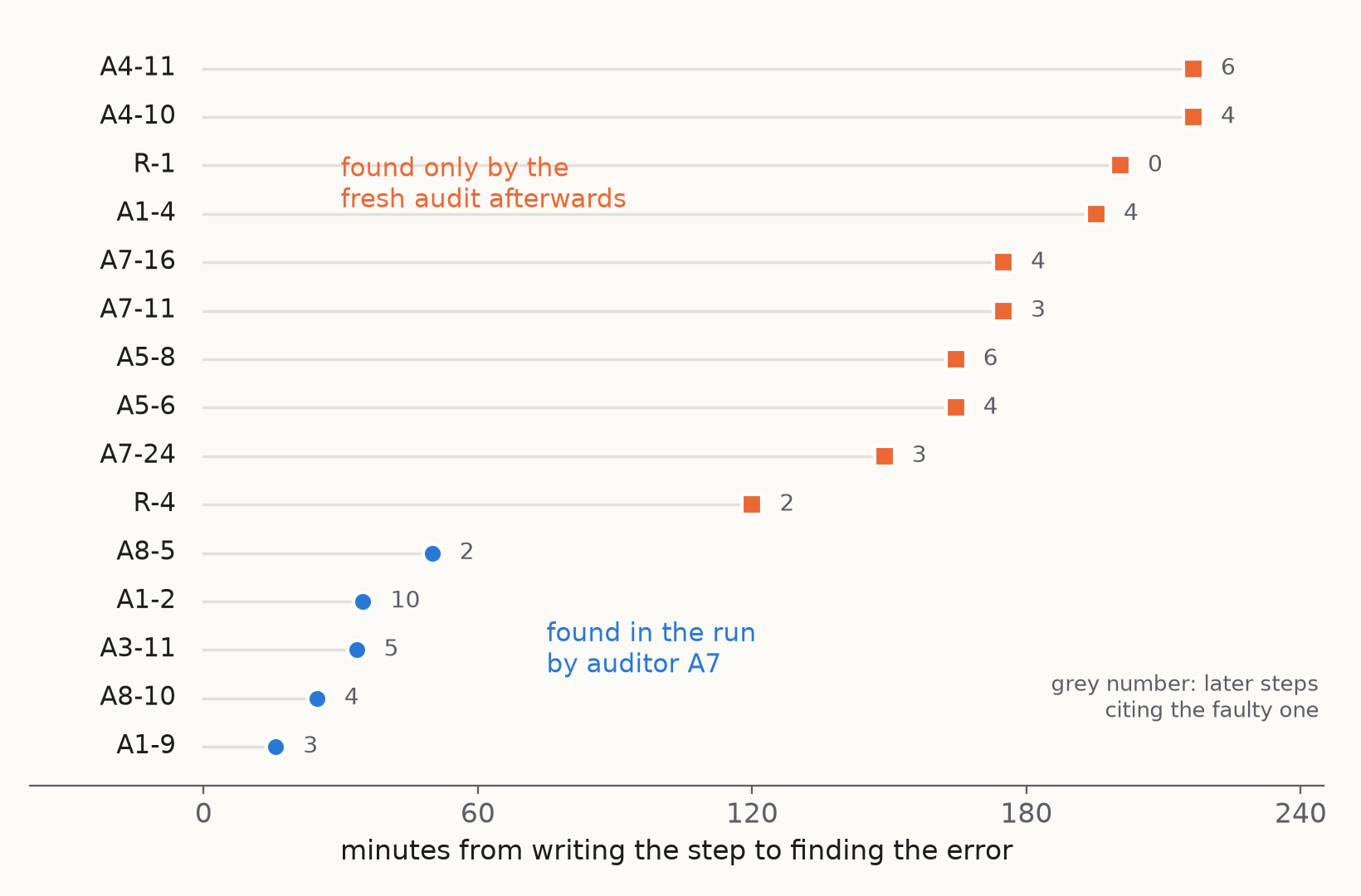
| found | errors |
|---|---|
| inside the run, by auditor A7 (median 33 min after writing) | 5 |
| only after the run, by fresh reviewers (median 175 min) | 10 |
Can a verifier grade a research step?
Not as “correct”. Without an answer key, an LLM's approval is weak evidence:
| source | setting | result |
|---|---|---|
| [Mahdavi et al., Table 3] | olympiad proofs | o1 labels 31 % of correct and 39 % of fallacious solutions “correct” |
| [Ma et al., Table 1] | olympiad proofs, 0–7 scale | o3: error 0.96 with a reference, 1.68 without, biased +0.92 upward |
| [Pandit et al., Fig. 4] | step-level, frontier maths | weaker verifiers fail by calling every step correct |
| [Feng, Trinh et al., Table 6] | Erdős problems | 212 answers passed the verifier; of 200 decided by experts, 31.5 % correct, 6.5 % meaningfully |
| worked example | Satake, two levels | in-run auditor found 5 of 15 errors; 3 more were in its own steps |
But a reported issue with a location and a reason is checkable in one step, and checking an issue is easier than finding one [Shao et al., §2.1.2]. So the verifier's job is reversed:
$$\underbrace{V(s)\in\{\text{correct},\text{minor},\text{error}\}}_{\text{strict: certify}}\qquad\longrightarrow\qquad \underbrace{V(s)=\big(K(s),\,I(s)\big)}_{\text{weak: checks run, issues found}}$$What to check: the errors we had
| check | \(V_i\) does | evidence it leaves | errors |
|---|---|---|---|
| scope | matches every cited result's hypotheses and setting (field, characteristic, (A1)–(A5)) to the step's | quoted hypothesis + result number | 7 |
| compute | evaluates the claim in the smallest case: \(q=2,3\); \(\mathrm{GL}_4\); \(m=2\) | a script | 6 |
| depend | checks that no parent has an open issue | parent ids | 1 |
| logic | re-derives the inference; looks for circularity | the re-derivation | 1 |
scope: A3-11, A7-16, A5-8, A7-24, A8-10, R-1, R-4 · compute: A4-10, A1-4, A5-6, A1-2, A8-5, A7-11 · depend: A1-9 · logic: A4-11. “In scope” is not “would have been caught”: that is the test.
Result: 14 of 15 errors fall under checks that leave mechanical evidence; only one needed reading the logic.
The report and the gate
(verifier report)
$$V_i(s)=\big(K(s),\,I(s)\big),\qquad K(s)\subseteq\{\text{scope},\text{compute},\text{depend},\text{logic}\},\qquad \iota=(\mathrm{sev},\ \mathrm{loc},\ \mathrm{reason},\ \mathrm{evidence})\in I(s),$$\(\mathrm{sev}(\iota)\in\{\text{critical},\text{gap}\}\): a critical issue breaks the step; for a gap the verifier assumes the claim and continues [Huang & Yang, §2.3]. A step too large to check gets the gap “split”.
(life of an issue)
$$\text{open}\ \longrightarrow\ \begin{cases}\text{resolved} & S_i \text{ repairs } s,\ V_i \text{ re-checks},\\[2pt] \text{dismissed} & S_i \text{ disputes},\ V_j\ (j\ne i) \text{ finds the issue not real}.\end{cases}$$\(\open(s)\) = the open issues of \(s\); \(\open_{\mathrm{crit}}(s)\) the critical ones.
(gate)
$$\begin{aligned} &\textbf{cite: } && s\to s'\ \Rightarrow\ t\big(V(s)\big)\le t(s')\ \text{and}\ \open_{\mathrm{crit}}(s)=\varnothing,\\ &\textbf{carry: } && \text{the gaps of } s \text{ are listed on every } s' \text{ with } s\in\supp(s'),\\ &\textbf{verdict: } && \st(v^\ast)=\text{proved}\ \Rightarrow\ \open(u)=\varnothing\ \ \forall\,u\in\supp(v^\ast);\\ & && \text{otherwise } \st(v^\ast)=\text{partial, with } \textstyle\bigcup_{u}\open(u) \text{ as its obligations.} \end{aligned}$$The verifier can block a step (with a reason) or lower a status; it never raises one. A critical error lives at most \(t(V(s))-t(s)\), not until the run's end ().
Architecture
Flow
Problem + references
├── Fix          statement, setting, completion criterion, checklist
├── Portfolio    N ≤ 4 approaches → pairs (S_i, V_i)    2N ≤ 9 agents
├── Round 1      in each pair, in parallel:
│     S_i writes step s ──► V_i: scope → depend → compute → logic ──► report
│     critical issue? S_i repairs (V_i re-checks) or disputes (V_j decides)
├── Registry     R lists citable steps and open gaps; check_invariants.py: I1–I8
├── Rounds 2…M   update briefs: repairs, redirects; team=same keeps the pairs
├── Verdict      proved / partial with obligations
└── Record       as /solve-maths, plus every report
Who does what
| role | sees | does | never |
|---|---|---|---|
| solver \(S_i\) | its brief; its reports | writes one inference per step, each citation with result number and quoted hypotheses | cites a step with an open critical issue |
| verifier \(V_i\) | the setting; one step with its parents' statements and the sources | runs the four checks, cheapest first; reports issues with evidence | certifies, repairs, or sees the solver's notes |
| root \(R\) | steps, reports, script output | registry, dispute routing, verdict | raises a status a report lowered |
check_invariants.py | the record | tests I1–I8 | judges the mathematics |
What a pair exchanges
Step · S → V
{"id": "S2-4", "t": "…Z",
 "statement": "…",
 "parents": [{"id": "S2-1",
   "statement": "…"}],
 "cites": [{"src": "…, Prop. 41",
   "hyp": "G split, p odd"}],
"body": "one inference"}Report · V → S, R
{"step": "S2-4", "t": "…Z",
 "ran": ["scope", "depend",
         "compute"],
 "issues": [{"sev": "critical",
   "loc": "line 2",
   "reason": "Prop. 41 needs
              p odd; here p = 2",
"evidence": "quote, p. 12"}]}Meta-check · Vj → R
{"issue": "S2-4#1",
 "real": true,
 "reason": "p = 2 allowed
   by the Fix's setting"}
Invariants the pairs add
I1–I6 are defined on the audit page.
$$\textbf{I7 gate: }\ t(s)\le t\big(V(s)\big)\le \min_{s\to c}\, t(c),\qquad \textbf{I8 evidence: }\ \forall\,\iota\in I(s)\ \forall\,k\in K(s):\ \text{a quote, script or id is attached}.$$Budget
$$\#\text{agents}=2N\cdot\begin{cases}1 & \texttt{team=same}\\ M & \texttt{team=new}\end{cases}\ \le 9\ \Rightarrow\ N\le 4,$$the budget of every /solve-maths option (run); cost per pair \(C_S+C_V\), with \(C_V<C_S\) when the logic check is spent only where the cheaper checks leave doubt.
Design choices
- Report, not grade. Without a key, LLM verdicts on proofs are lenient or near random (); an issue with a location can be checked by anyone [Huang & Yang].
- Checks from our errors. Scope and compute cover 13 of 15 (); misquoted results are the subtle failure of research agents with search [Feng, Trinh et al., §2.3]; debate works only with verified quotes [Khan et al., §2.2].
- Meta-check disputes. Verifiers trained on scores alone invent issues; checking an issue is easier [Shao et al., §2.1.2]; LLM critics trade recall for hallucinated bugs [McAleese et al., §3.4]. A false critical costs one meta-check, not a lost step.
- Small steps. A weak verifier is meaningful when the prover writes checkably [Kirchner et al., Anil et al.]; a dispute narrows to one step [Irving et al., §2.2].
- Depth, not votes. On step-level checking, longer reasoning helps and majority voting does not [Pandit et al., §4.4]; vary the strategy across \(V_1,\dots,V_4\) instead [MAV, Table 4].
- Process by script. The per-unit auditor only checked invariants of the record, so
check_invariants.pydoes it; \(N\) falls from 13 to 9. - Harness clock. \(t(s)\) is the harness's timestamp, so I3 and I7 can be enforced [Lamport].
- A filter, not a certifier. on Erdős problems the verifier pre-filtered for human review [Feng et al.].
Test before use
$$\mathrm{recall}_c(V)=\frac{\#\{\text{errors in scope of check } c \text{ that } V \text{ reports critical}\}}{\#\{\text{errors in scope of } c\}},\qquad \mathrm{false\ critical}(V)=\frac{\#\{\text{correct steps reported critical}\}}{\#\{\text{correct steps shown}\}}$$on the 15 errors of and as many steps graded correct (verifying agent).
Files the option would add
.claude/skills/solve-maths/        (mirrored in .agents/skills/)
  SKILL.md                 verifier=paired: pairs → gate → verdict
  references/
    agent-brief.md         + one inference per step, quoted hypotheses for every citation
    verifier-brief.md      four checks, cheapest first · report schema      (new)
  scripts/
    check_invariants.py    I1–I8 (new; I7–I8 under paired)
Status: made, 29 October 2026 (Skill changes); not yet run. The skill's check_invariants.py reads tree.json; the older copy here reads data.json.