The Iwahori–Matsumoto basis of the affine Hecke algebra
The algebra of functions on the double cosets of an Iwahori subgroup has a basis indexed by the extended affine Weyl group, and its whole multiplication table follows from one quadratic relation and the word combinatorics of that group. These pages define the objects, prove the statement by counting cosets, and draw everything for $\SL_2$ on a tree.
Setup
Fix a prime power $q$ and let $F=\Fq((t))$ with integers $\cO=\Fq[[t]]$. Let $G$ be a split reductive group over $\cO$ with Borel subgroup $B$ and maximal torus $T$. Two compact open subgroups of $\GF$ and the group that indexes their double cosets:
$$K=G(\cO)\ \supset\ I=\ev^{-1}\big(B(\Fq)\big),$$ $$\Wt=N_G(T)(F)/T(\cO)=\Xs\rtimes W=\Waff\rtimes\Om,$$ $$\GF=\bigsqcup_{w\in\Wt}IwI .$$Here $\Waff$ is the Coxeter group generated by the simple affine reflections $\Saff$, $\len$ is its length function, and $\Om$ is the finite group of elements of length zero (Groups and the affine Weyl group). The quantity studied is the convolution product on
$$\cH=\Cc(I\backslash\GF/I),\qquad (f\ast g)(x)=\int_{\GF}f(y)\,g(y^{-1}x)\,dy,\qquad \vol(I)=1,$$in the basis of indicator functions (Hecke algebras of double cosets). The one parameter that varies is $q$, the size of the residue field: it multiplies every count of cosets, $|IwI/I|=q^{\len(w)}$, and ranges over prime powers.
The Concept
(the Iwahori–Matsumoto basis and presentation) [IM65, Thm 2.16, Prop 3.2, Prop 3.4, Thm 3.5, Prop 3.8] Proved here
Put $T_w=\one_{IwI}$ for $w\in\Wt$. Then $\{T_w\}$ is a basis of $\cH$ with unit $T_e=\one_I$, and for $s\in\Saff$, $\sigma\in\Om$, $w\in\Wt$:
Consequently $T_w=T_{s_{i_1}}\cdots T_{s_{i_r}}T_\sigma$ along a reduced expression $w=s_{i_1}\cdots s_{i_r}\sigma$, and $\cH$ is generated by the $T_s$ and $T_\sigma$ subject only to $T_s^2=q\,T_e+(q-1)\,T_s$, the braid relations of $\Waff$, and $T_\sigma T_sT_\sigma^{-1}=T_{\sigma s\sigma^{-1}}$.
The question it answers: given that the double cosets of $I$ are indexed by $\Wt$, how does one multiply two of them? Answer: as in the group algebra of $\Wt$, except that a simple reflection squares to $q\cdot1+(q-1)\cdot$ itself. Full statement and proof: the Concept.
The easiest case, drawn
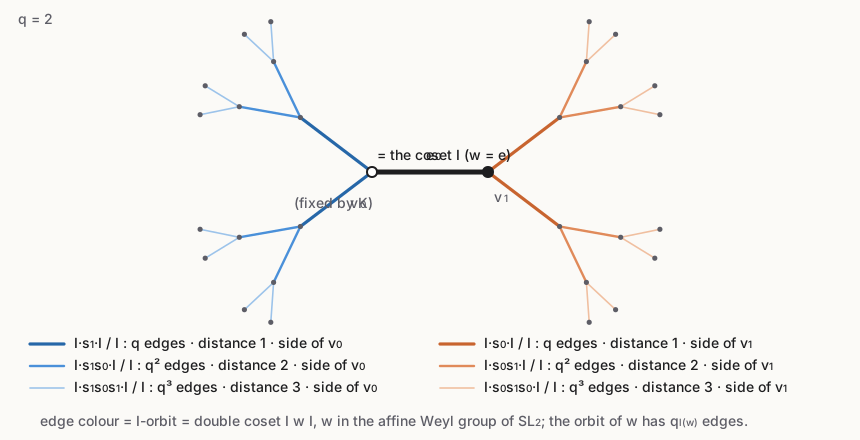
Each term of the Concept has a picture on the example pages:
- the double coset $IwI$ and the count $q^{\len(w)}$: the orbit widget on SL₂ I §3;
- the length $\len(w)$: walls and alcoves on the line, Groups, Figure 1;
- the quadratic relation $T_s^2=qT_e+(q-1)T_s$: two counts at one vertex, the widget on SL₂ II §2;
- the length-zero element $\sigma$: the reversal of the base edge, SL₂ III §2.
Why this site exists
The proof workspace on Iwahori generation compares, for a spherical variety, the part of the Iwahori module generated by the basic function with the whole module. Its group-case argument uses four consequences of the Concept: $\one_K=\sum_{w\in W}T_w$, $[K:I]=\sum_{w\in W}q^{\len(w)}$, the idempotent $\eK=\one_K/[K:I]$, and the sign character with $\eps(\one_K)=0$ (the Concept §5–6). The workspace's pages: Iwahori level, the criterion and the group case: why the spherical level generates and the Iwahori level does not.
Map of the pages
After reading, you can
- State the Concept with its three rules, and say which fact about double cosets each rule comes from (the Concept §3, §2).
- Compute any product $T_xT_y$ for $\SL_2$ by counting edges in the tree, and check it with the index character (SL₂ II §3).
- Prove $|IwI/I|=q^{\len(w)}$ from the product rules for double cosets, without a tree (the Concept, Step 3).
- Explain what changes when $\Om\neq1$: the oriented edges of $\PGL_2$, and the twisted tensor product $\C[\Om]\,\widetilde\otimes\,\Haff$ (SL₂ III).
- Write down $\one_K$, $\eK$ and $[K:I]$ in the basis, and show that the sign character kills $\one_K$ whenever $W\neq1$ (the Concept §6).
- Locate each cited number in Iwahori–Matsumoto and in Haines–Kottwitz–Prasad, and translate their conventions to these pages (source dictionaries, second dictionary).
Status
- Claim
- Proved here from five cited facts about double cosets (F1)–(F5), proved in [IM65] for Chevalley groups and checked by hand for $\SL_2$ and $\PGL_2$ (the Concept §4).
- Scope
- Proved (cited) For split reductive groups not of Chevalley type the facts (F1)–(F5) are used as known from Bruhat–Tits theory, as in [HKP10] (the Concept §8).
- In the repository
- Used by the proof workspace's classical pages [Draft], whose wording is matched in the Concept §7.
- References
- Checked on 2026-10-11: the two primary sources opened and every cited number read; context sources resolved through Crossref, with two location checks reused from 2026-10-07 and one entry marked unverified (References).
- Labels
- DefinitionProved (cited)Proved hereHeuristicOpen / gapContextQuestion