The running example: $\SL_2$ and its tree
For $\SL_2$ over $\Fq((t))$ the double cosets of the Iwahori subgroup are the orbits of $I$ on the edges of a tree. Every count in the Concept becomes a count of edges, and the parameter $q$ is the branching of the tree.
Why this case, and the model Definition
$\SL_2$ is the smallest case in which the affine Weyl group is infinite, and the only one whose building is a tree. It is also simply connected, so $\Om=1$ and the Hecke algebra is the affine Hecke algebra itself; Part III grows the model to $\PGL_2$, where $\Om=\Z/2$ appears.
(the running example $\SL_2(q)$)
Fix a prime power $q$. The model is $G=\SL_2$ over $F=\Fq((t))$ with
$$T=\Big\{\sm{a}{0}{0}{a^{-1}}\Big\},\qquad B=\Big\{\sm{a}{b}{0}{a^{-1}}\Big\},$$ $$K=\SL_2(\cO),\qquad I=\Big\{\sm{a}{b}{c}{d}\in\SL_2(\cO):\ c\in t\cO\Big\},$$ $$\dot s_1=\sm{0}{1}{-1}{0}\in K,\qquad \dot s_0=\sm{0}{-t^{-1}}{t}{0}\in\GF,$$ $$x_\alpha(b)=\sm{1}{b}{0}{1},\qquad x_{-\alpha}(c)=\sm{1}{0}{c}{1}.$$$\Wt=\Waff=\langle s_0,s_1\rangle$ is the infinite dihedral group, $\len$ is the number of letters of an alternating word, and $s_0s_1$ is the translation $t^{-\alpha^\vee}$ (Groups §4).
The parameter that drives this page is $q$: it is the number of neighbours of a vertex minus one, and it is the base of every count $q^{\len(w)}$.
Check: $\dot s_0$ represents the reflection in the wall $y=-1$
$\dot s_0=\sm{t^{-1}}{0}{0}{t}\dot s_1=t^{-\alpha^\vee}\dot s_1$ in the notation $\mu\mapsto t^{\mu}$. In the coordinate $y$ of Groups §4, $t^{-\alpha^\vee}$ translates by $-2$ and $s_1$ is $y\mapsto-y$, so $s_0$ acts by $y\mapsto-y-2$: the reflection in $y=-1$, the second wall of $A_0=(-1,0)$. This is the representative that fixes the vertex $v_1$ of §2 (), as a reflection in a wall of the alcove of $I$ must. Iwahori–Matsumoto take $I$ lower triangular modulo $t$, so their representative is the transpose [IM65, §2.2]; see the dictionary.
How the literature pictures it: the tree Proved (cited)
(the Bruhat–Tits tree) [Ser80, Ch. II, §1.1]
A lattice is a free $\cO$-submodule $L\subset F^2$ of rank $2$. The tree $\Tree$ has
$$\text{vertices: classes }[L]=\{aL:a\in F^\times\},\qquad \text{edges: }\{[L],[L']\}\ \text{ with }\ tL\subsetneq L'\subsetneq L .$$Base vertex and base edge: $v_0=[\cO^2]$, $v_1=[\cO e_1\oplus t\cO e_2]$, $e_0=\{v_0,v_1\}$.
(the tree and the groups) [Ser80, Ch. II, §1.1] Proved here
Proof
- The neighbours of $[L]$ are the $[L']$ with $tL\subset L'\subset L$ and $L/L'\simeq\Fq$: they correspond to the lines in $L/tL\simeq\Fq^2$, of which there are $q+1$. That the graph is connected and has no cycles is [Ser80, Ch. II, §1.1, Thm 1]; it is not used on this site beyond the local count.
- $g\in\SL_2(F)$ stabilizes $[\cO^2]$ iff $g\cO^2=a\cO^2$ for some $a\in F^\times$; comparing determinants gives $a\in\cO^\times$, so $g\in\SL_2(\cO)=K$. For $L_1=\cO e_1\oplus t\cO e_2$: $g=\sm abcd\in K$ stabilizes $L_1$ iff $ge_1=ae_1+ce_2\in L_1$ and $g(te_2)=tbe_1+tde_2\in L_1$, that is iff $c\in t\cO$. So $K\cap\Stab(v_1)=I$.
- $K$ acts on the neighbours of $v_0$ through $\ev:K\to\SL_2(\Fq)$ acting on the lines of $\Fq^2$, transitively. Every vertex of $\Tree$ is $[L]$ with $L\subset\cO^2$ of some index, and $\SL_2(F)$ is transitive on vertices of each of the two types (index $t^{\text{even}}$ or $t^{\text{odd}}$), so every edge is moved to an edge at $v_0$ and then to $e_0$ by (ii).
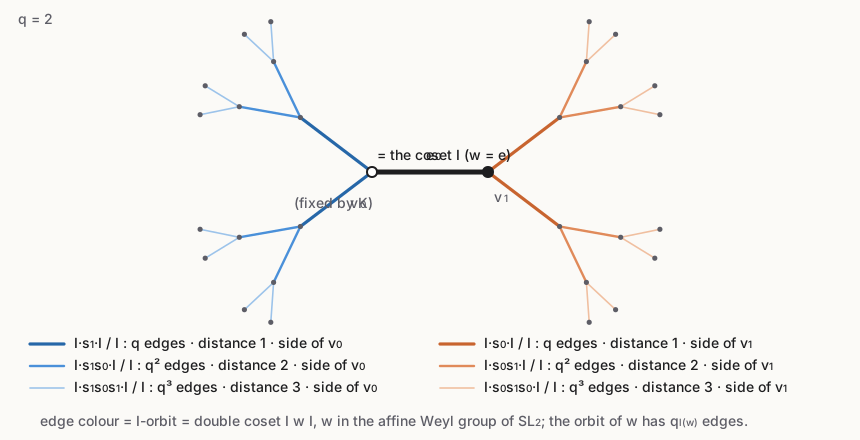
The mechanism: $I$-orbits on edges are the double cosets Proved here
Two edges $c=ge_0$ and $c'=g'e_0$ have a relative position $\delta(c,c')\in\Wt$: the element $w$ with $g^{-1}g'\in IwI$. It is well defined because changing $g$ or $g'$ within their $I$-cosets changes $g^{-1}g'$ within its double coset, and it is $\GF$-invariant. The double coset $IwI/I$ is the set of edges at relative position $w$ from $e_0$.
(orbits and the count $q^{\len(w)}$) Proved here
Let $w=s_{i_1}s_{i_2}\cdots s_{i_r}$ be the alternating word of $w\in\Waff$, so $r=\len(w)$. Then $IwI/I$ is the set of edges $c$ for which the unique path of edges $e_0=c_0,c_1,\dots,c_r=c$ in $\Tree$ has $c_{k-1},c_k$ sharing a vertex of type $i_k$ (type $1$ means the type of $v_0$, type $0$ that of $v_1$). Consequently
Proof
- The $s_1$-neighbours of $e_0$. By §4, $Is_1I=\bigsqcup_{\nu\in\Fq}x_\alpha(\nu)\dot s_1I$. Each $x_\alpha(\nu)\dot s_1$ lies in $K$, so fixes $v_0$, and sends $v_1$ to the vertex of the line $\Fq(\nu e_1+e_2)$ in $\Fq^2$: the $q$ lines other than $\Fq e_1$. So $Is_1I/I$ is the set of $q$ edges at $v_0$ other than $e_0$. Likewise $Is_0I/I=\bigsqcup_\nu x_{-\alpha}(t\nu)\dot s_0I$ is the set of the $q$ edges at $v_1$ other than $e_0$, since $\dot s_0$ and $x_{-\alpha}(t\nu)$ fix $v_1$ and $\dot s_0$ moves $v_0$.
- Induction on $r$ using $Is_{i_1}I\cdot Iw'I=IwI$ for $w'=s_{i_2}\cdots s_{i_r}$ (Groups §6(a), checked for $\SL_2$ in §4). An edge of $IwI/I$ is $u\,c'$ with $u\in Is_{i_1}I$ and $c'\in Iw'I/I$: by induction $c'$ is reached from $e_0$ by a path of type $(i_2,\dots,i_r)$ through a first vertex $v$ of type $i_2$, and $u$ fixes the vertex of $e_0$ of type $i_1$ and moves $e_0$ to a different edge there. Since $\Tree$ has no cycles, the path from $e_0$ to $uc'$ is $e_0,ue_0,uc_1',\dots$, of type $(i_1,i_2,\dots,i_r)$.
- Counting: from a vertex one can continue a path along $q$ edges other than the one arrived by, so there are $q^r$ paths of a given type of length $r$ starting at $e_0$, and distinct paths end at distinct edges because $\Tree$ is a tree.
This is the index formula of [IM65, Prop 3.2] read off the tree; the Concept proves it for every $G$ without a tree (the Concept §4).
Worked computation: the Iwahori factorization and coset representatives Proved here
(Iwahori factorization and the $q$ cosets) Proved here
Proof
- For $g=\sm abcd\in I$, $a\in\cO^\times$ because $ad-bc=1$ and $c\in t\cO$. Then $g=x_{-\alpha}(c/a)\sm{a}{0}{0}{a^{-1}}x_\alpha(b/a)$, as one checks by multiplying out, and the three factors are recovered from $g$. This is [IM65, Thm 2.5] for $\SL_2$.
- Conjugation: $\dot s_1^{-1}x_{-\alpha}(c)\dot s_1=x_\alpha(-c)$ and $\dot s_1^{-1}\sm a00{a^{-1}}\dot s_1\in T(\cO)$, so $I\dot s_1I=x_\alpha(\cO)\dot s_1I$ by (i). Two elements $x_\alpha(b)\dot s_1$, $x_\alpha(b')\dot s_1$ give the same coset iff $\dot s_1^{-1}x_\alpha(b'-b)\dot s_1=x_{-\alpha}(b-b')\in I$ iff $b'-b\in t\cO$. Hence $q$ cosets indexed by $\cO/t\cO=\Fq$. For $\dot s_0$: $\dot s_0^{-1}x_\alpha(b)\dot s_0=x_{-\alpha}(-t^2b)\in I$ for $b\in\cO$, so $I\dot s_0I=x_{-\alpha}(t\cO)\dot s_0I$, and $x_{-\alpha}(tc)\dot s_0I=x_{-\alpha}(tc')\dot s_0I$ iff $\dot s_0^{-1}x_{-\alpha}(t(c-c'))\dot s_0=x_{\alpha}(-t^{-1}(c-c'))\in I$ iff $c-c'\in t\cO$: again $q$ cosets.
- $Is_iI\cdot Is_iI$ contains $I$ (take $\dot s_i\dot s_i^{-1}$) and $Is_iI$ (take $\dot s_i\cdot\dot s_i^{-1}\dot s_i$), and it is a union of double cosets; it remains to show that it lies in $I\cup Is_iI$. For $i=1$: $x_\alpha(b)\dot s_1\,x_\alpha(b')\dot s_1=x_\alpha(b)\,x_{-\alpha}(-b')\,\dot s_1^{2}$ because $\dot s_1x_\alpha(b')\dot s_1^{-1}=x_{-\alpha}(-b')$, and $\dot s_1^2=-1\in I$. If $b'\in t\cO$ then $x_{-\alpha}(-b')\in I$ and the product lies in $I$. If $b'\in\cO^\times$, the rank-one identity below gives $x_{-\alpha}(-b')\in Is_1I$, so the product lies in $I\cdot Is_1I=Is_1I$. For $i=0$: $\dot s_0x_{-\alpha}(tc')\dot s_0^{-1}=x_\alpha(-t^{-1}c')$ and $\dot s_0^2=-1$; for $c'\in t\cO$ this is in $I$, and for $c'\in\cO^\times$ the transposed identity gives $x_\alpha(-t^{-1}c')\in Is_0I$.
How the rank-one identities are checked
For $u\in F^\times$, multiplying out gives
$$x_{-\alpha}(u)=x_\alpha(u^{-1})\,\sm{u^{-1}}{0}{0}{u}\,\dot s_1^{-1}\,x_\alpha(u^{-1}),\qquad x_\alpha(u)=x_{-\alpha}(u^{-1})\,\dot s_1\,\sm{u^{-1}}{0}{0}{u}\,x_{-\alpha}(u^{-1}),$$the second being the transpose of the first. For $u\in\cO^\times$ every factor of the first identity other than $\dot s_1^{-1}$ lies in $I$, so $x_{-\alpha}(u)\in Is_1I$. For $u=-t^{-1}c'$ with $c'\in\cO^\times$: $u^{-1}\in t\cO$, so $x_{-\alpha}(u^{-1})\in I$, and $\dot s_1\sm{u^{-1}}{0}{0}{u}=\sm{t^{-1}}{0}{0}{t}\dot s_1\sm{-c'^{-1}}{0}{0}{-c'}=\dot s_0\sm{-c'^{-1}}{0}{0}{-c'}$ with the last factor in $T(\cO)\subset I$; so $x_\alpha(u)\in Is_0I$.
Check of the first identity: $\sm{u^{-1}}{0}{0}{u}\dot s_1^{-1}=\sm{0}{-u^{-1}}{u}{0}$; then $x_\alpha(u^{-1})\sm{0}{-u^{-1}}{u}{0}=\sm{1}{-u^{-1}}{u}{0}$; then $\sm{1}{-u^{-1}}{u}{0}x_\alpha(u^{-1})=\sm{1}{0}{u}{1}=x_{-\alpha}(u)$.
Parts (ii) and (iii) are [IM65, Prop 2.6, Prop 2.8] for $\SL_2$; together with the tree they give the full Iwahori–Bruhat decomposition for $\SL_2$: every edge is reached from $e_0$ by a unique path, and the type of the path is the double coset.
How this page meets Part II Context
Part II (SL₂ II) multiplies the basis elements $T_w=\one_{IwI}$. Each structure constant is a count of edges in the tree, and the two inputs are already here: the $q$ edges of $Is_iI/I$ at each vertex of $e_0$ ((ii)) and the absence of cycles ().