/solve-maths-mem · design (proposal)
/solve-maths with a MemGPT memory
Same root, same ≤ 9 agents, same rounds. The only change: the root's state moves out of its context into three tiers it pages with five functions, after MemGPT [Packer et al.].
Why: what the root must remember
To continue a run, the root needs three things it wrote itself. In satake-two-levels:
registry · R-1, 02:56
central inertia     settled
  SL₂/SO₂ fails at both levels
convolution fibres  running
  GL₄/Sp₄ settled at both
trace dictionary    settled
  (SG) over F_q((t)) ⇒ sheaves
triangularity       running
restriction map r   settled
  E₆/F₄: r not onto
next action · R-1, 02:56
A7: audit every candidate
    proof (A2, A4, A6 now;
    A1, A3, A5 on return)
A8: attack the E₆/F₄ sheaf
    level by the fibre method
agents in use: 8 of 9verdict draft · R-4, 04:16
Every row agrees at both
levels except E₆/F₄:
  sheaves    C^Sat = C
             (A8, audited)
  functions  H_K·φ₀ ⊊ C_K
             (A6, under (A))
No case the other way round.Registry: every approach with its state and the step ids behind it. Next action: whom to launch or redirect, with what brief. Verdict draft: the answer as it would be stated now.
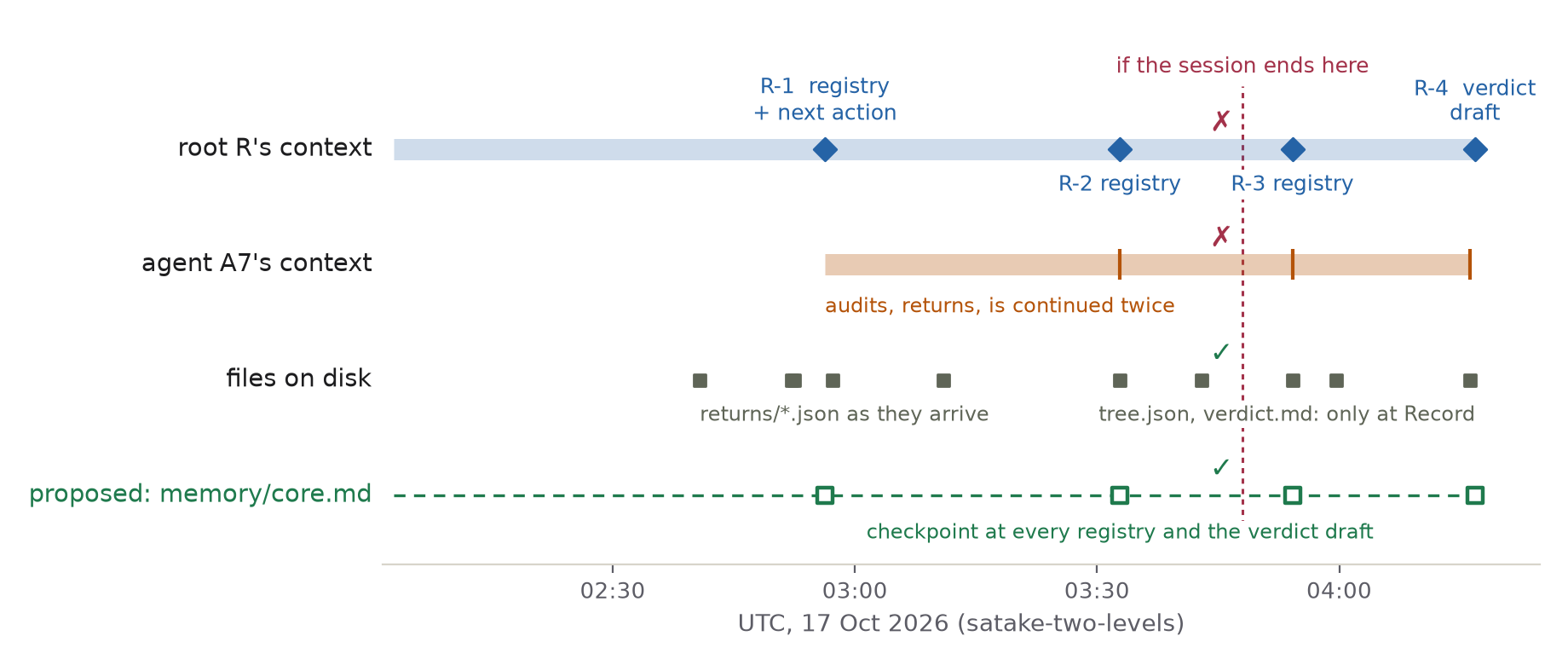
Across runs: iwahori-two-levels (18 Oct) received the satake-two-levels verdict and propositions as hand-picked references; the steps, dead ends and audited errors behind them were not searchable. Source of the figure: figures/make_mem_figures.py.
| design | memory |
|---|---|
| Hearsay-II [Erman et al.] | a blackboard every module reads and writes |
| Anthropic research system [Anthropic] | the lead agent saves its plan to an external memory before its context fills |
| MemGPT [Packer et al.] | tiers paged in and out of the context, like virtual memory |
| Generative agents [Park et al.] | a stream of every experience, summarized into reflections |
MemGPT in one definition
(memory hierarchy) [Packer et al., §2]
Context window of \(c_{\max}\) tokens; main context and external context:
$$\underbrace{\mathrm{sys}\ \oplus\ W\ \oplus\ Q}_{\text{main context},\ \le c_{\max}}\qquad\underbrace{\mathrm{Recall}\ \cup\ \mathrm{Archive}}_{\text{external, paged in by function calls}}$$\(\mathrm{sys}\) read-only instructions; \(W\) a fixed-size read/write text block, written only by function calls; \(Q\) a FIFO of messages whose head is a recursive summary; Recall holds every message, evicted ones included; Archive is a read/write store of texts.
(queue manager, function executor) [Packer et al., §2.2–2.4]
$$|\text{main}|\ge 0.7\,c_{\max}\ \Rightarrow\ \text{warning};\qquad |\text{main}|\ge c_{\max}\ \Rightarrow\ Q\ \xrightarrow{\ \text{evict}\ \approx 0.5\,c_{\max}\ }\ \mathrm{Recall},\quad \mathrm{head}(Q)\leftarrow\mathrm{summ}\big(\mathrm{head}(Q),\ \text{evicted}\big).$$0.7 and 1.0 are MemGPT's example values. Function calls are parsed and run; errors return to the model; retrieval is paginated. A call with request_heartbeat chains another step; otherwise the model yields until the next event.
Limit [§3.2.1]: MemGPT often stops paging before exhausting the retrieved results, and embedding search caps document QA.
From MemGPT to a solve run
MemGPT's Recall and Archive hold text. A solve run needs more: what was said, in order, and what is known, with the hypotheses it holds under. Let \(G=(V,E)\) be the run record (overview).
(Recall: a log) [Packer et al., §2.2; Kreps]
$$\mathrm{Recall}_t=(e_1,\dots,e_t),\qquad e_i=(\text{time}_i,\ \text{actor}_i,\ \text{kind}_i,\ \text{ids}_i\subseteq V,\ \text{text}_i),\qquad \text{time}_1\le\dots\le\text{time}_t,$$ $$\text{kind}\in\{\text{source},\ \text{brief},\ \text{return},\ \text{registry},\ \text{redirect},\ \text{audit},\ \text{correction},\ \text{checkpoint},\ \text{evict}\}.$$The only write is append, \(\mathrm{Recall}_{t+1}=\mathrm{Recall}_t\cdot e\); so \(\mathrm{Recall}_s\) is a prefix of \(\mathrm{Recall}_t\) for \(s\le t\), and a mistake is corrected by a later event. Briefs and returns are kept whole as files; their events point to them.
(Archive: a graph of steps) [Massot; Farmer et al.]
$$\mathrm{Archive}=(D,G,\mathrm{rec}),\qquad d=(\text{id},\ \text{origin: path or URL},\ \text{retrieved},\ \text{hash},\ \text{text})\ \ (d\in D),$$ $$ \mathrm{rec}(u)=\big(\text{statement},\ \mathrm{hyp}(u),\ \sigma(u),\ \text{parents},\ \text{proof},\ \st(u),\ \text{audit}\big)\quad(u\in V),$$ $$L\subseteq\textstyle\bigsqcup_r V_r,\qquad \text{kind}(u)\in\{\text{lemma},\ \text{dead end (with the missing statement)},\ \text{error (with the failed input)}\}.$$\(D\) is the read-only store of sources (the problem's files and webpages, snapshotted when fetched); a step that cites a source has it as a parent. Ids run/step are never reused. \(\mathrm{rec}(u)\) changes only after an event about \(u\) is appended to Recall (write-ahead [Mohan et al.]), so the Archive at time \(t\) is determined by \(\mathrm{Recall}_t\).
| tier | contains | written | read |
|---|---|---|---|
| \(\mathrm{sys}\) | SKILL.md; the Fix: statement, setting, criterion, checklist | once, at Fix | always in context |
| \(W\) | memory/core.md: phase, portfolio, open gaps, next, inputs; ids + one line | core_set, ≤ 2,000 tokens | always in context |
| \(Q\) | the root's messages, head = summary of the evicted ones | harness | in context until evicted |
| Recall | \(e_1,\dots,e_t\) in memory/events.jsonl; briefs/, returns/ verbatim | append only | recall_search, by id or keyword |
| Archive | sources \(D\) in sources/; \(\mathrm{rec}(u)\) for \(u\in V\) in tree.json; \(L\) in solve/library.jsonl | after an event; \(L\) at Record (M2) | archive_search, archive_get |
| design | entry | reuse is safe when |
|---|---|---|
| MemGPT [Packer et al., §2.2] | a text passage | not checked |
| LEGO-Prover [Wang et al., §3] | a lemma Isabelle verified; failed statements in a separate store | the prover checks the new proof |
| LeanDojo [Yang et al., §5] | a Lean declaration | it is accessible (earlier in the file, or imported) and Lean checks the use |
| little theories, MMT [Farmer et al.; Rabe & Kohlhase, §3] | a theorem in the smallest theory where it holds | a view (theory morphism) maps its axioms to theorems of the target |
| /solve-maths-mem | \(\mathrm{rec}(u)\) with \(\mathrm{hyp}(u)\) and \(\sigma(u)\) | an auditor checks \(\sigma_r\models\mathrm{hyp}(u)\) (M3) |
Recall is episodic memory and the Archive semantic memory [Sumers et al., §4.1]. Without a proof checker, M3 plays the role of the view. Exercises: Recall and Archive.
The problem's files and webpages
| item | tier | why |
|---|---|---|
| problem, setting, criterion | \(\mathrm{sys}\) (the Fix) | fixed for the run |
| each file or webpage, full text | Archive, \(d\in D\) | long, read on demand; a webpage can change, so the snapshot is kept |
| “fetched \(d_3\)” | Recall, kind source | when it entered, and from where |
| the parts in use now | \(W\): id + one line | e.g. “\(d_2\) = Sakellaridis §5, assumptions (A1)–(A5)” |
| a passage being read | \(Q\) | evicted like any message |
MemGPT does the same for document question answering: the documents sit in archival storage and are retrieved by function call [Packer et al., §3.2].
One of each, from satake-two-levels
\(\mathrm{sys}\) · the Fix (excerpt)
problem    For the symmetric spaces of Table 1,
           is there one where sheaves generate
           but functions do not, or the reverse?
setting    k = C; G connected reductive, θ an
           involution, G^θ connected, X = G/G^θ
criterion  decide every row of Table 1 at both
           levels, with proofs, or name the exact
           statement that would decide it
\(W\) · memory/core.md at 03:43
## phase       round 2 · 03:43Z
## portfolio   A1 literature · A2 SL₂/SO₂ · … · A6 E₆/F₄
## open gaps   E₆/F₄ at function level ← A5-9
## next        A7 (continued): audit A5-7, parents by id
## inputs      A2-4 audited · A5-7 not yet
\(Q\) · the root's last messages
[summary] six agents launched 02:06; A6, A2,
          A4 returned; R-1: A7, A8 launched
[02:57] return  A3: symplectic family, A3-11
[03:10] return  A1: classification, A1-9
[03:32] return  A7: audit, A7-19
[03:32] root    R-2: registry after the audit
Recall · events.jsonl
{"time":"03:42","actor":"A5","kind":"return",
 "ids":["A5-7","A5-8","A5-9"],"text":"returns/A5.json"}
{"time":"03:47","actor":"A7","kind":"return",
 "ids":["A7-24"],"text":"A5-8 holds; A5-9 stale"}
{"time":"06:16","actor":"audit","kind":"audit",
 "ids":["A5-8"],"text":"error: input (a) fails,
  pair model, residue char. 2"}
Archive · archive_search
archive_search("GL2m/Sp2m generation",
               setting="F_q((t))")
[{"id": "satake-two-levels/A5-7",
  "status": "proved", "audit": "minor",
  "setting": "every non-arch. local F",
  "statement": "(SG) for GL2m/Sp2m …"},
 {"id": "satake-two-levels/A5-9",
  "status": "blocked", "audit": "minor",
  "statement": "E6/F4 at function level:
                what is missing"}]   page 1 of 2
Archive · archive_get("…/A5-7")
statement  H_K·φ₀ = C_K for GL2m/Sp2m, every m ≥ 1
hyp        F non-archimedean local
parents    A5-5, A5-6
proof      1. orbits ↔ symplectic Smith form …
status     proved
audit      minor: every step re-derived
\(W\) holds ids and one line each; the proof comes back only with archive_get. Q's messages and the Recall times are from the run's record; the event file is the proposed format.
Architecture
Five functions
| call | returns / does | who |
|---|---|---|
core_set(field, text) | rewrites one field of \(W\); refused if \(|W|>2000\) tokens | root |
recall_search(q | id, page) | events, briefs, returns; 5 hits per page | root |
archive_search(q, setting, page) | steps of this run and the library: id, statement, status, grade, setting, run; 5 per page | root |
archive_get(id) | one full step: statement, hypotheses, proof, parents, audit | root; auditors, read-only |
archive_insert(id) | copies an audited step to solve/library.jsonl | root, at Record |
What memory may not do
Let \(G\) be the run record, \(L\) the library, \(\sigma(u)\) the setting and \(\mathrm{hyp}(u)\) the hypotheses of a step \(u\), and \(\sigma_r\) the setting of run \(r\).
(memory invariants M1–M4)
$$\begin{aligned} &\textbf{M1 cache: } && \st_{W}(u)=\st_{L}(u)=\st_{G}(u)\quad\text{for every } u \text{ named in } W \text{ or } L,\\ &\textbf{M2 admission: } && u\in L\ \Rightarrow\ \st(u)\in\{\text{proved},\text{refuted},\text{blocked}\}\ \text{and}\ u\ \text{passed the audit, or was repaired},\\ &\textbf{M3 reuse: } && u\in L\ \text{cited in run } r\ \Rightarrow\ \sigma_r\models\mathrm{hyp}(u),\ \text{checked by an auditor of } r,\\ &\textbf{M4 bound: } && |W|\le 2000\ \text{tokens};\ \text{checkpoint at } 0.7\,c_{\max}\ \text{and at registry, redirect, handoff}. \end{aligned}$$M1: a summary cannot promote a claim. M3 is the rule “no transfer by analogy” applied to the library: a lemma proved over \(F_q((t))\) is not an input over a \(p\)-adic field.
Flow
Problem + references
├── Recall       archive_search(statement, setting) over the library:
│                  audited lemmas · dead ends with the missing lemma · known errors
├── Fix          as /solve-maths; write W = core.md
├── Portfolio    as /solve-maths; briefs may cite library ids as inputs or dead ends
├── Round 1      root yields; each return → returns/, tree.json, events.jsonl
├── Registry     built by paging the archive, not from the context; checkpoint W
├── Round 2      auditors read parents by archive_get(id); M3 checked here
├── Verdict      checkpoint W
└── Record       as /solve-maths; archive_insert every step that satisfies M2
Design choices
- Root only. Agents keep their briefs; round 1 never sees the library, so independence (I1) is unchanged.
- Id before embedding. Lookup by step id and keyword over plain files; MemGPT's own limit is retrieval quality and early stopping [Packer et al., §3.2.1].
- Cache, not certificate. Status lives in
tree.json; memory copies it (M1). - Library across runs. Only audited steps enter (M2), each with its setting; reuse is checked like any cited theorem (M3).
- Checkpoint by events. Registry, redirect, handoff, and MemGPT's 70 % warning.
- Plan in memory. The lead agent saves its plan before its context fills [Anthropic]; here the plan is \(W\).
Test before use
| test | pass if |
|---|---|
resume: stop satake-two-levels after its registry R-1; restart from core.md | same next action; every blocked route found |
| reuse: Fix of iwahori-two-levels with the library of satake-two-levels | its audited inputs and dead ends returned, each with its setting |
status: mem.py check on the library | M1–M2 hold: 0 promoted statuses |
Files the skill would add
.claude/skills/solve-maths-mem/   (= .agents/skills/…)
  SKILL.md                = solve-maths + Recall step,
                            checkpoints, M1–M4
  references/
    memory-protocol.md    tiers · functions · core.md template
  scripts/
    mem.py                core_set · recall_search ·
                          archive_search · archive_get ·
                          archive_insert · check
  reuses solve-maths/references/, tree_md.py
<slug>/              as /solve-maths, plus
  memory/
    core.md           W, latest checkpoint
    events.jsonl      t · actor · action · ids · reason
solve/
  library.jsonl       one line per audited step:
                      run · id · statement · setting ·
                      hyp · status · grade · repair
Status: proposal. Not built; the installed /solve-maths and its schemas are unchanged.