What is \(\Esix/\Ffour\)?
\(\Esix/\Ffour\) is what \(\SL_3/\SO_3\), the symmetric \(3\times3\) matrices of determinant one, becomes when the matrix entries are octonions. These pages build it from the classical models \(\SL_2/\SO_2\) (ellipses) and \(\SL_3/\SO_3\) (ellipsoids), which you can manipulate by hand.
Setup
The \(\Oc\) form an 8-dimensional real algebra that is not associative. Over \(\C\), the Albert algebra is
\[\Jalg=\left\{X=\begin{pmatrix}a&z&\bar y\\ \bar z&b&x\\ y&\bar x&c\end{pmatrix}:\ a,b,c\in\C,\ x,y,z\in\Oc_\C\right\},\qquad\dim_\C\Jalg=27,\]with a cubic \(\det:\Jalg\to\C\) and identity \(\one\). Two groups act on it:
\[\Esix=\{g\in\GL(\Jalg):\det\circ g=\det\},\ \dim 78,\qquad \Ffour=\{g\in\Esix:g\one=\one\}=\Aut(\Jalg),\ \dim 52 .\]No parameter varies. There is no family \(E_n/F_n\), and no smaller case keeps the non-associativity, so these pages use instead the classical analogue \(\SL_3/\SO_3\) (real entries) and the finite list of four algebras \(\R,\C,\Ha,\Oc\), which places \(\Esix/\Ffour\) at the end of a row of four.
The Concept
Proved on the Proposition page
It is a of dimension 26 and rank 2, with of type \(A_2\), each of multiplicity 8, and it is .
The question it answers: how can a 78-dimensional exceptional group produce the same rank-two root picture as \(\SL_3/\SO_3\), and why are the dimensions \(26\) and \(5\)? Answer in one line: \(\dim=2+3\mult\), with \(\mult=8\) octonionic directions on each wall instead of 1.
One picture
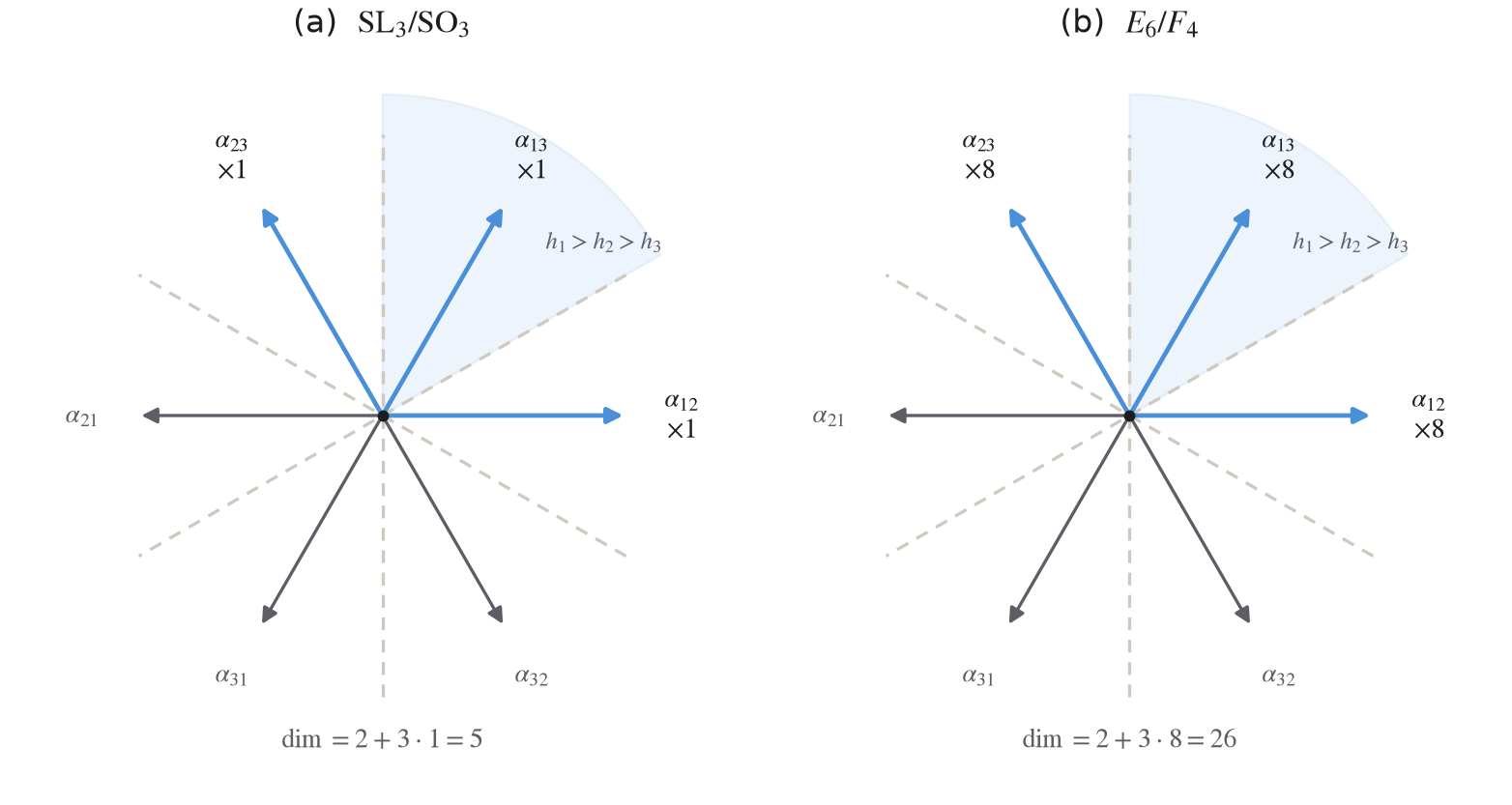
| \(\SL_3/\SO_3\) | \(\Esix/\Ffour\) | |
|---|---|---|
| ambient space | \(\mathrm{Sym}_3(\C)\), 6 | \(\Jalg\), 27 |
| \(\dim G\), \(\dim K\) | 8, 3 | 78, 52 |
| \(\dim G/K=2+3\mult\) | 5 | 26 |
| multiplicity \(\mult\) | 1 | 8 |
Map of the pages
- warm-up \(\SL_2/\SO_2\)
- ellipsoids \(\SL_3/\SO_3\)
- roots: \(A_2\) walls
- quaternions, octonions
- \(\Oc\) over \(\C\)
- Albert algebra \(\Jalg\)
- the \(A_2\) row
- the Proposition
- spherical
- timeline
- physics
- questions
Goals
Afterwards you can:
- draw \(\SL_2/\SO_2\) three ways (hyperboloid, disk, ellipses) and say which directions are size and which are angle;
- read \(\SL_3/\SO_3\) as ellipsoids of fixed volume, move a determinant-one symmetric matrix to \(I\), and explain why \(\SL_3/\SO_3\cong\Xs{\R}\);
- multiply octonion units on the Fano plane, and say what changes when the octonions get complex coefficients;
- say what the Albert algebra and its determinant are, and which maps lie in \(\Esix\) and in \(\Ffour\);
- derive the restricted roots of \(\Esix/\Ffour\) and explain why each multiplicity is 8;
- predict dimension, multiplicity and generic Borel stabilizer for the other members of the \(A_2\) row;
- prove that \(\Esix/\Ffour\) is spherical, and say what is left over (\(16=\dim\) of a Borel of \(\so_8\));
- spot the false reasons: \(\rk G-\rk K\), folding, and the word “symmetric”;
- say where \(\Esix/\Ffour\) appears in physics, and which of those uses are established.
Status and labels
DefinitionProved (cited)Proved hereHeuristic / experimentnumerical checkContextQuestion
- Proved here: the classical model; restricted roots and multiplicity 8 (given the Chevalley–Schafer decomposition); \(\det\)-invariance of the explicit moves; sphericity.
- Cited: transitivity of \(\Esix\) on \(\{\det=1\}\) (Krutelevich, Prop. 12); \(\Ffour=\mathrm{Stab}(\one)\) (Yokota); types and dimensions of \(\Esix,\Ffour\).
- Unverified in the source itself: the Helgason table number; section numbers in Springer–Veldkamp. See References.
- The labs check identities on random instances; they are checks, not proofs.
What these pages cost to make
| session | main agent | helper agents | US $ |
|---|